A Complete Guide to CRM Systems and Database Management
 Jeremy Wayne Howell : Jul 22, 2026 9:48:31 PM
7 min read


customer relationship development is the ongoing process of building, maintaining, and deepening trust between a business and its customers — across every interaction, from first contact to long-term loyalty.
If you want the short version:
| What It Is | What It’s Not |
|---|---|
| A proactive, company-wide strategy | Just customer service or support |
| Built on trust, empathy, and consistency | A one-time transaction or campaign |
| Measured by lifetime value and retention | Measured by a single sale |
| Driven by understanding buyer psychology | Driven by discounts or tactics alone |
Most businesses treat customers like a first date they never call back. They invest heavily in acquisition — ads, funnels, pitches — then wonder why revenue stalls and churn climbs.
The data tells a clear story: a 5% increase in customer retention can raise profits by at least 25%. In some industries, that number reaches 90%. That’s not a marginal gain. That’s a structural advantage hiding in plain sight.
But here’s what most companies get wrong: they treat relationship-building as a department — a support ticket queue, a CRM field, a quarterly NPS survey. In reality, it’s a system. One that runs on human psychology, consistent behavior, and genuine mutual value.
“It’s not the employer who pays the wages. Employers only handle the money. It’s the customer who pays the wages.” — Henry Ford
The companies that win long-term aren’t just better at service. They’re better at understanding people — what their customers believe, fear, need, and value — before they ever pitch a solution.
I’m Jeremy Wayne Howell, founder of The Way How, and over 20 years of working in revenue growth and go-to-market strategy, I’ve seen how deeply buyer psychology drives — or derails — customer relationship development. This guide distills what actually works, grounded in behavior, not buzzwords.
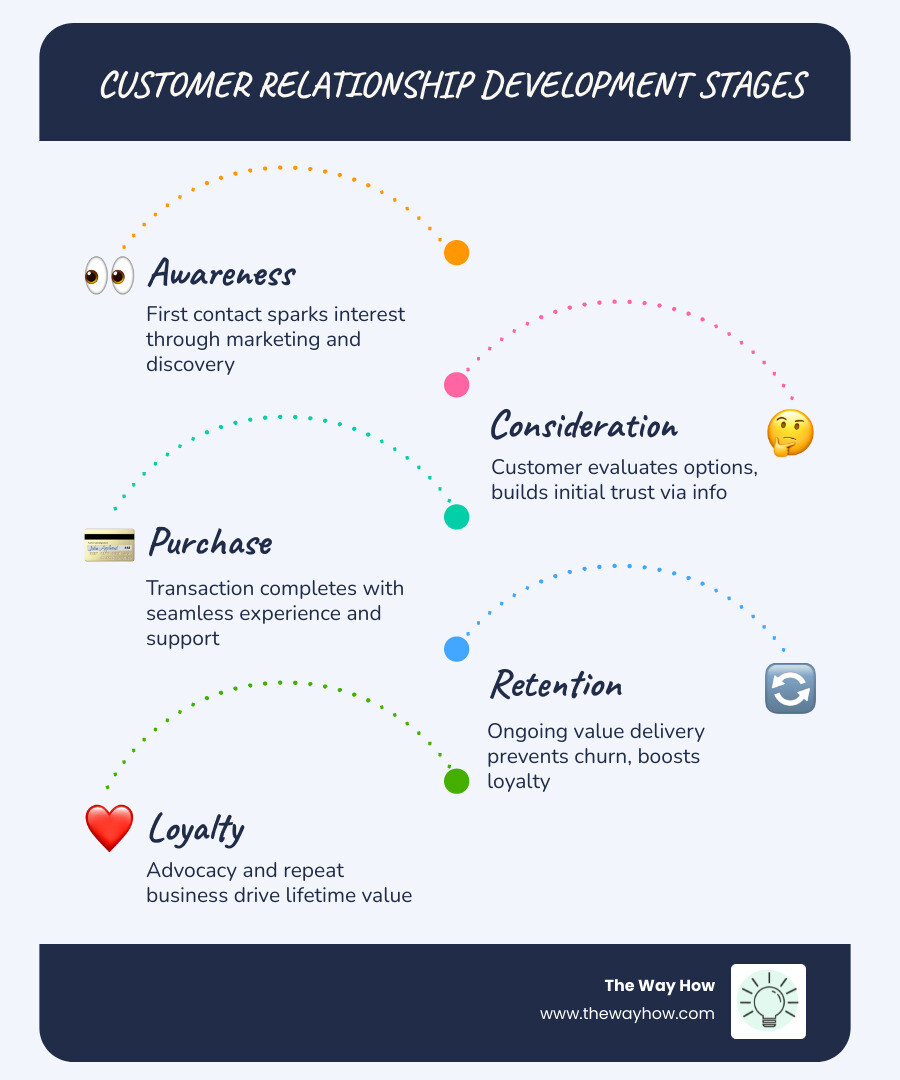
customer relationship development basics:
To build a high-growth business, we must first distinguish between “servicing” a customer and “developing” a relationship. Customer service is reactive; it is the fire extinguisher you grab when something goes wrong. customer relationship development, however, is the fireproofing of the building.
While customer service focuses on a single transaction or a specific complaint, customer relations encompasses the entire lifecycle. It is the sum of every touchpoint, from the first time a prospect sees your content to the tenth year they renew their contract.
The financial stakes are massive. Research shows that 70% of customers base their purchase decisions on the quality of service they receive, and 74% will forgive a mistake if the service is excellent. Conversely, poor customer experiences cost businesses an estimated $1.6 trillion globally in churned revenue.
When we talk about Building Customer Relations: Benefits, Strategies & Tips, we are talking about creating a competitive advantage that price cuts can’t touch. Brands that lead in customer experience generate 4% to 8% more revenue than their competitors. This is because strong relationships lead to pricing stability; loyal customers are less likely to jump ship for a cheaper alternative because they value the certainty and trust you provide.
For many organizations, this requires a shift in Crm Development from a simple database to a strategic engine that captures “relational intelligence”—the ability to recognize that different customers want different types of relationships with your brand.
Successful customer relationship development is a win-win process that balances the needs of the company with the desires of the customer. At The Way How, we view this through four primary lenses:
For technical teams, this often involves following a Crm For Web Developers Guide to ensure that the backend systems support these human-centric principles without creating friction.
Building a relationship strategy isn’t about “doing more marketing.” It’s about designing a system that removes uncertainty.
This structured approach is especially vital in high-stakes industries, such as Crm For Real Estate Developers, where the sales cycle is long and the cost of a lost relationship is astronomical.
To manage thousands of relationships at scale, we need more than just a good memory. We need a framework. Modern Customer Relationship Management (CRM) is categorized into four main types, each serving a specific purpose in the relationship-building process.
| CRM Type | Primary Focus | Key Benefit |
|---|---|---|
| Strategic | Customer-centricity | Places the customer at the center of the entire business strategy. |
| Operational | Automation | Streamlines sales, marketing, and service processes for a seamless journey. |
| Analytical | Data Analysis | Uses historical data to identify patterns and predict future behavior. |
| Collaborative | Communication | Ensures all departments (sales, marketing, support) share the same data. |
The history of CRM is a story of moving from manual files to intelligent systems. In the early 20th century, Franklin D. Roosevelt’s campaign manager used what was called the “Farley File”—a manual system of index cards tracking personal details about every person FDR met. Today, we use Hubspot Crm Architecture to do the same thing at a global scale, using cloud-based data to ensure no detail is forgotten.
Managing these relationships is a company-wide responsibility, but it requires specific leadership. Roles like the Chief Customer Officer (CCO) and Customer Success Manager (CSM) have become essential.
The skills required for these roles are a blend of high-touch empathy and high-tech data proficiency. A great relationship manager needs:
Many businesses find that they lack these specialized skills in-house, which is why they turn to Crm Consulting Services to help design the systems and train the teams necessary for sustainable growth.
As we move deeper into 2026, the “dating app” for clients has evolved. We are no longer just storing contact info; we are using customer relationship development to predict the future.
The rise of “Agentic AI” allows businesses to move beyond simple chatbots. These intelligent agents can autonomously analyze data to suggest the “best next step” for a specific customer, draft personalized emails, and even identify when a customer is likely to churn before they even know it themselves.

According to the latest trends in What is relationship marketing? Definition, Examples, Levels 2026, we are moving through four levels of relationship:
Hyper-personalization is the new standard. 80% of consumers are more likely to buy from a brand that offers a personalized experience. This isn’t just about putting their name in an email; it’s about using Crm Data Integration to know that they prefer a specific type of solution and offering it to them at the exact moment they need it.
Despite the benefits, many CRM initiatives fail. The most common hurdles include:
Overcoming these requires a clear Hubspot Crm Implementation strategy that prioritizes user adoption and data integrity from day one.
You cannot improve what you do not measure. To gauge the health of your customer relationship development, you should track:
For companies building custom solutions, working with Crm Software Developers can help create bespoke dashboards that track these metrics in real-time.
At its heart, it is about relational intelligence. It is the shift from seeing a customer as a “lead” to seeing them as a human being with specific goals and fears. By using empathy and consistent behavior, you build the trust required for long-term value.
CRM software acts as the “single source of truth.” It automates the repetitive tasks—like follow-up emails and data entry—so your team can focus on the human side of the relationship. It allows for personalization at scale, ensuring that even if you have 10,000 customers, each one feels like your only one.
For more on how these systems work together, see our guide on Business Development And Customer Relationship Management.
At The Way How, we believe that most “marketing problems” are actually “certainty problems.” When your revenue stalls, it’s usually because there is a gap in trust or a friction point in the customer journey that you haven’t identified yet.
We don’t just give you a list of tactics. As a psychology-first marketing and revenue strategy firm, we help founders and leadership teams diagnose the root cause of stalled growth. Whether it’s through Fractional CMO leadership, optimizing your HubSpot architecture, or designing a demand generation strategy rooted in human behavior, our goal is to turn your marketing into a dependable growth engine.

Stop treating your customers like a one-time transaction. It’s time to build a system that creates momentum and predictable revenue through strategic clarity and behavioral insight.
 Jeremy Wayne Howell : Jul 22, 2026 9:48:31 PM
 Jeremy Wayne Howell : Jul 21, 2026 9:47:10 PM
 Jeremy Wayne Howell : Jul 20, 2026 9:46:47 PM