
A Practical Guide to Marketing Psychology Principles
Why Your Marketing Feels Like a Gamble (And How to Fix the Odds)
The psychology of marketing is the application of psychological research and principles to understand how people make purchasing decisions, what influences their behavior, and how to create marketing strategies that resonate with their actual motivations—not just what they say they want.
Quick Answer: What You Need to Know
- Psychology of marketing uses research on human behavior to understand consumer decision-making
- It goes beyond tactics to address why people buy, not just how to sell
- Key principles include reciprocity, scarcity, anchoring, social proof, and the endowment effect
- It differs from behavioral economics by incorporating social, evolutionary, and cultural psychology
- Effective application requires understanding certainty gaps in the customer journey
- Ethical use builds trust; manipulation destroys it
You’ve tried the tactics. The webinars, the funnels, the AI tools, the “growth hacks.” Some worked for a while. Most didn’t. Now you’re stuck watching competitors grow while your pipeline stays flat, and you can’t figure out why.
Here’s what’s actually happening: you’re optimizing for the wrong thing.
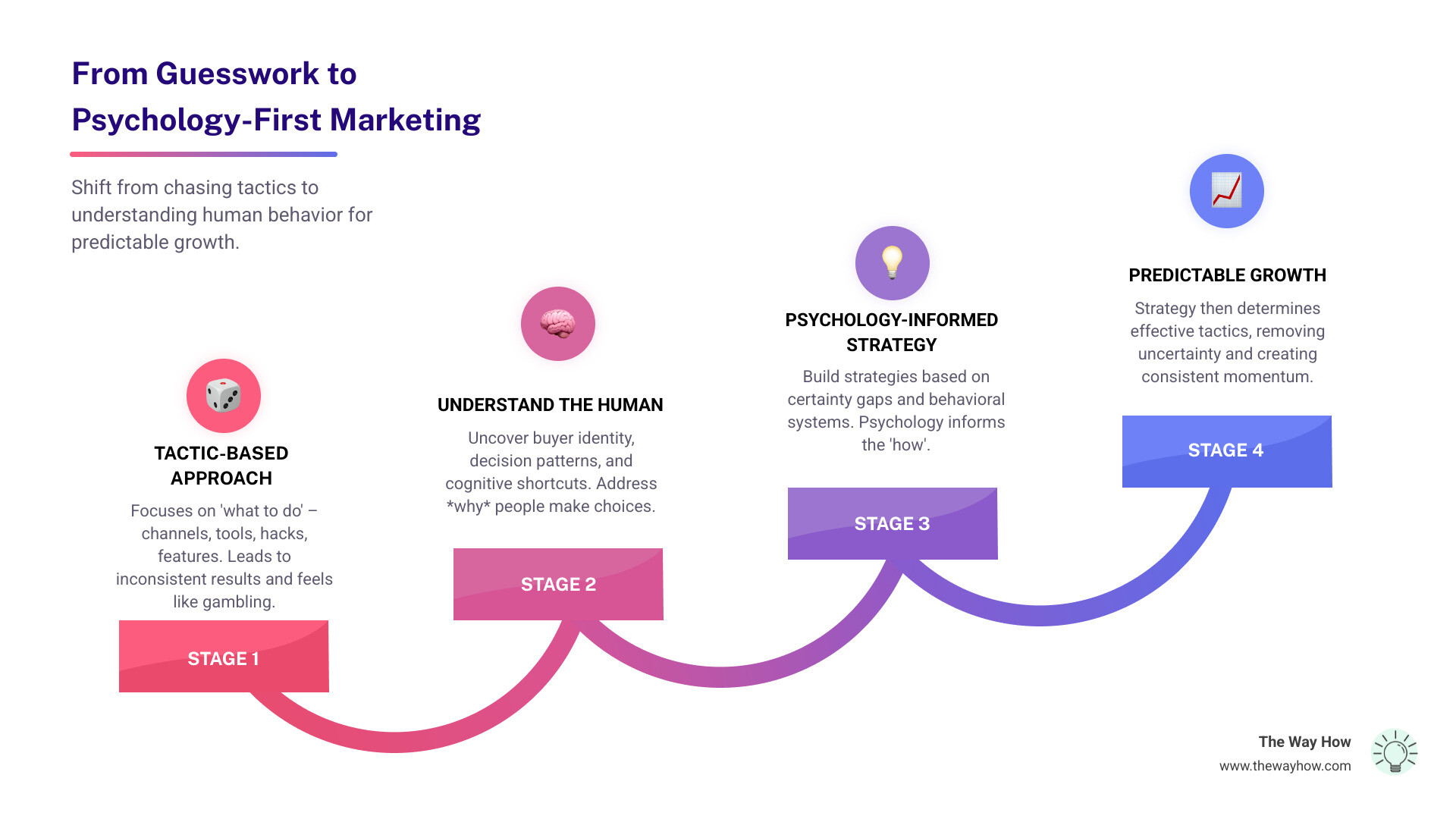
Most marketing advice focuses on what to do—which channel, which headline format, which CTA color. But none of that matters if you don’t understand who you’re talking to and why they make decisions the way they do.
Human behavior doesn’t follow your funnel. It follows patterns shaped by evolution, culture, social identity, and cognitive shortcuts that have nothing to do with your product features. When your marketing ignores these patterns, it feels like gambling because you’re guessing at what will work instead of building on what’s proven about how people think.
The research is clear: ads with higher distinctiveness scores perform significantly better. Concrete language is remembered 8.6 times more than vague phrases. Showing effort increases perceived quality by 14%. Specific numbers (like “47% longer”) are trusted 10% more than round numbers. These aren’t random tips—they’re applications of psychological principles that shape every purchase decision your customers make.
The gap between your current results and predictable growth isn’t about working harder or spending more. It’s about understanding the human on the other side of the transaction before you build your next campaign.
I’m Jeremy Wayne Howell, founder of The Way How, and I’ve spent over 20 years helping revenue teams move from tactic-chasing to building systems rooted in the psychology of marketing and buyer behavior. This guide will show you how to do the same—not through theory, but through principles you can apply immediately to remove uncertainty and create momentum.
Handy psychology of marketing terms:
The Foundation: What Is Marketing Psychology?
At its core, marketing psychology is the application of scientific insights into human behavior to commerce. It’s an interdisciplinary field that helps us understand why people choose to buy, use, or reject products and services. We dig into the depths of consumer behavior, exploring the intricate processes of human decision-making—from unconscious biases to conscious evaluations.
What makes marketing psychology so powerful is its reliance on both quantitative and qualitative research. Instead of relying on assumptions or what people say they do in surveys, we look at what they actually do. This scientific approach often reveals that our intuitions about consumer choices are wrong, helping us overcome common misconceptions and build more effective strategies. It’s about diagnosing the true drivers behind stalled growth and identifying certainty gaps in the customer journey.
Marketing Psychology vs. Behavioral Economics
While closely related, marketing psychology is a broader discipline than behavioral economics. Behavioral economics, often praised for uncovering “systematic irrationalities” in consumer choices, primarily focuses on economic decision-making—how people deviate from rational economic models. It explains how consumers actually behave, as opposed to how they should behave in a perfect economic world.
However, marketing psychology applies the full spectrum of psychological science to marketing and branding. It picks up where behavioral economics leaves off, exploring a much wider field of psychological perspectives, including social, evolutionary, and cultural influences. This means we consider not just the cognitive shortcuts people take when making a purchase, but also the deeper social, emotional, and biological underpinnings of their actions. It’s about understanding the whole human, not just the economic agent. For a deeper dive into the brain’s role, exploring the neuropsychology of consumer behavior and marketing can offer further insights.
The Influence of Social, Evolutionary, and Cultural Psychology
Our understanding of consumer behavior is profoundly shaped by three major branches of psychology:
Social Psychology: Humans are inherently social creatures. Our decisions are often influenced by our social identity, our desire to fit in, or to signal our values to others. Brands can tap into these social drives. For example, Jif Peanut Butter famously appealed to mothers with the slogan ‘choosy Moms choose Jif’, leveraging social identity. Similarly, luxury brands allow consumers to signal wealth and status, while sustainable brands signify environmental values. Brands like Budweiser, by associating itself with the ‘American Identity’, or Robinhood, by anchoring its brand to younger investors, demonstrate how social psychology influences brand relationships and product choices.
Evolutionary Psychology: The human brain, while capable of complex thought, is an organ forged through evolutionary pressures. Our modern consumer world is run on what is essentially ancient hardware. This means many of our innate leanings and biases stem from survival instincts. One key principle is the Mere Exposure Effect: the more we are exposed to something, the more we tend to like it. This is why consistent advertising, like Coke’s billions spent on campaigns, can be highly effective, building familiarity and preference over time.
Cultural Psychology: Culture influences nearly every element of human psychology, including how we perceive and interact with brands and products. Brands that ignore the impact of culture on consumer psychology do so at their peril, particularly when expanding into new markets. A classic example is Walmart’s expansion into Germany, where the enthusiastic smiling of store clerks, a norm in the US, was perceived negatively by German shoppers, leading to cultural misunderstandings and operational challenges. Understanding these cultural nuances is crucial for effective global marketing.
The Marketer’s Toolkit: Core Principles of Persuasion
Applying psychological principles in marketing is not about manipulation; it’s about ethical persuasion. Our goal is to remove uncertainty and build trust, creating momentum in the customer journey, not to exploit vulnerabilities. Ethical application means providing genuine value, being transparent, and respecting consumer autonomy. When a brand brings you something useful—whether it’s advice, a promo code, or a sample—you’re naturally more inclined to trust them and even buy from them. For more advanced techniques that dig into the brain, consider exploring neuromarketing techniques.
The Power of Giving: Reciprocity
The principle of reciprocity is simple yet powerful: when someone does something for us, we feel a natural urge to return the favor. In marketing, this translates to giving value first. Brands that offer something useful—like high-value content, a free sample (conceptually, a taste of what’s to come), or a helpful tool—build goodwill and make customers more inclined to engage or purchase.
Consider how Sephora fosters loyalty by offering free samples and birthday gifts to its members, creating a sense of being valued and appreciated. These aren’t just perks; they’re acts of giving that trigger a desire for customers to reciprocate, often through continued purchases. By consistently providing value, we build trust and establish a foundation for lasting customer relationships.
The Fear of Missing Out: Scarcity and Urgency
Few things motivate action like the fear of loss. The thought of missing out on something valuable often impacts us more emotionally than the pleasure of gaining it. This is where scarcity and urgency come into play.
- Scarcity: When products or offers are presented as limited in quantity, they become more desirable. For instance, a U.S. grocery store once capped soup purchases at 12 cans per customer. While no one had been buying anywhere near 12 cans before, sales doubled per customer after the limit was introduced. This creates a perception of high demand and exclusivity.
- Urgency: Time-based deadlines or limited-time offers create a sense of urgency, prompting immediate action. Booking.com masterfully uses messages like “Only 2 rooms left” or “4 people are looking at this offer” to trigger a fear of missing out (FOMO), encouraging quicker booking decisions.
Interestingly, even how we frame unavailability matters. A study found that using the label “Sold Out” triggered noticeably fewer negative reactions than “Out of Stock.” Participants reported feeling 8% less disappointed about the missing product and 15% less disappointed with the entire website compared to when the product was labeled “Unavailable.” This suggests that “Sold Out” implies high demand and success, rather than a mere inventory issue.
The First Impression: Anchoring and Framing
Our perception of value is highly relative, often influenced by the first piece of information we encounter—the “anchor.” This is known as anchoring bias. Once an anchor is set, subsequent information is judged in relation to it.
This principle is crucial in pricing strategy. When we present a premium-priced option first, or show a crossed-out original price alongside a discounted one, the initial higher price serves as an anchor. The discounted price then seems like a much better deal, highlighting the perceived value. Netflix, for example, subtly pushes users towards more expensive plans by highlighting what they ‘gain’ (HD resolution, number of screens) compared to the basic option, making the upgrade seem more beneficial.
Framing, another powerful psychological concept, involves presenting information in a way that influences its interpretation. The same information can elicit different responses depending on how it’s framed. For a comprehensive understanding of how to leverage this, consult our guide to the marketing framing effect. Additionally, dig deeper into the nuances of anchoring bias in marketing to refine your pricing and promotional strategies.
The Desire to Own: The Endowment Effect
The endowment effect describes our tendency to value something more once we own it, or even perceive ourselves to own it. This intrinsic bias means we demand more to give up an item than we would be willing to pay to acquire it.
Marketers can leverage this by creating opportunities for perceived ownership. Think of free trials, product samples, or test drives (as psychological concepts, not just product offerings). When customers experience a product, even temporarily, they begin to feel a sense of ownership, making it harder to part with it. This increased attachment translates into a higher perceived value and a greater willingness to purchase the item at its full price. For a deeper understanding of this phenomenon, explore understanding the endowment effect in marketing.
Applying the Psychology of Marketing Across the Customer Journey
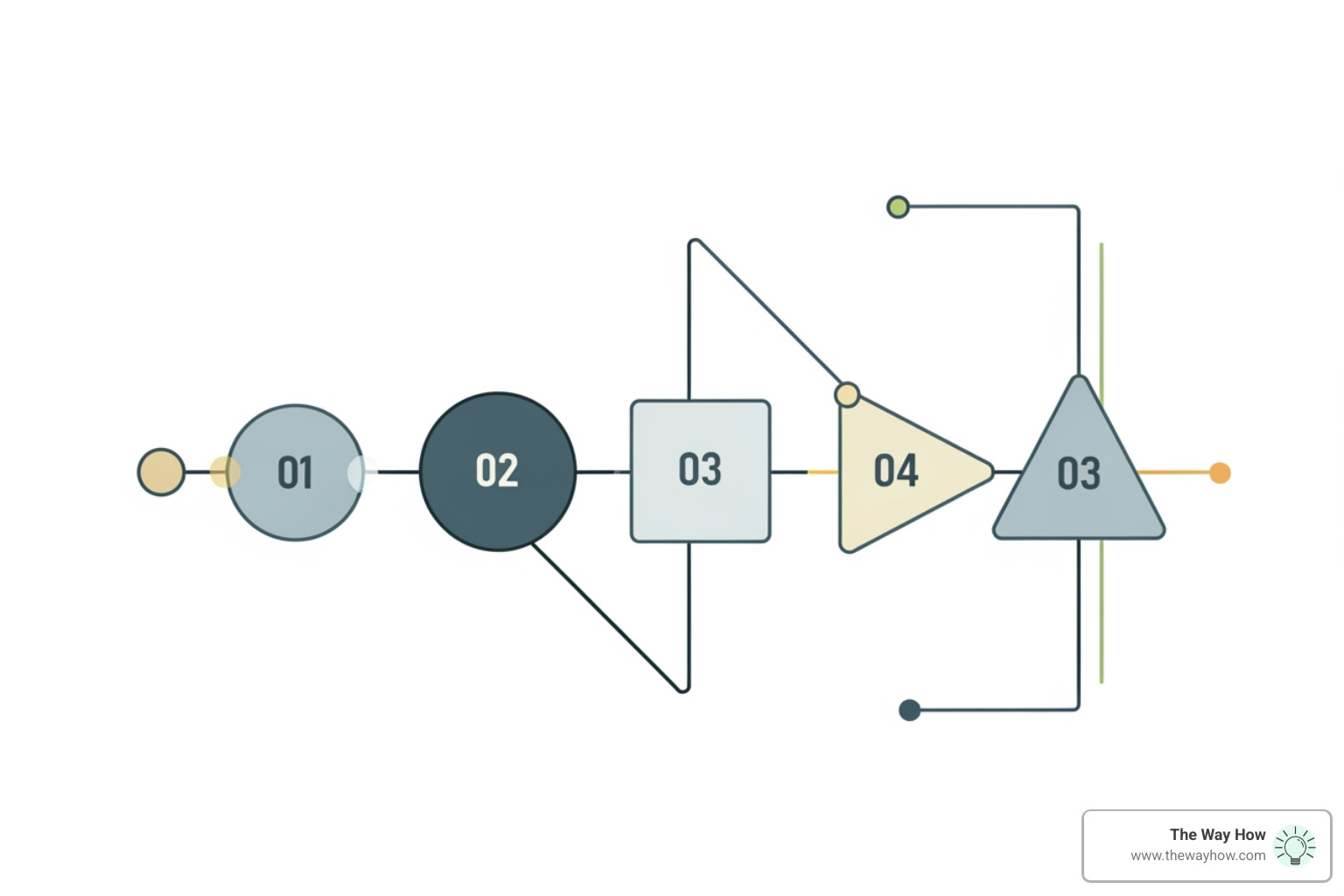
At The Way How, we understand that every touchpoint in the customer journey is an opportunity to apply psychological insights to remove uncertainty, create momentum, and ultimately drive predictable revenue. It’s about building systems that anticipate human behavior, rather than reacting to it.
Crafting Memorable Messages and Branding
The words we use, and how we present our brand, have a profound psychological impact.
- Concreteness vs. Vague Language: Our research shows that concrete phrases are 8.6 times more likely to be remembered than vague, abstract ones. Instead of talking about “innovative quality,” talk about “money in your pocket.” This clarity reduces cognitive load and improves memorability.
- Specificity and Trust: Precision builds credibility. Ads stating a fictitious deodorant lasted precisely 47% or 53% longer were deemed 10% more accurate than a generic “50% longer.” Brands like Heinz (with its “57 varieties”) and Dyson (testing “5,127 prototypes”) use specific numbers to build trust. Similarly, Apple’s “1,000 songs in your pocket” for the iPod was far more compelling than simply stating its memory capacity. For more on this, check out research on concrete language.
- Perceived Effort: Consumers often equate perceived effort with quality. If they believe a brand has invested significantly in its product or advertising, they infer higher quality. One study showed that consumers who thought a brand spent $20 million versus $2 million on advertising perceived the product as 14% higher quality. Even simply stating the effort put into a project, like “I had spent 480 minutes working on the podcast,” increased click-through rates by 45%.
- Distinctiveness: Standing out from the crowd is paramount. Ads in the top 10% for effectiveness achieved a distinctiveness score of 4.03, while the very best 1% had a score of 4.15. Heineken’s slogan, “The beer that makes Milwaukee jealous,” was recalled by 85% of people, highlighting the power of a unique and memorable message.
Designing for the Human Brain: UX and Visuals
The visual elements of your marketing—from website design to ad creatives—play a critical role in user attention and decision-making.
- Color and Contrast: While specific colors can evoke certain feelings (and these can vary culturally), high color contrast generally has a greater impact on human attention than any single color. High contrast helps elements stand out, guides the user’s eye, and reduces cognitive effort, making calls to action more noticeable.
- User Attention and Cognitive Load: The human brain is constantly filtering information. Design elements should reduce cognitive load, making it easier for users to process information and make decisions. This involves clear visual hierarchies and intuitive layouts.
- Trust Seals: In the digital field, trust seals at checkout are a simple yet effective application of marketing psychology. They provide visual cues of security and credibility, reassuring users at a critical point in the purchase journey.
- Heuristic Analysis: This usability evaluation method leverages psychological principles to identify potential issues in user interfaces. By analyzing a design against established heuristics (like “visibility of system status” or “match between system and the real world”), we can optimize for intuitive user experiences that align with how people naturally interact with systems.

Channel-Specific Applications of the Psychology of Marketing
Psychological principles aren’t confined to general strategy; they can be applied with precision across specific marketing channels:
- Digital Advertising: Beyond just targeting demographics, digital ads can leverage cognitive biases by using specific language, urgency timers, and social proof (e.g., “10,000 satisfied customers”) to increase click-through rates and conversions.
- Email Marketing: Crafting effective email subject lines is an art rooted in psychology. The “information gap” principle, for instance, can pique curiosity. Subject lines like “The secret to…” or “3 things you didn’t know about…” create a knowledge gap that recipients want to fill, encouraging them to open the email.
- Social Media: Social media thrives on social proof. Showcasing testimonials, user-generated content, or follower counts taps into our innate tendency to follow the crowd. It also plays on our social identity and desire for connection. Research even shows how social isolation and anxiety can drive Gen Z’s willingness to share personal information online.
- Nudge Marketing: This involves subtle interventions that guide behavior without restricting choices. A classic example is placing two cigarette disposal bins on a littered street, one asking “Vote for your favorite team” and the other “Vote for your least favorite team,” to encourage proper disposal through a playful “nudge.”
Beyond the Transaction: Building Loyalty and Lasting Relationships
For us at The Way How, marketing isn’t just about the next sale; it’s about building enduring customer relationships and brand loyalty that translate into long-term value and predictable revenue. This requires a deeper understanding of human connection.
Fostering Connection Through Empathy
Stronger customer relationships are built on empathy—understanding and valuing your customers. When we treat customers with respect and recognition, we create a lasting bond.
- Understanding Challenges: Showing that you genuinely understand your customers’ challenges and pain points creates an immediate connection. This empathy forms the bedrock of trust.
- Positive Reinforcement: The Pygmalion Effect suggests that if you value your customers, they will behave as such. By projecting positive expectations and communicating with a positive tone (“You have the power to…”, “Join those who change…”), you empower them and foster a sense of belonging.
- Brand Values: Highlighting shared brand values (like sustainability, autonomy, or excellence) helps customers feel connected to something larger than just a product, fostering a sense of community. This is about creating campaigns that value the customer as an engaged actor, not just a passive consumer.
Using Research to Challenge Assumptions
One of the most critical applications of marketing psychology is its ability to challenge our preconceived notions about consumer behavior. What customers tell us in surveys isn’t always what they do. Human psychology frequently counters expectations, and robust research helps us uncover these hidden motivations.
Consider Mason Haire’s classic instant coffee study. When asked directly, consumers often cited taste as a reason they didn’t buy instant coffee. However, a projective technique revealed that many homemakers described users of instant coffee less favorably than users of ground coffee, suggesting that social perception and convenience (laziness) were the real, underlying factors, not taste. This highlights the importance of using psychological research to look beyond surface-level responses and uncover deeper truths. By continuously testing psychological triggers through A/B tests and analyzing behavioral data, we can move beyond assumptions and build truly effective strategies.
Frequently Asked Questions about the Psychology of Marketing
What are the biggest ethical considerations in marketing psychology?
The line between ethical persuasion and unethical manipulation can be thin. The biggest ethical considerations in marketing psychology revolve around:
- Manipulation vs. Persuasion: Ethical marketing aims to guide consumers toward choices that genuinely benefit them, aligning with their needs and values. Manipulation, conversely, exploits vulnerabilities or biases to trick consumers into actions they wouldn’t otherwise take, often against their best interests.
- Transparency: Being upfront about offers, terms, and the intent behind marketing messages is crucial. Obscuring information or using deceptive practices erodes trust.
- Consumer Vulnerability: Targeting or exploiting individuals who are particularly susceptible due to age, emotional state, or cognitive limitations is unethical. This includes avoiding “dark patterns”—user interface tricks designed to make users do things they didn’t intend.
- Building Genuine Trust: Ethical application of psychological principles builds long-lasting relationships based on trust, not fleeting transactions based on deception. We must always ask ourselves: are we helping our customers make better decisions, or are we exploiting their psychological shortcuts for short-term gain?
How can I start applying marketing psychology without a big budget?
You don’t need a massive budget to start leveraging marketing psychology. Here are some actionable steps:
- Focus on Messaging: Small tweaks to your headlines, calls-to-action, and product descriptions can have a big impact. Use concrete language, specific numbers, and highlight effort or scarcity.
- A/B Test Small Changes: Use tools like Google Optimize (or similar) to A/B test different psychological triggers in your website copy, email subject lines, or ad creatives. Even minor changes can yield significant results.
- Use Free Tools for User Feedback: Observe how users interact with your website using heatmaps (like Hotjar’s free tier) or conduct informal user interviews to understand their thought processes.
- Study Your Existing Customer Data: Analyze purchase patterns, website analytics, and customer service interactions to identify common pain points, motivations, and decision-making triggers.
- Start with One Principle: Pick one psychological principle, like reciprocity, and implement a small initiative. Offer a valuable piece of content for free, or a helpful tip, and see how your audience responds.
How does psychology influence B2B marketing differently than B2C?
While many psychological principles are universal, their application in B2B marketing has distinct nuances:
- Group Decision-Making: B2B purchases often involve multiple stakeholders, committees, and complex approval processes. Marketers need to understand the psychology of group dynamics, consensus-building, and influencing different personas within an organization.
- Logic vs. Emotion: While B2B decisions are often perceived as more rational and data-driven, emotions still play a significant role. Fear of making the wrong choice, desire for career advancement, or the need for peer approval can heavily influence a B2B buyer. We aim to reduce risk aversion and build confidence.
- Risk Aversion: B2B purchases typically involve higher financial stakes and greater professional risk for the buyer. Psychological strategies here focus on building trust, demonstrating reliability, offering strong social proof (case studies, testimonials from similar businesses), and providing comprehensive support to alleviate perceived risks.
- Social Proof from Peers: In B2B, social proof often comes from industry leaders, competitors, or trusted peers. Highlighting success stories within a specific industry can be incredibly persuasive.
- Building Professional Trust: The B2B sales cycle is often longer and more relationship-driven. Psychological principles are used to build credibility, establish expertise, and foster long-term partnerships, rather than quick transactions. The role of an internal “champion” who advocates for your solution is also a key psychological dynamic.
From Guesswork to a Predictable Growth Engine
The world of marketing doesn’t have to feel like a gamble. By grounding your strategies in human behavior, empathy, and decision-making psychology, you can move away from chasing fleeting tactics and toward building robust, predictable systems. At The Way How, we specialize in helping founders and leadership teams remove uncertainty in their sales and marketing systems. We diagnose why growth is stalled, identify certainty gaps in the customer journey, and design systems that create trust, momentum, and predictable revenue.
This isn’t about quick fixes; it’s about understanding the fundamental drivers of human action. By applying the principles of marketing psychology, you can transform your marketing into a dependable growth engine, built on solid behavioral insights and strategic clarity.