

From Tactics to Trust: The Real Role of a Strategist
A web marketing strategist is a professional who plans, develops, and guides digital marketing efforts to meet specific business objectives. They act as a bridge between a company’s goals and the marketing campaigns created to achieve them, using data-driven insights and strategic thinking to orchestrate multiple channels—SEO, content, paid advertising, social media, and email—into a cohesive system designed to drive predictable growth.
Key responsibilities include:
- Conducting market research and competitor analysis to identify opportunities
- Developing comprehensive digital marketing strategies aligned with business goals
- Monitoring campaign performance and analyzing data to refine tactics
- Collaborating with cross-functional teams to ensure strategic alignment
- Diagnosing why growth has stalled and identifying certainty gaps in the customer journey
How they differ from other roles:
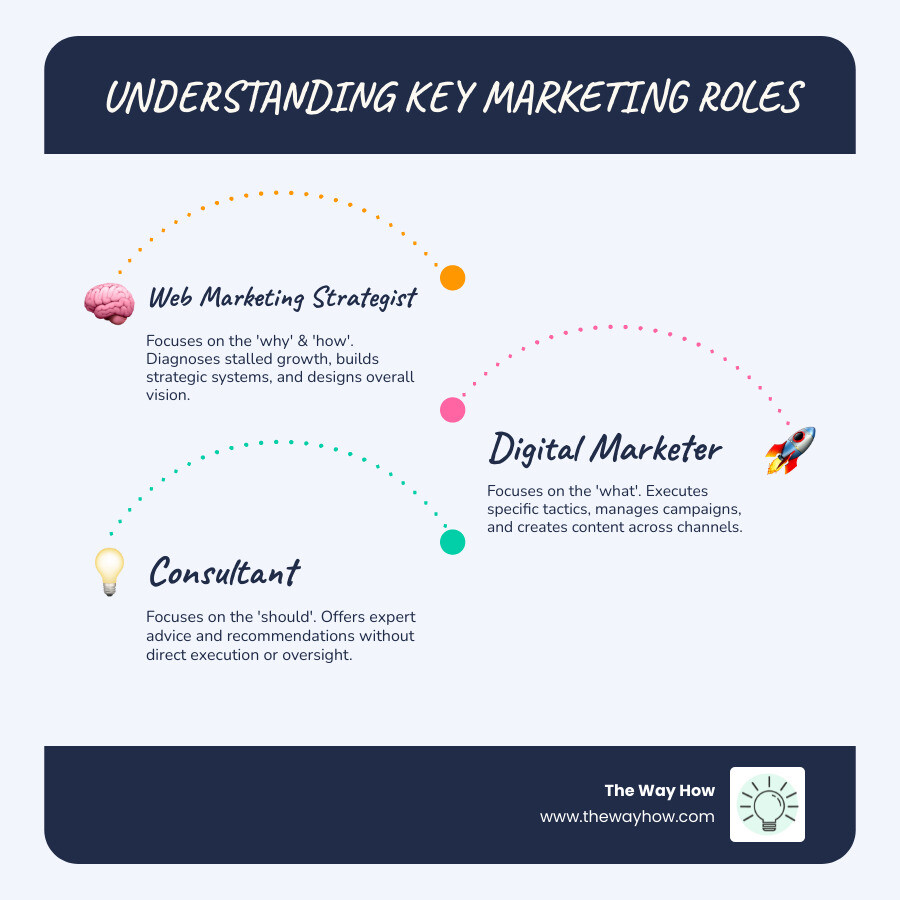
- Strategists focus on the “why” and “how”—solving complex problems and connecting customer needs to business outcomes
- Digital marketers focus on the “what”—executing specific tactics like posting on social media or running ads
- Consultants focus on the “should”—offering advice without direct involvement in execution or oversight
You’ve probably heard the title thrown around. Maybe you’ve even been pitched by someone calling themselves one.
But if you’re honest, you’re not entirely sure what a web marketing strategist actually does—or whether hiring one would solve the problem you’re facing.
That uncertainty isn’t accidental.
The role itself has become bloated with expectations. Job descriptions demand someone who can audit competitors, build HubSpot workflows, run PPC campaigns, write blog posts, manage social media, analyze data, and somehow still have time to “think strategically.”
It’s a purple squirrel problem. And it leaves most buyers confused about what they actually need.
Here’s the truth: a real strategist isn’t a tactician with a fancier title. They’re not the person running your ads or scheduling your posts. They’re the person who figures out why your current system isn’t working—and designs a new one that does.
They diagnose before they prescribe. They ask uncomfortable questions before they build campaigns. They connect the dots between what your customers need, what your business requires, and what your marketing is actually delivering.
This guide will help you understand what that role really looks like—what strategists do, how they think, what skills matter, and how to know if you need one. Not the idealized version from LinkedIn. The real one.
Because if you’re going to invest in strategy, you should know what you’re paying for.
The Architect, Not the Bricklayer: What a Web Marketing Strategist Actually Does
At its core, the web marketing strategist is the architect of your online success. They don’t just lay bricks; they design the entire structure, ensuring every component serves a clear purpose and supports the overall vision. This role is about big-picture thinking, driving sustainable business growth, and delivering a measurable Return on Investment (ROI).
Our philosophy at The Way How emphasizes that true growth comes from understanding the underlying psychological factors that influence buyer behavior. A skilled web marketing strategist applies this lens to diagnose why growth might be stalled, moving beyond surface-level symptoms to uncover the root causes. They identify “certainty gaps” in the customer journey—those points where potential customers hesitate or drop off due to lack of clarity, trust, or motivation.
Their ultimate goal is to build robust systems that create trust, momentum, and predictable revenue. They bridge the gap between abstract business goals and concrete marketing campaigns, translating high-level objectives into actionable, data-driven strategies. This blend of strategic clarity, behavioral insight, and operational execution turns marketing from a series of disconnected activities into a dependable growth engine.
Defining the Core Responsibilities
The primary responsibilities of a web marketing strategist revolve around strategic foresight and analytical interpretation. They are not merely implementing tasks; they are orchestrating a complex system.
First, they engage in data-driven planning. This involves a deep dive into market research, understanding the landscape your business operates in, and identifying emerging trends and customer needs. As the research indicates, they “typically begin their work with clients by auditing their current digital marketing content, as well as investigating their competitors’ efforts to determine the best course of action for the future.” This competitor analysis isn’t just about what others are doing; it’s about identifying opportunities to differentiate and create a competitive edge.
Next, the strategist shapes brand strategy and target segmentation. They assist with “market research, brand strategy, and target segmentation,” especially regarding research, analysis, and reporting. This ensures that all marketing efforts are aimed at the right audience with the right message. They then develop a comprehensive digital marketing plan that serves as a roadmap for all digital channels and activities—from content marketing and SEO to social media and paid advertising.
Throughout the execution phase, their “core duties include monitoring campaign performance, analyzing results, and creating reports that offer clear insights.” This isn’t just about presenting numbers; it’s about interpreting what those numbers mean for business objectives and making informed adjustments. They ensure that every dollar spent and every piece of content created contributes directly to achieving the agreed-upon goals, always with an eye on measurable ROI.
How a Web Marketing Strategist Differs from Other Roles
It’s easy to confuse a web marketing strategist with other roles in the digital marketing ecosystem, but their distinctions are crucial for understanding their unique value.
| Role | Primary Focus | |
|---|---|---|
| The “Why” & “How” | The “What” | The “Should” |
| Strategy & Problem-Solving | Execution & Tactics | Advice & Recommendations |
| Connects customer needs to business goals | Implements campaigns across channels | Offers strategic counsel |
| Designs systems for predictable revenue | Creates content, manages ads, optimizes landing pages | Conducts audits, provides reports |
| Focuses on long-term growth and ROI | Focuses on day-day task completion | Focuses on high-level insights |
| Oversees execution without doing it | Reports on performance metrics | Exits after delivering insights |
| Diagnoses why growth is stalled | Responds to specific campaign requirements | Identifies opportunities for improvement |
A web marketing strategist operates at the highest level of planning, asking not just “what are we doing?” but “why are we doing it?” and “how does this align with our overarching business objectives?” They are problem-solvers, connecting the dots between customer needs and elusive business, brand, and marketing goals. This is a crucial distinction from a digital marketer, who is typically focused on the tactical execution of campaigns across various channels like social media or email. While a digital marketer might manage the social media calendar, the strategist determines why certain content goes on social media and how it contributes to the larger strategy.
Similarly, a strategist differs from a consultant. While consultants offer expert advice and recommendations, a web marketing strategist often has a more integrated role, providing “high-level planning with practical execution oversight.” They are not just advising; they are guiding the implementation and ensuring that the strategy translates into tangible results, often working closely with in-house teams or agency specialists.
The Strategist’s Mind: Essential Skills for Diagnosing Growth Problems
To effectively diagnose why growth is stalled and to design systems that create trust and momentum, a web marketing strategist needs a unique blend of intellectual curiosity, analytical prowess, and profound empathy. Our work at The Way How is rooted in the belief that understanding human behavior and decision-making psychology is paramount. This isn’t just about crunching numbers; it’s about understanding the “why” behind those numbers.

A successful web marketing strategist is “highly analytical and able to quickly determine which digital marketing activities will benefit their clients.” They possess a “robust generalist’s understanding of traditional and digital marketing and some knowledge of how businesses work.” This broad perspective allows them to see patterns and connections that specialists might miss, helping them to “lead the problem-solving charge.” Continuous learning is also key in this rapidly evolving digital landscape, ensuring they stay ahead of trends and algorithm changes.
The Hard Skills: Tools for Understanding Behavior
While we emphasize strategy over tactics, a web marketing strategist must possess a strong grasp of the technical tools and concepts that underpin digital marketing. These “hard skills” aren’t about daily execution, but about understanding what’s possible, what’s effective, and how to interpret the data these tools provide. They are tools for understanding human behavior online.
- SEO & Search Intent: Understanding how search engines function and how users search for information is fundamental. “SEO is the process of improving your website so that it ranks high in search engine results for keywords and phrases related to your business.” A strategist knows that “SEO aims to direct more traffic to your website — specifically, traffic made up of people from your target audience.” This includes technical SEO, on-page optimization, and understanding core web vitals.
- Data Analysis & Interpretation: This is non-negotiable. “A successful digital marketing strategist is also a data-informed decision-maker.” They must be able to “gather and analyze extensive data” to drive strategic decisions. This involves proficiency with analytics platforms to measure campaign performance, user behavior, and conversion rates.
- Content Strategy: A strategist designs the content ecosystem. “Content marketing is a strategy for digital marketing where your business focuses on reaching, engaging, and connecting with consumers via informational content.” They determine what content to create, for whom, and how it aligns with the customer journey, often examining “landing pages, blog posts, and other forms of web content.”
- PPC & Paid Media Logic: While they might not manage bids daily, strategists understand the principles of paid advertising. “PPC advertising is a paid form of advertising that relies on an auction-based system.” They know how to leverage platforms like Google Ads and social media advertising to reach specific audiences and drive immediate results.
- Marketing Automation: Understanding how to automate repetitive tasks and nurture leads through integrated systems is crucial for efficiency and scalability. “Marketing automation refers to the software that automates your basic marketing operations.”
- Email Marketing: Strategists design email flows for customer retention and acquisition. “Email marketing focuses on retaining existing customers, as well as gaining new ones.”
Key tools for understanding this behavioral data include:
- Google Analytics: For tracking website performance and user behavior.
- Semrush: Essential for keyword research, competitor analysis, and SEO auditing.
The Soft Skills: The Art of Human Connection
Beyond technical knowledge, the most impactful web marketing strategists excel in “soft skills.” These are the human elements that allow them to connect with stakeholders, inspire teams, and truly understand the customer. These skills are central to our psychology-first approach at The Way How.
- Storytelling: The ability to craft a compelling narrative that resonates with the target audience and aligns with brand values. This isn’t just for content creation; it’s about communicating the strategy itself in an engaging way.
- Communication & Persuasion: “Digital marketing strategists need to be strong communicators, as they are constantly liaising with the digital marketing team as well as with clients directly.” They must articulate complex ideas clearly, present insights persuasively, and foster collaboration.
- Leadership: Guiding teams, setting direction, and inspiring confidence are hallmarks of an effective strategist. They lead the problem-solving charge, helping to connect the dots.
- Project Management: While not always the project manager, a strategist needs to understand the flow of work, manage timelines, and ensure that strategic initiatives are executed efficiently.
- Stakeholder Alignment: Working with business unit stakeholders to get a clear and detailed understanding of business challenges is critical. This requires empathy and the ability to align diverse perspectives towards a common goal.
- Problem-Solving: This is the strategist’s bread and butter. They are the ones who “lead the problem-solving charge,” helping to connect the dots between customer needs and business goals.
- Empathy Mapping: Understanding the customer’s perspective, their pain points, motivations, and journey is paramount. This deep empathy informs every strategic decision, ensuring that solutions are truly customer-centric.
A Day in the Life: From Data Puzzles to Strategic Clarity
A typical day for a web marketing strategist isn’t about rote tasks; it’s a dynamic blend of analysis, collaboration, and forward-thinking. It involves moving between different levels of abstraction, from granular data points to the overarching strategic vision.

The day often begins with “auditing their current digital marketing content” and reviewing performance dashboards. This means analyzing campaign performance across various channels, looking for trends, anomalies, and opportunities. They are constantly asking: Is this working? Why or why not? What can we learn from this data?
Identifying growth opportunities is a continuous process, fueled by this analytical review and ongoing market research. This could involve spotting a new keyword trend, noticing a shift in customer behavior, or identifying an underserved niche.
Crucially, a significant portion of their time is dedicated to collaborating with teams. They work closely with digital marketers, content creators, designers, and sales teams to ensure that strategy is understood, implemented correctly, and yielding the desired results. This includes providing guidance, feedback, and refining tactics based on performance. They are “constantly liaising with the digital marketing team as well as with clients directly,” meaning clear client communication and reporting insights are also vital aspects of their work.
The Strategist’s Toolkit: Platforms for Insight and Action
To steer the complexities of digital marketing and derive meaningful insights, a web marketing strategist relies on a sophisticated toolkit of platforms and software. These tools are not just for execution; they are powerful diagnostic instruments that reveal patterns in human behavior and market dynamics.
Here are some essential tools commonly used:
Analytics Platforms:
- Google Analytics: Indispensable for tracking website traffic, user behavior, conversion paths, and overall digital performance.
SEO & Competitor Analysis Tools:
- Semrush: For comprehensive keyword research, competitor analysis, backlink auditing, and site health checks.
- Ahrefs: Another powerful tool for SEO analysis, content gap analysis, and competitive intelligence.
CRM Platforms:
- HubSpot: For managing customer relationships, sales pipelines, marketing automation, and integrating various marketing efforts into a cohesive system.
- Salesforce: A leading CRM for sales, service, marketing, and analytics.
Social Media Management:
- Hootsuite: For scheduling posts, monitoring social conversations, and analyzing performance across multiple social channels.
Email Marketing Platforms:
- Mailchimp: For designing, sending, and analyzing email campaigns.
Design & Visual Content:
- Canva: For creating visually appealing graphics for social media, ads, and content.
- Adobe Premiere Pro: For creating impactful video content, an increasingly vital part of digital strategy.
User Behavior & Heatmap Tools:
- Hotjar: To understand user interaction on websites through heatmaps, session recordings, and surveys, revealing where certainty gaps might exist.
Project Management Software: Tools like Asana, Trello, or Jira help strategists organize tasks, manage workflows, and collaborate with teams, ensuring strategic initiatives stay on track.
Developing a Comprehensive Digital Marketing Plan
The culmination of a web marketing strategist’s work is the creation of a comprehensive digital marketing plan. This isn’t a static document; it’s a living roadmap that guides all online efforts, rooted in understanding the customer and clear business objectives.
- Building Buyer Personas: We begin by “building buyer personas” which represent the people most likely to purchase your products or services. This deep understanding of their demographics, psychographics, pain points, and motivations is foundational to a psychology-first approach.
- Setting S.M.A.R.T. Goals: Next, we “set goals and objectives using specific, measurable, achievable, realistic, and timely goals (also known as S.M.A.R.T. goals).” This provides a clear framework for success and accountability.
- Auditing Existing Assets: A thorough audit of your “existing digital channels, such as your website, social media accounts, content, and email campaigns” helps us understand your current state and identify areas for improvement or leverage.
- Competitor Analysis: We then “conduct a competitor analysis to get an edge over them” by understanding their strengths, weaknesses, and digital strategies. This informs our differentiation.
- Establishing a Realistic Budget: A crucial step is to “establish a realistic budget for your strategy so you know how much you can invest in different campaigns.” This ensures that strategic ambitions are grounded in financial reality.
- Channel Selection: Based on personas, goals, and budget, we “decide which digital marketing strategies you want to invest in based on value and where your target audience is most likely to be found.” This might include SEO, PPC, content marketing, social media, or email.
- Planning Out Strategies: This involves granular planning, such as “determining ad spend, building content calendars, and defining roles within the marketing team.” This is where the strategic vision starts to take concrete form.
- Monitoring and Iterating: Finally, we “monitor and report on the performance of your strategies by tracking key metrics to understand how you can improve them moving forward.” Digital marketing is an iterative process; continuous analysis and adaptation are key to sustained success and predictable revenue.
The Path to Strategic Mastery: Your Career Roadmap
For those drawn to the intellectual challenge of solving complex business problems through digital channels, a career as a web marketing strategist offers a rewarding and dynamic path. It’s a role that demands continuous evolution, moving from tactical expertise to strategic leadership.
The career progression for a strategist can be quite diverse. Many start in specialist roles (e.g., SEO specialist, content manager, paid media manager) before developing the broad understanding necessary for strategy. From there, they might move into a web marketing strategist role, then potentially a Digital Marketing Director, and ultimately, a Chief Marketing Officer (CMO). The role also lends itself well to becoming an independent consultant or even an entrepreneur, especially for those who thrive on diagnosing problems and designing solutions across various businesses.
The choice between in-house, agency, or freelance work also shapes the career. “In-house strategists may earn an annual salary ranging from $60,000 to over $100,000,” focusing deeply on one brand. “Agencies or freelance strategists often charge anywhere from $50 to $200 per hour,” offering diverse experiences across multiple clients. Each path offers unique opportunities to apply strategic thinking.
Education, Certifications, and Gaining Experience
Becoming a successful web marketing strategist is less about a single prescribed path and more about a combination of formal education, practical experience, and a commitment to lifelong learning.
While a Bachelor’s degree in marketing, communications, business, or a related field provides a strong foundation, it’s often just the starting point. Many aspiring strategists pursue advanced degrees, such as an online MSc in Strategic Marketing, which can “equip you with the skills needed to thrive in leadership roles” and prepare for advanced knowledge and leadership.
Certifications play a vital role in validating skills and staying current with industry best practices. Key certifications include:
- Google Analytics: Demonstrates proficiency in tracking and analyzing website data.
- HubSpot Inbound Marketing: Covers the methodology for attracting, engaging, and delighting customers.
- Meta Blueprint: Validates expertise in Facebook and Instagram advertising.
Crucially, hands-on experience and building a robust portfolio that demonstrates measurable results are paramount. This could involve starting in a digital marketing specialist role, managing campaigns, or even working on personal projects to learn SEO fundamentals, keyword research, and content optimization. The ability to “learn by doing” and consistently apply theoretical knowledge to real-world challenges is what truly hones a strategist’s diagnostic capabilities.
Salary Expectations and Job Outlook
The demand for skilled web marketing strategists continues to grow as businesses increasingly rely on digital channels for growth. As of 2024, the role offers competitive compensation, reflecting its strategic importance.
“As of 2024, Digital Marketing Strategists earn an average annual salary of $71,250.” However, this figure varies significantly based on experience, location, and the scope of responsibility:
- Entry-level professionals typically make $42,750–$57,000.
- Mid-level strategists with a few years of experience can earn $57,000–$85,500.
- Senior-level experts with over six years of experience can command $85,500–$128,250.
While the Bureau of Labor Statistics (BLS) may not have specific data solely for “web marketing strategists,” related occupations like “market research analysts and marketing specialists” provide valuable insight into the broader demand for analytical marketing roles. You can explore relevant data through the Bureau of Labor Statistics data. The digital marketing field is vibrant, with “digital marketing professionals in demand across various sectors including E-commerce, Healthcare, Education, Finance, and Entertainment.” This strong industry demand ensures promising future job prospects for those who develop the necessary strategic skills.
Ready to Build a Growth Engine, Not Just a Campaign?
In a world saturated with fleeting tactics and an ever-changing digital landscape, the need for clear, psychology-first marketing and revenue strategy has never been more critical. At The Way How, we believe that true growth doesn’t come from chasing the latest trends, but from deeply understanding human behavior, identifying certainty gaps, and designing systems that create predictable revenue.
A web marketing strategist embodies this philosophy. They are the ones who can diagnose why growth is stalled and remove uncertainty from your sales and marketing systems. They build frameworks rooted in empathy and decision-making psychology, changing disconnected efforts into a cohesive, dependable growth engine.
If you’re ready to move beyond the buzz and implement a marketing strategy built on strategic clarity, behavioral insight, and operational execution, we invite you to explore how our Fractional CMO leadership, HubSpot architecture expertise, and demand generation strategies can help.
We are here to help you build a growth engine, not just another campaign.