
Beyond the PowerPoint: Why Your Sales Training is Stalling

Sales enablement training is the ongoing process of equipping your sales reps with the skills, content, tools, and coaching they need to engage buyers effectively — and close more deals.
Here’s what it typically covers:
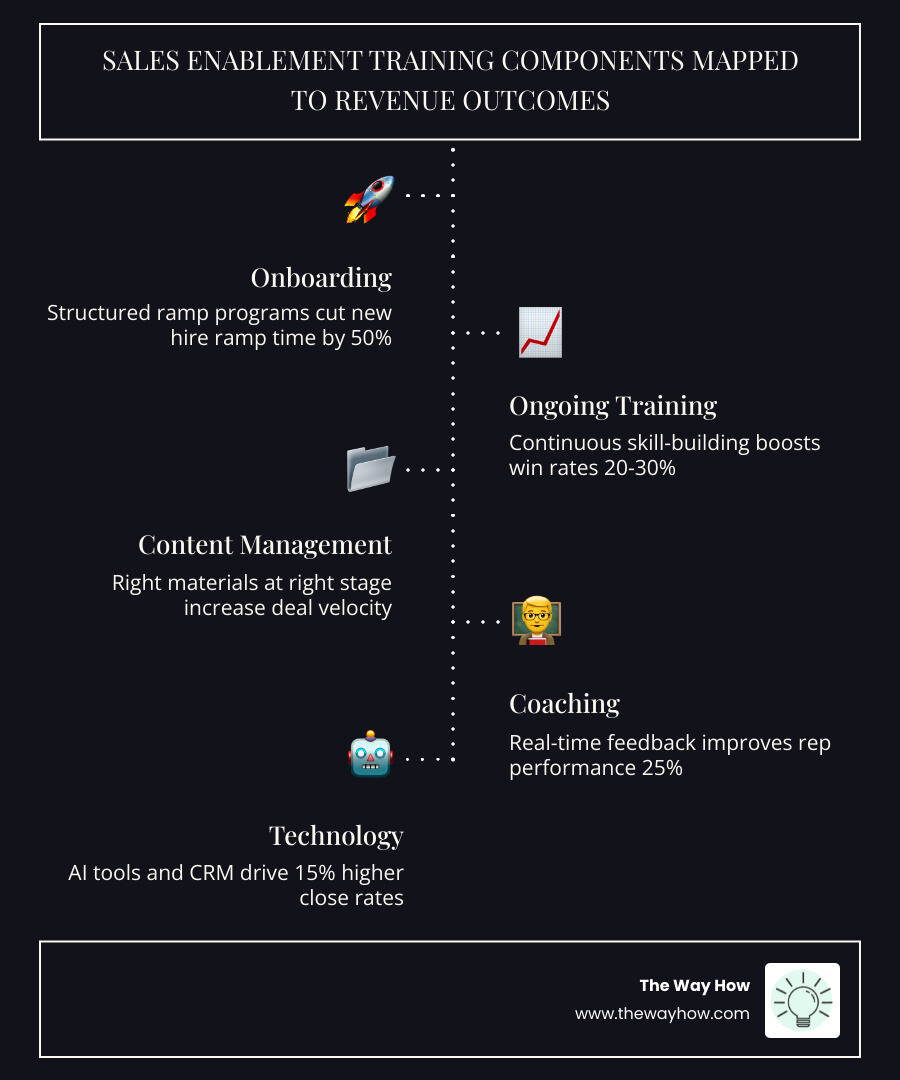
| Component | What It Means |
|---|---|
| Onboarding | Structured ramp programs for new hires |
| Ongoing Training | Continuous skill-building beyond initial onboarding |
| Content Management | Right materials, at the right stage, for the right buyer |
| Coaching | Real-time feedback tied to actual rep behavior |
| Technology | CRM, AI role-plays, conversation intelligence |
| Measurement | KPIs tied to revenue, not just completion rates |
This isn’t a one-day workshop. It’s a system.
The numbers make the problem hard to ignore. 74% of sellers say their jobs are becoming more consultative — yet most training programs still treat selling like a script. Meanwhile, 58% of reps say virtual selling is harder than in-person, but only 29% have received any training on how to do it.
That gap isn’t a training problem. It’s a systems problem.
Most revenue teams don’t lack effort. They lack clarity — about what behaviors actually drive deals forward, what content maps to each buyer stage, and what “good” looks like at each step of the sales process. When that clarity is missing, even motivated reps stall.
That’s exactly where sales enablement training is supposed to help. But too often, it doesn’t — because it’s built around inputs (courses completed, slides delivered) rather than outcomes (deals closed, ramp time cut, win rates improved).
I’m Jeremy Wayne Howell, founder of The Way How — a psychology-first revenue strategy firm where I’ve spent over 20 years helping founders and revenue teams diagnose the human problems underneath their performance problems, including rebuilding sales enablement training programs that actually change rep behavior. Everything in this guide reflects what I’ve seen work — and what quietly fails.
If you have ever sat through a three-hour product training session only to see your reps revert to their old habits by Monday morning, you have witnessed a “certainty gap.” In our work at The Way How, we find that growth stalls not because reps are lazy, but because they are uncertain. They are uncertain about how to handle a specific objection, which case study to send, or how to navigate a complex multi-stakeholder committee.
Traditional sales training attempts to solve this with more information. But information is not enablement.
Modern selling has shifted. With 74% of sellers reporting that their roles are now more consultative and less transactional, the old “feature-benefit” pitch is dead. Buyers don’t need a walking brochure; they need a guide who understands their internal psychology and decision-making frameworks. When training remains stuck in the “transactional” era—focusing on scripts and slide decks—it fails to address the behavioral psychology required to build trust in a virtual, high-stakes environment.
The Psychology of Performance: What is Sales Enablement Training?
At its core, sales enablement training is the strategic alignment of people, processes, and technology to improve sales productivity. It is the “scaffolding” that allows a sales team to learn, execute, and evolve. Unlike a one-off seminar, it is a continuous loop of Sales Team Optimization that focuses on the buyer’s journey as much as the seller’s workflow.
To understand this, we must look at buyer psychology. People do not buy products; they buy a “future state” where their current pain is resolved. Effective enablement equips reps with the empathy-driven frameworks needed to diagnose a buyer’s “Jobs to Be Done” and provide the exact Sales Enablement resources required to move the needle.
Why Sales Enablement Training Differs from Traditional Sales Training
The biggest mistake leadership makes is using these terms interchangeably. They are not the same.
| Feature | Traditional Sales Training | Sales Enablement Training |
|---|---|---|
| Frequency | One-off or annual events | Ongoing, daily reinforcement |
| Focus | “How to sell” (Skills) | “How to win” (Skills + Tools + Content) |
| Integration | Separate from daily work | Embedded in the CRM and workflow |
| Measurement | Attendance and quiz scores | Win rates, ramp time, and deal size |
| Content | Static manuals | Dynamic, stage-specific assets |
Sales training teaches a rep how to swing the bat. Sales enablement provides the bat, the scouting report on the pitcher, and real-time coaching from the dugout during the game.
Core Components of a Modern Sales Enablement Training Strategy
A successful program isn’t a collection of random files in a Google Drive. It is a Revenue-Driving Function built on six interconnected pillars:
- Onboarding and Ramp Programs: Moving beyond “here is your laptop” to a structured 30/60/90-day path that focuses on application, not just absorption.
- Ongoing Training: Continuous education that adapts to market shifts and new product launches.
- Content Management: Ensuring the right collateral (case studies, white papers, decks) is easily accessible and mapped to specific buyer stages.
- Sales Coaching: Moving from “manager as inspector” to “manager as coach,” utilizing call analysis to drive behavior change.
- Technology Enablement: Managing the tech stack so it reduces friction rather than adding to it.
- Measurement and Optimization: Tying every activity back to a specific revenue KPI.
Building a Revenue-Driving Engine from Scratch
Building a program from the ground up requires more than just a “Head of Enablement.” It requires a Sales Charter—a formal document that outlines roles, resources, and feedback loops. Without this, enablement becomes reactive, acting as a “help desk” for reps rather than a strategic growth engine.
Start by identifying the biggest “certainty gaps” in your current B2B Sales Strategy. Is it a lack of leads? Or is it that deals stall after the first demo? By diagnosing where the momentum stops, you can build a B2B Sales Funnel that guides both the rep and the buyer toward a predictable outcome.
Aligning Sales and Marketing Through Smarketing
One of the most common reasons sales enablement fails is a lack of alignment between sales and marketing. Marketing creates content no one uses; Sales complains that the leads are “bad.”
We solve this through “Smarketing”—the integration of these two departments under unified revenue goals. This involves:
- Service Level Agreements (SLAs): Defining exactly what a “qualified lead” looks like and how fast sales must follow up.
- Shared Buyer Personas: Ensuring both teams are speaking to the same human motivations and “Jobs to Be Done.”
- HubSpot Architecture: Using tools like Hubspot Sales Hub to create a single source of truth for both teams.
Measuring What Matters: ROI and Behavioral Metrics
The “tough question” for any enablement leader is always: Did it work?
If you only measure completion rates, you aren’t measuring enablement. You’re measuring compliance. To prove ROI, you must track how sales enablement training impacts the bottom line.
Real-world data shows the potential:
- Ramp Time: One organization, Janssen India, cut rep ramp time by 50% and saw a 35% increase in sales from new sellers after implementing structured enablement.
- Time to First Deal: Chownow achieved a 50% faster time to the first deal by focusing on a robust new-hire training program.
- Win Rates: Organizations with mature enablement functions are 48% more likely to experience higher win rates.
We recommend focusing on four primary metrics to gauge Sales Funnel Optimization:
- Ramp Time: How long does it take a new hire to reach 100% quota?
- Win Rate: Are we winning a higher percentage of our opportunities?
- Average Deal Size: Are reps selling on value rather than discounting?
- Sales Cycle Length: Are we removing the friction that causes deals to stall?
The Tech Stack: AI and Tools for the Modern Seller
In 2026 and beyond, the “scaffold” of enablement is digital. The average B2B organization now uses nearly 10 different tools to drive its sales strategy. However, more tools often lead to more confusion. The goal should be a single hub where content, training, and insights coexist.
According to the Definitive Guide to Sales Enablement, AI is no longer a “nice-to-have.” It is the engine that allows for personalized enablement at scale.
- AI Role-Plays: Reps can practice pitches and handle objections with an AI agent that provides instant, objective feedback.
- Conversation Intelligence: Tools that analyze sales calls to identify which phrases or behaviors are linked to successful deals.
- Microlearning: Delivering bite-sized training modules directly within the CRM (like HubSpot or Salesforce) exactly when a rep needs them.
By embedding training into the “flow of work,” you ensure that learning happens when the stakes are highest, leading to better retention and immediate application.
Frequently Asked Questions about Sales Enablement
Who is responsible for sales enablement in an organization?
In smaller organizations, this often falls to the Sales Manager or a founder. However, as a company scales, it becomes a cross-functional effort. Dedicated Sales Enablement Managers often sit between Sales, Marketing, and RevOps. The key is shared ownership; if marketing isn’t involved in content creation and RevOps isn’t involved in the tech stack, the enablement program will eventually fracture.
Which sales enablement certifications are recommended?
For professionals looking to upskill, several high-quality options exist:
- HubSpot Academy: Offers a comprehensive (and free) Sales Enablement Certification focused on alignment and “Smarketing.”
- Sales Enablement Collective (SEC): Provides “Core” and “Masters” certifications that are highly regarded by industry experts.
- Highspot Professional Certification: Focuses on practical execution, content management, and building sales plays.
- ATD SELL: A great resource for those interested in the research and talent development side of sales performance.
What are real-world examples of successful programs?
- Juniper Networks: Achieved 47% year-over-year sales growth by transforming their revenue productivity through enablement.
- Cisco: Rolled out training to 18,000 sellers in just six weeks with extremely high adoption rates by using a centralized enablement platform.
- Paint Nite: Ranked #2 on the Inc. 5,000 with over 36,000% growth, a feat they attribute largely to their aggressive sales enablement strategies.
Restoring Momentum: Your Path to Sales Certainty
The reason most sales enablement training feels boring is that it ignores the human being in the chair. It treats reps like data-processing machines rather than psychological actors who need confidence and clarity to perform.
At The Way How, we don’t believe in chasing the latest sales “hacks.” We believe in diagnosing the certainty gaps that keep your team from reaching their potential. Whether you are a founder trying to step out of the daily sales grind or a leadership team looking to scale, the path to predictable revenue starts with understanding human behavior.
If your growth has stalled and your sales training feels like a “check-the-box” exercise, it is time to build a system that actually removes uncertainty. Let’s design a revenue strategy that creates trust, momentum, and results.
Explore our revenue strategy and sales optimization services