A Complete Guide to CRM Systems and Database Management
 Jeremy Wayne Howell : Jul 22, 2026 9:48:31 PM

Sales team optimization is the ongoing process of aligning your people, processes, and tools around measurable outcomes — so your team sells more without simply working more hours.
If you’re looking for a quick orientation before diving deeper:
| What It Involves | Why It Matters |
|---|---|
| Mapping and formalizing your sales process | Eliminates guesswork and informal workarounds |
| Defining and tracking the right KPIs | Shows where deals stall, not just whether they close |
| Automating non-selling tasks | Reclaims up to 20% more capacity for customer-facing work |
| Aligning sales and marketing | Creates consistent messaging across the full buyer journey |
| Coaching frontline managers | Multiplies performance across the entire team |
| Building a connected tech stack | Reduces friction, improves forecasting, and routes leads intelligently |
| Structuring territories and incentives | Prevents revenue leaks from poor rep assignments |
Here’s the uncomfortable truth most sales leaders won’t say out loud: their teams are working harder than ever — and results still aren’t moving.
74% of B2B sales leaders say closing deals has become significantly more difficult. Sales cycles have grown by an average of 20 days per year from 2022 through 2024. And only 30% of sellers actually believe they’ll hit their quota.
That’s not a motivation problem. That’s a systems problem.
The typical response is to push harder — more calls, more follow-ups, more pipeline reviews. But when non-selling activities consume two-thirds of the average sales team’s time, hustle alone can’t close the gap. The leak isn’t effort. It’s structure.
The companies pulling ahead aren’t working harder. They’re building smarter. Top-quartile B2B organizations generate roughly two-and-a-half times more gross margin per sales dollar than the bottom quartile. That gap comes from decisions made upstream — about process, roles, tools, and talent — not from closing techniques.
That’s exactly what this guide is about.
I’m Jeremy Wayne Howell, a revenue growth strategist with over 20 years of experience helping founders and revenue teams diagnose what’s actually broken in their sales and go-to-market systems — and sales team optimization is one of the most consistent root causes I find underneath stalled pipelines and flat revenue. If the tactics are working on paper but revenue isn’t moving, there’s almost always a structural or behavioral problem underneath it, and that’s what we’re going to unpack here.
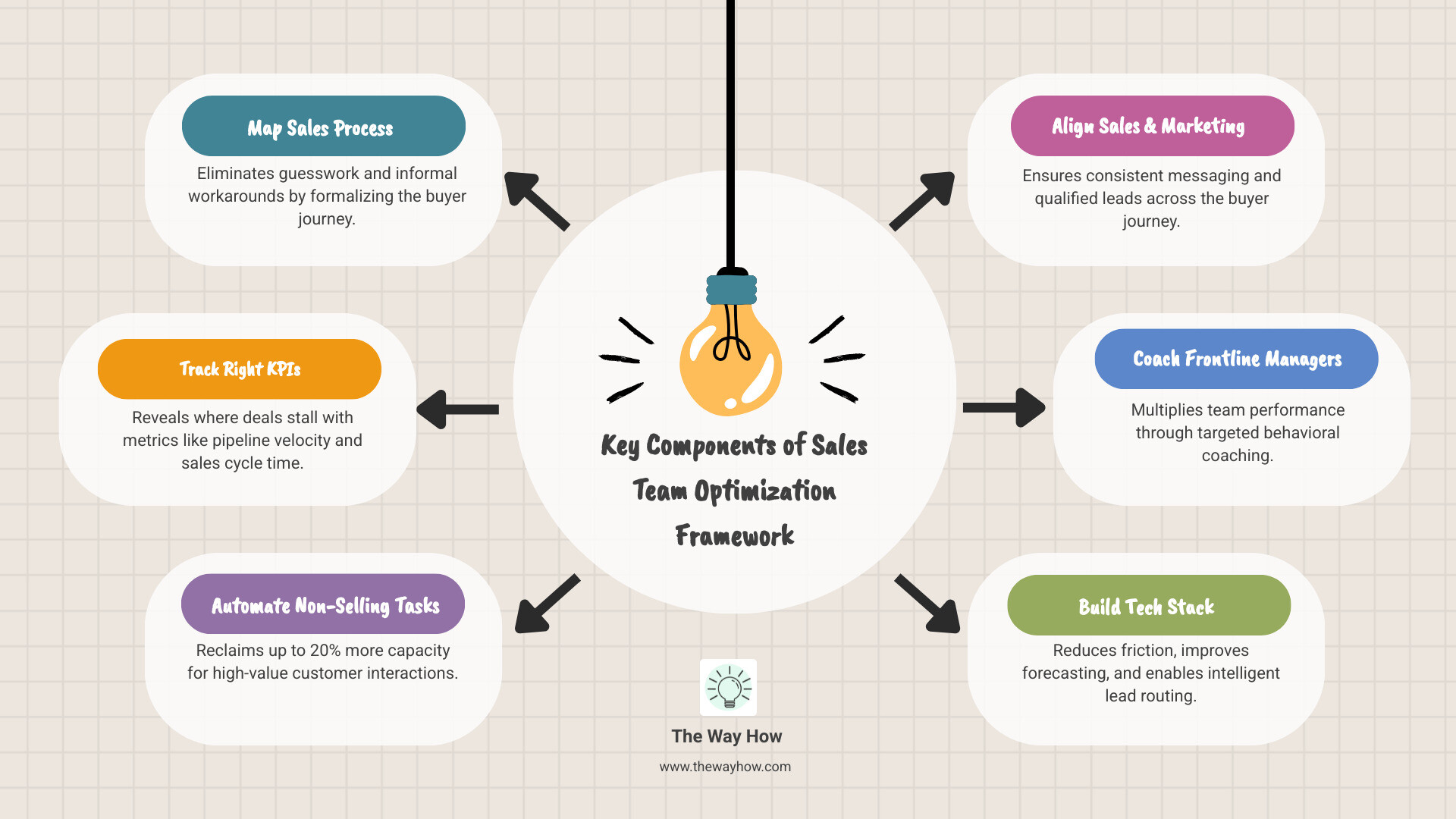
Sales team optimization word guide:
In our work at The Way How, we often find that the biggest hurdle to growth isn’t a lack of talent; it’s a lack of certainty. When a sales process is informal or “vibes-based,” it creates psychological friction for both the seller and the buyer. The seller is uncertain about the next best action, and the buyer senses a lack of structural empathy—the feeling that the vendor doesn’t actually understand their journey.
To fix this, we must shift our focus from “closing skills” to “process decisions.” Most sales advice wrongly fixates on the final handshake. In reality, sales outcomes are determined by how you allocate time, money, and effort early in the cycle. By the time a rep is trying to “close,” the deal’s fate was likely sealed weeks prior by the quality of the discovery and the alignment of the solution. Adopting a B2B Sales Strategy that prioritizes these upstream decisions is the first step toward genuine optimization.
You cannot optimize what you do not measure, but measuring the wrong things is just as dangerous. Traditional management often asks, “Why isn’t my rep on the road?” Optimization asks, “What percentage of leads move from discovery to proposal?”
To move from an informal to a data-driven culture, we track two types of indicators:
Quantitative KPIs: These are the hard numbers that tell you if the engine is running.
Qualitative Behavioral Strengths: These identify why your top performers succeed. Do they personalize outreach better? Do they navigate complex stakeholder committees more effectively?
| Metric Category | Quantitative KPI | Qualitative Behavioral Strength |
|---|---|---|
| Activity | Calls made, emails sent | Strategic questioning, active listening |
| Efficiency | Sales cycle length | Ability to multi-thread within an account |
| Outcome | Quota attainment | Creative problem-solving in negotiations |
One of the most common revenue leaks occurs in the handoff between marketing and sales. If marketing promises a “seamless digital transformation” but the sales rep opens the call by talking about “server rack specifications,” the buyer experiences immediate cognitive dissonance.
Alignment is a critical revenue lever. By establishing a shared messaging framework and Service Level Agreements (SLAs), both teams gain visibility into buyer behavior. This ensures that the Sales Funnel Optimization efforts of marketing directly support the conversations sales is having on the frontline.
Most companies have a sales process that was designed for how they want to sell, not how their customers want to buy. Optimization requires mapping the current, often informal, process and formalizing it into a repeatable system.
When you Build Sales Funnels based on the actual buyer journey, you create accountability. You can pinpoint exactly where deals stall—whether it’s a 10-day delay in sending quotes or a lack of follow-up after a demo. Simplicity here is a feature, not a bug; it allows your team to adapt as market demands shift.
A scalable structure isn’t just about hiring more people; it’s about defining roles that align with specific customer segments and sales motions. We look at four primary ways to structure:
According to research on How to Optimize Your Sales Team Structure to Drive Growth, the best companies use a hybrid of these models to ensure that every customer segment receives the appropriate level of support, from high-touch relationship management to automated transactional flows.
We are entering an era where technology doesn’t just support the seller—it collaborates with them. By 2028, Gartner predicts that 60% of B2B seller activities will be executed through conversational user interfaces via Generative AI (GenAI).
The real power lies in the distinction between GenAI and Agentic AI:
By offloading the two-thirds of time currently spent on non-selling activities, leaders can open up 20% more capacity for their teams. This is a core part of any modern HubSpot Sales Hub Implementation.
A tech stack should be a “single pane of glass” that reduces cognitive load, not a collection of siloed tabs. At the center of this stack is your CRM. 85% of top-performing salespeople say CRM functionality directly impacts their ability to win deals.

Key tools for a high-performing stack include:
Sales Performance Management (SPM) is the strategic backbone of a connected team. It moves the organization from reactive “firefighting” at the end of the quarter to proactive planning. When SPM is poorly implemented, companies lose 2–5% of their revenue simply due to unoptimized rep assignments.
A robust SPM system involves harmonizing data across finance, marketing, and HR to ensure that quotas are calibrated to reality and territories are designed for maximum potential. For those getting started, a HubSpot Sales Implementation Guide can provide the operational roadmap needed to integrate these data points.
Territory planning is often the “silent killer” of sales morale. If one rep is drowning in leads while another is starving, you have a structural leak. Smart routing tools allow you to assign leads based on:
As noted in the PandaDoc Overview: Optimize Your Sales Team with Strategy, Tools and Territory Planning in 5 Steps, diagnosing these performance gaps is the first step toward building a scalable system that balances workload and improves forecast accuracy.
While AI handles the data, humans handle the empathy. Optimizing your talent means looking beyond job titles to “Success Profiles”—a blend of soft skills, behavioral competencies, and mindsets that predict success in a specific role.
In our B2B Sales Consulting practice, we emphasize that training shouldn’t stop at onboarding. It must be a continuous loop of feedback and refinement. When sellers feel invested in, they don’t just perform better—they stay longer.
The frontline manager is the most critical link in the optimization chain. They act as a “noise filter,” protecting their team from administrative distractions and serving as a performance multiplier through coaching.
94% of top sales organizations said that sales coaching improved their sellers’ performance.
AI can support this role by providing managers with real-time analytics on deal health and identifying specific skill gaps in their reps. This allows coaching to shift from generic advice to surgical interventions that actually move the needle on win rates.
Growth is risky. When you expand your sales force, you risk alienating your existing high performers by taking away their best accounts or diluting the culture.
According to A Checklist to Help You Grow Your Sales Team, successful expansion requires:
The first step is mapping and formalizing your current sales process to identify where informal behaviors are creating uncertainty and revenue leaks. Without a clear map of how a lead becomes a customer, any tool or training you add will be built on a shaky foundation.
AI transforms the role by automating administrative “non-selling” tasks—like research and data entry—allowing reps to focus on high-value human interactions and relationship building. It moves the rep from being a data-entry clerk to being a strategic consultant for the buyer.
Alignment ensures consistent messaging across the buyer journey, reducing friction and ensuring that leads are qualified and routed based on shared data rather than guesswork. It prevents the “certainty gaps” that occur when a buyer hears different stories from different departments.
Optimization isn’t a project you finish; it’s a discipline you maintain. It requires a blend of strategic clarity, behavioral insight, and operational execution. At The Way How, we help leadership teams stop chasing the “tactic of the month” and instead build systems rooted in how humans actually make decisions.
If your growth has stalled and you suspect the leaks are in your sales structure, we can help you diagnose the root cause and design a system that creates trust and predictable revenue.
 Jeremy Wayne Howell : Jul 22, 2026 9:48:31 PM
 Jeremy Wayne Howell : Jul 21, 2026 9:47:10 PM
 Jeremy Wayne Howell : Jul 20, 2026 9:46:47 PM