

Beyond the Click: The Real Reason People Buy
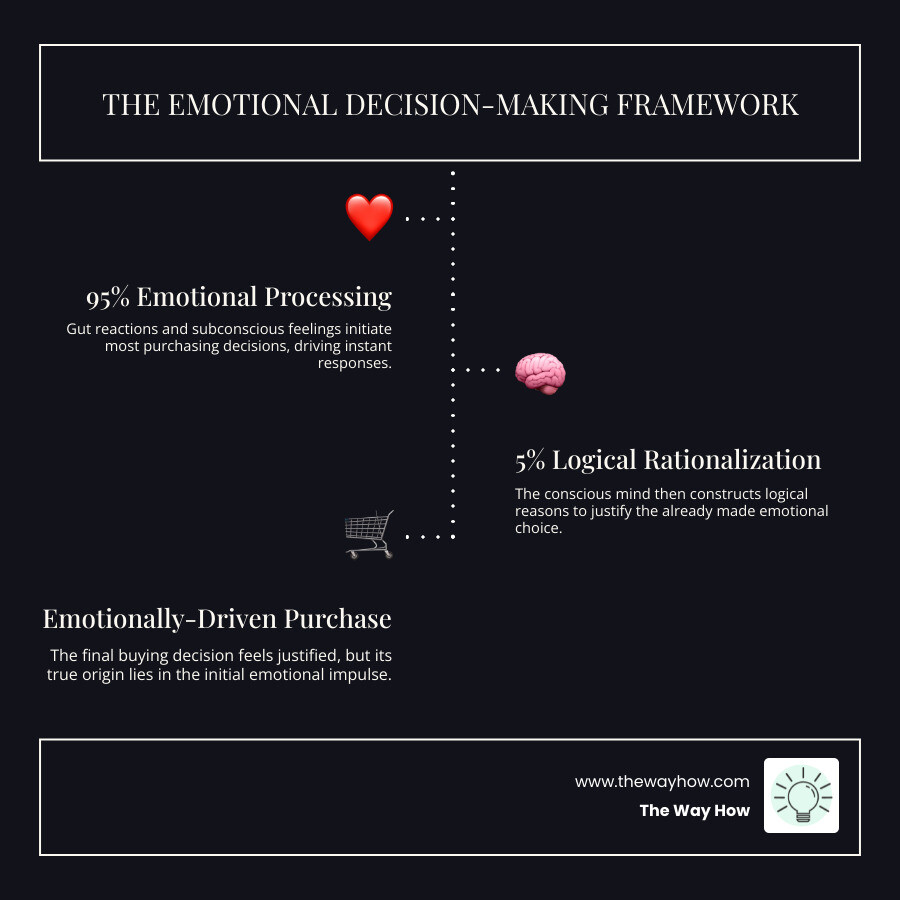
Emotional marketing tactics are strategies that leverage human feelings — like joy, fear, trust, or nostalgia — to influence purchasing decisions and build brand loyalty. They work because 95% of buying decisions happen subconsciously, driven by emotion rather than logic.
Quick Overview: Key Emotional Marketing Tactics
- Storytelling: Use narrative arcs that mirror your customer’s journey
- Color Psychology: Apply colors that trigger specific emotional responses
- Nostalgia: Tap into positive memories to create instant connection
- Social Proof & Community: Build belonging through user-generated content
- Scarcity (FOMO): Create urgency that drives immediate action
- Aspiration: Show the ideal version of your customer’s life
- Humor: Break through noise with unexpected delight
You’ve probably tried marketing tactics that looked good on paper but didn’t move the revenue needle. The reason isn’t your execution — it’s that most marketing ignores how people actually decide.
The uncomfortable truth: your prospects aren’t sitting down with spreadsheets to compare features. They’re making gut-level judgments about whether they trust you, whether you understand them, and whether buying from you will make them feel secure, successful, or seen.
This isn’t manipulation. It’s reality.
Every business decision — even in B2B, even with committees, even with procurement processes — ultimately gets filtered through human emotion. The companies that grow consistently are the ones that stop pretending otherwise.
I’m Jeremy Wayne Howell, and over 20 years of building revenue systems, I’ve seen that emotional marketing tactics only work when they’re rooted in genuine buyer psychology, not borrowed from last year’s viral campaign. This guide will show you how to diagnose what your audience actually feels, choose the right emotions to target, and measure whether your efforts are building trust or just burning budget.
The Unseen Engine: Why Emotion Overrides Logic in Decision-Making
We like to believe we’re rational, but the science of decision-making shows emotions drive purchasing more than logic. This is the core of effective emotional marketing tactics. At The Way How, we know human connection, brand loyalty, and customer engagement are direct results of tapping into this primal emotional landscape. The payoff is huge, impacting spending, brand advocacy, and viral potential.
Consider these compelling statistics:
- 70% of customers who feel high emotional engagement with a brand will spend up to twice as much with those brands, compared to only 49% of consumers with low emotional engagement. This insight from the Digital Change Institute underscores the tangible financial benefits of emotional connection.
- Emotionally engaged customers aren’t just spending more; they’re becoming advocates. 81% of them will recommend the brand to friends and family, and 62% will promote the brand on social media platforms.
- The ripple effect of emotion extends to virality. Kantar reports that digital advertisements that evoke strong emotional responses are 2.6 times more likely to go viral and four times more likely to generate impact and drive long-term brand value.
These numbers illustrate a fundamental truth about human behavior: we buy on emotion and justify with logic. Understanding this is critical for any business looking to remove uncertainty from its sales and marketing systems.
To further understand how our perceptions are shaped, we can explore the principles outlined in our Marketing Framing Effect Guide.
The Science Behind the Feeling
The effectiveness of emotional marketing tactics is rooted in neuroscience. Our brains process information on two levels: a fast, automatic, emotional level and a slower, deliberate, logical one. Neuroscientist Antonio Damasio studied individuals with damage to the brain’s emotional centers and found they struggled immensely with decision-making. This illustrates that emotions are not just reactions; they are essential components of our decision-making process.
When we encounter things that trigger our emotions, it changes how we behave and perceive information. In fact, research shows that 95% of purchasing decisions are subconscious, driven by emotional responses rather than logic. Our emotional fixation on certain details can impair our ability to make fully objective decisions, causing us to make choices based on how information taps into our emotions.
Positive emotions like joy increase engagement with advertising. When you experience joy, your body releases “feel-good” hormones, including dopamine. This helps us absorb and remember information more effectively, making emotional content more memorable and likely to encode into long-term memory.
The Business Case for Emotion
The case for embracing emotional marketing tactics is clear: they deliver tangible business results that feature-focused marketing often misses. When companies strategically connect with customers’ emotions, the impact is quantifiable.

Consider these real-world examples:
- A major bank introduced a credit card for Millennials designed to inspire emotional connection. This initiative led to a remarkable 70% increase in credit card use among this demographic and a 40% rise in new account growth.
- A leading household cleaner, facing market share losses, turned its fortunes around by launching products and messaging explicitly designed to maximize emotional connection, resulting in double-digit growth.
- A nationwide apparel retailer reoriented its merchandising and customer experience to cater to its most emotionally connected customer segments. The result? Same-store sales growth accelerated more than threefold.
These outcomes demonstrate that emotional marketing isn’t a “soft” approach; it’s a strategic driver of growth. A study of 1,400 successful advertising campaigns found that purely emotional content performed about twice as well (31% vs. 16%) as those with only rational content. Nielsen’s research also revealed that ads with the best emotional response resulted in a 23% increase in sales.
This powerful impact translates into increased customer lifetime value, higher conversion rates, market share growth, and crucial brand differentiation. In today’s attention economy, emotional connection provides a competitive advantage that can’t be easily replicated.
Mapping the Heart: How to Diagnose Your Audience’s Emotional Triggers
Before we can effectively deploy emotional marketing tactics, we must first understand the emotional landscape of our audience. This isn’t about guessing; it’s about rigorous diagnosis rooted in human behavior. At The Way How, we believe in diagnosing why growth is stalled and identifying certainty gaps in the customer journey. This means going beyond surface-level demographics to truly map the heart of our target consumers.
Identifying emotional triggers involves comprehensive audience research, developing detailed buyer personas, and empathy mapping. We need to understand their pain points, their deepest aspirations, and the values that guide their decisions. What keeps them up at night? What do they dream about achieving? What principles do they hold dear? These are the foundational questions that open up emotional resonance.
For a deeper dive into understanding consumer psychology, our insights on Neuromarketing Techniques can provide valuable context.
From Demographics to Psychographics
Understanding our audience requires moving beyond simple demographic data (age, location, income) to dig into psychographics — their attitudes, interests, values, and lifestyles. This is where the real emotional insights lie.
To uncover these deeper emotional needs, we employ a combination of qualitative and quantitative research methods:
- Surveys: Designed with open-ended questions that encourage emotional responses.
- Focus Groups: Facilitated discussions that reveal group dynamics and shared emotional experiences related to a product or problem.
- Social Listening: Monitoring conversations on social media and online forums to identify recurring sentiments, frustrations, and desires.
- Review Analysis: Scrutinizing customer reviews for emotional language, pain points, and moments of delight.
- Customer Interviews: One-on-one conversations that allow for deep exploration of individual experiences and emotional drivers.
When conducting customer interviews, we find these questions particularly effective in uncovering emotional triggers:
- What problem were you trying to solve when you found our product/service? How did that problem make you feel?
- What was the biggest frustration or challenge you faced before using our solution?
- What were you hoping to achieve or feel by using our product/service?
- How did our product/service make your life better or easier? What emotions did that evoke?
- What values are most important to you when choosing a brand in this category?
- How do you want to feel when you interact with a brand like ours?
- Can you describe a moment when our product/service truly delighted you?
- What fears or anxieties do you have about similar products/services on the market?
- What aspirations or goals does our product/service help you achieve?
By asking these types of questions, we move beyond functional benefits to identify the core emotional drivers that truly motivate purchase behavior and foster lasting brand loyalty.
Choosing the Right Emotion to Target
Once we’ve diagnosed our audience’s emotional landscape, the next step in implementing effective emotional marketing tactics is to strategically choose which emotions to target. It’s often more impactful to focus on one primary emotion per campaign to avoid diluting the message.
Robert Plutchik’s Wheel of Emotions provides a useful framework for understanding the spectrum of human feelings. It categorizes eight basic emotions: joy, trust, fear, surprise, sadness, disgust, anger, and anticipation, with varying intensities and combinations.

While many campaigns gravitate towards positive emotions like joy and excitement, others can be equally powerful:
- Joy/Happiness: Creates positive associations with your brand. Coca-Cola’s “Open Happiness” campaign is a classic example, encouraging people to enjoy simple pleasures.
- Trust/Security: Essential for building long-term relationships. Brands like Adidas, Reebok, Patagonia, Esprit, and H\&M build trust through supply chain transparency.
- Awe/Inspiration: Captivates audiences and makes content memorable. Dropbox’s early launch leveraged awe, and Intel’s “Meet the Makers” series profiles inspiring individuals.
- Nostalgia: Taps into cherished memories, especially effective with older demographics. Olipop successfully leaned into 1990s nostalgia for its prebiotic soda.
- Belonging: Fosters community and inclusivity. Black Travel Box, a hair and skin care brand, was founded on community and representation for Black travelers.
- Fear (of Missing Out - FOMO): Creates urgency and drives immediate action. Dapper Boi saw success with limited product drops and discounts.
The key is to align the chosen emotion with your brand’s values, your product’s benefits, and your audience’s current emotional state. For example, if your product solves a common frustration, targeting relief or empowerment might be more effective than pure joy.
Crafting Connection: Core Emotional Marketing Tactics That Build Trust
With a clear understanding of audience triggers, we can craft messages that resonate deeply. Effective emotional marketing tactics are about building genuine connection and trust through storytelling, authenticity, and community. At The Way How, we design systems rooted in human behavior, moving beyond generic ads to create relatable narratives and experiences. For inspiration on breaking through the noise, see our Disruptive Marketing Examples.
The Power of Storytelling and Brand Narrative
Storytelling is arguably the most powerful emotional marketing tactic. Humans are hardwired for stories, which capture attention and move audiences in ways facts cannot. This improves brand-customer relationships, as customers develop affection for a brand they see as more than just a provider.
We can leverage various narrative approaches:
- Classic Story Arcs: Whether it’s a “Hero’s Journey” where the customer is the hero overcoming a challenge with your product as the guide, or a simple rags-to-riches tale, structured narratives are inherently engaging.
- Customer Success Stories: Real testimonials and case studies, told with emotion, can be incredibly persuasive. They provide social proof and allow prospective customers to see themselves in the narrative.
- Founder’s Story: The origin story of your brand, detailing the passion, challenges, and vision, can humanize your company and build an emotional bond.
- Mission-Driven Narratives: Brands like TOMS have successfully built communities around a mission, linking purchases to helping those in need.
- Relatable Characters: Creating characters, whether real or archetypal, that your audience can connect with builds empathy and makes your message stick.
A prime example is Dove’s “Real Beauty” campaign, which shifted the narrative around beauty standards, fostering a deep emotional connection. More recently, Airbnb’s “The Grand Adventure” video for its experiences platform emphasized authentic travel by evoking nostalgia, belonging, and optimism, setting it apart from typical hotel stays.
Storytelling works because it allows us to showcase the emotional content we want to deliver, moving the audience and pushing them to take action. Studies show that 73% of consumers are more likely to engage with content that is easy to read, and stories naturally simplify complex messages.
Using Visuals and Color Psychology
Visual elements and color psychology are silent but potent emotional marketing tactics. They communicate instantly, bypass rational thought, and directly tap into our subconscious. A ScienceDaily study found that logo colors significantly affect how consumers emotionally engage with brands, directly influencing emotions like excitement. Shopify’s color psychology report further highlights how colors influence purchasing decisions.
- Color Psychology: Every color carries emotional associations. Red can evoke excitement and hunger (think fast-food brands), blue suggests trust and stability (finance, healthcare), green often relates to health and nature, and yellow implies optimism and warmth. Knowing the impact of colors on emotions and human attention, we must incorporate them thoughtfully into our promotional materials. Rocky’s Matcha, for example, made a bold choice by selecting blue tins over conventional silver or green matcha packaging. Founder Rocky Xu explained, “We leaned into a color that isn’t commonly associated with matcha,” effectively leveraging color to stand out and appeal to individuality.
- Imagery and Video: High-quality images and videos can convey complex emotions in a fraction of a second. A brand video production can combine bright colors with an upbeat tune and smiling actors to evoke joy. Conversely, images of poorly treated animals can evoke sadness and empathy, prompting donations.
- Brand Identity: Your logo design, website aesthetics, and overall visual presence should consistently reflect the emotions you wish to associate with your brand. Muted, neutral palettes with strong negative space can imply thoughtfulness and clarity, aligning with a psychology-first approach.
Leveraging Specific Emotional Hooks
Beyond broad storytelling and visual appeals, specific emotional hooks can be powerful emotional marketing tactics when applied strategically.
- Humor: Genuine humor breaks through the noise and creates positive brand associations. Canned water company Liquid Death used hilarious ads to build a cult following and a $1 billion valuation. Laughter makes content highly shareable and more likely to go viral.
- Nostalgia: Tapping into cherished memories creates an instant connection. Olipop successfully used 1990s nostalgia to market its prebiotic soda, using a feel-good campaign that reminded viewers of their childhood soda memories.
- Aspiration: Many brands connect with consumers’ desires for a better self or life. Nike’s “Just Do It” campaign, featuring professional athletes overcoming adversity, inspires aspiration and empowers individuals to achieve their goals. Polar Monkeys, selling high-end cold plunges, markets itself not just as a product but as inspiring growth, encouraging change, and fostering a community driven by wellness.
- Scarcity/FOMO (Fear of Missing Out): Creating a sense of urgency or exclusivity can drive immediate action. Vicky Pasche, founder of Dapper Boi, saw success with FOMO when releasing new products with limited drops combined with discounts. This taps into the psychological principle of scarcity, making an item seem more desirable when its availability is limited. This is also related to the Endowment Effect Marketing where people value things more once they feel they own or might lose them.
From Feeling to Figure: Measuring Impact and Avoiding Pitfalls
Deploying emotional marketing tactics is only half the battle; the other half is understanding their impact and navigating potential challenges. At The Way How, we emphasize that true marketing effectiveness comes from clarity and measurable results, not just creative campaigns. We need to know if our emotional appeals are genuinely building trust and driving predictable revenue, or if we’re simply burning budget.
Measuring emotions is inherently challenging, as they are subjective and often subconscious. However, we can track the behavioral outcomes of emotional engagement using a combination of Key Performance Indicators (KPIs), brand sentiment analysis, and direct customer feedback. For broader context on how advertising can create impact, explore our insights on Disruption in Advertising.
How to Measure the Success of Your Emotional Marketing Tactics
To move from “feeling” to “figure,” we need a robust measurement framework. While direct emotional measurement can be complex, we can track proxy metrics that indicate emotional resonance and its impact on business objectives:
Engagement Metrics: Likes, shares, comments, and time spent on content are strong indicators of emotional connection. Content that evokes positive emotions is more likely to be shared. Digital advertisements that evoke strong emotional responses are 2.6 times more likely to go viral.
Brand Sentiment Analysis: Tools that monitor online conversations can help us understand the overall tone and emotion associated with our brand. Are customers expressing joy, trust, or frustration?
Conversion Rates: Emotional marketing aims to drive action. Tracking conversion rates (purchases, sign-ups, downloads) linked to emotional campaigns is crucial. Emotional campaigns have been shown to increase sales by 23%.
Customer Feedback & Research:
- Surveys: Post-campaign surveys can ask about how content made customers feel and if it influenced their perception or purchase intent.
- Focus Groups: Provide qualitative insights into emotional responses and brand associations.
- Brand Recall Surveys: Measure how memorable emotional campaigns are compared to more rational ones.
Net Promoter Score (NPS): Emotionally engaged customers are more likely to recommend a brand. An increase in NPS can signal successful emotional connection.
Customer Lifetime Value (CLV): Emotionally engaged customers spend up to twice as much. Tracking CLV helps assess the long-term financial impact of building emotional bonds.
A/B Testing: Testing different emotional appeals in ad copy, visuals, or calls to action can reveal which emotions resonate most with specific segments.
Attribution Modeling: Connecting emotional marketing efforts to specific revenue outcomes can be challenging but is vital for proving ROI.
Here’s a simplified comparison of metrics:
The Fine Line: Authenticity vs. Manipulation
The power of emotional marketing tactics comes with a significant responsibility: the imperative of authenticity. While tapping into emotions is effective, crossing the line into manipulation can severely damage brand trust and reputation. 81% of consumers say trust is a deciding factor in their purchasing decisions, and when trust is broken, 65% of customers will stop buying from the brand and share negative feedback with others.
To avoid potential pitfalls, we must adhere to key principles:
- Authenticity: This is paramount. About 88% of consumers agree that authenticity is key to engaging with a brand. Your emotional appeals must genuinely align with your brand’s values, mission, and the actual experience your product or service delivers. Sharing real-life experiences in promotional materials is a great way to foster this. As Lindsey Carter of SET Active explains, giving audiences a behind-the-scenes look at the brand helps build a deep emotional connection.
- Empathy-Based Marketing: This involves truly understanding and sharing the feelings of your audience, rather than exploiting them. Brands tried to deliver empathetic messages during the pandemic to show solidarity, with varying degrees of success. Ernst & Young’s website, for instance, uses pictures of nature, society, and aspirations to fit its empathetic tagline.
- Transparency: Be honest about what your brand stands for and what it offers. If you evoke hope or inspiration, ensure your actions and products deliver on that promise.
- Avoiding Stereotypes and Tone-Deaf Messaging: What resonates with one group might offend another. Pepsi’s 2017 ad featuring Kendall Jenner, which tried to use emotions to piggyback on social protests, came across as incredibly tone-deaf and was pulled shortly after its release. This highlights the critical need for cultural sensitivity and rigorous testing.
- Ethical Considerations: Always ask: “Are we genuinely trying to connect and serve, or are we trying to trick people into buying?” The former builds loyalty; the latter breeds resentment.
The importance of authenticity in emotional marketing cannot be overstated. It’s the foundation upon which lasting customer relationships are built.
The Future of Feeling: AI, Personalization, and Empathy
The landscape of emotional marketing tactics is continuously evolving, driven by technological advancements and shifting consumer expectations. In an era where data is the new oil, artificial intelligence (AI) and machine learning (ML) will have an even more central role in the future of marketing.
- Hyper-Personalization: AI and ML enable us to analyze massive amounts of data in real-time, providing a deeper understanding of consumer needs, preferences, and behaviors. This allows for hyper-personalized emotional marketing campaigns that resonate with individuals on a much deeper level. Instead of broad emotional appeals, AI can help tailor messages to a person’s specific emotional triggers and current context.
- Predictive Analytics: AI can predict emotional responses and purchasing behaviors with increasing accuracy, allowing us to optimize campaigns before they even launch. This moves us closer to designing systems that create predictable revenue.
- Empathy at Scale: Companies and research initiatives like Empath and Hume AI are making AI more emotional and empathetic. This means future marketing tools may be able to not only detect emotions but also generate content that responds to them with nuanced, human-like empathy. While the machines will only get better and become more ‘human’ as technology evolves, the human touch of empathy will always be critical.
- Ethical AI in Marketing: As AI becomes more sophisticated in understanding and influencing emotions, the ethical considerations become even more pronounced. We must ensure these powerful tools are used responsibly to build genuine connections and trust, rather than for manipulative purposes. The principles of authenticity and transparency will be more important than ever.
Around 41% of marketers report that AI and machine learning have accelerated revenue growth and improved marketing performance. This trend suggests that integrating these technologies with a deep understanding of human psychology will be key to mastering emotional marketing in the years to come. For more on this, explore The role of AI in marketing’s future.
Stop Chasing Tactics, Start Building Connection
We’ve explored the profound impact of emotional marketing tactics, delving into the science behind why emotions drive decisions, how to diagnose your audience’s emotional triggers, and the core strategies for crafting compelling, trust-building campaigns. We’ve also touched on the critical need for authenticity and the exciting future shaped by AI.
At The Way How, our philosophy is rooted in this understanding: growth isn’t about chasing the latest marketing trends or simply layering on tactics. It’s about diagnosing the underlying reasons why growth is stalled, identifying certainty gaps in the customer journey, and designing systems that create trust, momentum, and predictable revenue.
We believe that true marketing mastery comes from a psychology-first approach, blending strategic clarity, behavioral insight, and operational execution. When you understand the human behind the purchase, you stop guessing and start connecting. This means shifting your focus from merely selling a product to truly understanding and addressing the emotional needs and aspirations of your audience.
By implementing emotional marketing strategies grounded in genuine buyer psychology, you can transform casual customers into loyal advocates. You can build a brand that resonates, not just on a logical level, but deep within the hearts of your consumers. This isn’t just good marketing; it’s smart business.
If you’re ready to move beyond surface-level tactics and develop a marketing system rooted in psychology, designed to build trust and predictable revenue, we invite you to learn more about how we can partner with you. Let’s work together to open up your brand’s full emotional potential. Find how to Develop a marketing system rooted in psychology.