
From Market Chaos to Predictable Momentum

A go-to-market strategy is a plan for introducing a product to customers in a way that creates demand and drives predictable revenue. It answers four critical questions: Who are you selling to? Why should they care? How will they buy? And how will you know it’s working?
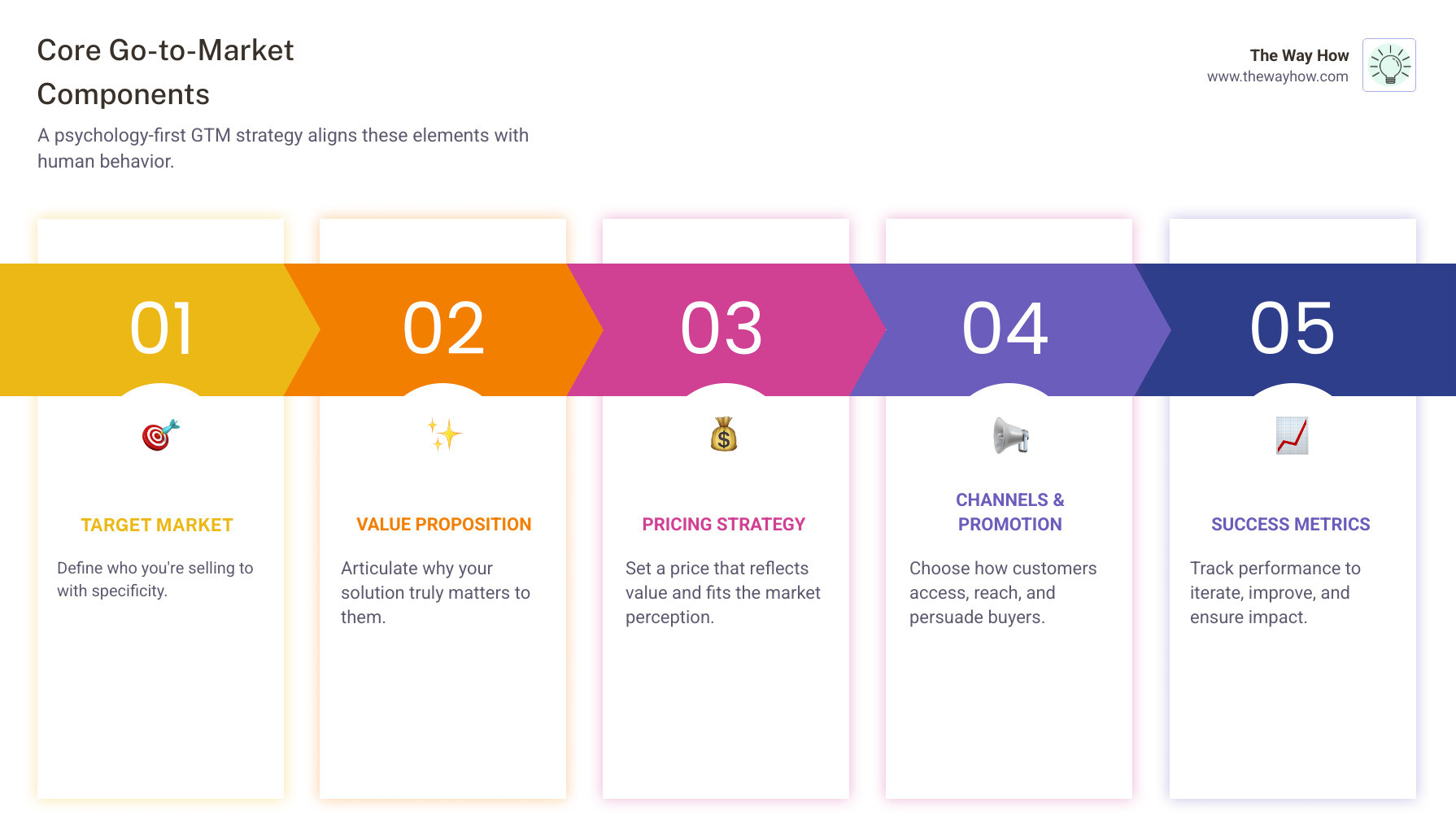
Core components of a go-to-market strategy include:
- Target Market – Defining who you’re selling to with specificity
- Value Proposition – Articulating why your solution matters to them
- Pricing Strategy – Setting a price that reflects value and fits the market
- Distribution Channels – Choosing how customers will access your product
- Promotion Strategy – Deciding how you’ll reach and persuade buyers
- Success Metrics – Tracking performance to iterate and improve
Many companies treat a GTM strategy like a launch checklist. They define a persona, write messaging, pick channels, and hope for the best. But when growth stalls—when leads don’t convert or customers churn—the problem isn’t the tactics. The strategy was built on assumptions about what the company wanted to say, not on an understanding of why a buyer would listen.
Research shows that more than a third of startups fail because there was no identified market need. This isn’t a product problem; it’s a certainty problem. Buyers didn’t understand the value or trust the claim. They didn’t feel confident enough to act.
A psychology-first go-to-market strategy begins with the buyer’s reality. It identifies where uncertainty exists in their decision-making and how to create clarity at every stage. It aligns messaging, channels, and sales systems around human behavior, not internal assumptions.
This guide walks through the full GTM framework. You’ll see examples from companies like Oatly, Slack, and Apple that succeeded not because they had better products, but because they understood their buyers’ psychology and built systems that reduced friction.
I’m Jeremy Wayne Howell, and I’ve spent over 20 years helping companies build go-to-market strategies that create momentum. My work focuses on diagnosing the human problem underneath the performance problem—understanding buyer psychology and decision-making behavior before investing in channels or funnels.
Go-to-market strategy vocabulary:
The Blueprint vs. The Reality: What a GTM Strategy Actually Is (and Isn’t)
At its heart, a go-to-market strategy is a plan to deliver a unique value proposition and achieve a competitive advantage. It’s about bringing a product to market with precision to minimize risk and optimize success. The core purpose is to thoroughly identify the target market, articulate the product’s value, and develop a marketing, sales, and distribution strategy.
A well-crafted GTM strategy improves the customer experience by offering a better product or pricing and creating a clear framework for market entry. It helps focus on experiences that lead to loyalty and retention. Without this clarity, buyers might not see your product’s value, turning instead to competitors who seem more understandable.
Go-to-Market Strategy vs. Marketing Strategy
It’s easy to confuse a go-to-market strategy with a marketing strategy or plan, but they are distinct, interconnected entities.
Think of it this way:
A marketing strategy is your long-term vision for building and maintaining relationships with your audience. It defines overall brand objectives and sustainable growth goals.
A marketing plan is the action plan for a specific campaign or period. It details the concrete steps and tactics to achieve specific marketing objectives, like a loyalty program for a retail brand.
A go-to-market strategy is a focused plan for launching a specific product or service. It asks, “How will we launch this product, to this audience, now?” For example, Microsoft’s launch of its Surface tablet addressed a particular market problem—that existing tablets lacked the functionality of a full computer.
| Feature | Go-to-Market Strategy | Marketing Strategy | Marketing Plan |
|---|---|---|---|
| Primary Focus | Launching a new product or entering a new market | Overall long-term business and brand objectives | Specific campaigns and tactics |
| Time Horizon | Short to medium-term (launch and initial adoption) | Long-term (3-5+ years) | Short to medium-term (quarterly, annual) |
| Scope | Product-centric; delivering value to a specific market | Brand-centric; market positioning and customer relationships | Tactic-centric; execution details for activities |
| Key Question | How do we get this product to these customers? | How do we build a strong brand and customer base? | How do we execute this campaign to achieve these goals? |
| Components | Target market, value prop, pricing, channels, metrics | Market research, SWOT, brand positioning, marketing mix | Campaign details, budget, timelines, content plans |
Understanding these distinctions is crucial. Companies often struggle because they apply a long-term marketing strategy to a short-term launch challenge, leading to stalled growth.
For more strategic guidance on aligning your vision with execution, explore More info about our Fractional CMO services.
Why a GTM Strategy is Crucial for Business Growth
The reality is stark: more than a third of startups fail because there was no identified market need. This reflects a misjudgment of buyer psychology. A lack of market need translates to a lack of buyer certainty. If we don’t understand the problem our product solves, our buyers won’t either.
A robust go-to-market strategy is your shield against this pitfall. It’s a framework for market entry that ensures an understanding of the market, the competition, and the customer. This understanding reduces the risk of introducing something new.
By forcing consideration of every element, a GTM strategy:
- Avoids market failure: It ensures you’re building for a genuine need.
- Optimizes resource allocation: It identifies effective channels and messaging to reduce marketing costs.
- Accelerates time to market: A clear plan prioritizes tasks and troubleshoots positioning before launch.
- Builds brand awareness: A successful launch creates momentum and opens doors to new markets. For more on this, visit our Business Growth page.
- Aligns sales and marketing: It creates a shared understanding and common goals across teams.
A GTM strategy is about creating certainty for your team and your future customers. It replaces guesswork with a data-informed, psychology-driven approach to predictable revenue.
Diagnosing the Disconnect: The Core Components of a Psychology-First Go-to-Market Strategy
True market success isn’t about clever tactics; it’s about understanding human behavior and decision-making. Our psychology-first approach to a go-to-market strategy focuses on diagnosing the disconnects that create certainty gaps for your potential customers.
Whether developing B2B Marketing Strategies or B2C campaigns, we start by asking: What are the underlying emotional and cognitive factors influencing your buyer’s journey? How can we design systems that build trust by speaking directly to those factors?
Who Are You Really Talking To? Identifying Your True Target Market
Many companies define their target market with demographics. A psychology-first approach digs deeper into their fears, aspirations, and frustrations.

- Ideal Customer Profile (ICP): This is the type of company or individual that will derive the most value from your product and provide the most value back. An accurate ICP is critical, as an incorrect profile leads to misaligned strategies.
- Buyer Personas: These are semi-fictional representations of your ideal customers, based on research and data. They go beyond demographics to include psychographics, motivations, behaviors, and pain points.
- Market Segmentation: This is the process of dividing customers into groups that share common needs and will react similarly to marketing. This allows for a value proposition customized to these segments. You can learn more about this at Market Segmentation Definition from Investopedia.
- Pain Points vs. Needs: We focus on diagnosing pain points. What specific frustrations does your ideal customer have? What problems does your product actually solve?
- Job-to-be-done framework: This framework helps us understand why customers “hire” a product to do a “job” for them. It shifts focus from product features to customer outcomes. For example, people don’t buy a drill because they want a drill; they buy it because they want a hole.
By understanding the audience at a deep, psychological level, we remove uncertainty from our messaging.
Why Should They Care? Crafting a Value Proposition That Resonates
Once we know who we’re talking to, the next step is to articulate a value proposition that resonates with their pain points. A compelling value proposition is a clear statement of the unique benefits your product provides.
- Value Proposition Definition: It tells your customer why they should choose you over the competition. It’s the promise of value to be delivered.
- Value Matrix: To map messaging effectively, a value matrix breaks down each persona, their pain points, the product’s value, and a key message that conveys how your product solves their problem.
- Unique Selling Proposition (USP): What makes you different? This requires competitor research to identify similar products and unique offerings. AI tools can scan data for competitor mentions and pricing to help pinpoint differentiation.
- Problem-Solution Messaging: Messaging should be framed from the buyer’s perspective. Instead of leading with features, lead with the problem you solve. This connects with their reality and addresses certainty gaps. Slack’s marketing, for example, often highlights how the platform solves common workplace problems.
- Differentiating from Competitors: To differentiate, we must connect our offerings to buyer problems. A customer-centric design approach, like Apple’s, emphasizes analyzing customer needs and designing products accordingly, leading to a strong value proposition.
What is the Price of Certainty? Defining Your Pricing and Positioning
Pricing is a psychological lever that signals value and quality. Our approach considers how pricing influences perception and alleviates buyer uncertainty.
- Pricing Strategy: This involves considering costs, profit margins, competitor pricing, and customer willingness to pay.
- Value-Based Pricing: This strategy sets prices based on the perceived value to the customer. If your product solves a significant problem, your pricing should reflect that.
- Subscription vs. Transactional Models: A subscription model, like Adobe’s Creative Cloud, can reduce the upfront cost barrier and foster long-term relationships. A transactional model might be better for products with intermittent usage.
- Competitor Pricing: Understanding competitor pricing helps position your product. Are you a premium solution or a cost-effective alternative? How does your price communicate your value?
- Perceived Value: The right price aligns with the customer’s perceived value. If it’s too low, it might signal low quality. If it’s too high without justification, it creates friction.
Where Do You Build Trust? Choosing Your Sales and Distribution Channels
The channels we choose are fundamental to building trust and reducing friction. A psychology-first strategy selects channels based on where ideal customers feel most confident to make a purchase.

- Sales and Distribution Channels: These are the paths your product takes to your customer. We consider the product’s nature and where the target market shops.
- Product-led vs. Sales-led Growth: This is a critical choice. Product-led strategies leverage the product itself to pull customers in, often with freemium models (e.g., Slack). Sales-led strategies focus on relationship-building to push customers to convert, which is often better for complex B2B solutions. Many companies find a hybrid approach is optimal.
- Direct vs. Indirect Channels: Direct channels (e.g., your website) offer control over the customer experience. Indirect channels (e.g., partners, resellers) can offer broader reach. Oatly’s strategy of partnering with coffee shops is a brilliant example of an indirect channel choice that built trust.
- Buyer’s Journey Mapping: We map the buyer’s journey to identify every touchpoint. This helps ensure a seamless experience. The traditional sales funnel is linear, but a modern approach is the flywheel model, which focuses on attracting, engaging, and delighting customers to turn them into promoters. Our Client Acquisition Funnel guide offers further insights.
From Theory to Traction: Activating and Measuring Your Strategy
A brilliant go-to-market strategy on paper is useless until it’s brought to life with implementation and measurement. Activating your strategy requires cross-functional alignment, clear goals, and the ability to adapt based on performance data. This is where systems like HubSpot Marketing Hub Implementation become invaluable for operationalizing your approach.
Measuring What Matters: A Guide to Your Go-to-Market Strategy Metrics
To know if our go-to-market strategy is working, we must focus on Key Performance Indicators (KPIs) that reveal insights into buyer behavior and revenue generation. These metrics are our compass for diagnosing where certainty might be breaking down.
Common metrics we track include:
- Customer Acquisition Cost (CAC): Total sales and marketing costs divided by new customers acquired. A high CAC may indicate inefficient channels or messaging.
- Sales Cycle Length: The time it takes for a prospect to become a customer. A long cycle can point to buyer uncertainty or friction.
- Conversion Rates: The percentage of prospects who complete a desired action. Low rates signal a problem with the value proposition or messaging.
- MQL to SQL Conversion: Tracking the conversion from a Marketing-Qualified Lead (a prospect likely to become a customer) to a Sales-Qualified Lead helps gauge lead quality. For a deeper dive, see Gartner’s Marketing-Qualified Lead (MQL) definition from Gartner.
- Customer Lifetime Value (CLTV): Helps evaluate if CAC is sustainable and if we are attracting the right customers.
- Return on Investment (ROI): Which promotional channels deliver the highest return? This helps optimize budget and focus.
We don’t just track these numbers; we analyze them. Our Marketing Data Analysis helps uncover the why behind the what, allowing us to diagnose stalled growth.
The Adaptive System: How to Iterate and Scale Your Strategy
The market is a living entity. An effective go-to-market strategy is never static; it’s an adaptive system that accepts experimentation and iteration.
- Market Feedback: Actively solicit feedback from customers, lost prospects, and your sales team. What are the common objections or points of confusion? This feedback directly informs our understanding of buyer certainty gaps.
- Experimentation and A/B Testing: Approach GTM with a scientific mindset. Formulate hypotheses, design tests for channels or messaging, and prioritize those with the greatest potential impact.
- Sales Learning Curve: As businesses scale, sales teams evolve. The initial phase focuses on learning how to sell. The next phase establishes a repeatable process. The final phase is about execution and scaling. Knowing when to scale is critical.
- Scaling Sales and Marketing Teams: The right time to scale is when you have product-market fit, a defined ICP, and a predictable customer acquisition process. Scaling prematurely amplifies inefficiencies. Our Small Business Growth Strategies emphasize building a solid foundation first.
- Adaptation: Insights from feedback and experiments must be integrated into the strategy. Regularly review and adjust your GTM elements to meet evolving buyer needs. This continuous cycle of learning and adapting maintains momentum.
Learning from the Field: Successful Go-to-Market Strategy Examples
The best way to understand a go-to-market strategy is to see it in action. These examples highlight how a deep understanding of human behavior and decision-making can lead to remarkable success.
Key takeaways from successful GTM strategies:
- Deep Market Understanding: Research into audience pain points and competitive landscapes.
- Clear Value Proposition: Articulating benefits that resonate emotionally and rationally.
- Strategic Channel Selection: Choosing channels where the target audience is most receptive.
- Problem-Solution Focus: Framing the product as an answer to a specific need.
- Building Trust: Reducing uncertainty at every touchpoint.
- Adaptability: Willingness to iterate the strategy based on feedback.
Oatly: Winning the Coffee Shop
When Oatly expanded into the US, oat milk was not a consumer staple. Their go-to-market strategy wasn’t about a massive ad campaign; it was about understanding human behavior and influencing key decision-makers.
- Targeting Influencers (Baristas): Oatly went straight to artisanal coffee shops, understanding that baristas were trusted experts whose recommendations held sway.
- Creating a New Category: By focusing on the coffee experience, Oatly positioned itself as the best milk alternative for coffee, creating a new category in the consumer’s mind.
- Bypassing Traditional Retail: This approach built grassroots momentum and social proof before a mainstream push into grocery stores.
- Experiential Marketing: Customers experienced Oatly in a curated setting, building positive associations and reducing the risk of trying something new.
The result was a tenfold revenue growth between 2017 and 2018, demonstrating the power of a psychology-first channel strategy. Read more about Oatly’s revenue growth after US expansion.
Slack: Solving the “Big Meeting” Problem
Slack’s growth is a testament to a go-to-market strategy rooted in product-led growth and problem-solution marketing that spoke directly to workplace frustrations.
- Freemium Model: Slack offered a generous free tier, allowing teams to experience its value without commitment. This reduced the barrier to adoption and perceived risk.
- Product-led Growth: The product was designed to be intuitive and immediately useful, driving organic adoption and referrals.
- Problem-Solution Marketing: Slack’s campaigns highlighted common workplace pain points, like inefficient email chains. Their ‘Big Meeting’ campaign humorously showed how Slack could streamline communication. You can watch Slack’s ‘Big Meeting’ campaign to see this in action.
- User Experience Focus: By continuously improving the user experience, Slack ensured that once users adopted the platform, they rarely left.
Slack understood the problem was the friction in existing communication methods. Their GTM strategy provided a clear, low-friction solution.
iMac G3: Rebuilding Trust Through Design
Apple’s launch of the iMac G3 in 1998 is a classic example of a go-to-market strategy that rebuilt trust and excitement around a struggling brand.
- Rebuilding Trust: Apple, under Steve Jobs’ return, needed to signal stability and innovation. The launch event emphasized strong leadership and financial stability, addressing concerns about the company’s future.
- Unique Design as a Value Proposition: The iMac G3’s translucent, egg-shaped design was unlike anything else. It created immediate emotional appeal and differentiated it from the beige boxes of competitors. Jobs noted it looked like it was from “a planet with better designers.” You can relive that moment by watching Steve Jobs’ 1998 iMac G3 presentation.
- Targeting Multiple Segments: Apple targeted first-time buyers, loyal Apple users, and PC owners. The iMac’s simplicity and “internet ready” features appealed to new users, while its aesthetic offered a compelling alternative to others.
- Aggressive Marketing Blitz: A $100 million marketing blitz followed the launch, reinforcing the key messages and creating widespread interest.
The iMac G3’s GTM strategy wasn’t just about selling a computer; it was about selling a vision and rebuilding confidence, resonating with the psychological need for simplicity and beauty.
Your Path to Predictable Revenue
In a world brimming with noise, your go-to-market strategy is your blueprint for creating certainty. It’s the system that transforms market chaos into predictable momentum by understanding the human element at every stage of the buyer’s journey.
At The Way How, we specialize in diagnosing why growth is stalled and identifying the certainty gaps that prevent customers from moving forward. We don’t chase tactics; we design systems rooted in human behavior and decision-making psychology. Our approach blends strategic clarity with operational execution to help you build trust and achieve predictable revenue.
A robust go-to-market strategy is not merely a launch plan; it is a system for creating certainty for your team, your partners, and most critically, for your customers.
To explore how we can help you build marketing and revenue systems that truly resonate, visit Discover how we build marketing and revenue systems.