A Complete Guide to CRM Systems and Database Management
 Jeremy Wayne Howell : Jul 22, 2026 9:48:31 PM

HubSpot system design is a discipline that sits at the intersection of distributed systems engineering, SaaS product thinking, and real-world business constraints — and it is meaningfully different from what most engineers prepare for.
Here is what you need to know, fast:
| Topic | What HubSpot Actually Tests |
|---|---|
| Multi-tenancy | Data isolation across thousands of businesses on shared infrastructure |
| Scale | Billions of records, 1,200+ microservices, 9,000+ deployable units |
| SaaS-specific challenges | Email deliverability, CRM deduplication, real-time notifications |
| Architecture philosophy | Small autonomous teams, clear ownership, fast iteration |
| Compliance | GDPR, SOC 2, audit logging, immutable data stores |
| Trade-off thinking | SQL vs NoSQL, latency vs durability, consistency vs availability |
Most system design prep focuses on generic infrastructure — design Twitter, design YouTube. HubSpot interviews go deeper into product-aware architecture. They want to see how you think about multi-tenant data isolation, how you handle bulk email delivery without triggering spam filters, and how you design APIs that support thousands of third-party integrations without breaking backward compatibility.
The platform itself reflects this complexity. HubSpot serves over 64,000 customers on shared infrastructure, stores billions of customer records, and runs a microservices architecture so large it required more than 10,000 pull requests from nearly every one of its 1,000+ engineers just to support multi-region deployment.
That is not a coding challenge. That is an organizational and architectural undertaking.
If you are preparing for a HubSpot system design interview — or trying to understand how HubSpot builds its platform so you can implement, integrate, or extend it — this guide covers both.
I’m Jeremy Wayne Howell, founder of The Way How, and over the past 20+ years I’ve helped revenue teams implement and architect HubSpot CRM systems that reflect how buyers actually think — which means I’ve spent considerable time understanding HubSpot system design not just as an interview topic, but as a living, operational reality. That perspective shapes everything in this guide.
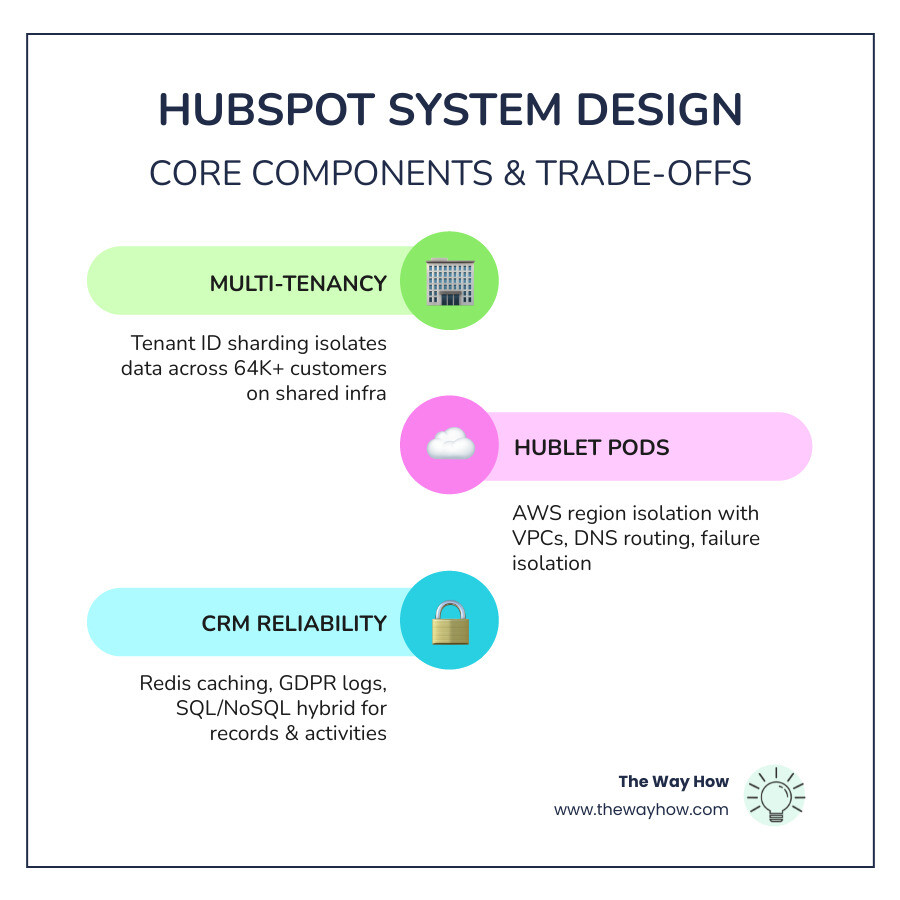
Simple guide to HubSpot system design:
When we look at how HubSpot builds software, we see a direct application of Conway’s Law: the idea that organizations design systems which mirror their own communication structures. At HubSpot, this results in a sprawling but highly organized microservices architecture. We are talking about over 1,200 different web services and dozens of static front-end apps.
The core unit of this philosophy is the small, autonomous team. Typically, a team consists of one tech lead and two developers, paired with a product manager and a designer. These teams own their functional areas end-to-end. If they build a service, they deploy it, monitor it, and fix it. This structure is designed to eliminate communication overhead and maximize iteration velocity.
This high-velocity environment is supported by a massive scale of infrastructure. There are more than 9,000 separately deployable units that can be scaled independently. The goal isn’t just to move fast; it is to focus on the user experience. As Mariah Muscato notes in her work on design systems, building a design system empowers teams to focus on people — not pixels. By standardizing the “how,” engineers are free to solve the “why” for the customer.
If you are stepping into a HubSpot interview, leave the “how many golf balls fit in a 747” brain teasers at the door. We find that HubSpot prioritizes practical, real-world problem-solving. They are less interested in what you have memorized and more interested in how you think through a complex HubSpot CRM Architecture.
Expect to use your own laptop. You will be encouraged to use the tools and resources you use every day, including Google. The interviewers are looking for clarity in your thought process. Can you verbalize your trade-offs? Can you identify edge cases? In system design rounds, you might be asked to design a high-level system like a video streaming service or a scheduling tool like Calendly, but the follow-up questions will quickly dive into SaaS-specific nuances like data isolation and API rate limiting.
Culture isn’t just a HR topic at HubSpot; it is baked into the code. The “Culture Code” emphasizes autonomy and ownership, which is why the HubSpot system design relies so heavily on internal tooling to provide a safety net.
We see this in the use of “Blazar,” their open-source build system, and the heavy reliance on feature flags (or gates). Feature flags allow developers to separate code deployment from feature release. A team can merge code into the primary branch, but keep the feature hidden until it is ready for a progressive rollout — first to the developer, then the team, then beta users, and finally all customers. This reduces the “blast radius” of any single change and allows for a “fail fast, learn faster” approach.
One of the most significant shifts in HubSpot’s history was the move from a single AWS region to a multi-region, “Hublet” (pod) architecture. Before July 2021, everything lived in AWS us-east-1. As the company grew, they needed to solve for data residency requirements (especially in the EU), improve global latency, and isolate failures so a regional outage wouldn’t take down every customer worldwide.
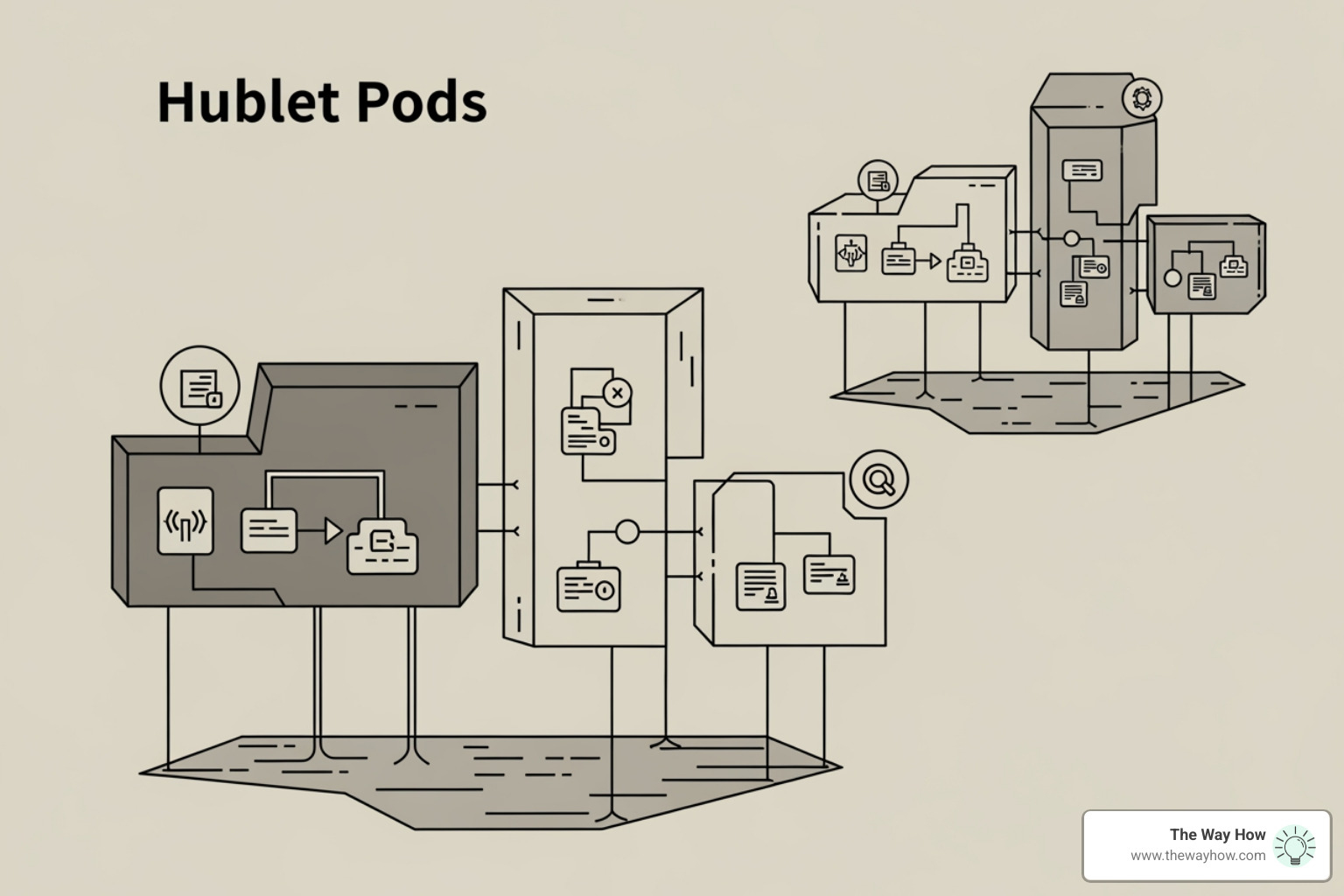
The solution was the “Hublet.” A Hublet is an independent, full copy of the HubSpot platform hosted in a single AWS region. Each Hublet serves a specific subset of customers and has its own AWS account, VPC, and databases. This ensures that an issue in “na1” (North America 1) does not impact “eu1” (Europe 1).
Implementing this was a Herculean effort. It required over 10,000 pull requests from nearly 1,000 engineers. This architecture allows HubSpot to scale by simply spinning up a new Hublet (like na2 or eu2) when an existing one reaches its capacity limits. For an engineer, this means you must design every HubSpot API and service to be “Hublet-aware,” ensuring data never accidentally crosses these regional boundaries.
Hublets are designed with strict guardrails. Each one is a “walled garden” with no cross-Hublet dependencies. This is achieved through:
In a multi-tenant environment, the biggest risk is data leakage — seeing another company’s contacts. HubSpot solves this by sharding data by Tenant ID. Every database query and service request is scoped to a specific portal or account ID.
To handle global consistency while maintaining regional speed, we see HubSpot using sophisticated MySQL replication and custom tools like “VTickets” for handling auto-increment IDs across regions. This ensures that even if data is moved or replicated, the primary keys remain unique and consistent. This level of detail is critical for accurate HubSpot Analytics across a global customer base.
When we talk about HubSpot system design, we have to address the “big three” challenges: bulk email, real-time notifications, and massive data ingestion. If you are preparing for an interview, a great resource to solidify these foundations is Grokking System Design Interview: Patterns & Mock Interviews.
For bulk email, the challenge is sending millions of messages without getting blacklisted. HubSpot uses Kafka-based queues to throttle delivery and manage rate limits per domain. They also implement sophisticated feedback loops to handle bounces and spam complaints instantly, protecting the sending reputation of all customers.
Designing a CRM data model is a classic HubSpot interview question. You have to manage complex relationships between Contacts, Companies, and Deals (one-to-many and many-to-many).
The consensus in HubSpot’s architecture is a hybrid SQL-NoSQL approach:
A major hurdle here is contact deduplication. HubSpot uses background jobs and fuzzy matching algorithms to identify potential duplicates. This is particularly challenging in a multi-tenant setup where you must ensure the deduplication logic only runs within the boundaries of a single tenant’s data. This is vital for HubSpot Transactional Email to ensure the right person gets the right message without being bombarded by duplicate entries.
HubSpot’s ecosystem thrives on integrations. Designing APIs for this scale requires a “compatibility-first” mindset. We see heavy use of OAuth 2.0 for secure authentication and robust API gateways for rate limiting.
When designing these APIs, engineers must account for:
Reliability at HubSpot scale means planning for the “unthinkable.” What happens if an entire AWS region goes dark? Their multi-region strategy includes global load balancing and the ability to gracefully degrade services. If the primary CRM database is slow, perhaps the UI allows read-only access to cached data so sales reps can still see their phone numbers.
Compliance is not an afterthought. With GDPR and SOC 2 requirements, every change to a customer record must be auditable. HubSpot often uses immutable data stores for logging, ensuring that there is a permanent, unchangeable record of who accessed or modified what data.
Caching is the secret sauce that makes a CRM feel fast. HubSpot uses multiple layers of caching to reduce database load.
| Caching Layer | Technology | Purpose |
|---|---|---|
| Metadata Cache | Redis | Storing account settings and user permissions |
| Query Cache | Memcached | Frequently accessed CRM lookups (e.g., “Get Contact by Email”) |
| Suppression Lists | Redis | Real-time check to see if an email should be blocked |
| CDN | Cloudfront | Static assets and front-end application code |
The biggest challenge here is cache invalidation. When a user updates a contact’s phone number, the cache must be invalidated across all services instantly to prevent the sales rep from seeing old data.
In a microservices environment, logging can become an enormous expense. HubSpot engineers have written extensively about “saving millions on logging” by optimizing what they store and how they store it. By moving to more efficient software architectures and using platforms like Mesos and Kubernetes for better server density, they manage the Cost of Goods Sold (COGS) effectively.
Monitoring is handled through tools like SignalFX, which visualizes Dropwizard metrics from the JVM. Every service has standard health checks, ensuring that the autonomous teams are alerted the moment their specific piece of the puzzle starts to fail.
Deduplication is handled via asynchronous background jobs. When a new contact is added, it is queued for a “fuzzy matching” service. This service uses tenant-specific indexing to compare the new record against existing ones within that specific portal. If a high-confidence match is found (based on email, name, or phone number), the system suggests a merge or follows pre-defined merging logic to combine the records while preserving activity history.
Kafka acts as the central nervous system for event data. When a lead visits a website or opens an email, that event is published to a Kafka topic. Various “consumer” services then process this stream in real-time — one service might update the contact’s “last seen” date, another might trigger a notification to a sales rep, and a third might pipe the data into a data warehouse for long-term HubSpot Analytics. Kafka provides the durability and low latency needed to handle billions of events per day.
Consistency is maintained through “Peer Communities” and standardized tooling. While teams are autonomous, tech leads participate in cross-team guilds to discuss high-level design patterns. Additionally, the use of a common build system (Blazar), a unified design system (Canvas), and standardized metrics (Dropwizard) ensures that even though 1,200 services exist, they all “speak the same language” and follow the same operational standards.
At The Way How, we believe that the best systems aren’t just technically sound; they are designed with a deep understanding of human behavior. Whether you are an engineer preparing for a HubSpot system design interview or a founder looking to scale your revenue operations, the goal is the same: removing uncertainty.
Technical architecture is simply a tool to create trust and momentum. When a system is reliable, fast, and intuitive, it allows the people using it to focus on what matters — building relationships and solving problems for their customers. We specialize in helping leadership teams bridge the gap between complex technical systems and predictable revenue growth.
If you are looking to Discover HubSpot’s Powerful Business Software or need help architecting a system that actually drives results, we are here to guide you. We diagnose the certainty gaps in your journey before we ever talk about tactics.
 Jeremy Wayne Howell : Jul 22, 2026 9:48:31 PM
 Jeremy Wayne Howell : Jul 21, 2026 9:47:10 PM
 Jeremy Wayne Howell : Jul 20, 2026 9:46:47 PM