

Your Customers Have Questions. SEO is How You Answer Them.

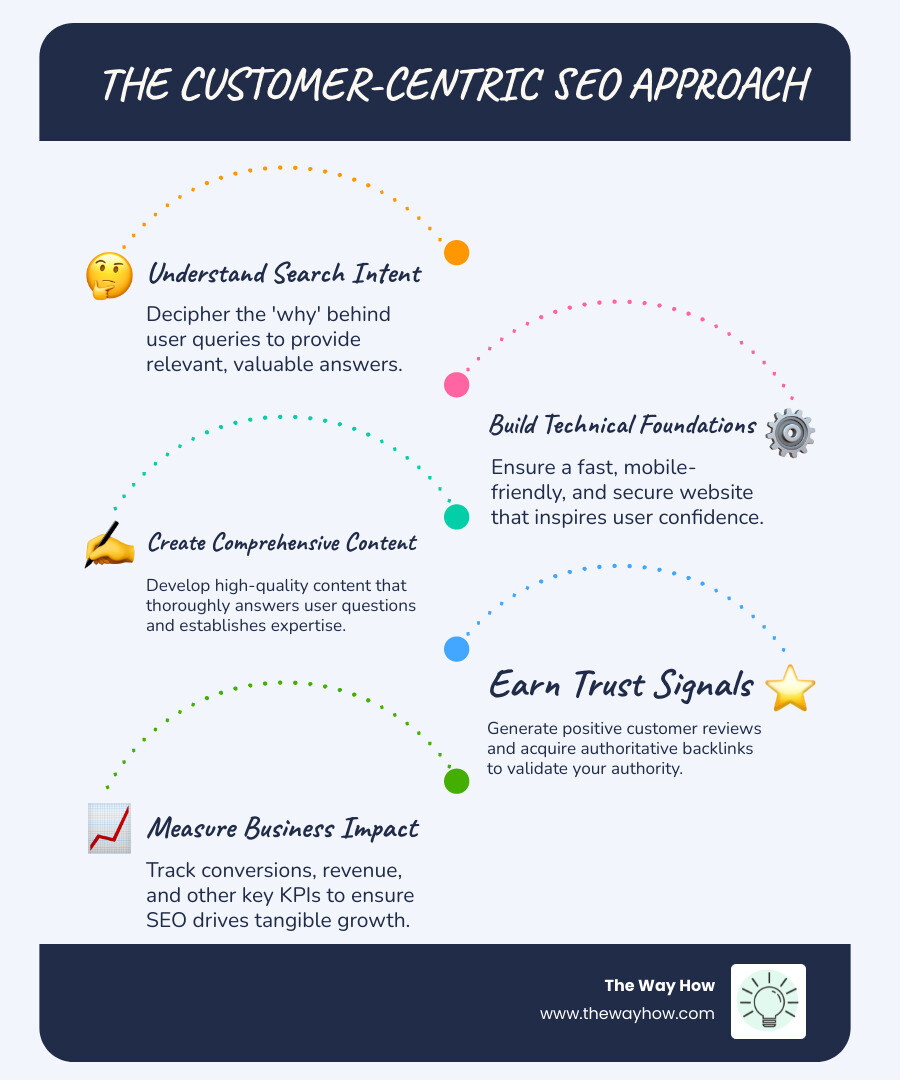
Internet business SEO is the practice of optimizing your online presence so that potential customers can find you when they search for solutions you provide. Here’s what matters most:
- Understand search intent - Know what your customer truly needs when they type a query
- Build technical foundations - Fast, mobile-friendly sites that inspire confidence
- Create comprehensive content - Answer questions completely, not superficially
- Earn trust signals - Reviews and backlinks validate your authority
- Measure business impact - Track conversions and revenue, not just rankings
The challenge most internet businesses face isn’t a lack of tactics. It’s a lack of clarity about why those tactics work.
When you built your website, you likely created it with your users in mind. But somewhere between launch and now, the focus shifted to pleasing algorithms instead of serving people. That’s where growth stalls.
Search engines exist to connect people with answers. Your job isn’t to trick the algorithm. It’s to become the most helpful, trustworthy answer available. When you do that, rankings follow naturally.
For every one click on a paid search result, organic results generate 8.5 clicks. Users trust earned visibility over bought visibility. They’re looking for businesses that understand their problem deeply enough to explain it clearly.
But here’s what most SEO advice misses: tactics without psychology create noise, not revenue. You can optimize meta descriptions and build backlinks all day. If you don’t understand the emotional and cognitive journey your customer is on, you’re just guessing.
I’m Jeremy Wayne Howell, and I’ve spent over 20 years helping businesses diagnose why their growth has stalled and rebuild strategies around buyer psychology and decision-making behavior. Throughout my career, I’ve seen that successful internet business SEO starts with understanding the human on the other side of the search bar before investing in any tactic or tool.
Diagnosis: Moving Beyond Keywords to Understand Customer Intent
The first step in any effective internet business SEO strategy is not about keywords, but about people. We believe that growth stalls when you lose sight of the human behind the search query. It’s not about tricking an algorithm; it’s about deeply understanding the psychology behind a search query to provide the clearest, most valuable answer. A purely tactical approach often fails because it neglects the fundamental human need for certainty and clarity. Our goal is to diagnose why a tactical approach might not be yielding results and to build a strategy rooted in human behavior.
Users searching for “near me” queries, for instance, often have a high purchasing intent. This isn’t just a keyword; it’s a signal of immediate need and a desire for a local solution, even if the business is online-only. The search engine’s role is to deliver personalized, local results, and our role is to ensure our online business is seen as the best, most relevant answer.
Decoding the “Why” Behind the Search
To truly excel at internet business SEO, we must decode the “why” behind every search. What problem is the user trying to solve? What emotions are driving their query? This goes beyond simply listing keywords; it requires analyzing search intent. We use search query analysis to uncover the underlying needs and questions. For example, a user searching for “best running shoes” has a different intent than “how to tie running shoes.” We focus on conversational keywords and question-based keywords, as these often reveal deeper user needs.
By analyzing competitors content and thoroughly analyzing Search Engine Results Pages (SERPs) for a given keyword, we can identify the type of content Google is already rewarding. Are they showing images, videos, shopping results, or informational articles? This insight helps us understand the user’s implicit intent. We need to become the “last click,” providing such complete and valuable information that users have no need to click on any other search result after finding ours. This level of user satisfaction is where true value is created.
The rise of AI in search further emphasizes the importance of clarity and direct answers. AI models are designed to summarize information, potentially reducing clicks to websites. To adapt, we must ensure our content is structured for AI summaries, using clear answers, labeled headings, and FAQs. We accept this shift by creating content that is not only useful for humans but also easily digestible by AI, enabling us to win “AI mentions” and maintain visibility.
Creating Content That Serves as the Definitive Answer
Once we understand the user’s intent, our focus shifts to creating content that genuinely serves as the definitive answer. This is where understanding how important is content quality for seo becomes paramount. Google explicitly states that content should be helpful, reliable, and people-first, often coming from expert or experienced sources. This concept is encapsulated in Google’s E-E-A-T guidelines (Experience, Expertise, Authoritativeness, Trustworthiness). While E-E-A-T isn’t a direct ranking factor, it’s a guiding principle for creating high-quality content that Google wants to surface. Our content should not just be “SEO content” – a phrase we believe implies a commodity separated from user value – but rather content that provides superior value and answers.
We strive for topical authority, which means demonstrating comprehensive knowledge and reliability on a specific subject. Building topical authority for your niche involves creating a web of interconnected content that covers all facets of a topic. This signals to search engines that we are a trusted source. Complete content, which fully satisfies a user’s query, offers supporting evidence, answers related questions, and provides quality supplemental content, is crucial. It’s not about content length, but completeness and value.

The Foundation: Building a Trustworthy Digital Experience
A website that is confusing, slow, or difficult to steer creates uncertainty and friction for users. This friction leads to abandonment, which sends negative signals to search engines. For an internet business SEO strategy to succeed, we must first ensure our digital home is a place of clarity and confidence. This means focusing on the foundational elements of on-page and technical SEO, not as mere checklist items, but as essential steps to build a seamless, trustworthy experience for users.
Structuring Your Site for Clarity and Confidence
The way your site is structured directly impacts how search engines crawl, index, and understand your content, and more importantly, how users experience it.
- URL Structure: We ensure our URLs are descriptive and user-friendly. A URL like
/running-shoes/mens/nike-air-zoomis far more helpful than/product?id=12345. How URL path structure can impact SEO and user experience is often underestimated. - Title Tags and Meta Descriptions: These are our first impression in the search results. They need to be compelling, accurate, and include relevant keywords to encourage clicks. We aim to influence how our site looks in Google Search by writing clear and accurate title links and unique, relevant meta descriptions.
- Header Tags (H1, H2, H3, etc.): A logical hierarchy of headings makes content scannable for both users and search engines. They help chunk content, improving readability and signaling topic importance.
- Internal Linking: Strategically adding internal links creates a web of topical relevance across our site. This helps users find more related content and distributes “link equity,” strengthening the authority of interconnected pages.
- Schema Markup: This structured data helps search engines understand the context of our content. Implementing schema for Article, Local Business (even for online-only businesses targeting specific regions), FAQ, or Product types can improve our listings with rich snippets, improving visibility and click-through rates. How schema markup can enhance on-page SEO is a critical component of modern SEO.
- Site Speed: While often considered a minor ranking factor, page speed can significantly impact bounce rates and conversion rates. Users expect fast loading times, and Google rewards sites that deliver a good page experience. We regularly check site speed on Google PageSpeed and optimize for Core Web Vitals to ensure a smooth user journey.
Optimizing for the Modern Searcher: Mobile and Voice
The way people search has evolved dramatically. Mobile devices dominate, and voice assistants are increasingly common. For effective internet business SEO, we must optimize for these modern search behaviors.
- Mobile-Friendliness: Google officially uses mobile-first indexing, meaning it primarily uses the mobile version of our content for indexing and ranking. If our site isn’t mobile-optimized, our rankings will suffer. This means responsive design, easy-to-use navigation, and visible calls-to-action on smaller screens.
- Voice Search Optimization: Voice search queries tend to be more conversational and question-based. We optimize for this by incorporating natural language, answering common questions directly within our content, and using FAQ schema. For example, instead of just “roof repair,” we might optimize for “how to fix a leaking shingle roof.” This also aligns with creating content that is easily summarized by AI, as voice search often leverages AI-driven answers.
The Local Paradox: Winning in Specific Markets as an Online-Only Business
There’s a common misconception that local SEO is exclusively for brick-and-mortar stores. However, for an internet business SEO strategy, local SEO is a powerful, often overlooked, tool. Even without a physical storefront, an online-only business can build immense trust and relevance by strategically targeting specific geographic areas where their customer base is concentrated. This allows us to connect with high-intent customers searching for solutions “near me” and stand out from global competition.
Why is local SEO crucial for eCommerce businesses, even without a physical store? Local SEO creates a stronger connection with customers in specific regions, making our brand feel more relevant and trustworthy. An online business selling handcrafted jewelry, for example, might notice a high concentration of sales from a particular city. By implementing local SEO for that city, they can tap into that existing demand more effectively. Users searching for “soy candles in Austin” have a clear, localized intent, and we want our online store to appear in those results. This is a key internet business SEO strategy.

Your Google Business Profile: The Digital Front Door
For online-only businesses, the Google Business Profile (GBP) can still play a vital role in local SEO. While we may not have a physical address, we can set up our GBP as a “service-area business.” This allows us to define the geographic regions we serve.
We optimize our GBP by:
- Choosing strategic service areas: Clearly indicating the cities, states, or regions where we want to attract customers.
- Adding detailed business descriptions and categories: Ensuring our services are accurately represented.
- Maintaining consistent business information: Though we don’t have a physical address, keeping our website URL, contact information, and hours (if applicable) consistent across all online platforms is crucial.
- Leveraging customer Q\&A and Google Posts: Engaging directly with potential customers and sharing relevant updates.
The GBP acts as a digital front door, even without a physical one, allowing us to appear in local search results and Google Maps when users search for our products or services within our defined service areas.
Creating Hyper-Relevant Local Content for Your Internet Business SEO
One of the most effective strategies for implementing local SEO for an eCommerce website is to create content that speaks directly to local audiences.
- Location-specific landing pages: We develop dedicated landing pages custom to specific cities or regions where we have a strong customer base or want to expand. These pages feature local keywords, region-specific offers, and even testimonials from customers in that area. For instance, an online fitness gear company might create a landing page for “premium yoga mats New York City.”
- Optimizing for local keywords: We integrate geographic locations into our product descriptions, meta tags, headers, and blog content. This means going beyond “running shoes” to “best running shoes for city running in Chicago.”
- Geo-targeted content: Our blog can feature articles relevant to specific locations, such as “Top 5 Hiking Trails in Colorado (and the Gear You’ll Need).” This not only attracts local searchers but also builds topical authority for that region.
- City-specific offers: Running promotions or offering free shipping specifically for customers in a target city can further improve local relevance and conversion rates.
By tailoring our website and content, we can effectively tap into local search results, even without a physical location, driving high-intent traffic to our online business.
Amplifying Authority: Earning Trust Signals Across the Web
In the digital landscape, trust isn’t just built on what you say about yourself; it’s validated by what others say about you. For an effective internet business SEO strategy, earning powerful trust signals like customer reviews and backlinks is paramount. These aren’t just checklist items; they are the tangible results of providing genuine value that others want to endorse. This forms the core of off-page SEO, which focuses on activities outside your website to improve its credibility and authority.
Leveraging Customer Reviews as Social Proof
Customer reviews are powerful social proof. According to Forbes, between 80-90% of customers now check online reviews prior to making a purchase. Positive feedback, especially from customers in the areas we target, improves visibility and reassures new customers.
We implement a strategic review generation process:
- Encourage reviews: We follow up with customers after purchases, providing easy links to leave reviews on relevant platforms.
- Respond to all reviews: Whether positive or negative, responding shows we value customer feedback and are engaged. This also helps manage any uncertainty for potential customers.
- Display reviews prominently: We integrate customer testimonials and reviews directly onto our product pages and location-specific landing pages.
Earning Backlinks Through Value and Partnerships
Backlinks—links from other credible websites to ours—are like votes of confidence. They signal to search engines that our content is valuable and authoritative. Building high-quality backlinks is a cornerstone of any strong internet business SEO strategy.
- Local backlinks: Even as an online-only business, we can earn local backlinks. This involves partnering with local influencers, collaborating with regional businesses, or getting featured in local online publications. For instance, an online store selling sustainable home goods might partner with a local eco-friendly blog for a product review and a backlink.
- Digital PR: We create “linkable assets” – valuable content like original research, infographics, or in-depth guides – that journalists and bloggers want to link to. We then use strategies like outreach campaigns to promote this content.
- Influencer partnerships: Collaborating with relevant influencers or industry experts can lead to valuable mentions and backlinks.
- Niche directories: Listing our business in relevant, high-quality online directories, even if they are not strictly “local” in the physical sense, can still provide valuable signals.
We also conduct regular backlink audits to ensure the quality of our backlink profile and identify new opportunities. The goal is to earn links that genuinely reflect our expertise and value, rather than chasing quantity over quality.
Measuring What Matters: From Rankings to Revenue
In internet business SEO, the ultimate goal isn’t just to rank #1 for a vanity keyword; it’s to generate predictable revenue and foster sustainable growth. We believe in connecting every SEO effort to tangible business outcomes, moving beyond surface-level metrics to measure the actual impact on our bottom line. This approach brings clarity to our marketing investments and transforms SEO from a cost center into a predictable growth engine.
Key Performance Indicators for a Successful Internet Business SEO Strategy
To measure the success of our local SEO efforts and overall internet business SEO strategy, we focus on KPIs that directly align with our business objectives:
- Organic Traffic: This is the foundation – how many users find our site through unpaid search results. We track not just total visits but also the quality of this traffic, looking at metrics like time on page and bounce rate.
- Keyword Rankings: While not the sole focus, tracking our position for target keywords, especially local and long-tail ones, helps us understand our visibility. We use rank tracking tools to monitor progress.
- Click-Through Rate (CTR): This measures how often users click our listing in the search results. A high CTR indicates that our titles and meta descriptions are compelling and accurately reflect user intent.
- Conversion Rate: This is perhaps the most critical metric. Are users who arrive from organic search completing desired actions, such as making a purchase, signing up for a newsletter, or filling out a contact form? This is how we truly measure our internet business SEO effectiveness.
- Return on Investment (ROI): By attributing revenue directly to organic search, we can calculate the ROI of our SEO efforts, ensuring they contribute positively to our financial health.
We use tools like Google Analytics and Google Search Console to gather these critical data points, allowing us to make data-driven decisions.
Connecting SEO Efforts to Business Goals
To truly connect SEO efforts to business goals, we look beyond simple traffic numbers.
- Goal Completions: We set up specific goals in Google Analytics 4 (GA4) to track key user actions on our site, such as “product added to cart,” “checkout initiated,” or “contact form submission.” How to set up and track custom events in Google Analytics 4 is essential for this.
- Assisted Conversions: We understand that SEO often plays a role in the customer journey even if it’s not the last touchpoint. GA4 helps us see when organic search “assists” in conversions that might ultimately be attributed to another channel. This provides a more holistic view of SEO’s value.
- Customer Lifetime Value (CLTV): By understanding the long-term value of customers acquired through organic search, we can better assess the enduring impact of our internet business SEO strategy. This helps us move beyond short-term gains and focus on sustainable growth.
- Business Data Analysis: We regularly integrate our SEO performance data with broader business data analysis to identify trends, opportunities, and areas for improvement. This ensures our SEO strategy is always aligned with our overall business objectives.
From Uncertainty to a Predictable Growth Engine
Effective SEO is not a dark art; it is a system for creating clarity. By focusing on the psychology of your customer, building a trustworthy digital experience, and measuring what truly drives growth, you transform your online presence from a source of uncertainty into a predictable engine for revenue. It’s about being the right answer, at the right time, for the right person.
At The Way How, we specialize in helping businesses diagnose why growth is stalled and design marketing systems rooted in human behavior, empathy, and decision-making psychology. We believe that when you remove uncertainty from your sales and marketing, you create trust, momentum, and predictable revenue.
Discover how our strategic services can remove uncertainty from your marketing.