

Beyond the Dashboard: Why Your Marketing Feels Like a Black Box

A marketing system audit is a structured, objective evaluation of your entire marketing function — not just individual channels or campaign metrics, but the full system: strategy alignment, team structure, technology, messaging, and how all of it connects to revenue.
Quick answer: What is a marketing system audit?
Most marketing leaders aren’t flying blind because they lack data. They’re flying blind because they have too much disconnected data and no clear picture of how the pieces interact.
Clicks are up. Leads look decent. But revenue isn’t moving.
That gap — between marketing activity and business outcomes — is almost never a channel problem. It’s a system problem.
The research backs this up. Businesses that conduct regular marketing audits see an average 20% increase in marketing ROI. B2B companies have reported up to 35% more qualified leads after auditing their digital channels. And 67% of audited firms that optimized their CRM integrations cut lead response times by an average of 42%.
But the audit only works if it goes deep enough to find why the system is leaking — not just where the numbers look bad.
I’m Jeremy Wayne Howell, founder of The Way How and a revenue growth strategist with over 20 years of experience diagnosing broken marketing and sales systems through a psychology-first marketing system audit framework. If you’ve ever had the feeling that “the tactics are working on paper, but revenue isn’t moving,” this guide is built exactly for that moment.
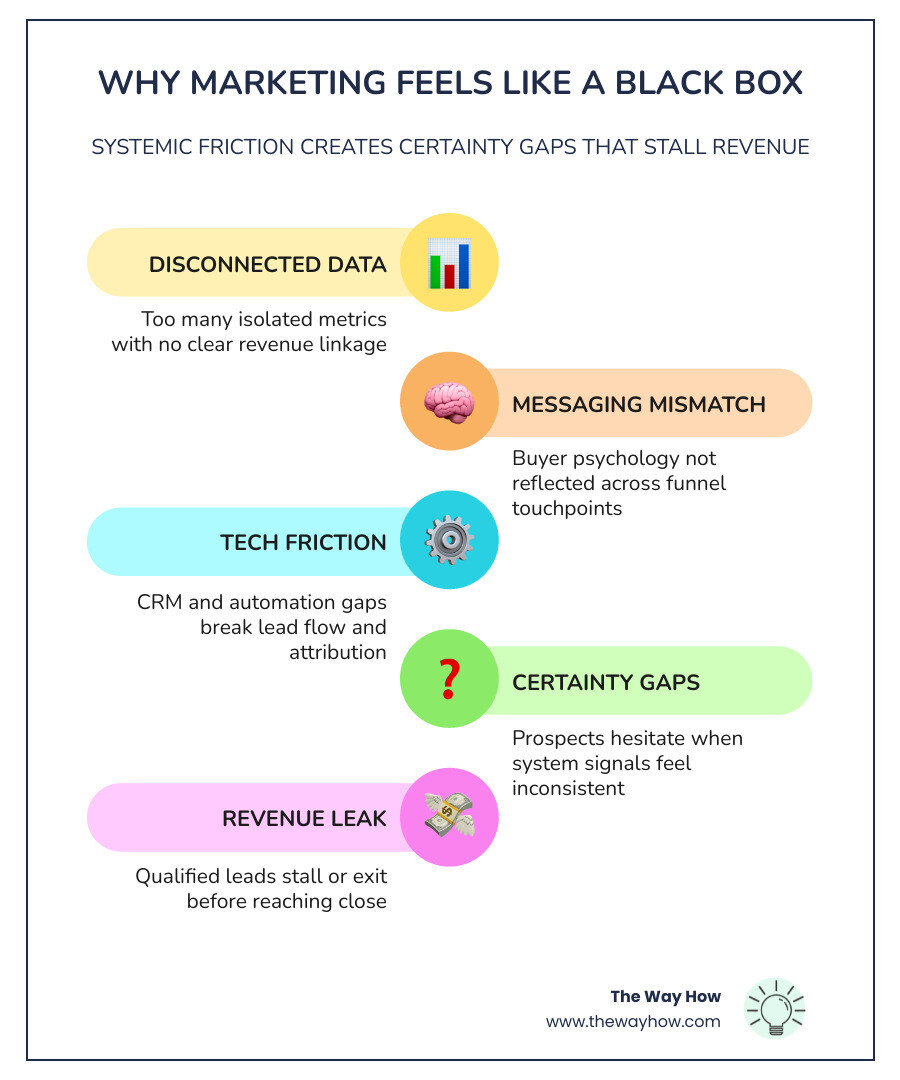
When we look at a typical marketing dashboard, we see a collection of isolated metrics: click-through rates, cost-per-lead, and organic traffic growth. It looks impressive on a slide deck. Yet, beneath the surface, a quiet anxiety lingers. Founders and executive teams frequently tell us they feel a profound sense of uncertainty. They are spending money, but they cannot confidently point to which investments are directly driving revenue.
This uncertainty exists because traditional reporting treats marketing as a series of independent activities rather than an interconnected system. When growth stalls, the default reaction is often tactical. We might think we need to write more blog posts, launch another paid ad campaign, or buy a new software tool.
In reality, the problem is rarely a lack of tactics. It is systemic friction. Your prospects do not experience your brand in isolated silos. They move from an ad to a landing page, read a piece of content, receive an email, and eventually speak with a sales representative. If there is a mismatch in the messaging, or if data fails to pass cleanly between your marketing automation and your CRM, the buyer experiences a certainty gap. They hesitate, lose momentum, and quietly exit your funnel.
To solve this, we must look past the surface-level symptoms and focus on the structural root causes of underperformance.
What is a Marketing System Audit?
A marketing system audit is a comprehensive, objective diagnostic of your entire marketing ecosystem. Unlike a standard marketing review, which merely describes what happened in a specific channel over the past quarter, a system audit is prescriptive. It evaluates the structural capability of your marketing function to deliver on your long-term business goals.
To understand this distinction, we can look at how we define the baseline. According to HubSpot’s guide on What’s a Marketing Audit? [+ How To Do One], a standard audit looks at campaigns, channels, and assets to check for consistency and performance. A true system audit, however, goes a step further by evaluating the underlying infrastructure, data integrity, and human processes that power those campaigns.
This aligns closely with a modern Revenue Operations Strategy. We are not just asking if an ad is performing; we are asking if the system is designed to turn that initial attention into predictable revenue.
| Evaluation Dimension | Standard Marketing Audit | Comprehensive Marketing System Audit |
|---|---|---|
| Focus | Channel-specific performance (e.g., CTR, CPC, impressions). | Interconnected system capability and revenue contribution. |
| Nature | Descriptive (explains what occurred). | Prescriptive (diagnoses why it occurred and how to fix it). |
| Tech Stack | Individual tool usage and basic setup. | Platform architecture, data flow, and CRM integration. |
| Goal | Optimize immediate campaign tactics. | Align marketing, sales, and technology with business growth. |
| Outcome | A list of tactical recommendations for creative or spend. | A prioritized 90-day strategic roadmap with quantified revenue impact. |
Strategic Alignment in a Marketing System Audit
The foundation of any effective system is strategic alignment. During this phase of the audit, we step away from the software and look at the fundamental business assumptions. We begin by validating your Ideal Customer Profile (ICP). Is your current target audience definition accurate, or has your market shifted?
We also examine your positioning. In competitive markets, differentiation is your strongest asset. If your messaging does not clearly articulate why you are the obvious choice, your campaigns will struggle regardless of how much budget you allocate. By designing Data-Driven Marketing Strategies, we ensure your positioning is backed by actual customer behavior and decision-making psychology, removing the guesswork from your messaging.
The Functional and Technical Levels of a Marketing System Audit
Once strategy is aligned, the audit moves into the functional and technical layers.
At the functional level, we evaluate how your marketing is organized and resourced. Is your team structured to support the buyer journey, or are they working in silos? We look at budget allocation to ensure resources are distributed proportionally to your highest-leverage opportunities, rather than simply repeating last year’s plan.
At the technical level, we dive deep into your tech stack. We analyze your Marketing Analytics Solutions to verify data integrity. This is where we often find critical issues: broken tracking codes, duplicate lead records, and misconfigured attribution models. We pay special attention to your CRM integration — particularly within platforms like HubSpot — to ensure that the handoff between marketing and sales is seamless and that lead routing rules are functioning correctly.
Diagnosing the Leaks: How Systems Waste Budget and Momentum
Inefficiency is a silent killer of marketing budgets. When systems are disconnected, money leaks through the cracks of your funnel without anyone noticing.

The most common area for wasted spend is in the transition from marketing-generated interest to sales conversations. We often see organizations spending tens of thousands of dollars on paid acquisition, only to have those hard-won leads sit unattended in a database due to a broken CRM routing rule or an undefined sales handoff process.
Through rigorous Marketing Data Analysis, we can pinpoint these exact drop-off points. We calculate your true lead-to-close conversion rates and trace them back to specific channels. This process exposes attribution gaps, showing you where you might be over-investing in channels that generate high click volumes but zero closed-won revenue.
Auditing Content and Search Visibility
Content is a powerful asset, but only if it serves a clear strategic purpose. A thorough audit must evaluate how your content performs across the entire customer journey. We begin by conducting a How to Perform Content Gap Analysis to identify where you are missing critical educational or trust-building assets that prospects need to make a buying decision.
Next, we look at search visibility from multiple technical angles:
- We run a How to Perform an On-Page SEO Audit on a Page process to ensure your high-value pages are technically optimized for search crawlers.
- We execute a How to Perform a Backlink Audit on Your Website to assess your domain authority and identify any toxic links that might be suppressing your visibility.
- We perform a How to Perform a URL Audit on Your Site to clean up site structure, redirect loops, and broken pages.
In May 2026, we must also audit for Answer Engine Optimization (AEO). With the rapid rise of AI-powered search engines, your prospects are increasingly asking complex questions directly to AI assistants. Our audits assess how visible your brand is within these AI search summaries, ensuring your content is structured in a way that AI models can easily parse, synthesize, and cite.
Analyzing Competitors and Market Context
No marketing system operates in a vacuum. To build a system that wins, we must understand the competitive landscape. We use structured methodologies to How to Analyze Competitors Content, looking not just at what keywords they target, but how they position their brand and address customer pain points. This analysis helps us find positioning white space — angles of communication and market needs that your competitors are completely ignoring, allowing you to establish clear differentiation.
The Step-by-Step Diagnostic Process
To turn a complex system audit into an actionable business asset, we follow a structured, phased methodology. This ensures we don’t just hand you a list of problems, but rather a clear, prioritized path forward.

Every step of this process relies on rigorous Business Data Analysis. We validate your data sources at the beginning of the project to ensure that every recommendation we make is grounded in clean, indisputable facts.
Phase 1: Discovery and System Mapping
We begin by gathering context. We conduct interviews with key stakeholders across marketing, sales, and customer success to understand where they experience friction. We then map your entire system architecture: how data flows from your website, through your marketing automation, and into your CRM.
During this phase, we secure read-only access to your primary platforms (such as GA4, Google Search Console, HubSpot, and your ad accounts) to verify that what is happening in reality matches the documented processes.
Phase 2: Analysis and Quantification
With the system mapped and data validated, we begin the diagnostic work. We analyze channel performance, evaluate technical integrations, and review messaging alignment.
Crucially, we do not just list issues; we quantify them. If we find a bottleneck in your lead nurturing sequence, we calculate exactly how much revenue that bottleneck is costing your business. If we find wasted ad spend on non-converting terms, we attach a specific dollar amount to that waste. This quantification changes the conversation from “what we think we should fix” to “what we must fix first based on financial impact.”
Phase 3: The 90-Day Actionable Roadmap
The final phase of the audit is translating findings into action. We organize our recommendations into a clear impact-effort matrix, dividing the work into two distinct categories:
- Quick Wins: Highly impactful, low-effort adjustments that can be executed within the first 30 days (e.g., correcting a broken lead-routing workflow or pausing wasted ad spend).
- Strategic Projects: Larger initiatives that require more coordination but deliver long-term systemic value (e.g., restructuring your HubSpot architecture or redesigning your core messaging framework), mapped out over a 60-to-90-day roadmap.
Common Pitfalls to Avoid When Evaluating Your Systems
Conducting an audit is a major step forward, but many organizations fail to realize the full value because of a few common missteps:
- Self-Audit Bias: It is incredibly difficult to objectively evaluate a system you built or manage daily. Internal teams often suffer from blind spots, overlooking structural issues because “that’s just how we’ve always done it.”
- Focusing on Vanity Metrics: Measuring success by impressions, clicks, or raw lead volume without connecting those numbers to pipeline value and actual revenue.
- Treating Symptoms Instead of Root Causes: Assuming a drop in conversions is an ad creative problem, when the actual issue is a slow website load time or a confusing CRM handoff process.
- Channel-Only Focus: Auditing SEO, paid search, or social media in isolation without evaluating how those channels interact as a unified system.
Frequently Asked Questions About Marketing System Audits
How often should we conduct a marketing system audit?
We recommend conducting a comprehensive, horizontal marketing system audit annually. This ensures your strategy, technology, and team structure remain aligned with your evolving business goals.
Additionally, we suggest running lightweight, channel-specific audits quarterly. You should also trigger an immediate audit if you experience key performance indicators dropping for two consecutive quarters, if you are planning a major platform migration, or if a new marketing leader is taking over the function.
What is the difference between a marketing audit and a marketing analysis?
A marketing analysis is descriptive and retrospective. It looks at a specific set of data to tell you what happened (e.g., “our organic traffic decreased by 15% last month”).
A marketing system audit is prescriptive and forward-looking. It evaluates the entire system to explain why something happened, assesses whether the current infrastructure is capable of hitting future goals, and provides a structured, actionable plan for what to do next.
How much does a professional marketing system audit cost and how long does it take?
A professional, outsourced marketing system audit typically takes between 2 to 4 weeks, depending on the complexity of your tech stack and the number of channels being reviewed.
For mid-market and B2B companies, the typical investment ranges from $4,000 to $15,000. This investment covers the discovery, technical validation, data analysis, and the creation of the prioritized 90-day roadmap.
Restoring Certainty to Your Growth Engine
At The Way How, we believe that most businesses do not have a marketing problem — they have a visibility and system problem. When your systems are fragmented, your leadership team operates in a state of constant, quiet anxiety, guessing which tactics will finally move the needle.
We help founders and leadership teams remove that uncertainty. As a psychology-first marketing and revenue strategy firm, we look past the superficial metrics to design systems that create genuine trust, momentum, and predictable revenue. By blending strategic clarity, deep behavioral insight, and precise operational execution in HubSpot, we turn your marketing from a black box into a dependable growth engine.
If you are ready to stop guessing and start building a high-performing, predictable revenue system, Explore our strategic marketing services and let’s discuss how we can restore certainty to your growth journey.