

The Psychology of Speed: Why Every Millisecond is a Trust Signal

Pagespeed optimization is the practice of improving how quickly your website loads, responds to user input, and stays visually stable — so visitors stay, engage, and convert instead of leaving.
Here’s what it covers at a glance:
| Goal | What to Fix |
|---|---|
| Faster loading | Image compression, CDNs, caching |
| Better responsiveness | Defer scripts, reduce JavaScript |
| Visual stability | Reserve space for images and ads |
| Stronger SEO | Hit Core Web Vitals benchmarks |
| Higher conversions | Reduce friction at every step |
Speed isn’t just a technical metric. It’s a trust signal.
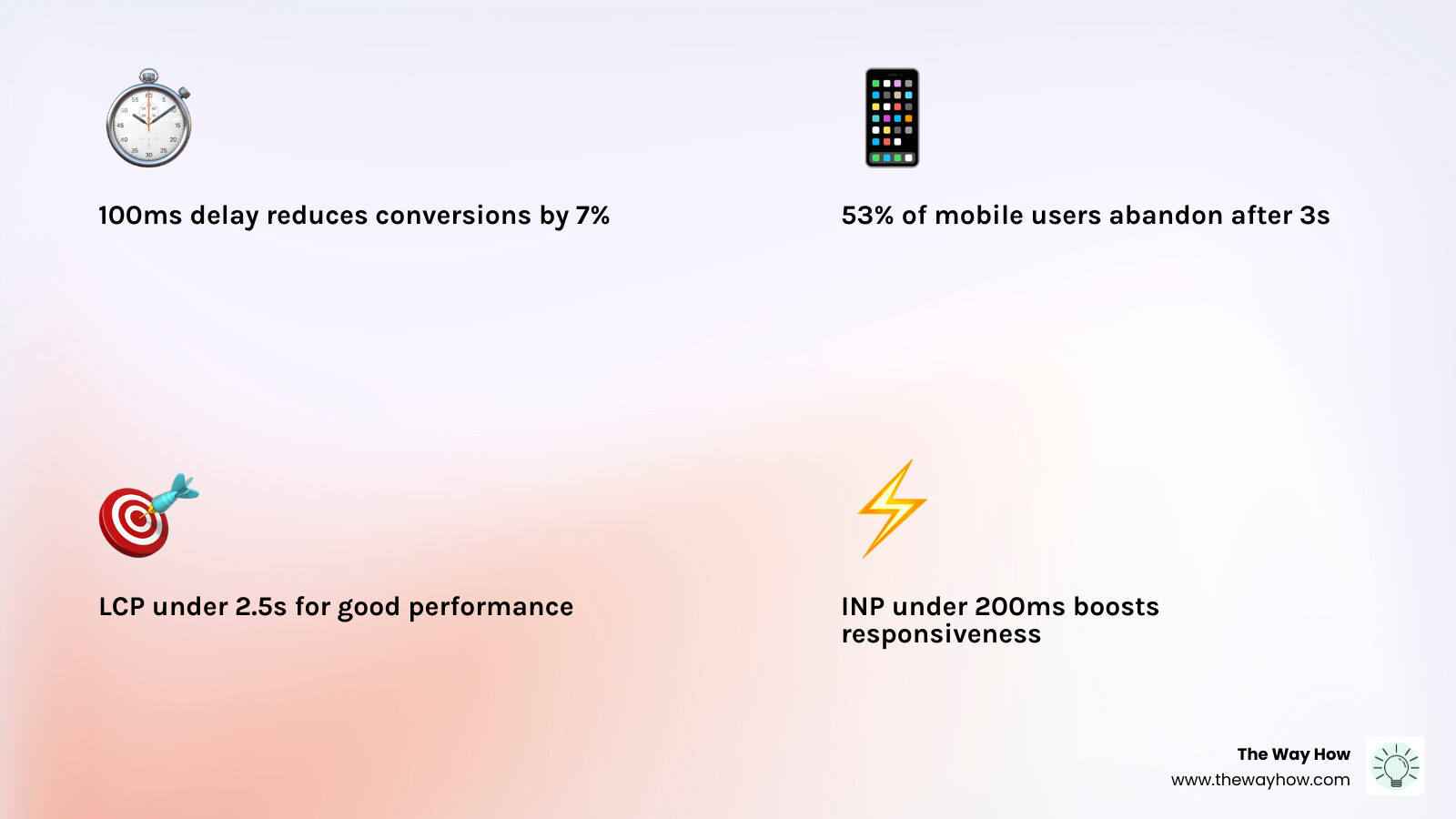
When a page loads slowly, visitors don’t think “this site has server issues.” They feel something is off — and they leave. Research shows that a delay of just 100 milliseconds can reduce conversion rates by seven percent. More than half of mobile visitors will abandon a page that takes longer than three seconds to load.
That’s not impatience. That’s human psychology.
The brain interprets friction as risk. A slow page creates a small but real moment of uncertainty — and uncertain buyers don’t convert. They bounce. Then they go to your competitor.
For founders and revenue leaders, this matters beyond UX. Slow pages quietly drain the return on every dollar spent on ads, content, and sales. You can have the right message, the right offer, and the wrong load time — and still lose the customer.
I’m Jeremy Wayne Howell, founder of The Way How and a revenue growth strategist with over 20 years of experience helping businesses identify and fix the hidden friction points that stall growth — including technical issues like pagespeed optimization that most leadership teams overlook until revenue is already impacted. In the sections ahead, we’ll move from the psychology of speed to the concrete systems — starting with one of the most powerful delivery tools available: CDNs.
Decoding the Core Web Vitals: Your 2026 Performance Benchmarks
In 2026, we no longer guess if a website is “fast enough.” We measure it through Core Web Vitals (CWV). These are the specific metrics Google uses to quantify the user experience. They aren’t just arbitrary numbers; they are proxies for human frustration. If your site fails these benchmarks, you aren’t just losing SEO rankings—you are losing the psychological battle for your customer’s attention.
To understand how these metrics influence your growth, it is helpful to look at Understanding How Page Speed Impact SEO Strategies. Search engines like Google and Ecosia prioritize sites that respect the user’s time.
The data we use to track these vitals comes in two forms: Lab Data and Field Data. Lab data is gathered in a controlled environment (like a developer’s desk), while Field Data—often sourced from the Chrome User Experience Report (CrUX)—reflects what real users actually experience on their varied devices and connections.
For a deep dive into how to pull these reports yourself, see our guide on How to Check Site Speed on Google PageSpeed.
The Thresholds for Snappy Pagespeed Optimization
To maintain a competitive edge and minimize abandonment, we aim for the following “Good” thresholds:
- Largest Contentful Paint (LCP): This measures loading performance. To provide a good user experience, LCP should occur within 2.5 seconds of when the page first starts loading. Anything beyond 4 seconds is considered sluggish.
- Interaction to Next Paint (INP): This is the new gold standard for responsiveness in 2026. It measures how quickly the page responds to a user’s click or keypress. Aim for 200 milliseconds or less. If it takes longer than 500ms, the user feels a “lag” that creates immediate cognitive friction.
- Cumulative Layout Shift (CLS): This measures visual stability. Have you ever tried to click a button only for the page to jump, causing you to click an ad instead? That is a high CLS. We aim for a score of 0.1 or less.
- First Contentful Paint (FCP): This is the moment a user sees the first sign of life on your screen. Ideally, this happens in 1.8 seconds or less.
When these metrics are optimized, the “uncertainty gap” closes. The user feels safe, the brand feels professional, and the path to conversion remains clear. You can find more technical documentation on these standards at Fast load times | web.dev.
Accelerating Delivery with CDNs and Edge Infrastructure
One of the most effective ways to achieve rapid pagespeed optimization is by closing the physical distance between your data and your user. This is where a Content Delivery Network (CDN) becomes essential.

A CDN is a geographically distributed group of servers that work together to provide fast delivery of internet content. Without a CDN, every visitor—whether they are in New York or Tokyo—must request data from your “origin server” (where your website is hosted). If that server is in London, the Tokyo user experiences a massive delay known as latency.
By using a CDN, you leverage “Edge Infrastructure.” Your static assets—images, CSS, and JavaScript—are cached on servers located at the “edge” of the network, closer to the user. This significantly improves Time to First Byte (TTFB).
Furthermore, modern CDNs allow for server-side rendering (SSR) at the edge. Instead of the user’s browser doing all the heavy lifting to build the page (which can be slow on mobile devices), the edge server prepares the page and sends it over nearly complete. This reduces the processing load on the user’s device and slashes LCP times. To explore more about how Google views these infrastructure improvements, visit Make the Web Faster | Google for Developers.
A Strategic Framework for Pagespeed Optimization
While CDNs handle the delivery, we must still address the “weight” of what we are delivering. A strategic framework for pagespeed optimization balances technical efficiency with the psychological need for high-quality visuals.
| Metric Type | Lab Data (Controlled) | Field Data (Real-World/CrUX) |
|---|---|---|
| Purpose | Debugging and testing new features | Measuring actual business impact |
| Environment | Fixed device and network speed | Diverse devices, locations, and speeds |
| Value | Immediate feedback for developers | Accurate reflection of user frustration |
The heaviest part of most modern pages is imagery. Statistics show that GIF, PNG, and JPEG formats make up 96% of the entire internet’s image traffic. Most of this is unoptimized. To fix this, we use the WebP or AVIF formats, which provide superior compression without losing visual quality.
We also implement “lazy loading,” a technique where images below the fold are only loaded when the user scrolls down to them. This ensures the “Above the Fold” content—the stuff the user sees first—loads instantly. For a step-by-step implementation, refer to How to Optimize Images for Web: A Step-by-Step Guide for Better Site Performance.
Eliminating Friction through Technical Pagespeed Optimization
Beyond images, we must streamline the code itself. Render-blocking resources are the primary culprits behind slow FCP and LCP scores. These are scripts or stylesheets that stop the browser from showing the page until they are fully downloaded.
We solve this through:
- Minification: Removing unnecessary spaces and comments from code.
- Script Deferral: Using the
deferorasyncattributes so that non-essential JavaScript doesn’t stop the page from rendering. - Critical CSS: Identifying the exact CSS needed to show the top of the page and inlining it, while pushing the rest of the stylesheet to load later.
- Resource Hints: Using
preconnectordns-prefetchto tell the browser to start making connections to third-party domains (like Google Fonts or CDNs) before it even needs them.
If you are running a specific platform, our guide on How to Optimize WordPress to Speed Up Your Website provides tailored steps for these techniques.
Measuring Success: Tools for Continuous Pagespeed Optimization
Optimization is not a one-time event; it is a discipline. To maintain momentum, we use a suite of tools to monitor performance:
- PageSpeed Insights (PSI): The gold standard for seeing how Google views your site. It combines Lighthouse lab data with real-world CrUX data.
- GTmetrix: Excellent for “Waterfall Visualizations,” which show you exactly which file is causing a bottleneck.
- Pingdom: Useful for monitoring uptime and seeing how different server response codes (2xx, 3xx, 4xx) are impacting your speed.
We recommend setting a “performance budget.” For example, we might decide that our homepage must never exceed 2MB in total weight or that our INP must stay under 200ms. If a new marketing script pushes us over that budget, we don’t just accept it—we diagnose and optimize. You can explore more about these tools at PageSpeed Tools | Google for Developers.
Common Pitfalls That Stall Digital Momentum
In our work at The Way How, we often find that the biggest speed killers aren’t the primary site files, but the “invisible” additions made over time.
The most common pitfalls include:
- Third-Party Script Bloat: Every tracking pixel, chat widget, and heat-map tool adds a “tax” to your page speed. If you have 15 pixels firing on page load, your INP will suffer.
- Font Service Overuse: Loading five different weights of a custom web font can add hundreds of kilobytes to your load time. We suggest using system fonts or limiting custom fonts to just one or two essential styles.
- Google Tag Manager (GTM) Mismanagement: While GTM is powerful, it can become a graveyard for old, unused scripts. We regularly audit GTM to ensure only essential tags are firing.
- Lack of Mobile Focus: Many teams optimize for desktop and assume mobile will follow. In reality, mobile devices have slower processors and less stable connections. A page that feels “fine” on a Macbook Pro might be unusable on an older smartphone.
To ensure your site remains accessible and fast for everyone, check our resources on How to Layout is Mobile Optimized.
Frequently Asked Questions about Website Performance
What is the most common cause of slow mobile pages in 2026?
The primary cause remains unoptimized media. High-resolution images meant for 27-inch monitors are often served to 6-inch phone screens. This is compounded by excessive JavaScript execution, which drains mobile batteries and causes the browser to “freeze” while processing. For mobile-specific fixes, see How to Optimizing Images for Mobile.
How does Interaction to Next Paint (INP) affect my revenue?
INP is a direct measure of “click-to-action” friction. If a user clicks “Add to Cart” and the site hangs for half a second before showing a confirmation, the user’s brain registers a micro-moment of failure. This leads to frustration and decreased trust. High INP scores are almost always correlated with lower conversion rates in checkout flows.
Can a CDN replace the need for on-site code optimization?
No. A CDN makes the delivery of your files faster, but it doesn’t make the files themselves any smaller or more efficient. Think of it like this: a CDN is a faster delivery truck, but if you’re trying to deliver a ton of lead, the truck still has to work hard. You need both a fast truck (CDN) and a lighter package (code optimization) to win.
Restoring Certainty to Your Digital Growth Engine
At The Way How, we believe that marketing shouldn’t be a source of anxiety or a series of “best guesses.” When growth stalls, it’s rarely because of a lack of effort—it’s because of a lack of clarity.
We help founders and leadership teams remove the uncertainty from their sales and marketing systems by applying behavioral insights to technical operations. Whether it’s fixing the psychological friction of a slow-loading page through pagespeed optimization or architecting a HubSpot system that actually drives revenue, our goal is to create trust and momentum.
We don’t just chase tactics; we design dependable growth engines. If you’re ready to move past surface-level tips and build a system rooted in human psychology and operational excellence, we’re here to guide you.