
The Certainty Gap in the Age of Algorithmic Speed

The AI software development process has fundamentally changed how software gets built — and most teams are still catching up.
Here’s what you need to know upfront:
What is the AI software development process?
The AI software development process is a structured, data-driven methodology for building intelligent applications that learn from data, automate decisions, and improve over time. Unlike traditional development, it replaces hard-coded rules with trained models — and wraps the entire lifecycle around continuous iteration.
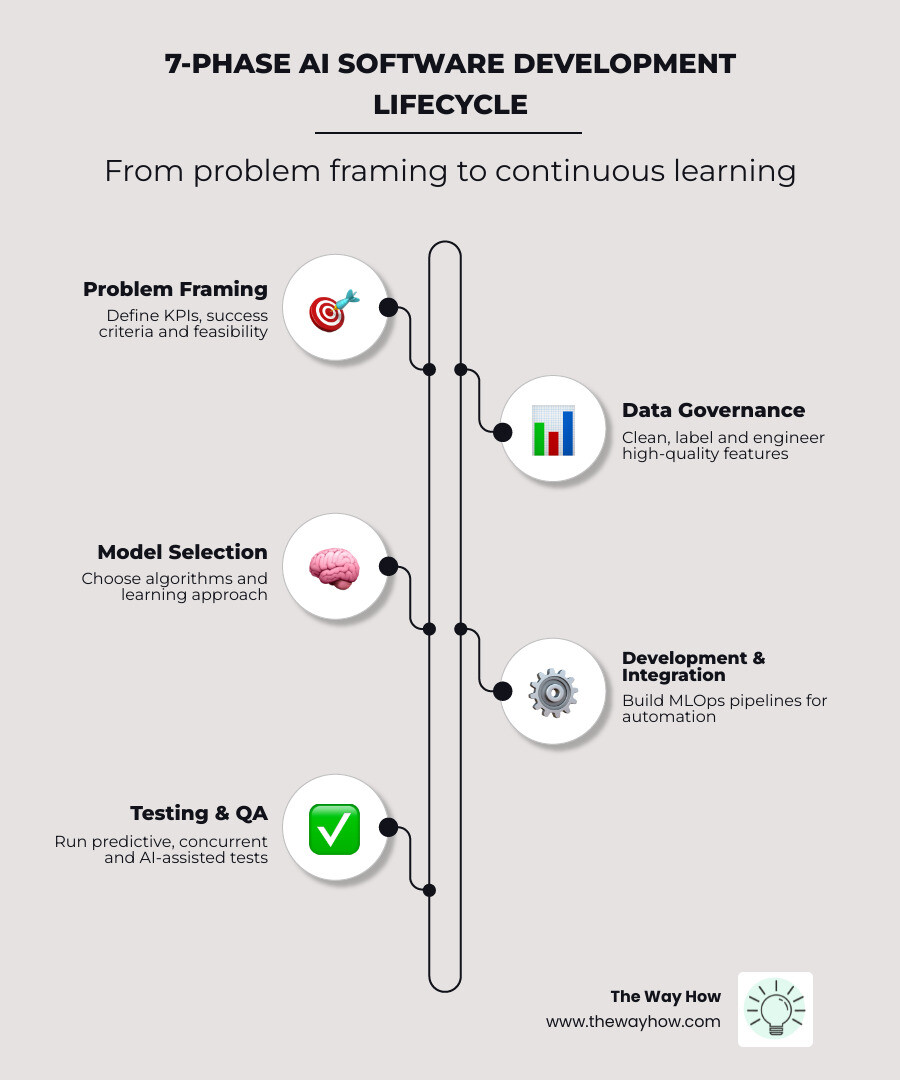
The 7 core phases at a glance:
- Requirement Analysis & Problem Framing — Define the business problem, success metrics, and data requirements
- Data Collection & Preparation — Gather, clean, label, and govern structured and unstructured data
- Model Selection & Design — Choose the right algorithm and learning approach for the problem
- Development & Integration — Build, integrate, and implement MLOps pipelines for automation
- Testing & Quality Assurance — Run predictive, concurrent, and AI-assisted QA across scenarios
- Deployment & Monitoring — Ship to production using containerization, CI/CD, and health checks
- Maintenance & Continuous Learning — Retrain models, close feedback loops, and prevent data drift
How it differs from traditional software development:
| Dimension | Traditional SDLC | AI-First Process |
|---|---|---|
| Logic source | Hard-coded rules | Learned from data |
| Predictability | High | Probabilistic |
| Team composition | Engineers only | Engineers + data scientists + domain experts |
| Development time | 6–12 months | 6–12 weeks |
| Maintenance focus | Bug fixes | Model retraining + drift monitoring |
The pressure is real. According to research compiled across leading engineering teams, organizations that integrate AI across the full development lifecycle — not just the coding phase — achieve 25–30% productivity gains, compared to just 10–15% for teams that limit AI to code generation alone. And yet, most teams are doing exactly that: bolting a coding assistant onto a broken process and wondering why velocity hasn’t changed.
The problem isn’t the tools. It’s the process underneath them.
Most software teams are still running human-designed workflows — weekly sprints, sequential handoffs, reactive QA — and simply asking AI to fit inside them. That approach, as AWS’s AI-DLC framework puts it, “reinforces outdated inefficiencies” rather than unlocking the speed that’s actually possible.
What’s missing isn’t more AI. It’s clarity about where human judgment is irreplaceable — and where it’s just friction.
I’m Jeremy Wayne Howell, founder of The Way How, a psychology-first revenue strategy firm. While my background is rooted in buyer behavior and go-to-market systems rather than engineering, I’ve spent years helping revenue leaders navigate the AI software development process as a strategic business decision — not just a technical one. The patterns I see stalling AI adoption mirror the same certainty gaps that stall revenue growth: teams moving fast on tactics before they’ve diagnosed the human problem underneath.
Ai software development process terms at a glance:
Understanding the AI Software Development Process vs. Traditional SDLC
The fundamental difference between building a standard web app and building an AI-powered system lies in how the “brain” of the software is constructed. In traditional development, we tell the computer exactly what to do using explicit “if-then” logic. In the ai software development process, we provide the computer with data and allow it to discover the patterns itself.

This shift changes everything from how we plan to how we maintain the system. According to an AI Software Development Process Guide by Atiba, traditional software is deterministic—if you put in X, you always get Y. AI software is probabilistic; it offers the most likely correct answer based on its training.
The Shift from Hard-Coded Rules to Learned Behaviors
We are moving away from rigid instructions toward dynamic learning. This requires a robust ai software engineering foundation where data pipelines are as important as the code itself. Instead of just writing functions, developers now manage:
- Model Training: Teaching the system using historical data.
- Inference: The process where a trained model makes predictions on new data.
- Data Pipelines: The infrastructure that keeps fresh information flowing into the system.
Why Traditional Agile Fails the AI Software Development Process
Agile was designed for humans working in two-week increments. However, AI agents can now compress work that used to take weeks into hours or days. When we try to force AI into old-school sprints, we create “cognitive debt.”
Research shows that while 92.6% of developers use AI assistants, many see flat productivity because they haven’t shifted to specification-driven development. This means writing precise, upfront architectural constraints instead of just “winging it” in a ticket. Without this, the AI produces brittle code that breaks as soon as the system scales.
The 7 Core Phases of the AI Software Development Lifecycle
To successfully integrate AI, we have to look at the entire lifecycle. It isn’t just about the “Build” phase; it’s about how the system evolves.
A comprehensive SDLC in the AI Era: 7-Phase Guide for 2026 suggests that the timeline for production-grade software has shrunk from 6–12 months down to 6–12 weeks for most categories.
Requirement Analysis and Problem Framing in the AI Software Development Process
The biggest reason AI projects fail isn’t the technology; it’s the scoping. We must identify a clear business challenge that AI is uniquely suited to solve. This involves setting clear KPIs and conducting a feasibility analysis to ensure the data actually exists to support the goal. For those just starting out, our ai for small business complete guide breaks down how to align these technical goals with revenue growth.
Data Governance and Preparation
AI is only as good as the data it eats. This phase involves:
- Cleaning and Labeling: Removing noise and ensuring data is accurate.
- Anonymization: Protecting user privacy through encryption.
- Feature Engineering: Creating the right input variables to help the model perform better.
As noted in this AI Software Development Process: Step-by-Step Guide, enterprise-grade solutions require 6–12 months of data refinement to truly reach peak accuracy.
Psychology of the Shift: From Code Implementer to System Orchestrator
The role of the software engineer is undergoing a massive psychological shift. We are no longer just “writers of code.” We are becoming orchestrators of technology.
This requires a move toward intent specification. Instead of worrying about syntax, we focus on architectural reasoning and empathy-driven design. We ask, “How will the user actually interact with this intelligence?” This is a core part of our ai application development services, where we focus on the human behavior behind the interface.
Managing the Cognitive Load of AI-Generated Code
Reviewing AI-generated code is exhausting. There is a real risk of “review fatigue,” where developers skim over logic errors because the code looks correct. To mitigate this, we use multi-model verification—having one AI model audit the output of another before a human ever sees it.
Democratization and the Rise of the Non-Technical Builder
The ai software development process is becoming accessible to everyone. No-code and low-code platforms allow non-technical founders to build functional prototypes using natural language. Selecting the right ai tech stack is now about choosing tools that balance ease of use with the ability to scale into a custom-built solution later.
Mitigating Risks and Security Vulnerabilities in the AI Software Development Process
AI introduces risks that don’t exist in traditional software, such as “hallucinations” (where the AI confidently makes things up) and adversarial attacks.
According to a Generative AI in Software Development: Full SDLC Guide, AI-generated code can actually contain 2.74 times more security vulnerabilities than human-written code if not properly audited.
Addressing the 2.74x Vulnerability Gap
To bridge this gap, we implement:
- SAST Scanning: Automated security testing on every line of AI output.
- Private Model Deployment: Keeping proprietary code inside a secure environment rather than sending it to public servers.
- MLSecOps: A new discipline that combines machine learning, security, and operations.
Ethical Frameworks and Regulatory Compliance
Whether it’s HIPAA for healthcare or GDPR for privacy, compliance is non-negotiable. A Guide to AI in Application Development: Complete 2026 Workflow emphasizes that organizations treating AI as a structural redesign rather than a quick fix capture three times more value while maintaining safety.
Frequently Asked Questions about AI Development
How much does the AI software development process cost in 2026?
Costs vary significantly based on scope. A focused prototype or MVP typically costs between $15,000 and $30,000. For a full-scale, enterprise-ready custom build, budgets usually range from $80,000 to $300,000 or more, depending on data complexity and integration requirements.
Will AI replace human software engineers?
No. AI is a productivity multiplier, not a replacement. It handles the “rote implementation”—the boring, repetitive wiring of code—so that engineers can focus on higher-level problem solving, system architecture, and innovation. The developers who thrive in 2026 are those who act as orchestrators.
How do I measure productivity gains from AI integration?
Don’t just look at lines of code. Measure “time-to-market” for new features and the reduction in bugs found in production. Teams using AI effectively often see a 40% faster release cycle and a 25% reduction in security vulnerabilities through automated testing.
Restoring Momentum through Strategic Clarity
At The Way How, we believe that technology should never be a source of uncertainty. Whether you are navigating the ai software development process for the first time or trying to fix a stalled project, the solution usually isn’t more code—it’s more clarity.
We help leadership teams bridge the gap between their technical capabilities and their revenue goals. By applying behavioral insight and decision-making psychology, we ensure that your AI systems don’t just work—they create trust and momentum for your customers.