A Complete Guide to CRM Systems and Database Management
 Jeremy Wayne Howell : Jul 22, 2026 9:48:31 PM

Content marketing psychology is the study and application of human behavioral principles to create content that influences decision-making, builds trust, and drives action. At its core, it’s about understanding why people pay attention, remember messages, and choose to act — then designing content around those cognitive and emotional patterns.
Key principles of content marketing psychology include:
You’ve already tried the tactics. You’ve hired agencies, tested channels, and invested in tools that promised predictable growth. But the pipeline is still inconsistent. Close rates haven’t improved. And you’re left wondering if the problem is your message, your market, or something you can’t quite see.
Here’s what’s actually broken: most marketing strategies are built on execution before understanding. They focus on what to say and where to say it, but ignore how people decide, what they need to feel certain, and why they say yes or walk away.
Content marketing psychology closes that gap. It’s not about manipulating people — it’s about removing friction, building trust, and aligning your message with how your buyers actually think. When you understand the behavioral patterns that drive attention, memory, and action, your content stops being noise and starts being a system that works.
The difference shows up fast. Founders who apply these principles see higher engagement, shorter sales cycles, and stronger customer retention — not because they’re “hacking” psychology, but because they’re finally speaking to the human on the other side of the decision.
I’m Jeremy Wayne Howell, and I’ve spent over 20 years helping companies move from random tactical activity to behavior-driven revenue systems rooted in content marketing psychology. Before founding The Way How, I worked inside sales and marketing teams where I saw how often execution happens without clarity — and how much faster growth happens when strategy starts with the buyer’s brain, not the org chart.
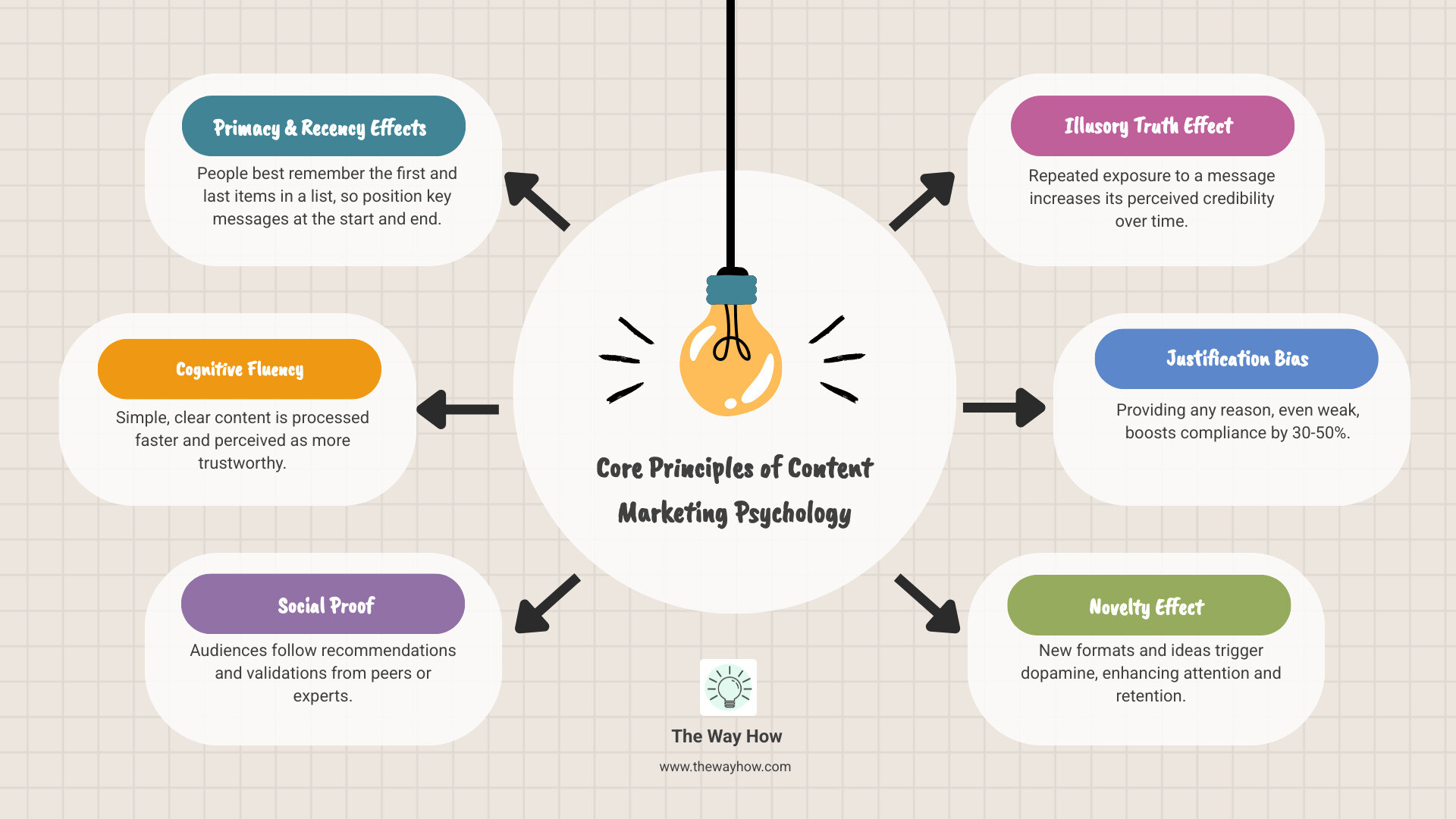
Content marketing psychology terms made easy:
To move beyond the noise, we must look at how the brain actually processes information. Two of the most foundational concepts are the Primacy and Recency Effects. Glanzer and Cunitz in 1966 discovered a pattern showing that participants remember words better when they appear at the beginning and the end of a list. In marketing, this means your introduction and your call to action are the most valuable real estate you own.
However, even the best-structured content can fail if it feels stale. This is where the Novelty Effect comes in. When we encounter something new, our brains release dopamine, which leads to stronger neural connections being formed. By experimenting with fresh formats — like shifting from standard whitepapers to interactive tools or diagnostic quizzes — we can perk up the reader’s reward system and improve long-term recall.

Retention isn’t just about keeping a customer; it’s about keeping your message alive in their mind. By understanding memory patterns, we can structure copy to ensure the most critical value propositions are anchored in those high-recall zones (the start and the finish). The 1966 Glanzer and Cunitz study remains a cornerstone for us because it proves that the “middle” of your content is where attention dips. To fight this, we use subheaders, bold text, and visual breaks to create “new” beginnings throughout a single piece of content.
While these triggers are powerful, they must be used to build, not burn, trust. Scientific research on misleading information shows that perceived deception in social media marketing severely damages brand image and consumer trust. Our goal is never to trick a reader into a click, but to use content marketing psychology to make the truth more accessible and memorable. Ethical marketing is about creating content that satisfies search intent and meets customer needs while maintaining transparency.
One of the more subtle ways the brain determines what is true is through the Illusory Truth Effect. This phenomenon suggests that the more we hear a message, the more we believe it to be true, simply because it becomes familiar. While this is often associated with propaganda, we use it ethically by consistently conveying the same core message using different words and phrases. Repetition builds a sense of brand authority and certainty.
To balance authority with human connection, we look to the Pratfall Effect. This principle states that highly competent individuals (or brands) actually become more likable after they make a mistake. Sharing a “pratfall” — a personal failure or error — makes an expert approachable. When a founder admits a strategic misstep, it doesn’t diminish their expertise; it builds a bridge of relatability that a “perfect” corporate facade never could.
The speed of the digital world is staggering. A 2012 study showed that visitors judge a website in just 0.05 seconds. Furthermore, Microsoft research noted that the average human attention span has narrowed to approximately eight seconds.
This is why cognitive fluency is vital. If a message is hard to read, the brain assumes the task is hard to do. We prioritize simplicity to reduce the mental load on our readers. But simplicity isn’t the only way to increase compliance. Sometimes, all you need is the word “because.”
A widely known 1978 study on justification found that giving a reason — even a redundant one — dramatically increased the likelihood of people saying yes.
| Request Type | Phrasing | Compliance Rate |
|---|---|---|
| No Reason | “May I use the Xerox machine?” | 60% |
| Real Reason | “May I use the Xerox machine because I’m in a rush?” | 94% |
| Placeholder Reason | “May I use the Xerox machine because I have to make copies?” | 93% |
By simply providing a justification, you satisfy the brain’s need for logic, even if the “logic” is just a confirmation of the obvious.
We are social creatures who look to others to validate our choices. According to Mintel research, more than two-thirds (69%) of Americans seek out reviews or recommendations before making a purchase. This is the power of social proof. It acts as a cognitive shortcut, allowing buyers to feel certain about a decision because others have already taken the risk.
However, social proof only works if it aligns with Perceptual Set Theory. This theory suggests that our past experiences create expectations for how things should work. If a user lands on a page and expects to find a “Get Started” button but finds a confusing “Let’s Journey Together” link, the friction increases.
To drive action, we often use the Fogg Behavior Model, which states that behavior happens when Motivation, Ability, and a Prompt (Trigger) converge at the same moment.
Visual cues are often the first thing the brain processes. Recent studies suggest people judge a product within 90 seconds, and up to 90% of that assessment is based on color alone. We use color not just for aesthetics, but to evoke specific emotional states: blue for trust, red for urgency, or green for growth.
To ensure your prompts are seen, we use contrasting colors for CTA buttons. A color calculator can help designers find high-contrast pairings that make the “Prompt” part of the Fogg model impossible to miss.
When a brand repeats its core message across multiple channels (blogs, social media, emails), the audience develops a sense of familiarity. This familiarity is often subconsciously equated with credibility. Consistency in messaging reinforces your position as an authority because the brain perceives a stable, repeated message as more likely to be true than a fragmented one.
In B2B, there is often a “perfection bias” where founders feel they must appear infallible. However, the Pratfall Effect shows that admitting to a mistake — like a failed product launch or a hiring error — actually increases trust. It humanizes the brand and demonstrates that the founder is competent enough to learn from their errors, which makes them a more reliable partner.
The most effective social proof comes from peers. While expert endorsements are great for authority, the 69% of consumers who rely on opinions are looking for people “like them.” User-generated content, customer testimonials, and raw reviews carry more weight because they are perceived as unbiased and authentic.
At The Way How, we believe that understanding how important content quality is for SEO starts with understanding the human on the other side of the screen. We help founders move away from “chasing tactics” and toward building a revenue engine rooted in content marketing psychology.
Whether we are serving as your Fractional CMO or auditing your HubSpot architecture, our focus is on removing uncertainty. We diagnose the certainty gaps in your customer journey stages and design systems that create trust and momentum.
The path to predictable revenue isn’t found in the latest trend; it’s found in the timeless principles of human behavior. By applying these insights, you stop guessing and start growing.
Register today for strategic clarity and begin turning your marketing into a dependable growth engine.
 Jeremy Wayne Howell : Jul 22, 2026 9:48:31 PM
 Jeremy Wayne Howell : Jul 21, 2026 9:47:10 PM
 Jeremy Wayne Howell : Jul 20, 2026 9:46:47 PM