A Complete Guide to CRM Systems and Database Management
 Jeremy Wayne Howell : Jul 22, 2026 9:48:31 PM
Human psychology in marketing is the application of psychological principles — like cognitive biases, emotional triggers, and behavioral patterns — to understand and influence how consumers make decisions.
Here’s what that means in practice:
| Principle | What It Is | How It’s Used in Marketing |
|---|---|---|
| Loss Aversion | People fear losing more than they enjoy gaining | “Only 3 left in stock” |
| Social Proof | We look to others to decide what’s correct | Reviews, user counts, bestseller labels |
| Anchoring | First information shapes all judgments that follow | Showing a high price before a discount |
| Scarcity | Rare things feel more valuable | Limited editions, countdown timers |
| Reciprocity | We feel obligated to return favors | Free trials, samples, giveaways |
| Cognitive Fluency | Easier to process = more trustworthy | Clean design, simple language |
Most buying decisions aren’t made logically. Research from Harvard professor Gerald Zaltman suggests that 95% of purchasing decisions happen subconsciously — driven by emotion, habit, and mental shortcuts, not careful analysis.
That’s not a consumer flaw. That’s just how the human brain works.
Yet most marketing is still built around features, pricing, and placement — the rational layer. It talks at buyers instead of connecting with how they actually think and decide.
The gap between what marketers say and what customers feel is where revenue quietly disappears.
Understanding human psychology in marketing doesn’t mean manipulating people. It means building the kind of clarity, trust, and relevance that makes the right buyer feel understood — before you ever ask them to do anything.
I’m Jeremy Wayne Howell, founder of The Way How, a psychology-first marketing and revenue strategy firm, and I’ve spent over 20 years applying human psychology in marketing to help founders and revenue leaders close the gap between what they’re saying and what their buyers are actually hearing. Everything in this guide is drawn from that hands-on experience — designed to help you build momentum, not just traffic.
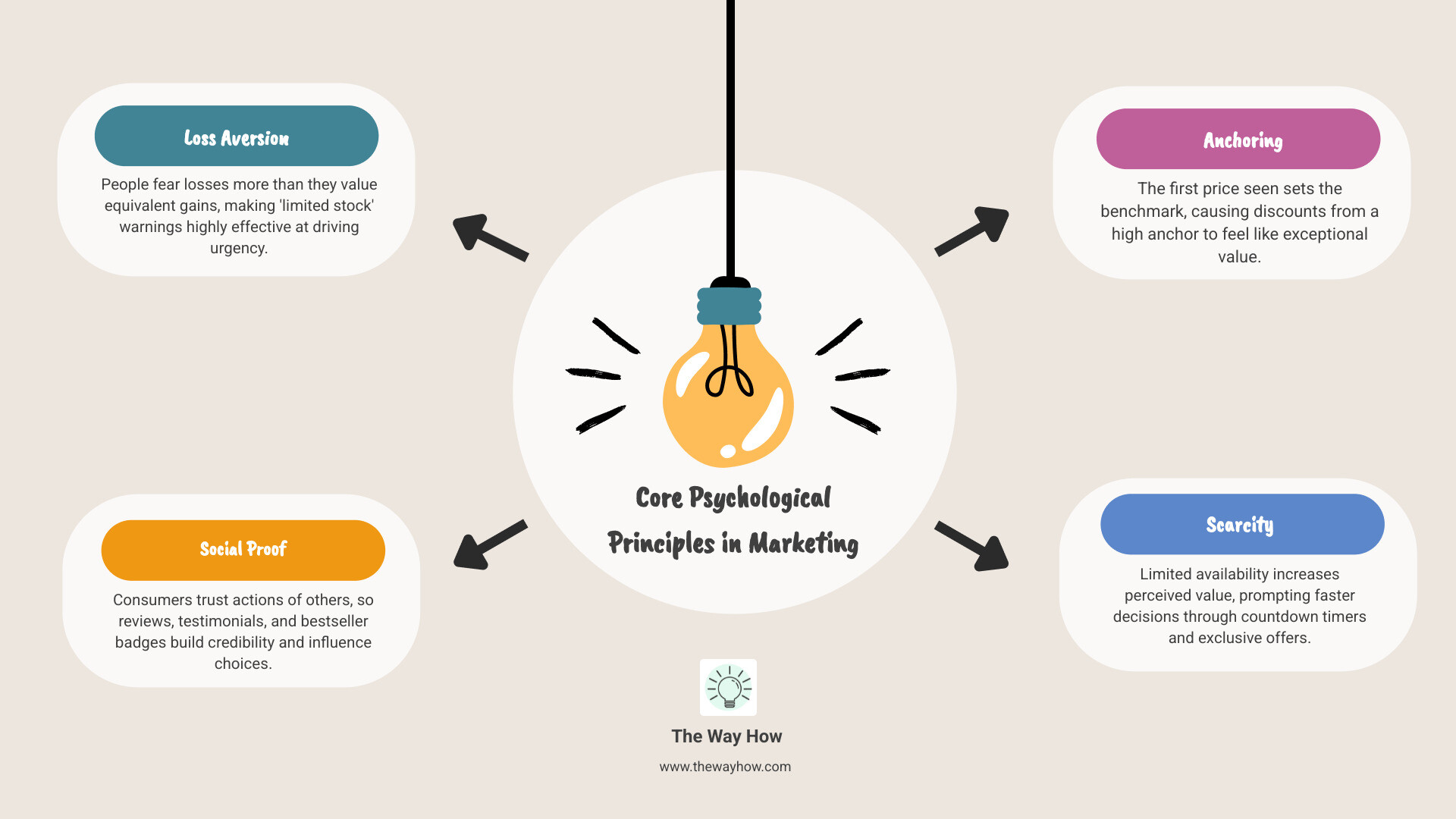
Terms related to human psychology in marketing:
At its core, Indeed defines marketing psychology as “the study and application of how the human mind interacts with and responds to various marketing materials and strategies.” It is the bridge between cognitive science and commercial messaging. While traditional marketing might focus on the “what”—the product features or the price point—the psychology of marketing focuses on the “why.”
This discipline often overlaps with “Neuromarketing,” which applies neuropsychology to content and sales to influence purchasing decisions. When we look at how people respond to stimuli, we see three primary layers: sensorimotor (what they see/feel), cognitive (what they think), and affective (how they feel).
To make these insights work at scale, we use Integrated Marketing Communications (IMC). As Adobe for Business explains, IMC is a strategic approach to aligning all brand messaging across multiple platforms. By combining IMC with behavioral insights, we ensure that a consumer encounters a consistent, psychologically resonant message whether they are scrolling through social media, visiting a website, or reading an email.
The way we understand the buyer has shifted from the “homo economicus” model—the idea that humans are rational calculators of utility—to a model of bounded rationality. Nobel laureate Daniel Kahneman popularized the framework of System 1 and System 2 thinking in Thinking, Fast and Slow.
System 1 is fast, instinctive, and emotional. System 2 is slower, more deliberative, and logical. Most marketing mistakenly targets System 2, providing data and specs. However, because 95% of cognition happens non-consciously, effective strategies first earn an intuitive preference via System 1 before providing the rational justifications System 2 needs to endorse the purchase. Accessing HubSpot’s guide to marketing psychology can provide further foundational frameworks for these behavioral models.
Many marketers rely on the “4Ps”—Product, Price, Place, and Promotion. While these are useful for organization, they are insufficient for execution. You can have the right price and the right product, but if you fail to address the “certainty gaps” in the customer journey, the sale stalls.
As Zappi notes regarding creative effectiveness, strategies learned in a vacuum often fail in the real world because they ignore how people actually perceive value. For example, simply stating a product is “high quality” is a vague claim. Behavioral research shows that being concrete—using specific phrases—makes a message 8.6 times more likely to be remembered. Without empathy-driven strategy, you are just adding to the noise of the 5,000+ ads the average person sees daily.
To move a buyer from “maybe” to “yes,” we use a toolkit of foundational principles. These aren’t “hacks”; they are reflections of how our species has evolved to navigate social environments and risk.
Key principles often discussed on the Nudge Podcast include:
By integrating these neuromarketing techniques, we can design systems that feel natural to the buyer rather than forced.
Social proof is perhaps the most powerful tool for reducing buyer uncertainty. The classic Asch conformity experiments showed that people will often ignore their own senses to align with a group. In a more modern context, a famous hotel study on towel reuse found that telling guests “75% of people who stayed in this room reused their towels” was significantly more effective than general environmental appeals.
To use this effectively, we look for trust signals that resonate with the specific buyer:
Scarcity works because of loss aversion marketing—the psychological fact that the pain of losing is twice as powerful as the joy of gaining. When an item is scarce, we perceive it as more valuable.
We see this in the Supreme resale market, where limited-release items often sell for double or triple their original price. In a grocery store experiment, sales per customer doubled from 3.3 to 7 cans simply by adding a “limit of 12 per person” sign. This created an anchor and a sense of scarcity simultaneously. However, scarcity must be authentic; if a “limited-time offer” never actually ends, you destroy the very trust required for long-term growth.
Our brains use mental shortcuts, or “heuristics,” to save energy. While efficient, these shortcuts lead to predictable biases.
The first piece of information a customer encounters sets the “anchor” for everything that follows. This is why SaaS companies often show their most expensive “Enterprise” plan first. It makes the $99/month “Pro” plan look like a bargain by comparison.
According to our anchoring bias marketing strategies, relativity is everything. Furthermore, research by Schindler and Yalch on precision found that specific numbers are more credible than round ones. A claim that a product lasts “47% longer” was perceived as 10% more accurate than saying it lasts “50% longer.” Precision implies that actual measurement took place, which increases trust.
The endowment effect in marketing describes our tendency to value things more highly simply because we own them. In a famous Kahneman, Knetsch, and Thaler study, people who were given a coffee mug refused to sell it for anything less than double what others were willing to pay to buy it.
Marketers can trigger “psychological ownership” through:
Branding isn’t just about aesthetics; it’s about sensory stimuli that bypass the rational brain.
Our brains use “top-down processing,” meaning they make assumptions based on prior knowledge and expectations to perceive situations faster. As Verywell Mind explains, we don’t just see what is there; we see what we expect to see.
This is why the Baader-Meinhof phenomenon (or frequency illusion) is so effective. Once you notice a brand, you start seeing it everywhere. We also leverage the Zeigarnik Effect—the tendency to remember uncompleted tasks better than completed ones. As Forbes highlights, creating “suspense” through teasers or delayed reveals keeps your brand at the top of the consumer’s mind.
Color also plays a massive role. Research suggests that 62% to 90% of impulse decisions are based on color alone. Blue often signals trust and dependability, while green is associated with health and growth. Using harmonious color combinations improves memory retention, making your brand more “fluent” and easier to trust.
Neuroscience shows that if the orbitofrontal cortex—the part of the brain that processes emotion—is damaged, people can’t make even simple decisions, even if their logic remains intact. Emotion is the engine of action.
We see this in Dove’s Real Beauty campaign, which built deep loyalty by challenging beauty standards and connecting with the customer’s self-identity. Similarly, Coca-Cola’s personalization through “Share a Coke” labels led to an 11% increase in sales by making a mass-market product feel personal and connected to social belonging.
Check out these emotional marketing tactics to see how to apply these triggers to your own brand.
With great insight comes great responsibility. The line between persuasion and manipulation is often found in the “Transparency Test”: If you explained the psychological principle you were using to your customer, would they thank you for helping them make a choice, or would they feel deceived?
Modern McKinsey research on personalization shows that consumers actually want personalized experiences—they want to feel special. We can achieve this ethically by understanding personality traits (like the Big Five) and cultural cognition. For example, some customers are “promotion-focused” (driven by gains), while others are “prevention-focused” (driven by safety). Aligning your message with their regulatory fit isn’t manipulative; it’s empathetic.
How do we know if these principles are actually working? We move beyond vanity metrics like “likes” and look at behavioral data.
| Psychological Trigger | Traditional Metric | Behavioral Insight Metric |
|---|---|---|
| Social Proof | Page Views | Referral Traffic / Review Growth |
| Scarcity | Click-Through Rate | Time-to-Purchase / Conversion Rate |
| Cognitive Fluency | Bounce Rate | Task Completion Rate / “Ease of Use” Scores |
| Reciprocity | Email Opens | Resource Downloads / Lead Quality |
By using A/B testing, we can isolate specific psychological variables—like testing a “Sold Out” frame versus an “Out of Stock” frame—to see which reduces consumer disappointment and maintains momentum.
Traditional marketing often focuses on the “what” (product features and placement), while marketing psychology focuses on the “why” (the cognitive and emotional drivers behind human behavior). It seeks to understand the subconscious processes that lead to a “yes.”
Colors evoke specific emotional responses and can account for 62% to 90% of impulse purchase decisions. They signal brand values—like trust (blue), energy (red), or health (green)—and help the brain categorize a brand before a single word is read.
It is ethical when used to reduce friction, simplify complex choices, and help customers find solutions that truly benefit them. It becomes manipulation when it uses deception, creates false scarcity, or exploits vulnerabilities for short-term gain at the expense of the customer’s well-being.
At The Way How, we believe that marketing shouldn’t feel like a guessing game. When growth stalls, it’s rarely because you aren’t “doing enough tactics.” It’s usually because there is a fundamental disconnect between your message and how your customers’ brains process information.
We are a psychology-first marketing and revenue strategy firm. We help founders and leadership teams remove uncertainty through Fractional CMO leadership, HubSpot architecture, and demand generation strategies rooted in human behavior. We don’t just chase trends; we diagnose the “certainty gaps” in your customer journey and design systems that create trust and predictable revenue.
If you’re ready to stop guessing and start growing with a strategy that respects the science of how people actually decide, we should talk.
 Jeremy Wayne Howell : Jul 22, 2026 9:48:31 PM
 Jeremy Wayne Howell : Jul 21, 2026 9:47:10 PM
 Jeremy Wayne Howell : Jul 20, 2026 9:46:47 PM