
Beyond the Handshake: Why Growth Requires More Than Networking

Developing strategic partnerships is one of the highest-leverage moves a business can make — and one of the most misunderstood.
Here’s the quick version, if that’s what you need:
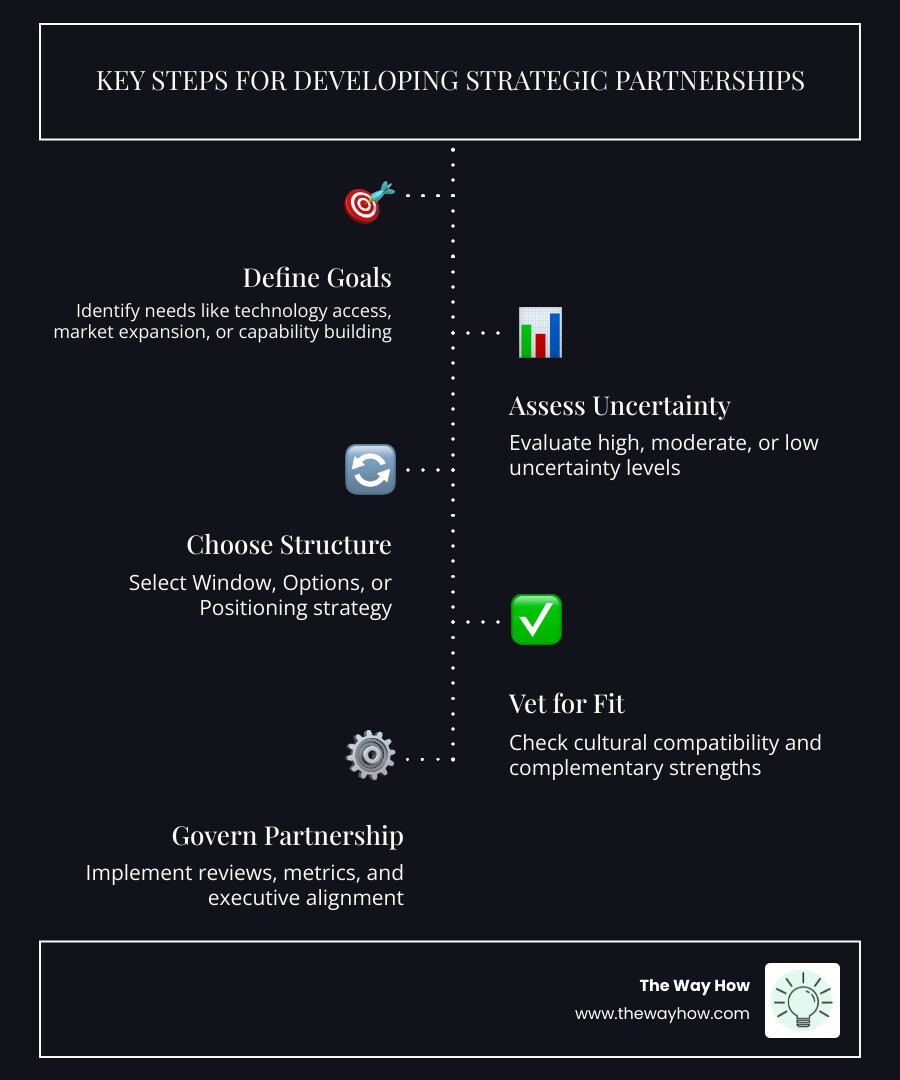
How to develop strategic partnerships:
- Define your goals — technology access, market expansion, or capability building
- Assess your uncertainty level — high, moderate, or low
- Choose the right structure — Window, Options, or Positioning strategy
- Vet for cultural fit and complementary strengths, not just brand prestige
- Set mutual goals using a clear, documented value proposition
- Negotiate with trust and alignment as the priority, not just deal terms
- Govern consistently — regular reviews, shared metrics, and executive involvement
Most leaders already know partnerships matter. What stops them isn’t awareness — it’s the gap between a promising handshake and a partnership that actually moves revenue.
The numbers make this uncomfortable. More than 80% of US CEOs are actively seeking or planning strategic partnerships right now. Yet more than half of all strategic partnerships fail. That’s not a coincidence. It’s a pattern — and patterns have causes.
The cause is almost never a bad idea. It’s a broken process. Misaligned goals, vague agreements, cultural friction, and negotiations that prioritize deal structure over relational trust. The result? Partnerships that feel strategic on paper and stall within six months of launch.
This guide is built to close that gap.
I’m Jeremy Wayne Howell, founder of The Way How and a revenue growth strategist with over 20 years of experience helping founders and executives build go-to-market systems that actually work — including developing strategic partnerships that drive measurable, lasting growth. I’ll walk you through the psychology, the frameworks, and the operational blueprint that separates alliances that compound from ones that quietly collapse.
The Psychology of Developing Strategic Partnerships
In our work at The Way How, we often find that the biggest barrier to successful collaboration isn’t a lack of resources—it’s unmanaged uncertainty. When we talk about developing strategic partnerships, we aren’t just talking about signing a contract; we are talking about creating a psychological bridge between two distinct organizations.
To build that bridge, we must first diagnose the environment. Partnerships aren’t one-size-fits-all. A framework often taught at Wharton suggests that your strategy must match your level of uncertainty. If you treat a high-risk experimental venture like a stable distribution deal, you create a “certainty gap” that leads to friction and eventually, failure.
Strategic alliances allow companies to pool resources, tap into new markets, and enhance capabilities that would take years to build internally. However, as noted in this step-by-step guide to building successful strategic partnerships, the “power of collaboration” lies in creating synergies that exceed individual capabilities. This requires a deep understanding of your Go To Market Strategy and how a partner fits into that engine.
Assessing Uncertainty for Developing Strategic Partnerships
When uncertainty is high—perhaps you are exploring a nascent technology or a completely foreign market—the goal isn’t immediate scale. It’s information. This is where we use the Window Strategy.
A Window Strategy provides real-time access to emerging ideas without the massive capital expenditure of a full acquisition or internal R\&D shift. Think of a non-profit managing a portfolio of antimalarial drug projects. By partnering with various biotech firms, they create a “window” into diverse research paths, reducing the overall R\&D timeline and spreading the risk.
In this phase, you aren’t looking for a “forever” marriage; you’re looking for a front-row seat to innovation.

Scaling Capabilities for Developing Strategic Partnerships
When uncertainty is moderate, we shift to an Options Strategy. Here, we aren’t just looking; we are placing small, scalable bets. You might know the technology works, but you aren’t sure which application will win the market.
Energy consortiums often use this approach. By collaborating on alternative fuel production, multiple companies can test various technologies with limited individual resources. If one path proves successful, they have the “option” to scale up their investment. This is a critical component of different go-to-market strategies where flexibility is the primary competitive advantage.
Identifying the Certainty Gap in Potential Alliances
The most common mistake we see in developing strategic partnerships is choosing a partner based on their “resume” rather than their “character.” Brand prestige is great, but cultural compatibility and complementary strengths are what keep the partnership alive when things get difficult.
Before reaching out, we recommend a rigorous internal inventory. We use a modified SWOT analysis to identify exactly where our “certainty gaps” are. Do we lack market access? Technical expertise? Brand credibility? Once you know your own gaps, you can look for a partner whose strengths fill them.
As outlined in these 10 steps to forming long-lasting strategic partnerships, due diligence must go beyond financial health. You need to assess their reputation, their internal decision-making speed, and whether their team actually wants to work with yours. This is where B2B Sales Consulting becomes invaluable—ensuring that the “front of house” promises match the “back of house” reality.
Vetting for Leverage and Scalability
A partnership that doesn’t scale is just a project. For a partnership to be truly strategic, it must offer three things:
- Leverage: Does this partner give us a presence or brand authority we couldn’t get alone?
- Scalability: Can this collaboration be repeated across different sales forces or regions?
- Incremental Revenue: Does this create “new” money, or are we just splitting the same pie?
Technical interoperability is often the silent killer here. If your systems can’t talk to each other, your teams won’t either. Ensuring seamless Crm Data Integration is a foundational step that many leaders skip, only to find six months later that they have no way to track joint leads or measure success.
From Transactional Deals to Transformational Alliances
We believe that every partnership is a psychological contract before it is a legal one. If you approach a partnership as a transactional “deal,” you will get transactional results. To build a transformational alliance, you must align on a mutual vision of success.
This starts with a strong value proposition. Why should they work with you? If your answer is “because we need their customers,” you’ve already lost. You must position your organization as the solution to their goals.
During negotiations, it is vital to establish your BATNA (Best Alternative to a Negotiated Agreement). Knowing your walk-away point gives you the confidence to negotiate for long-term value rather than just short-term concessions. We also recommend using emotional intelligence to probe for underlying interests. Sometimes, a partner cares more about brand alignment or “innovation credit” than they do about the specific revenue split.
| Feature | Equity Partnership (Joint Venture) | Non-Equity Alliance |
|---|---|---|
| Commitment Level | High (Shared ownership) | Moderate (Contractual) |
| Complexity | High (Legal/Financial) | Lower (Operational) |
| Average Lifespan | ~7 Years | Varies |
| Best For | Low uncertainty, high scale | High uncertainty, flexibility |
| Risk | High capital/resource risk | Lower, easier exit |
The Role of Trust in Developing Strategic Partnerships
Trust is the currency of collaboration. In negotiation theory, personal trust expands the ZOPA (Zone of Possible Agreement). When partners trust each other, they share “hidden” priorities, which allows for creative trade-offs that benefit both sides.
We often suggest involving a Fractional CMO or a dedicated alliance manager to act as a bridge. Their role is to maintain relational conversations and coordinate stakeholders across both organizations.
Interestingly, in April 2026, we are seeing technology act as a “fourth party” in these discussions. AI tools can now be used for scenario modeling and reframing communication to ensure that both parties are speaking the same “strategic language,” reducing the chance of misaligned expectations.
The Operational Blueprint: Governance and Longevity
Once the “honeymoon phase” of the signing ceremony is over, the real work begins. More than half of partnerships fail because of underinvestment and a lack of operational integration. To avoid this, you need a governance structure.
The IMD five-step framework is a reliable guide:
- Strategize: Define the “why” and map internal capabilities.
- Search & Select: Screen for capability and culture.
- Structure: Choose the right legal and financial framework.
- Start & Stabilize: Build the supportive culture and resolve early conflicts.
- Study & Steer: Create a dedicated unit to oversee the partnership portfolio.
A partnership agreement should be a living document. It must include clear responsibilities, risk-sharing protocols, and—most importantly—conflict resolution mechanisms. If you wait until there is a problem to decide how to handle disagreements, it’s usually too late.

Maintaining Momentum and Measuring Success
Longevity in developing strategic partnerships requires constant adaptation. The market in 2026 moves too fast for a “set it and forget it” mentality. We recommend a tiered governance approach:
- Weekly: Partner managers discuss operational hurdles and lead flow.
- Monthly: Review KPIs and joint marketing efforts.
- Quarterly: Executive-level reviews to ensure the partnership still aligns with the overall Go To Market Process.
Success shouldn’t just be measured in dollars. Look at strategic influence, resource sharing, and brand sentiment. And be honest about the end. Joint ventures have an average lifespan of seven years. Sometimes, the most “successful” move you can make is executing a clean exit strategy once the partnership has served its strategic purpose, allowing both companies to reallocate resources to the next growth phase.
Frequently Asked Questions about Strategic Alliances
Why do more than half of strategic partnerships fail?
Failure often stems from misaligned goals, underinvestment, and a lack of operational integration. Research shows that while 80% of CEOs seek partnerships in 2026, only 65% of those alliances achieve their intended success due to these “certainty gaps.” When companies focus more on the deal terms than the actual business model or cultural fit, friction is inevitable.
How do you choose between a joint venture and a non-equity alliance?
The choice depends on the level of uncertainty and the need for control. Joint ventures, which have an average lifespan of seven years, are often used for low-uncertainty positioning where scale is the primary goal. Conversely, non-equity alliances provide the flexibility needed for high-uncertainty “Window” strategies, allowing companies to collaborate without the legal and financial complexity of a new entity.
What are the red flags when evaluating a potential partner?
Key red flags include a poor online reputation, unrealistic promises, reluctance to share references, and a lack of cultural alignment. If a partner is hesitant to define clear responsibilities and risks upfront, or if there is a significant imbalance in resources and commitment, the partnership is likely to stall. Pay attention to how they handle “small” disagreements during the negotiation phase; it’s a preview of how they will handle major crises.
Turning Handshakes into Growth Engines
At The Way How, we don’t believe in growth for growth’s sake. We believe in growth that is predictable, sustainable, and rooted in human behavior. Developing strategic partnerships is a powerful tool, but only if it removes uncertainty rather than adding to it.
Our approach is to diagnose before we prescribe. We help leadership teams identify the “certainty gaps” in their current strategy and design partnership systems that create genuine trust and momentum. Whether you need a Fractional CMO to lead the charge or a behavioral strategy to align your stakeholders, we focus on the psychology of the “yes” and the operations of the “how.”
If your current alliances feel more like “awkward small talk” than revenue engines, it’s time to change the system. Let’s move beyond the handshake and build something that lasts.