A Complete Guide to CRM Systems and Database Management
 Jeremy Wayne Howell : Jul 22, 2026 9:48:31 PM
A growth strategy roadmap is a structured plan that connects your current business position to a future revenue goal — through prioritized initiatives, clear ownership, defined timelines, and measurable milestones.
Here’s what a growth strategy roadmap includes at a glance:
| Component | What It Does |
|---|---|
| Vision and North Star Metric | Defines what success looks like and the single metric that signals you’re moving toward it |
| Market and situational analysis | Identifies where real growth opportunity exists right now |
| Prioritized growth initiatives | Sequences high-impact bets by feasibility, timing, and strategic fit |
| Resource and responsibility allocation | Assigns budget, people, and tools to each initiative |
| Milestones and timelines | Creates checkpoints to measure progress and trigger decisions |
| KPIs and review cadence | Tracks whether the strategy is working and when to adjust |
Most companies don’t lack ambition. They lack architecture.
Their teams are running campaigns. Publishing content. Testing channels. Attending pipeline reviews. Everyone looks busy — and yet revenue stays flat, or grows in ways that feel fragile and hard to repeat.
That’s not a tactics problem. It’s a systems problem.
The frustration isn’t that nothing is working. It’s that nothing is connecting. Marketing runs one direction. Sales runs another. Leadership keeps asking for a number that the business can’t reliably produce — because no one has built the system that would produce it.
A growth strategy roadmap isn’t another planning document to file away. It’s the architecture that turns disconnected activity into compounding revenue.
Research consistently shows that companies with a documented growth roadmap are 2.5 times more likely to achieve sustained revenue growth over a five-year period. And yet only 23% of organizations report that their roadmaps are consistently aligned with execution and resource allocation.
The gap isn’t in the planning. It’s in the translation — from strategy on a slide to decisions made on a Tuesday morning when resources are tight and pressure is high.
I’m Jeremy Wayne Howell, founder of The Way How and a revenue growth strategist with over 20 years of experience helping founders and revenue leaders build the kind of clarity that a growth strategy roadmap is supposed to deliver — but rarely does without the right psychological and structural foundation. This guide is built from that experience, designed to help you diagnose what’s actually stalling your growth and build a roadmap that holds up when the pressure is real.
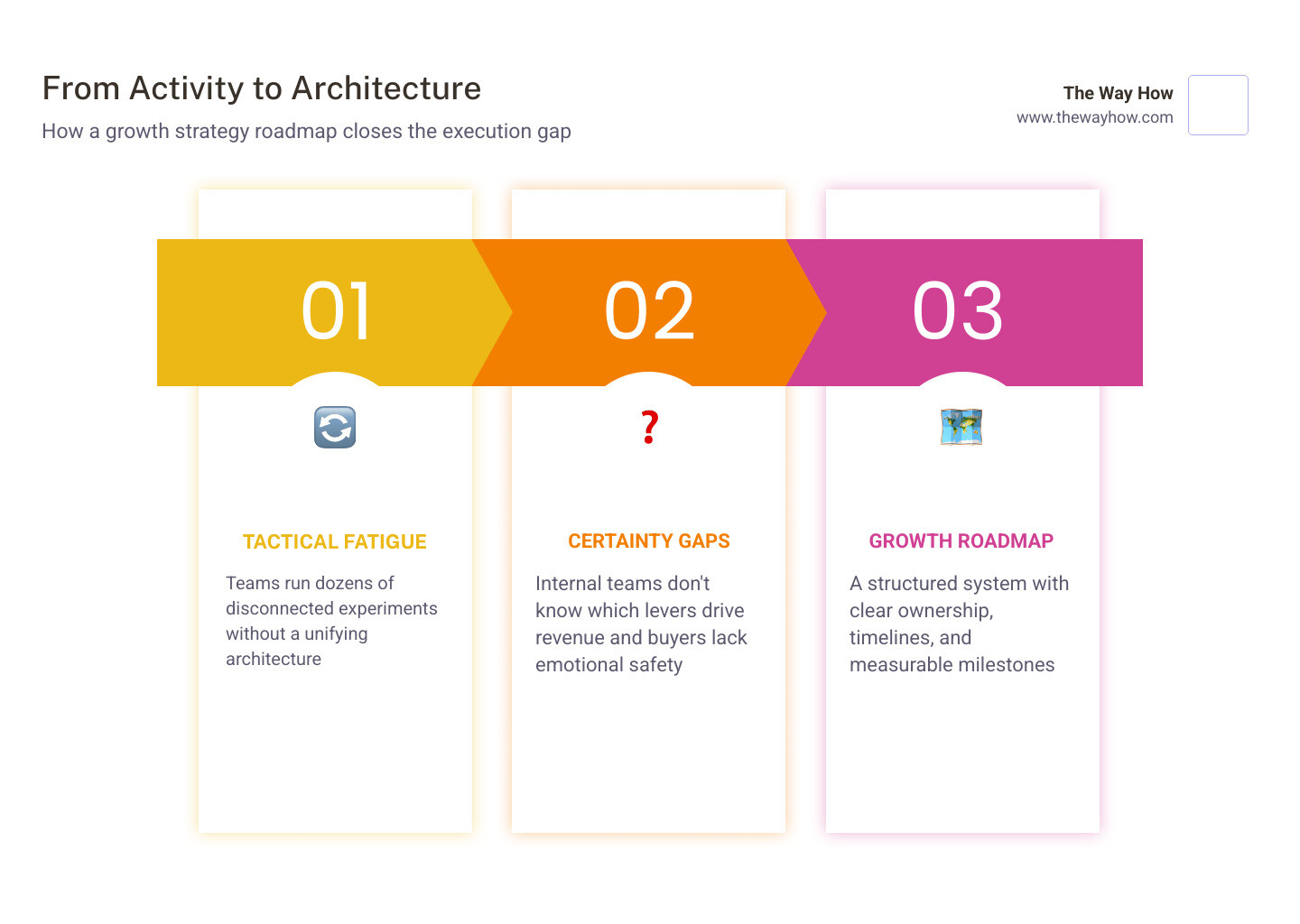
When we look closely at stalled organizations, we find that the root cause is rarely a lack of effort. Instead, we see “tactical fatigue.” This is the psychological weariness that sets in when a team runs dozens of disconnected marketing experiments without a unifying architecture.
Leaders often mistake motion for progress. They assume that because the team is testing new ad platforms, rewriting the website copy, and sending cold outbound emails, they are executing a growth strategy. In reality, they are operating with a channel plan wearing a strategy costume.
This creates what we call certainty gaps. A certainty gap exists when your internal teams do not know which levers actually drive revenue, and your buyers do not feel enough emotional or cognitive safety to make a purchasing decision. To close these gaps, we must design systems that address human behavior and decision-making psychology first, rather than chasing the latest marketing trend.
To build a system that works, we must first define what it actually is. A growth strategy roadmap is not a static document. It is a dynamic, commercial blueprint that bridges the gap between high-level business goals and daily operational execution.
Many leadership teams confuse this tool with other planning documents. Let us clarify the differences:
| Document Type | Primary Focus | Horizon | Adaptability |
|---|---|---|---|
| Traditional Business Plan | Operational details, regulatory compliance, long-term financial modeling, and corporate structure. | 3 to 5 Years | Low (often written once for investors or bank loans). |
| Strategic Marketing Plan | Tactical execution of brand messaging, channel selection, campaign calendars, and lead generation. | 1 Year | Medium (adjusted based on campaign performance). |
| Growth Strategy Roadmap | Commercial architecture mapping customer value to compounding revenue through sequenced growth bets. | 1 to 3 Years | High (reviewed quarterly to adjust to market changes). |
If you are looking to refine your promotional and channel activities, a Strategic Marketing Plan is highly valuable. However, if your goal is to architect a system where customer acquisition, conversion, and retention compound together, you require a growth strategy roadmap.
A true roadmap does not focus on operational minutiae. Instead, it serves as a commercial document that forces hard choices. It defines not only what the business will do to grow, but explicitly what it will not do. By limiting your focus to a few high-impact vectors, you protect your team from the cognitive overload of trying to chase every opportunity at once.
The execution gap is where good intentions go to die. When a strategy fails, leadership often blames poor execution. But more often, the failure lies in how the strategy was structured.
An effective roadmap solves this by improving cross-functional alignment and decision-making speed. When marketing, sales, and product teams operate from the same visual blueprint, they stop fighting over localized metrics (like click-through rates or lead volume) and start focusing on systemic outcomes (like customer lifetime value and retention).
Organizations that use structured roadmapping processes report a 40% improvement in cross-functional alignment and decision-making speed. This alignment directly impacts how resources are deployed. Instead of spreading your budget thinly across eight different channels, a roadmap helps you concentrate capital and talent on the two or three initiatives that represent the shortest path to sustainable Business Growth.
Every successful roadmap requires a single, guiding light: the North Star Metric.
From a psychological perspective, a North Star Metric is essential because it reduces cognitive load for your leadership and execution teams. When teams are forced to track dozens of competing key performance indicators (KPIs), decision paralysis sets in. By aligning the organization around one primary metric, you create cognitive ease and operational focus.
However, many businesses choose the wrong North Star Metric. They focus on internal, lagging indicators like monthly recurring revenue (MRR) or total sales volume.
A true North Star Metric must measure the core value your customers receive from your product or service. When your customers receive maximum value, financial growth follows as a natural byproduct. For example, if you run an online marketplace, your North Star Metric should not be total sign-ups; it should be the number of successful transactions where both buyer and seller achieved their goals.
By focusing your roadmap on customer value, you align your internal business objectives with the psychological needs of your market. This relationship is explored deeply in our Revenue Growth Strategy Guide 2026, which details how to build demand systems rooted in human empathy.

To build a roadmap that delivers predictable revenue, we must move away from guesswork and adopt a structured framework. Two of the most powerful models for doing this are McKinsey’s Seven Degrees of Freedom for Growth and our own five-layer Growth Strategy System Stack.
McKinsey’s framework encourages businesses to look beyond simple customer acquisition and explore other dimensions of growth, such as:
Rather than attempting to pursue all seven degrees simultaneously—which is a recipe for operational collapse—a mature roadmap focuses on two to four coherent degrees of freedom. You can explore how to structure these bets systematically in the Growth Strategy Playbook for Prioritized Winning Bets.
To make these strategic choices actionable, we map them directly to the five layers of our Growth Strategy System Stack.
A growth strategy must be built in a specific sequence. If you scale acquisition before you have structured your conversion and measurement systems, you are simply pouring water into a leaky bucket.
Once the first three layers are instrumented, the revenue system can begin to compound.
By designing your roadmap around this sequenced stack, you avoid the traps of traditional, high-churn Growth Hacking Strategies and build a self-sustaining revenue engine.

Once you have identified your growth opportunities, the next challenge is prioritization. You cannot execute thirty ideas at once. You must turn your ideas into “option atoms”—standardized, one-page write-ups that outline the economics, feasibility, and risks of each initiative so they can be compared objectively.
We recommend sorting these initiatives into a clear portfolio matrix based on three horizons:
A real-world example of this disciplined sequencing can be seen in the Kempower 2.0 Strategy Update, where the company updated its long-term strategy by balancing its core European market footprint with disciplined geographic expansion into North America and Asia-Pacific, while shifting its business model toward recurring lifecycle services.
A common failure point in strategic planning is the “all-or-nothing” trap, where companies commit to a rigid five-year plan and refuse to adapt. An effective growth roadmap balances long-term ambition with short-term execution flexibility.
We achieve this by breaking the roadmap down into highly focused 90-day plans. While your long-term vision remains steady, your tactical execution is evaluated and adjusted every quarter.
To do this successfully, you must track leading indicators (such as demo request rates, activation velocity, or trial sign-ups) rather than relying solely on lagging indicators (like closed revenue). Leading indicators give you the early warning signals needed to pivot before capital is wasted.
This balance between long-term vision and operational agility is masterfully demonstrated in the Astellas Five-Year Corporate Strategic Plan. The organization maintains a steady, long-term commitment to pipeline-led patient value while executing aggressive, short-term cost-optimization and asset maximization initiatives to fund that future growth.
For businesses looking to implement this level of operational agility, our framework for Business Growth Acceleration provides a step-by-step methodology for aligning short-term performance with long-term enterprise value.
Why do most strategic roadmaps fail to get executed? It is rarely because the strategy was bad. It is because the organization failed to align incentives and manage change.
If you introduce a new growth initiative—such as moving up-market to target enterprise clients—but your sales team’s compensation structure still rewards them for closing high-volume, low-value transactional deals, they will ignore the new strategy. Human behavior follows incentives.
Furthermore, you must design your roadmap with realistic resource constraints in mind. If your team is already operating at 95% capacity, adding three transformational growth bets without removing existing operational burdens will lead to burnout and execution failure.
When designing Small Business Growth Strategies, leaders must be particularly ruthless about what they stop doing to free up the mental bandwidth and capital required for new growth initiatives.
A traditional business plan is typically a dense, static document focused on operational details, financial projections, and corporate structure, often created to satisfy external stakeholders like banks or investors. A growth strategy roadmap is a highly visual, adaptable commercial document. It focuses strictly on high-level strategic objectives, customer value creation, and the sequenced initiatives required to scale revenue. While a business plan is rarely updated, a growth roadmap is a living system reviewed and adjusted quarterly.
We recommend a two-tier review cadence:
Firms that revisit and update their strategy roadmaps at least quarterly achieve 30% higher profitability than those that review annually or less.
The single biggest mistake is trying to pursue too many growth vectors simultaneously. Many leadership teams write down roadmaps that demand more customers from existing segments, expansion into new geographic regions, the launch of three new products, and a transition to an enterprise sales model all in the same year. This dilutes focus, exhausts resources, and leads to systemic execution failure. A strong strategy is defined by what you choose not to do.
At The Way How, we believe that sustainable revenue growth is not the result of chasing short-term hacks or disconnected channel tactics. It is the natural outcome of a well-architected system that respects human psychology, buyer behavior, and operational discipline.
If your growth has stalled, the solution is not to push your team to run faster on the tactical treadmill. The solution is to step back, diagnose where the certainty gaps exist in your customer journey, and build a structured growth strategy roadmap that aligns your entire organization around a shared vision.
For many organizations, the first step toward restoring strategic clarity is organizing and unifying their commercial data. If your sales and marketing systems are fragmented, your teams cannot access the clean demand signals needed to guide your growth decisions.
To build a solid foundation for your growth engine, we invite you to read our guide on how to optimize your HubSpot CRM architecture. Let us help you remove the uncertainty from your revenue systems and build a predictable path forward.
 Jeremy Wayne Howell : Jul 22, 2026 9:48:31 PM
 Jeremy Wayne Howell : Jul 21, 2026 9:47:10 PM
 Jeremy Wayne Howell : Jul 20, 2026 9:46:47 PM