
Why Marketing Keeps Businesses Alive — and Why Most Get It Wrong

marketing foundations are the core principles that determine whether a business grows, stalls, or quietly disappears.
If you’re trying to understand what actually drives revenue — not just traffic or impressions — here’s the short version:
| Foundation | What It Means |
|---|---|
| Product | What you’re selling and why it matters |
| Price | What the market will pay and what that signals |
| Place | Where and how customers access your offer |
| Promotion | How you communicate value to the right people |
| Segmentation | Who you’re actually talking to |
| Research | What you know vs. what you assume about buyers |
| Strategy | How all of the above connect into a system |
These aren’t just academic concepts. They’re the levers that either move revenue or don’t.
Here’s the problem most leaders run into: they skip the foundations and go straight to tactics. They hire an agency, run ads, post content — and wonder why nothing sticks. The tactics aren’t always wrong. The sequence is.
Think about it this way. Why does someone wait in line for hours to buy the same phone they already own in a slightly different form? That’s not a product decision. That’s psychology. That’s trust built over years through consistent, intentional marketing.
Most businesses never build that. Not because they lack effort — but because they never got clear on the fundamentals beneath the execution.
That’s exactly what this guide is for.
I’m Jeremy Wayne Howell, founder of The Way How, a psychology-first marketing and revenue strategy firm — and I’ve spent over 20 years helping founders and revenue leaders rebuild growth by getting marketing foundations right before touching a single tactic. If your pipeline is flat or your messaging isn’t landing, the answer is almost never “do more” — it’s usually buried in something foundational you haven’t looked at closely enough yet.
Why We Buy: The Psychology Behind the Engine
To truly understand marketing foundations, we have to start with the human brain. Every commercial transaction begins with a psychological shift. Before a customer hands over their money, they must cross what we call a “certainty gap.” This is the psychological distance between their current state of doubt and a state of complete trust in your brand.
When businesses struggle to grow, they often assume they have a lead generation problem. In reality, they usually have a certainty problem. Buyers do not make decisions in a vacuum; they are guided by cognitive shortcuts, emotional triggers, and deep-seated desires for safety and status. Why does a consumer buy the exact same brand of detergent for twenty years, or wait in line overnight for a new smartphone? It is not because the utility of the item has exponentially increased. It is because the brand has successfully eliminated the psychological risk of the purchase.
By looking at marketing through the lens of human behavior, we see that it is not about manipulation or loud messaging. It is about understanding the buyer’s internal narrative, validating their anxieties, and presenting a solution that feels like the logical next step. When we align our marketing systems with the natural decision-making psychology of our audience, we build systems that generate predictable revenue without needing to rely on aggressive sales tactics.

The Core Pillars of Marketing Foundations
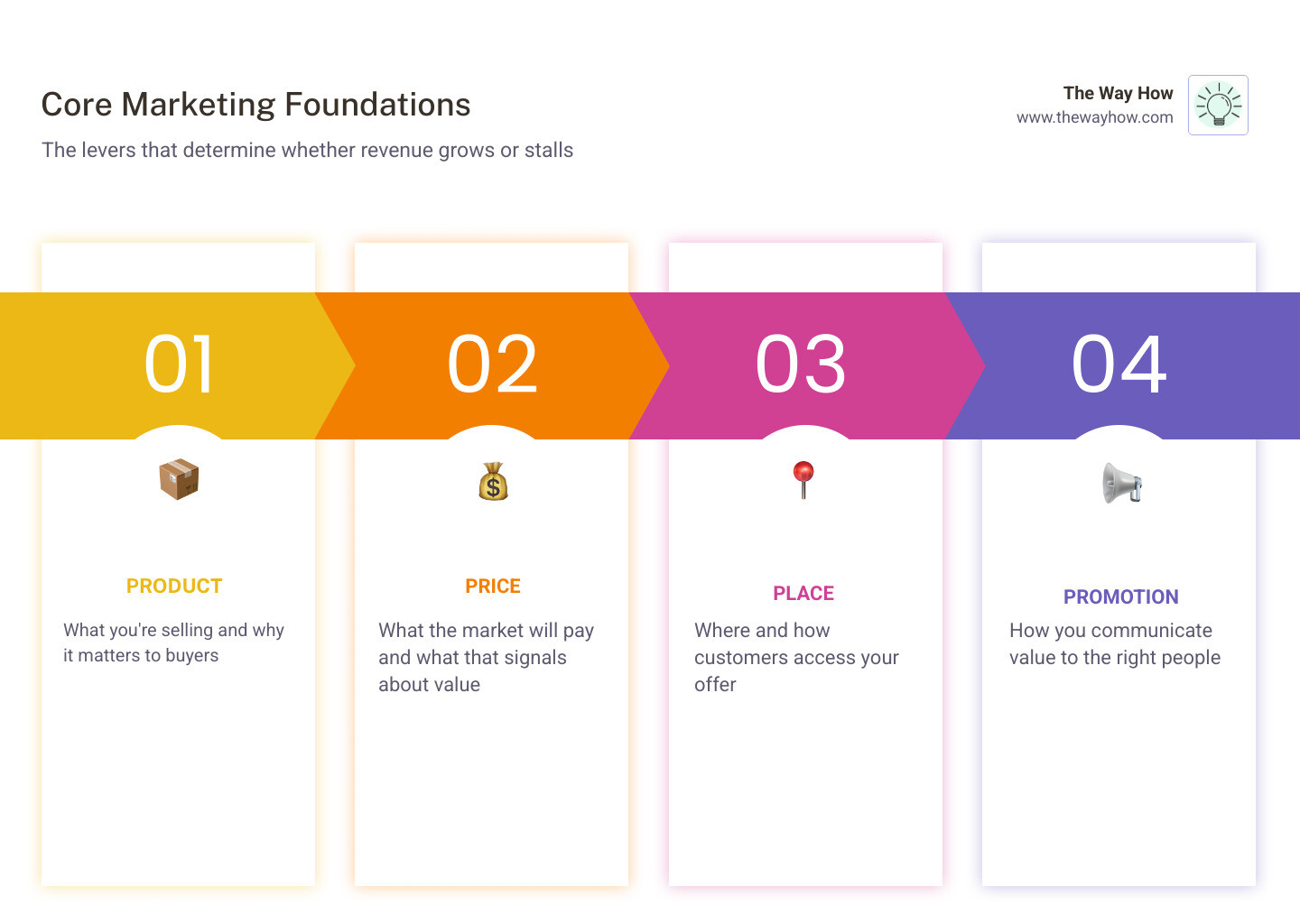
At its core, marketing is the process of creating, communicating, delivering, and exchanging offerings that have value for customers, clients, and partners. To manage this process, we rely on established frameworks that organize these commercial activities. The most enduring of these is the classic marketing mix, often referred to as the 4Ps.
As explored in academic texts like Foundations of Marketing, 8e, these pillars do not exist in isolation. They are deeply interconnected. If you change your product, your pricing strategy must adapt. If you shift your distribution channels (place), your promotional strategy must follow suit. Understanding how these pieces fit together is what separates strategic marketing from random acts of promotion.
Deconstructing the 4Ps of Marketing Foundations
Let us look closely at how the four traditional pillars function in the real world:
- Product: This is the core offering. It includes physical goods, digital services, or experiences. To manage a product successfully, we must understand its lifecycle—from development and introduction through growth, maturity, and eventual decline. Every stage of the product lifecycle requires a different marketing approach.
- Price: Pricing is more than a financial calculation; it is a psychological signal. Your price dictates how the market perceives your value. We must evaluate various pricing strategies—such as value-based pricing, penetration pricing, or skimming—to ensure they align with the brand’s positioning.
- Place: This refers to distribution and supply chain management. How does the customer actually buy from you? Whether you use a direct-to-consumer digital model, wholesale distribution, or physical retail, your supply chain must deliver a seamless, reliable experience that preserves customer trust.
- Promotion: This is the communication layer. It covers integrated marketing communications, including advertising, public relations, personal selling, and social media. The goal of promotion is to deliver a consistent, clear message across all touchpoints, guiding the buyer through the sales funnel.
Expanding to Modern Marketing Foundations Frameworks
While the 4Ps remain vital, modern market dynamics require us to look at broader frameworks to diagnose business challenges.
For instance, the 5Cs framework expands our view to include:
- Company: Our internal strengths, weaknesses, and unique resources.
- Collaborators: Our partners, suppliers, and distributors who make operations possible.
- Customers: The needs, behaviors, and segments of our target market.
- Competitors: The alternative options our audience has to solve their problem.
- Context: The external environment, including economic trends, laws, and technological shifts.
Additionally, service-based businesses often use the 7Ps framework, adding People (the staff delivering the service), Process (the customer experience journey), and Physical Evidence (the environment where the service is delivered).
To analyze our competitive position, we also look to tools like Porter’s Five Forces, which evaluates the threat of new entrants, the bargaining power of buyers and suppliers, the threat of substitute products, and industry rivalry. Learning to navigate these structures is a core focus of programs like Essential Marketing Frameworks | Coursera, which help professionals analyze markets systematically rather than relying on guesswork.
Mapping the Market: Segmentation, Targeting, and Research
A common mistake in marketing is trying to speak to everyone. When you target everyone, you resonate with no one. To prevent this, we use the STP process: Segmentation, Targeting, and Positioning.
- Segmentation: We divide a broad market into distinct groups of buyers who share common characteristics, needs, or behaviors. These segments can be demographic, geographic, psychographic, or behavioral.
- Targeting: We select which of these segments we are best equipped to serve. This choice is based on market size, growth potential, and how well our unique value proposition aligns with their specific pain points.
- Positioning: We design our offering and brand image so that it occupies a distinct, valued place in the target customer’s mind relative to competitors.
To make these segments actionable, we build target audience personas. These are detailed, semi-fictional representations of our ideal customers based on qualitative data and behavioral insights. By understanding their daily frustrations, goals, and decision-making habits, we can apply the Psychology Of Marketing to create empathetic, highly relevant messaging that builds immediate trust.
The Role of Market Research and SWOT Analysis
We cannot build an effective strategy on assumptions. We must anchor our decisions in real-world data. Market research acts as our diagnostic tool, letting us see the market as it actually is, not just how we hope it is.
To assess our position, we often begin with a SWOT analysis:
- Strengths (Internal): What do we do exceptionally well? What unique assets do we possess?
- Weaknesses (Internal): Where are our operational gaps? Where do we lose momentum?
- Opportunities (External): What market gaps, technological shifts, or customer needs can we step into?
- Threats (External): What economic, regulatory, or competitive pressures could disrupt our business?
To feed this analysis, we combine quantitative data with qualitative research, such as customer interviews and focus groups. This balance allows us to find the deeper stories behind the numbers. If you want to dive deeper into how to structure and interpret this data, you can read our guide on Marketing Data Analysis to see how we turn raw metrics into actionable growth strategies.
Navigating the Marketing Environment: Economics, Ethics, and Law
No business operates in a vacuum. The broader marketing environment constantly shapes and limits our strategic choices. Economically, we must understand how concepts like inflation, consumer confidence, and Gross Domestic Product (GDP) influence buyer behavior. In a free enterprise system, market dynamics dictate supply and demand, meaning our pricing, distribution, and product development must remain flexible to survive economic cycles.
Beyond economics, we must navigate a complex web of legal and ethical boundaries. Government regulations protect consumers from deceptive advertising, price-fixing, and privacy violations. In an era where data privacy is paramount, staying compliant with global and regional standards is not just a legal requirement—it is a cornerstone of brand trust.
Furthermore, modern marketing demands a commitment to ethical marketing and Diversity, Equity, and Inclusion (DEI). True ethical marketing goes beyond mere compliance; it means communicating honestly, respecting customer data, and ensuring our campaigns represent and respect diverse audiences. When we integrate these values into our core strategy, we protect our brand reputation and build deeper, more authentic connections with our market.
The Digital Evolution: Content, Automation, and Analytics
The fundamentals of marketing have not changed, but the channels we use to reach people certainly have. The rise of digital marketing has transformed how we engage with buyers, making communication faster, highly interactive, and measurable.
To build a modern marketing engine, we must understand how different digital pillars work together:
- Foundational Knowledge: First, we must grasp the core digital landscape. For a structured overview of this space, explore our guide on Digital Marketing Foundations.
- Value-Driven Content: Instead of interrupting buyers with loud ads, we pull them in by solving their problems. Creating valuable, consistent content is the core of inbound marketing. To learn how to build this trust-first approach, look at Content Marketing Hubspot.
- System Efficiency: As your business grows, manual execution becomes a bottleneck. We use technology to deliver the right message at the exact right moment in the buyer’s journey. To see how to scale your communication without losing the human touch, read about Marketing Automation Hubspot.
To ensure these digital efforts actually drive revenue, we rely heavily on web analytics and Key Performance Indicators (KPIs). By tracking metrics like customer acquisition cost, conversion rates, and customer lifetime value, we can continuously optimize our efforts and avoid wasting budget on tactics that do not perform.
Building Predictable Revenue Systems
A common symptom of a stalled business is a highly unpredictable pipeline. One month is busy; the next is quiet. This roller-coaster effect happens when a company relies on ad-hoc campaigns rather than a built-in system.
To build a dependable growth engine, we must connect our lead generation and demand generation efforts into a single, cohesive strategy:
- Demand Generation: This is the process of building long-term awareness, interest, and trust in your category and brand. It is about educating the market on the problem they have and why it matters. To see how we design these systems, read our Demand Generation Strategy Complete Guide.
- Lead Generation: Once demand exists, we need clear mechanisms to capture that interest and turn anonymous visitors into known prospects. For actionable tactics on setting up these capture points, check out our guide on Lead Generation Strategy.
- Operational Execution: To keep these systems aligned, we need a robust technology stack to track the customer journey from first touch to closed deal. We highly recommend exploring Marketing Strategies With Hubspot to understand how to build a clean, unified database that supports your sales and marketing teams.
Frequently Asked Questions About Marketing Foundations
What are the 4 foundations of marketing?
The four primary foundations of marketing—traditionally known as the 4Ps or the marketing mix—are Product, Price, Place, and Promotion. Together, they form the core framework for designing and executing any marketing strategy. Product focuses on creating an offering that solves a real customer problem. Price determines the value and positioning signal of that offering. Place ensures the product is accessible to the buyer through efficient distribution. Promotion encompasses the integrated communication channels used to build awareness and trust.
How long does it take to learn marketing foundations?
The time it takes to learn the fundamentals depends on the depth of study you choose. For instance, a foundational course such as the Certificate in Marketing Foundations program offered by professional associations takes about 15 hours of study and costs approximately $330. This specific program is highly rated by learners, earning a 4.6 out of 5 rating, and offers Continuing Education Units (CEUs) for certified professionals. For those looking for structured, self-paced learning, platforms like LinkedIn Learning offer beginner-level courses like Marketing Foundationsthat can be completed in just over an hour.
Why is marketing essential for business success?
Marketing is essential because it is the primary bridge between a business’s product and its target market. Without foundational marketing, even the best products fail because buyers do not know they exist, do not understand their value, or do not trust the company behind them. Marketing allows organizations to identify customer needs, segment their audience, analyze market dynamics, and build long-term brand loyalty. It transforms a business from a passive seller into an active, trusted partner in the buyer’s journey, driving predictable, long-term revenue growth.
Restoring Momentum: Moving Beyond Tactical Noise
When growth stalls, it is rarely because a business lacks talent, effort, or budget. It is almost always because they have lost touch with their marketing foundations.
It is easy to get distracted by the latest marketing trends, social platforms, and software tools. But tools and tactics cannot save a strategy built on weak fundamentals. If you do not know who your buyer is, what psychological obstacles keep them from trusting you, or how your value proposition sets you apart, no amount of advertising spend will fix the problem.
At The Way How, we help leadership teams strip away the tactical noise and diagnose what is actually holding them back. We look at the customer journey through the lens of human behavior and decision-making psychology, identifying the certainty gaps where potential buyers are dropping out. Whether you need fractional CMO leadership to guide your team, a complete restructure of your HubSpot architecture, or a demand generation strategy built on empathy and data, we are here to help you build a clear, predictable growth engine.
If you are ready to stop guessing and start building a marketing system that works, we invite you to take the next step. Let us clarify your strategy, align your systems, and restore your growth momentum.