
Why Your Growth Engine is Spitting Smoke

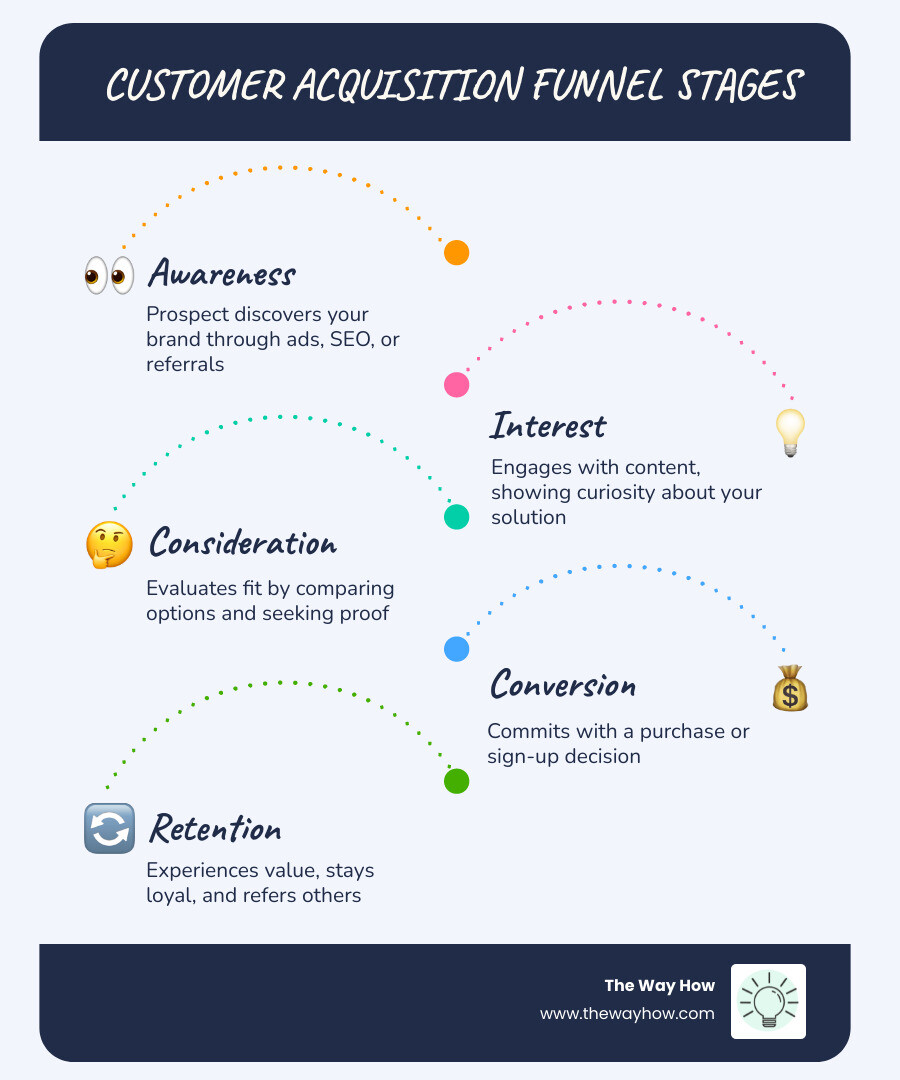
A customer acquisition funnel is the structured path a potential buyer travels — from first hearing about your business to becoming a paying customer and, ideally, a loyal one. It typically moves through these stages:
- Awareness — they discover you exist
- Interest — they engage with your content or brand
- Consideration — they evaluate whether you’re the right fit
- Conversion — they make a purchase or commitment
- Onboarding — they experience your product or service for the first time
- Retention — they stay, return, and refer others
Most businesses have some version of this in place. The problem isn’t the absence of a funnel — it’s that the funnel leaks. And most teams don’t know where.
Here’s the uncomfortable truth: the leak is rarely a channel problem. It’s a people problem. Somewhere along the journey, a real human being lost certainty — in your brand, your offer, or their own decision. And no amount of ad spend fixes that.
That’s the lens this guide is written through.
I’m Jeremy Wayne Howell, founder of The Way How and a revenue growth strategist with over 20 years of experience helping founders and revenue teams diagnose why their customer acquisition funnel stalls — and rebuild it around how buyers actually think and decide. If your tactics look fine on paper but revenue isn’t moving, you’re in the right place.
Quick look at customer acquisition funnel:
Defining the customer acquisition funnel: More Than Just a Sales Pipe
When we talk about a customer acquisition funnel, it is tempting to view it as a mechanical device where you pour leads in the top and money comes out the bottom. In reality, it is a visualization of a relationship. It maps the evolution of a prospect’s mindset.
In April 2026, the market is noisier than ever. According to The New Customer Acquisition Funnel Guide (2026) - SalesIntel, the modern funnel must be data-driven and non-linear. Buyers do not move in a straight line; they hop between channels, consume content out of order, and research alternatives behind your back.
The essential stages we track include:
- Awareness: The discovery phase where you solve a problem or provide a “hook” that stops the scroll.
- Interest: The engagement phase where the prospect trades their time for your information.
- Consideration: The evaluation phase where they compare your solution against competitors and their own status quo.
- Conversion: The decision phase where the transaction occurs.
- Onboarding: A critical but often ignored stage where the customer realizes the value they were promised.
- Retention: Turning a one-time buyer into a repeat customer and advocate.
By understanding the conversion funnel in digital marketing, we can see that each stage requires a different level of psychological safety and information depth.
The psychology of the customer acquisition funnel stages
Every stage of the customer acquisition funnel is actually a hurdle of uncertainty. At the Top of Funnel (ToFu), the buyer is asking, “Is this relevant to me?” By the Middle of Funnel (MoFu), the question shifts to, “Can I trust this company to solve my specific problem?” At the Bottom of Funnel (BoFu), the anxiety is about risk: “What if this doesn’t work and I look foolish?”
Building a client acquisition funnel is about systematically removing these “certainty gaps.” When we lead with empathy and buyer psychology, we reduce the cognitive load on the prospect. We make it easy for them to say yes because we have already answered the objections their subconscious is whispering.
How it differs from marketing and sales funnels
It is a common mistake to use the terms “marketing funnel,” “sales funnel,” and “acquisition funnel” interchangeably. While they overlap, their focus differs:
- Marketing Funnel: Often ends at lead generation or “handoff.” It focuses on reach, engagement, and MQLs.
- Sales Funnel: Usually starts after a lead is identified and focuses on the deal stages, contract negotiations, and closing.
- Customer Acquisition Funnel: This is the holistic, end-to-end journey. It aligns marketing, sales, and customer success.
As we discuss in our ultimate b2b sales funnels guide, a true acquisition system ensures that the promises made by marketing are kept by sales and validated during onboarding. It is about revenue alignment, not just department-specific KPIs.
Diagnosing the Leak: Why Most Funnels Fail in 2026
If your funnel isn’t converting, it’s rarely because your ads aren’t pretty enough. It’s usually because of a misalignment between your message and your Ideal Customer Profile (ICP).
According to Customer Acquisition Guide: Strategy, Funnel & Channels | Salesforce, the first step in any strategy must be defining your ICP. If you are casting too wide a net, you are filling your funnel with “low-intent” noise. This creates a “certainty gap” because your content feels generic. It speaks to everyone and therefore resonates with no one.
Common reasons for funnel failure include:
- Vague Stages: Not knowing what a “lead” actually looks like at each step.
- Top-of-Funnel Bias: Obsessing over traffic while ignoring the friction at the checkout or demo stage.
- Misaligned Tactics: Using a “hard sell” when the prospect is still in the research phase.
For a deeper look at fixing these issues, see our funnel optimization complete guide.
Identifying friction points in the buyer journey
Friction is anything that slows down the momentum of a purchase. It could be a technical bug, but more often, it is a psychological barrier. Using session recordings or heatmaps can reveal “rage clicks” or areas where users get confused.
We look for micro-conversions. Did they scroll to the bottom of the page? Did they click the “pricing” link but leave immediately? Analyzing these small actions helps in sales funnel optimization. It allows us to diagnose exactly where the buyer lost the thread of the story we were telling.
Building a High-Performing Acquisition System Step-by-Step
Building a funnel is an exercise in architecture. You are designing a path that leads to a specific destination.
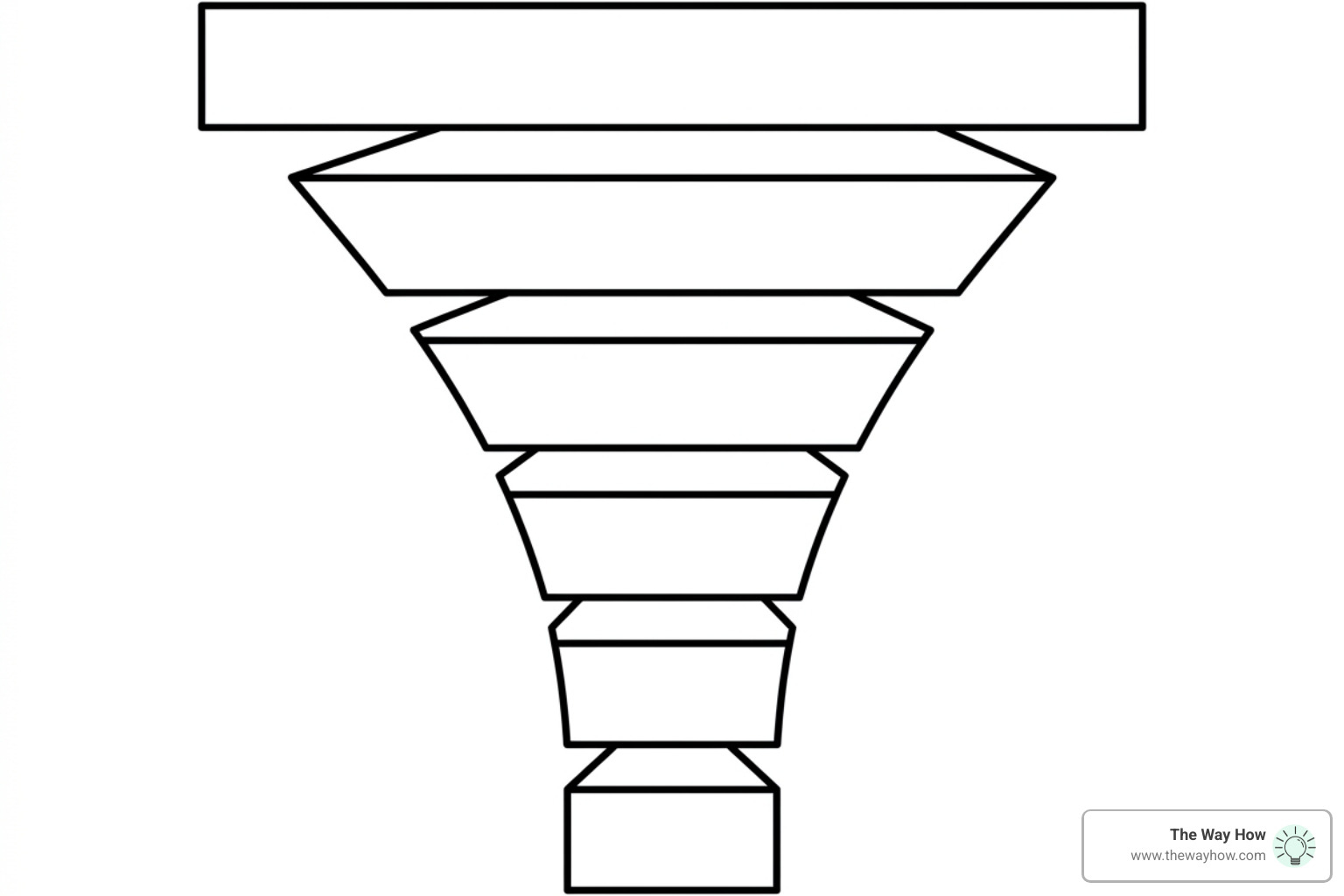
A highly effective model is the “Value Ladder.” You don’t ask for a marriage proposal on the first date. You start with “Bait” (a lead magnet), move to a “Frontend Offer” (a low-risk trial or small purchase), and gradually lead them to your “Backend” (high-ticket services).
When you build sales funnels, you must ensure each step provides enough value to earn the right to the next step. This is the core of a sustainable lead generation strategy.
Mapping channels to psychological intent
Not all channels are created equal. Someone searching on Google for “best CRM for small business” has higher intent than someone scrolling LinkedIn who happens to see your ad.
- SEO & Search: Captures active intent. These people are looking for answers.
- Social Media: Best for awareness and building “mental availability.”
- Email Marketing: The ultimate tool for nurturing and building trust over time.
- Referrals: Leverages the highest form of social proof — trust transferred from a friend.
Following a lead generation best practices guide ensures you aren’t shouting into the void, but rather meeting the buyer where their mind already is.
Content strategies for ToFu, MoFu, and BoFu
Your content must evolve as the prospect moves deeper into the customer acquisition funnel.
- ToFu (Awareness): Educational blogs, “how-to” videos, and infographics. The goal is to be helpful and visible.
- MoFu (Consideration): Case studies, webinars, and comparison guides. The goal is to prove your expertise and build preference.
- BoFu (Decision): Product demos, free trials, and testimonials. The goal is to remove the final barriers to purchase.
For B2B companies, our b2b lead generation complete guide details how to tailor these assets to complex buying committees where multiple stakeholders need to be convinced.
Measuring What Matters: Metrics Beyond Surface-Level Vanity
Clicks and impressions are “vanity metrics.” They feel good but don’t pay the bills. To truly optimize your funnel, you need to track the numbers that impact your bottom line.
According to research in How to Build a Customer Acquisition Funnel (Step-by-Step Guide), the most critical metrics include:
- Customer Acquisition Cost (CAC): Total sales and marketing spend divided by new customers.
- Customer Lifetime Value (CLV): The total revenue a customer generates over their relationship with you.
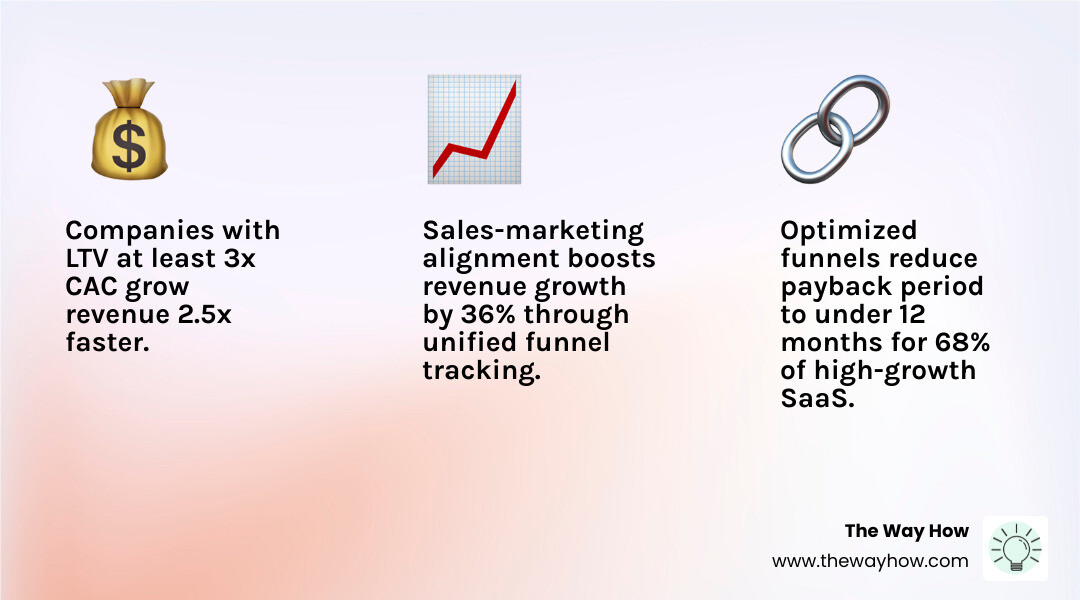
- CAC-to-LTV Ratio: A healthy business typically aims for an LTV that is at least 3x the CAC.
- Payback Period: How many months it takes to earn back the cost of acquiring a customer.
Tracking these allows you to evaluate different lead generation methods and strategies based on actual ROI rather than just lead volume.
Using AI and CRM for predictive insights
In 2026, manual spreadsheets are a liability. Tools like HubSpot allow you to unify your data and see the entire journey in one place. AI can now help prioritize leads based on “intent data” — identifying which prospects are actually ready to buy versus those just browsing.
Using hubspot lead generation tools, we can automate the nurturing process, ensuring that no lead falls through the cracks. Automation doesn’t mean being impersonal; it means using data to be more personal at scale.
Real-World Funnel Architecture: B2B SaaS, E-commerce, and Gaming
Different industries require different funnel structures, but the psychological principles remain the same.
| Industry | Primary ToFu Channel | Conversion “Hook” | Key Retention Metric |
|---|---|---|---|
| B2B SaaS | LinkedIn / SEO | Free Trial / Demo | Net Revenue Retention |
| E-commerce | Instagram / TikTok | Discount Code / Free Shipping | Repeat Purchase Rate |
| Gaming | YouTube / Game News | Free-to-Play / Demo | Daily Active Users (DAU) |
In B2B SaaS, the journey is often long and involves multiple “micro-conversions” like downloading an ebook or attending a webinar. You can find more details in our automated client acquisition funnel guide 2026.
Conversely, in e-commerce, the funnel is often compressed. A single Instagram ad can lead to a purchase within minutes. However, the “leak” often happens after the first purchase. Without a retention strategy, the CAC becomes unsustainable.
For professional services, such as a financial planning client acquisition funnel, the focus is almost entirely on trust and authority. The “onboarding” stage is where the relationship is truly won or lost.
Frequently Asked Questions about Acquisition Systems
What is the most common mistake in a customer acquisition funnel?
The most common mistake is driving cold traffic directly to a high-friction sales page. It is the digital equivalent of asking a stranger to marry you. You must establish trust first. If you haven’t addressed the “certainty gap” — the space between what the customer knows and what they need to feel safe — they will bounce.
How do you reduce CAC without sacrificing lead quality?
The most effective way to reduce CAC is to tighten your ICP. Stop spending money on people who are “sort of” a fit. Additionally, investing in organic channels like SEO and building a referral loop can lower your average cost over time because these channels have a compounding effect.
How does personalization impact funnel conversion?
Personalization is about relevance. When a prospect sees a message that mirrors their specific pain point or industry, their “cognitive friction” drops. They don’t have to work as hard to understand how you help them. This creates momentum and speeds up the transition from interest to decision.
Stop Patching Leaks and Start Building Dams
At The Way How, we believe that a customer acquisition funnel should be a dependable growth engine, not a source of constant anxiety. If you feel like you are pouring money into a leaky bucket, it’s time to stop chasing new tactics and start diagnosing the underlying system.
We specialize in helping founders and leadership teams remove uncertainty. Whether it’s through Fractional CMO leadership, optimizing your HubSpot architecture, or designing behavior-driven demand generation strategies, our goal is to create clarity.
We don’t just look at the data; we look at the human beings behind the data. We identify the certainty gaps that are stalling your growth and build the systems to close them.
Ready to turn your marketing into a predictable revenue driver? More info about our services