
Why Deals Go Dark (And It Is Not Why You Think)

Momentum sales acceleration techniques are structured methods for increasing the speed, predictability, and psychological certainty of deals moving through your pipeline — without simply asking your team to work harder or send more emails.
Here is a quick overview of what they include:
- Signal-based selling — acting on real-time trigger events like job changes or new executive hires before competitors do
- Pipeline stage optimization — applying clear qualification criteria and mutual action plans at every stage
- Behavioral sales frameworks — using methodologies like Challenger Sale and SPIN Selling to build urgency through insight, not pressure
- Momentum coaching — training leaders to coach deal progression, not just inspect pipeline volume
- Scalable sales systems — replacing founder intuition with documented, repeatable processes
- CRM and automation — using technology to maintain deal movement without adding manual effort
Most revenue leaders believe stalled deals are a rep performance problem. Work harder. Send more follow-ups. Close better.
But that diagnosis is almost always wrong.
Deals go dark because buyers lose certainty — not interest. Something shifts internally. A stakeholder gets added. A budget gets questioned. And because no one built enough alignment early, the deal quietly drifts.
Meanwhile, the sales environment has gotten measurably harder. The number of activities required to book a single outbound meeting has quadrupled since 2020. Deal cycles have stretched 66% longer. And at least 50% of the prospects most B2B sales teams are actively chasing are not actually a good fit for what the company sells.
The problem is not effort. It is architecture.
Most pipelines are built on volume assumptions — more calls, more emails, more demos — rather than on understanding how buyers actually make decisions. When the architecture is wrong, momentum cannot exist. Deals move forward when buyers feel certain and safe, not when reps feel urgent.
This guide is built for founders, CEOs, and revenue leaders who are done guessing. It walks through the specific techniques, frameworks, and systems that create genuine sales momentum — and explains why they work before telling you how to use them.
I am Jeremy Wayne Howell, founder of The Way How and a revenue growth strategist with over 20 years of experience helping companies diagnose what is actually breaking their pipeline and build buyer-psychology-driven systems that turn momentum sales acceleration techniques into predictable revenue. The thinking in this guide comes directly from that work — not from theory.
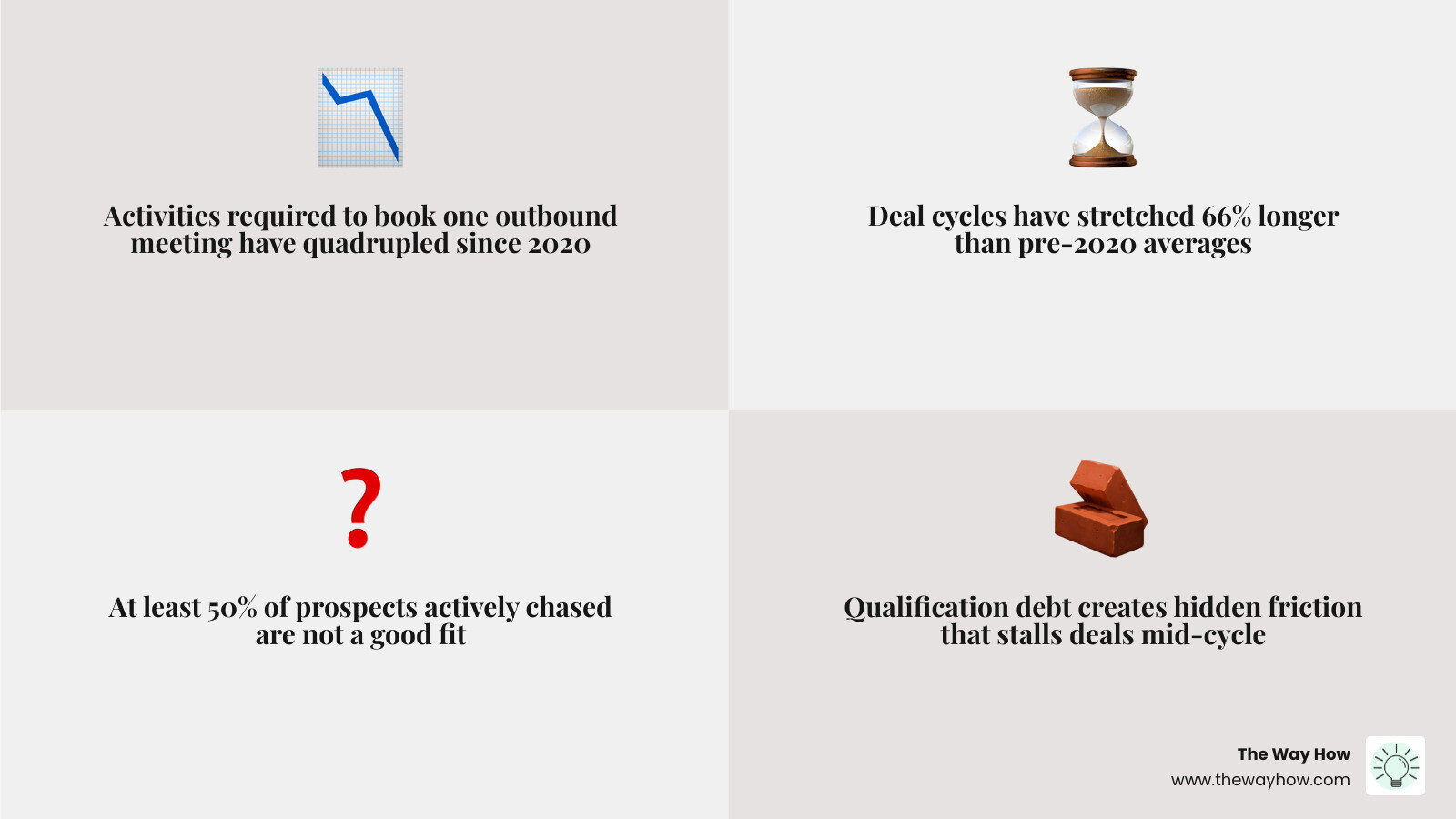
When a buyer goes silent after a seemingly stellar discovery call or demo, sales reps tend to panic. They follow up with “just checking in” emails or offer sudden discounts. This reaction is a symptom of qualification debt.
Qualification debt is the hidden tax a sales team pays when they prioritize moving a deal forward over establishing genuine alignment. If your reps do not address friction, budget constraints, or internal skepticism in the early stages, those unaddressed issues will inevitably resurface mid-cycle. The result is a stalled sales pipeline where prospects simply stop responding because the emotional cost of decision-making has become too high.
Redefining Velocity: Sales Acceleration vs. Traditional Volume Playbooks
Traditional sales playbooks focus almost entirely on volume: more activities, larger email blasts, and aggressive closing sequences. But in 2026, where 80% of B2B sales interactions occur in digital channels, buyers have developed a deep skepticism toward cold, generic outreach.
The old “list-blast-pray” methodology is mathematically broken. When you push more volume into a flawed system, you only accelerate your team’s burnout and damage your brand’s reputation.
Sales acceleration is not about doing things faster; it is about removing the structural drag that slows down the buyer’s journey. It means building a B2B Sales Strategy focused on removing friction and establishing trust.
| Traditional Volume Sales | Modern Sales Acceleration |
|---|---|
| High-volume cold outreach (1-5% reply rates) | Signal-based, high-context outreach (25-40% reply rates) |
| Rep-driven urgency and aggressive closing | Buyer-centric momentum and mutual action plans |
| Intuitive, founder-led qualification | Documented, reproducible qualification criteria |
| Inspection of activity metrics (calls, emails sent) | Inspection of deal health and velocity metrics |
| Chasing any prospect who shows interest | Laser-focused targeting on the Ideal Customer Profile (ICP) |
The Psychology of Momentum: Keeping Deals Moving Through the Funnel
Momentum is not just an physical concept; it is a fundamental leadership skill. As Vince Beese outlines in Momentum Is a Leadership Skill, momentum disappears because no one teaches reps how to maintain or regain control of a deal mid-cycle.
To manage momentum systematically, we can divide the sales process into two primary zones:
- The Green Zone (The Momentum Zone): This is the early stage of the sales cycle. Buyers are curious, meetings are relatively easy to book, and the energy is high. However, this is also where qualification debt is accumulated. If you do not test urgency and establish clear mutual agreements here, the deal will stall later.
- The Red Zone (The Procedural Zone): This is the late stage where more stakeholders emerge, procurement gets involved, and budgets are scrutinized. If you run structured, disciplined plays in the Green Zone, the Red Zone becomes a boring, predictable formality. If you ignore early friction, the Red Zone becomes chaotic and unpredictable.
To understand how to design these pathways, refer to our Ultimate B2B Sales Funnels Guide.

Optimizing the Key Stages of Your Sales Pipeline
To prevent deal drift, every stage of your pipeline must have explicit, objective exit criteria. Instead of relying on a rep’s “good feeling,” transition deals based on verified buyer actions.
First, establish a Mutual Action Plan (MAP) early in the sales cycle. A MAP is a shared document that outlines the exact steps both your team and the buyer must take to evaluate, purchase, and implement your solution. It shifts the dynamic from a vendor-buyer transaction to a collaborative partnership.
Second, practice early multi-threading. Relying on a single champion is one of the most common reasons deals stall. If your point of contact leaves the company or gets reassigned, your deal dies. You must map out and engage the broader buying committee—including economic decision-makers, technical evaluators, and end-users—during the initial stages. For a step-by-step breakdown of how to build these pathways, see our guide on how to Build Sales Funnels.
Coaching Momentum Over Activity
Most sales managers run deal reviews by looking backward at pipeline volume or asking generic questions like, “When is this closing?” This type of inspection does not create alignment or build momentum.
Instead, transition your leadership team to Coaching Sales Team dynamics. Focus coaching sessions on the Green Zone. Ask your reps to prove the buyer’s commitment:
- What is the specific, scheduled next step?
- Have we confirmed the buyer’s internal decision-making process?
- Who else have we engaged besides our primary champion?
- What is the cost of inaction that the buyer has explicitly agreed to?
By shifting coaching from late-stage inspection to early-stage deal qualification, you prevent low-probability opportunities from clogging your pipeline.
Core Momentum Sales Acceleration Techniques for Modern Pipelines
To build a high-velocity revenue engine, you must implement specific momentum sales acceleration techniques that align with how modern buyers make decisions. These techniques are designed to reduce cognitive load and build trust.
Designing High-Velocity Momentum Sales Acceleration Techniques
To evaluate the health of any deal in your pipeline, we recommend using a simple four-part filter:
- Fit: Does this prospect match our highly defined Ideal Customer Profile (ICP)? Pursuing the wrong accounts accounts for 50% of wasted sales effort.
- Friction: What internal roadblocks (legal, IT security, change management) will this buyer face, and how can we proactively help them navigate those hurdles?
- Funding: Has the budget been allocated, or are we trying to sell a “nice-to-have” solution during a budget freeze?
- Forecast: Do we have a clear, verified timeline based on the buyer’s business milestones, or are we guessing?
By systematically applying this filter, you can identify which deals are worth pursuing and which ones should be gracefully exited. For more advanced strategies on structuring your commercial approach, explore our guide on Disruptive Sales Strategies.
The 90-Day Momentum Window: Why Q2 Prospecting Prevents Q4 Panic
Revenue is a delayed signal. The closed-won deals you secure in Q4 are the direct result of prospecting actions taken roughly 90 days earlier—primarily during Q2.
When sales teams experience a strong Q1, they often make the mistake of reducing their early-stage prospecting efforts to focus entirely on closing mid-funnel deals. This creates a severe pipeline lag effect. By the time Q3 and Q4 arrive, the pipeline has dried up, leading to reactive, desperate selling behaviors (such as heavy discounting or expensive, last-minute travel).
To maintain a consistent commercial operating rhythm, you must implement behavioral reinforcement strategies that reward early-stage prospecting activities. Do not just celebrate closed-won deals; measure and reward the daily, consistent actions that build predictable pipeline.
Behavioral Frameworks: Merging Challenger and SPIN Methodologies
To keep deals moving, your reps must act as trusted advisors rather than product pushers. This requires structured behavioral frameworks that guide the conversation naturally. We frequently combine the Challenger Sale and SPIN Selling methodologies to achieve this. To scale these behaviors across your organization, consider investing in structured Sales Enablement Training.
Challenging Buyer Assumptions to Build Urgency
Modern B2B buyers have already done extensive research before they ever speak to a sales representative. If your reps simply repeat product features, they add zero value.
The Challenger methodology teaches reps to take control of the conversation by presenting unique, data-backed perspectives that challenge the customer’s underlying assumptions. As explored in Supercharge your Sales with Momentum.io and the Challenger Sales Methodology, this approach relies on three core pillars:
- Teaching: Providing commercial insights that help the buyer see their business challenges in a new light.
- Tailoring: Customizing the message to address the specific economic and psychological drivers of each stakeholder.
- Taking Control: Comfortably discussing pricing, challenging customer pushback, and guiding the decision-making process.
SPIN Questioning as Momentum Sales Acceleration Techniques
To build deep trust, your reps must prioritize active listening over delivering pitches. The SPIN Selling framework provides a structured questioning sequence that helps buyers discover their own needs:
- Situation Questions: Gathering basic facts and context about the prospect’s current state.
- Problem Questions: Uncovering the specific pain points, difficulties, and dissatisfactions they are facing.
- Implication Questions: Exploring the consequences and ripple effects of those problems if left unresolved. This is where urgency and the “cost of inaction” are built.
- Need-Payoff Questions: Helping the buyer articulate the value and benefits of solving the problem.
As detailed in Spin Up your Sales with Momentum.io and the SPIN Selling Methodology, the goal of SPIN is to guide the buyer toward an “Advance” (a concrete, action-oriented next step) rather than a mere “Continuation” (a polite but non-committal agreement to stay in touch).
Signal-Based Selling: Turning Intent into Action
The traditional outbound playbook is mathematically broken because it relies on cold, out-of-context outreach. Modern high-velocity teams are transitioning to signal-based selling, which matches real-time buyer intent with highly tailored plays.
According to The Signal-Based Sales Playbook: From First Alert to Booked Meeting | Salesmotion, teams running signal-based plays are booking meetings at 25-40% reply rates, while the rest of the market struggles at 1-5%.

Capitalizing on Past Champions and Executive Hires
Not all sales signals are created equal. The two highest-converting trigger events you should track are:
- Past Champion Job Changes: When a champion who successfully used your product at a previous company moves to a new organization, they convert at 3x the rate of cold prospects. These warm, known contacts deliver 114% higher win rates, 12% shorter sales cycles, and 54% higher deal sizes.
- New Executive Hires: New executives typically spend 70% of their allocated budget within their first 100 days on the job. These hires convert at 2.5x higher rates during their first three months compared to after their first year.
By tracking these job changes, your team can reach out with high-context, warm messages precisely when these leaders are looking to make an impact.
Operationalizing Signals into Repeatable Plays
Simply having signal data in a dashboard is not enough; it quickly becomes noise. You must operationalize these signals into repeatable, structured plays. For every high-priority signal, define:
- The Owner: Who is responsible for acting on this signal (e.g., the Account Executive or Sales Development Representative)?
- The Channel: What is the most effective channel for outreach (e.g., LinkedIn, personal email, or a phone call)?
- The SLA: What is the required response time (e.g., within 72 hours of a past champion’s job change)?
- The Message Template: A highly tailored, non-generic message template that references the specific trigger event and offers immediate value.
Scaling Past $5M ARR: Transitioning from Founder-Led Heroics to Systems
Reaching $5M ARR is an incredible milestone, but the commercial dynamics that got you there will not get you to $10M. At the $5M ARR breakpoint, customer acquisition costs (CAC) typically climb by 40% to 60% while conversion rates drop. Only one in ten software startups ever successfully reaches $10M ARR.
As Reggie James explains in How to build a scalable sales motion when you are growing past $5M to $10M ARR | by Reggie James | Apr, 2026 | Medium, this stagnation occurs because companies continue to rely on “artisanal,” founder-led sales heroics rather than building a systematic, repeatable revenue engine. To successfully scale, you must transition to professional B2B Sales Consulting methodologies that codify your sales motion.
Documenting a Reproducible Sales Motion
To scale your sales team past $5M ARR, you must document your entire sales process so that any new hire can replicate your top performers’ success. This documentation should include:
- Step-by-Step Discovery Scripts: Moving away from intuitive conversations to structured, psychology-driven discovery frameworks.
- Objective Qualification Criteria: Clear, explicit conditions that must be met before a deal can progress to the next pipeline stage.
- Objection Handling Playbooks: Documented strategies for addressing common competitive, technical, and financial objections.
To design and implement these systematic playbooks, review our Sales Team Optimization Complete Guide.
Establishing a Commercial Operating Rhythm
A scalable sales motion requires a consistent operating rhythm to keep the system honest. This rhythm includes:
- Structured Pipeline Reviews: Moving away from deal volume discussions to evaluating deal quality and velocity.
- Regular Win-Loss Analysis: Systematically analyzing why deals were won or lost, and feeding those insights back into your ICP definition and qualification criteria.
- Marketing and Sales Alignment: Establishing shared, behavior-driven metrics that ensure both teams are focused on generating high-probability revenue, not just lead volume.
To align your consulting and commercial strategies, read our guide on Sales Strategy For Consulting Firms.
The Tech Stack as an Accelerator: CRM, Automation, and AI
Technology should never be used as a band-aid for a broken sales process. However, when paired with a clear behavioral strategy, modern Sales Enablement Tools can dramatically accelerate your pipeline.
Your CRM should serve as the single source of truth and the foundation for your automation. Use CRM workflows to automate follow-up emails after meetings, place lost deals into automated nurture campaigns, and trigger alerts when high-value signals occur. By automating these administrative tasks, you free up your reps to focus on what they do best: building genuine human relationships.
Essential Metrics for Measuring Acceleration Success
To measure the effectiveness of your sales acceleration efforts, track metrics that reflect momentum and deal health:
- Sales Cycle Length: The average number of days it takes for a deal to move from creation to closed-won.
- Pipeline Velocity: A calculation of how much revenue flows through your pipeline per day, based on the number of active opportunities, average deal size, win rate, and sales cycle length.
- Conversion Rates: The percentage of deals that successfully transition from one pipeline stage to the next.
- Outbound Reply Rates: The response rate of your prospecting campaigns, comparing traditional cold outreach against signal-based plays.
Frequently Asked Questions About Sales Momentum
Why do deals stall mid-cycle?
Deals typically stall mid-cycle because of qualification debt accumulated during the early stages. If your reps do not address internal friction, map out the broader buying committee, or establish a clear cost of inaction early on, the buyer will lose certainty and quietly drift away when decision-making becomes complex.
What is the difference between sales speed and sales momentum?
Sales speed is simply trying to force a transaction to happen faster, which often increases buyer anxiety and leads to stalled deals. Sales momentum is about systematically removing the friction and uncertainty that slow down the buyer’s journey, allowing the prospect to move forward naturally and confidently.
How do signal-based plays improve outbound reply rates?
Signal-based plays improve reply rates because they target prospects who are experiencing a specific, high-context trigger event (such as a past champion changing jobs or a new executive hire). Because the outreach is highly relevant and timely, reply rates typically range from 25% to 40%, compared to just 1% to 5% for cold outreach.
Restoring Certainty to Your Revenue Engine
At The Way How, we believe that sustainable revenue growth is not about chasing the latest sales hacks or forcing your reps to work longer hours. It is about understanding the fundamental psychology of how human beings make decisions.
We help founders and leadership teams remove uncertainty from their commercial systems by diagnosing why growth has stalled, identifying certainty gaps in the customer journey, and designing highly structured, behavior-driven sales engines. Whether you need Fractional CMO leadership, a robust HubSpot architecture, or a scalable, signal-based sales playbook, we align your GTM strategy with human empathy and operational execution.
If you are ready to stop guessing and start building a predictable, high-momentum revenue engine, we invite you to take the next step.
Book an AI Transformation Session with our team today, and let us help you turn your sales pipeline into a dependable growth engine.