A Complete Guide to CRM Systems and Database Management
 Jeremy Wayne Howell : Jul 22, 2026 9:48:31 PM
B2B SaaS growth follows a fixed sequence — and most companies that stall don’t have a tactics problem. They have a stage problem.
Here’s the short answer for those who want it fast:
The 4 stages of B2B SaaS growth — in order:
You cannot skip a base. Companies that try end up back where they started — frustrated, over-invested, and no closer to scale.
The pressure to grow is real. Investors expect it. Competitors are moving. And yet the median growth rate for private B2B SaaS companies in 2024 was just 25% — down from 30% the year before. Only a fraction of companies will ever reach $100M ARR.
What separates those that do? It’s rarely the product. More often, it’s whether the team knew which stage they were actually in — and built their go-to-market accordingly.
This guide walks through every stage of the journey: what defines it, what it demands, and what breaks when companies try to shortcut it.
I’m Jeremy Wayne Howell, a revenue growth strategist with over 20 years of experience helping B2B SaaS founders and revenue leaders diagnose what’s actually blocking their growth — not just optimize what’s already running. My work at The Way How is built around understanding the human side of B2B SaaS growth: the buyer psychology, the certainty gaps, and the behavioral patterns that no funnel report will show you. Let’s start at the beginning — with why so many scaling engines stall before they ever leave the ground.
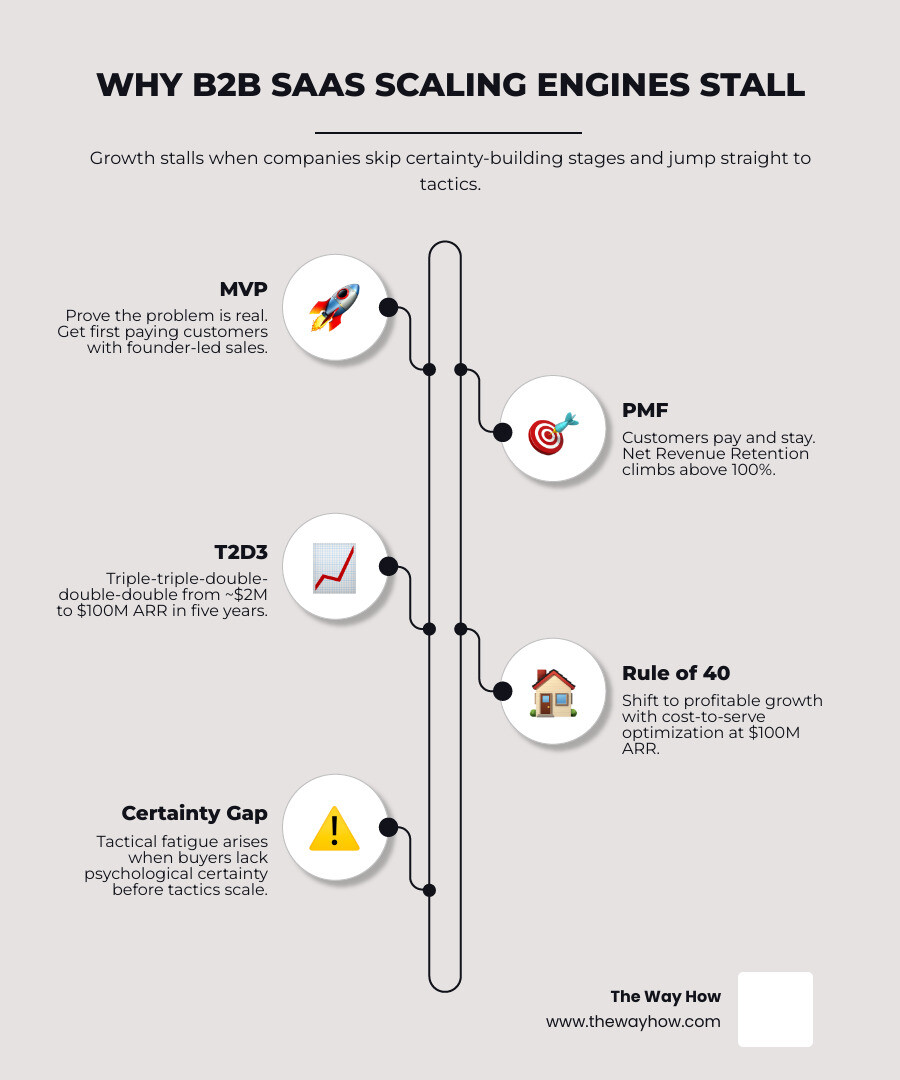
When we look at B2B SaaS companies that stall between $1M and $10M ARR, we rarely find a bad product. Instead, we find tactical fatigue. The leadership team is running every play in the marketing playbook: paid search, outbound email, LinkedIn thought leadership, webinars, and SEO. Yet, the pipeline remains dry, and customer acquisition costs (CAC) continue to climb.
Why does this happen? It happens because of “certainty gaps” in the B2B Customer Journey.
In B2B purchasing, the primary emotional driver is not desire; it is the avoidance of regret. B2B buyers are risk-averse. They are protecting their budgets, their time, and their professional reputations. When a SaaS company scales its marketing tactics before establishing psychological certainty for the buyer, it is simply magnifying confusion.
If your messaging does not address the buyer’s unspoken fears—such as implementation failure, internal resistance, or hidden costs—no amount of ad spend will convert them. Before launching a multi-channel demand generation campaign, you must first diagnose where the customer journey is broken.
We often use a baseball analogy to explain the journey of B2B SaaS growth. To score a run and reach home plate ($100M ARR), a runner must touch every base in order. You cannot sprint from first base directly to third.

In SaaS, the bases are:
Skipping a base—such as attempting to scale a sales team (Third Base) before proving that customers will actually stay (Second Base)—is the most common cause of SaaS failure. When you scale a leaky bucket, you simply waste capital. To build a predictable growth engine, you must respect the sequential nature of the B2B SaaS Growth Framework - 2026 Complete Guide.
At this initial stage, your goal is simple: prove a problem-solution fit. You are looking for validation that a specific group of buyers has a painful problem and is willing to pay money for your solution.
To get off first base, you need a repeatable way to find prospects who feel the pain acutely. For a detailed breakdown of how to build this initial pipeline, refer to our B2B Lead Generation Complete Guide.
Reaching second base means moving beyond “paying” customers to “paying and staying” customers. Many founders mistake early sales success for product-market fit. True PMF is defined by retention.
According to data from the B2B SaaS 2026: Complete Guide to Metrics, GTM & AI - maketocreate.com, companies with the highest Net Revenue Retention report median growth that is 83% higher than the population median. In fact, increasing NRR from the 90-100% range to the 100-110% range improves your overall growth rate by 5 percentage points. Retention is the ultimate foundation for scale.
Once you have established PMF and reached approximately $2M in ARR, you are ready for third base: T2D3 growth. This is the hyper-scale phase where you transition from a single-threaded tactical approach to a multi-threaded GTM strategy.
At this stage, you must shift your marketing from a series of ad-hoc campaigns to a repeatable learning system. The focus is on removing friction from the buyer’s decision-making process across multiple personas.
Reaching home plate means achieving sustainable scale. At $100M+ ARR, your company is a market leader, and your strategic priorities must shift.
To sustain growth at this level, you need sophisticated B2B Revenue Strategies that focus on operational efficiency and customer lifetime value.
The T2D3 formula represents the growth trajectory that venture capitalists expect from a high-performing B2B SaaS company after achieving product-market fit. It stands for Triple, Triple, Double, Double, Double over a five-year period.
Here is how the five-year journey maps out from a starting point of ~$2M ARR:
| Year | Growth Target | ARR Target | GTM Focus Area |
|---|---|---|---|
| Year 1 | Triple (3x) | $6M | Establish repeatable outbound & paid acquisition channels |
| Year 2 | Triple (3x) | $18M | Diversify demand generation; optimize CAC payback |
| Year 3 | Double (2x) | $36M | Build out product-led expansion & customer success |
| Year 4 | Double (2x) | $72M | Introduce channel partnerships & enterprise sales motions |
| Year 5 | Double (2x) | $144M | Focus on global expansion & cost-to-serve optimization |
This is a steep climb. To achieve these targets, you must execute The 5 Factors of a B2B SaaS Growth Strategy for T2D3 in parallel. You cannot rely on a single channel; you must build a robust, multi-channel B2B Sales Strategy that reaches buyers wherever they are researching solutions.
As you progress through the T2D3 journey, your go-to-market motion must adapt to your Average Contract Value (ACV).
To visualize how these motions intersect with the buyer’s experience, teams often map out detailed customer journeys. You can find practical models in our guide on B2B Customer Journey Map Examples.
Achieving T2D3 growth requires a balanced approach. You cannot simply spend your way to scale. You must optimize five key growth factors simultaneously:

The two most common failure points during the T2D3 transition are the “conversion gap” (failing to turn trials or leads into paying customers) and the “retention gap” (losing customers within their first 90 days).
To close these gaps, you must plan for churn from day zero. This means mapping out the exact steps a customer must take to realize value from your software, and automating the support they receive during those critical moments.
For example, you can use behavioral triggers to send targeted, contextual emails when a user stalls during onboarding. For practical ideas on how to set up these systems, review our B2B Marketing Automation Examples Guide.
Additionally, don’t overlook operational friction. Simple changes, such as localizing your payment methods and currencies, can have a major impact. In South Korea, for instance, 70% of buyers prefer local payment methods over international options. Localizing payments has been shown to deliver an average revenue uplift of 9% globally.
According to the McKinsey study “Grow Fast or Die Slow,” SaaS companies growing at only 20% per year have a 92% chance of ceasing to exist within a few years. Even at 60% annual growth, a company’s chances of reaching giant scale are only 50/50.
Most companies stall because they attempt to scale before they have built a repeatable engine. They mistake early founder-led sales for product-market fit, hire an expensive sales team, and watch their capital burn.
To benchmark your performance, look at how you compare to private B2B SaaS peers at different ARR levels:
If your growth has stalled, you need to step back and diagnose the system before changing your tactics. For guidance on how to run this diagnosis, consider engaging with a specialist through B2B Sales Consulting. You can also read about proven scaling frameworks in the B2B SaaS Growth: From 0 to $10M ARR — The Playbook That Works | Growth Tools Blog.
To determine which stage of growth you are truly in—and what steps you should take next—you must look at your core operational metrics:
(New Quarterly MRR x 4) / Sales & Marketing Spend Last Quarter. A score above 0.75 indicates a healthy, efficient acquisition engine that is ready for investment. A score above 1.0 is excellent.If your metrics are healthy, you are ready to scale your acquisition channels. If you are using HubSpot as your primary system of record, you must ensure your data architecture is configured correctly to track these metrics without manual effort. For tips on setting up this tracking, read our guide on B2B Marketing HubSpot.
Most SaaS companies stall at $1M ARR because of the “SMB trap.” They build their early traction by selling to small businesses because the sales cycles are short and easy to close. However, small businesses have high churn rates and low average contract values.
When the company tries to move upmarket to mid-market or enterprise buyers to find stability, they run into friction. Their product lacks enterprise-grade security, their sales team doesn’t know how to navigate multi-stakeholder procurement, and their marketing fails to establish the psychological certainty that enterprise buyers require.
The shift from pure growth to the Rule of 40 typically occurs as a company approaches $100M ARR, or when market capital becomes expensive. In the early stages ($2M - $10M ARR), growth is highly valued, and investors are willing to tolerate high burn rates to capture market share.
As your market matures and your revenue reaches scale, the cost of acquiring new customers rises. At this stage, your focus must shift to profitability, customer expansion, and cost-to-serve optimization. The Rule of 40 ensures that you are balancing your growth investments with capital efficiency.
AI is fundamentally changing the economics of B2B SaaS. Historically, the benchmark for a healthy SaaS company was $200K - $400K of ARR per employee. Today, AI-native companies are operating at $500K - $1M of ARR per employee.
AI allows small teams to achieve massive scale by automating manual processes. In marketing, AI enables a 2-3x increase in content volume and a 5x increase in research speed, allowing teams to repurpose a single executive interview into dozens of high-quality assets. In customer success, AI-driven automation helps manage user onboarding and support requests without a corresponding increase in headcount.
Scaling a B2B SaaS company is a complex challenge. When growth stalls, the natural reaction is to try new marketing tactics, launch new campaigns, or hire more salespeople. But more activity rarely solves a structural problem.
At The Way How, we believe that sustainable growth is built on clarity and systems, not ad-hoc tactics. We help B2B SaaS founders and leadership teams diagnose why their growth has stalled, identify the certainty gaps in their customer journey, and design systems that build trust and momentum.
Whether you need hands-on leadership to guide your go-to-market strategy, a complete audit of your HubSpot architecture, or a behavior-driven demand generation plan, we are here to help you turn marketing into a predictable growth engine.
If you are ready to remove uncertainty from your revenue systems, consider bringing in a B2B Fractional CMO to guide your team through the transition. For a detailed explanation of how fractional leadership can support your scaling journey, read More info about Fractional CMO services. If your marketing automation systems are holding you back, we can also connect you with a B2B Marketing Automation Consultant to optimize your operations.
 Jeremy Wayne Howell : Jul 22, 2026 9:48:31 PM
 Jeremy Wayne Howell : Jul 21, 2026 9:47:10 PM
 Jeremy Wayne Howell : Jul 20, 2026 9:46:47 PM