
Most Pipeline Problems Start Here

B2B demand gen is the ongoing process of building awareness, trust, and interest in your product or service among businesses that may eventually buy from you — long before they’re ready to talk to sales.
Here’s the short version:
| What it is | What it isn’t |
|---|---|
| A long-term strategy to create and capture buyer interest | A one-time campaign or lead list purchase |
| Full-funnel: from first awareness to closed deal | Just lead generation (that’s one part of it) |
| Focused on educating the 95% not yet in-market | Chasing the 5% already ready to buy |
| Measured by pipeline, revenue, and win rates | Measured by MQL volume alone |
B2B demand gen works by making your brand familiar, credible, and trusted before a buyer ever fills out a form. When they’re finally ready to buy, you’re already on their shortlist.
That matters more than most teams realize. Research shows that 80–90% of B2B buyers already have a vendor shortlist in mind before they begin formal research — and nine out of ten choose from that list.
If you’re not on it, no amount of outbound or ad spend will fix that.
I’m Jeremy Wayne Howell, founder of The Way How — a psychology-first revenue strategy firm — and I’ve spent over 20 years helping founders and revenue teams diagnose why growth stalls and rebuild their go-to-market around how buyers actually make decisions, including building B2B demand gen systems that create predictable pipeline rather than just activity. What follows is the clearest, most practical breakdown of B2B demand gen I know how to write.
B2B demand gen basics:
The Psychology of the Modern B2B Buyer
To understand B2B demand gen, we have to first understand the person on the other side of the screen. By April 2026, the digital noise has reached a fever pitch. AI-generated content is everywhere, and buyers have developed a sophisticated “defense mechanism” against traditional marketing.
The average B2B buyer is emotionally exhausted. They are not looking for more “information”—they are looking for clarity and safety. In a corporate environment, a bad purchase decision doesn’t just lose money; it costs social capital and career momentum. This is why 80% of tech buyers say they can build a vendor shortlist entirely from online information without ever speaking to a sales rep.
They are self-educating in the “dark funnel”—places like Slack communities, podcasts, and private peer networks where your tracking pixels cannot follow. If your strategy relies on gating a PDF to “catch” them, you are likely pushing them away. Modern B2B demand gen is about entering that dark funnel by providing so much value that you become the obvious choice before they ever hit your “Request a Demo” page.
Demand Generation vs. Lead Generation: The Great Divide
We often see these terms used interchangeably, but they represent two very different mentalities.
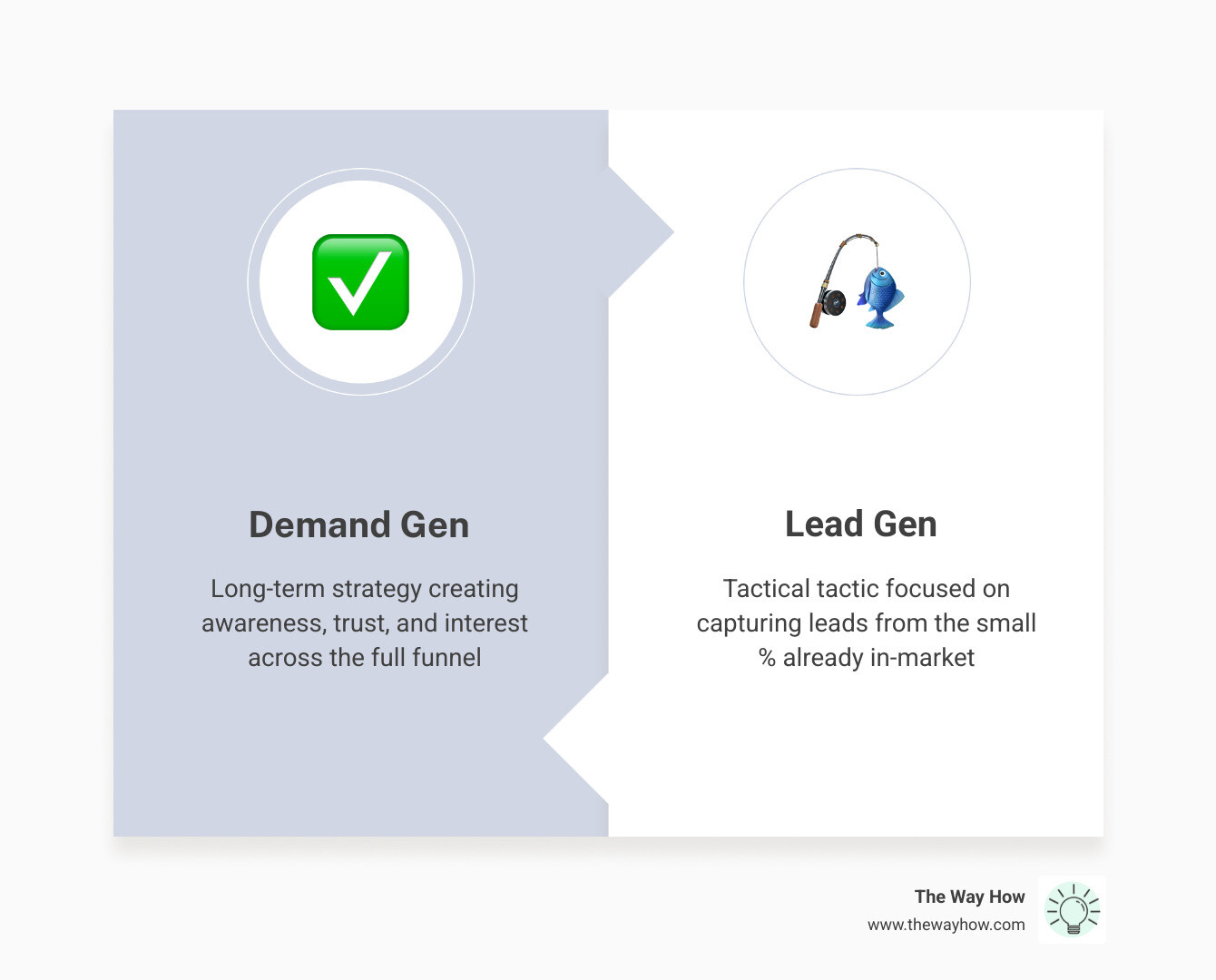
Lead generation is tactical and transactional. It focuses on the “capture”—getting an email address in exchange for a whitepaper. The goal is volume. But as many sales teams will tell you, a high volume of leads often results in “garbage” data—people who just wanted the PDF and have no intention of buying.
B2B demand gen is the strategic umbrella. It includes lead generation, but it starts much earlier and ends much later. While lead generation asks, “How can we get their contact info?” demand generation asks, “How can we make them want to solve this problem with us?”
- Lead Gen: Captures the 5% of the market actively looking to buy today.
- Demand Gen: Educates the 95% who aren’t buying yet but will be in six to eighteen months.
When you focus only on lead gen, you are fighting over a tiny sliver of the market with all your competitors. When you master demand gen, you own the mental real estate of the other 95%.
For a deeper dive into these differences, see our B2B Lead Generation Complete Guide.
Creation vs. Capture: The Two Halves of Revenue
Effective B2B demand gen requires a balance between two distinct activities:
1. Demand Creation
This is about building “mental availability.” You are teaching the market that a problem exists, that there is a better way to solve it, and that your brand is the authority on the subject. This happens through ungated content, social media insights, and podcasts. You aren’t asking for anything; you are giving.
2. Demand Capture
This is where you meet the buyers who are already looking. They are searching for keywords like “best CRM for manufacturing” or “how to reduce churn.” Tactics here include SEO, PPC, and G2 reviews. If you haven’t done the work of demand creation, demand capture becomes much more expensive because you’re bidding against everyone else for a stranger’s attention.
Why B2B Demand Generation is Your Only Real Competitive Advantage
When features are easily copied, your brand’s relationship with the buyer’s mind is the only thing that can’t be stolen.
Effective B2B demand gen provides a competitive edge by:
- Shortening Sales Cycles: When a lead arrives already trusting your expertise, they don’t need to be “convinced.” They need to be “onboarded.”
- Increasing Average Contract Value (ACV): Trusted authorities can charge a premium. Commodities have to compete on price.
- Improving Sales Morale: Sales reps stop chasing “dead-end” ebook downloaders and start having consultative conversations with high-intent prospects.
The Five Pillars of a Sustainable Engine
To build a B2B demand gen system that doesn’t break, we focus on five core pillars:
- Goals: Moving beyond vanity metrics (likes, downloads) to revenue-centric KPIs (pipeline value, win rates).
- Audience: Deeply understanding your Ideal Customer Profile (ICP). This isn’t just “Job Title” and “Company Size.” It’s about their “jobs-to-be-done,” their fears, and what triggers them to change.
- Content: Moving from “promotional” to “educational.” Your content should solve a small part of their problem for free.
- Channels: Being where your buyers hang out. If they are on LinkedIn, you should be there with a strong professional presence.
- Measurement: Using a mix of software attribution and self-reported attribution (“How did you hear about us?”) to see into the dark funnel.

The Stages of the Demand Generation Funnel
The journey isn’t a straight line, but for the sake of strategy, we can look at it through these stages:
Awareness (Top of Funnel)
The buyer realizes they have a problem or an opportunity. They aren’t looking for a product; they are looking for a diagnosis. Your role here is thought leadership.
Consideration (Middle of Funnel)
The buyer is evaluating different categories of solutions. They might be asking, “Should we hire an agency or buy software?” This is where your Hubspot B2B Marketing Strategies and comparison guides come into play.
Decision (Bottom of Funnel)
The buyer has picked a category and is now picking a vendor. They need social proof, case studies, and clear ROI calculations.
Retention and Expansion (Post-Purchase)
Demand gen doesn’t stop at the signature. It continues by turning customers into advocates, which feeds back into the top of the funnel.
Proven Strategies and Tactics for 2026
What actually works in the current market? We’ve seen a shift away from “hacks” toward “helpfulness.”
- The Content Capsule: Instead of producing 20 mediocre blogs, produce 3-4 “pillar” assets that are so good your ICP would pay for them. Then, repurpose those into 50 social posts, 10 emails, and 2 webinars.
- LinkedIn Thought Leadership: 92% of B2B customers are willing to engage with sales reps who have positioned themselves as industry thought leaders. Personal profiles currently outperform company pages 10:1 in reach and engagement.
- Webinars as Events: Stop doing “product demos” and start doing “practitioner panels.” When you bring in experts to solve real problems, you generate 4x more pipeline per attendee.
- Intent Data: Nearly 40% of businesses now allocate over half their marketing budget to intent data tools (like 6sense or ZoomInfo) to find out who is actively researching their category before they ever visit the website.
For more tactical advice, check out Demand Generation Best Practices.
Inbound vs. Outbound: A False Dichotomy
In a modern B2B demand gen strategy, inbound and outbound are two sides of the same coin.
Inbound is the magnet. It draws people in by being helpful and visible. It’s great for long-term compounding growth. Outbound is the spear. It is proactive and targeted.
However, “cold” outbound is dying—90% of B2B decision-makers never respond to it. Successful outbound today is “warm.” It involves sales reps sharing relevant content and insights with prospects who have already shown some level of engagement with the brand’s demand creation efforts.
Learn how to balance these in our Outbound Lead Generation Complete Guide.
The Role of Content Marketing
Content is the fuel for your demand gen engine. But not all content is created equal. 62% of B2B decision-makers place a premium on practical content, such as case studies and visual materials like webinars.
The key is to ungate your educational content. If you want people to trust you, let them read your best ideas without forcing them to fill out a form. Gate your tools (calculators, templates, audits) instead. This builds massive goodwill and ensures that when someone does fill out a form, they are already “sold” on your philosophy.
Leveraging Technology: SEO, PPC, and Social Media
These are the delivery vehicles for your message.
- SEO: Focus on “problem-aware” keywords. Don’t just rank for your product name; rank for the questions your buyers ask at 2:00 AM.
- PPC: Use paid search to capture existing demand and paid social (like LinkedIn Ads) to distribute your best content to a specific, targeted list of accounts.
- Social Media: It’s not a distribution channel for links; it’s a platform for conversation. 81% of buyers are more likely to engage with brands that have a cohesive professional social presence.
The Demand Generation Waterfall Model
The “Waterfall” (originally popularized by SiriusDecisions) is a way to track how a lead moves from an anonymous visitor to a closed customer. In 2026, we look at:
- Target Demand: The total number of accounts in your ICP.
- Engaged Demand: Accounts interacting with your content.
- Prioritized Demand: Accounts showing high-intent signals.
- Qualified Lead: When a human confirms there is a fit and a need.
- Pipeline: The dollar value of the opportunities created.
How to Build Your Strategy from Scratch
If you are starting from zero, don’t chase twenty channels. Follow this three-step “Be Ready” framework:
- Be Ready (The Foundation): Conduct an 80/20 analysis of your current customers. Who are the 20% that bring 80% of the value? Interview them. Find out what triggered them to look for you. Map their B2B Customer Journey.
- Be Helpful (The Content): Create a “content capsule” based on those interviews. Address the blockers and motivators you uncovered.
- Be Seen (The Distribution): Pick two channels (e.g., LinkedIn and SEO) and be relentlessly consistent. Use the 1:Many / 1:Few / 1:1 model to scale your reach.
For a step-by-step roadmap, see our Demand Generation Strategy Complete Guide.
Measuring Success: KPIs That Matter
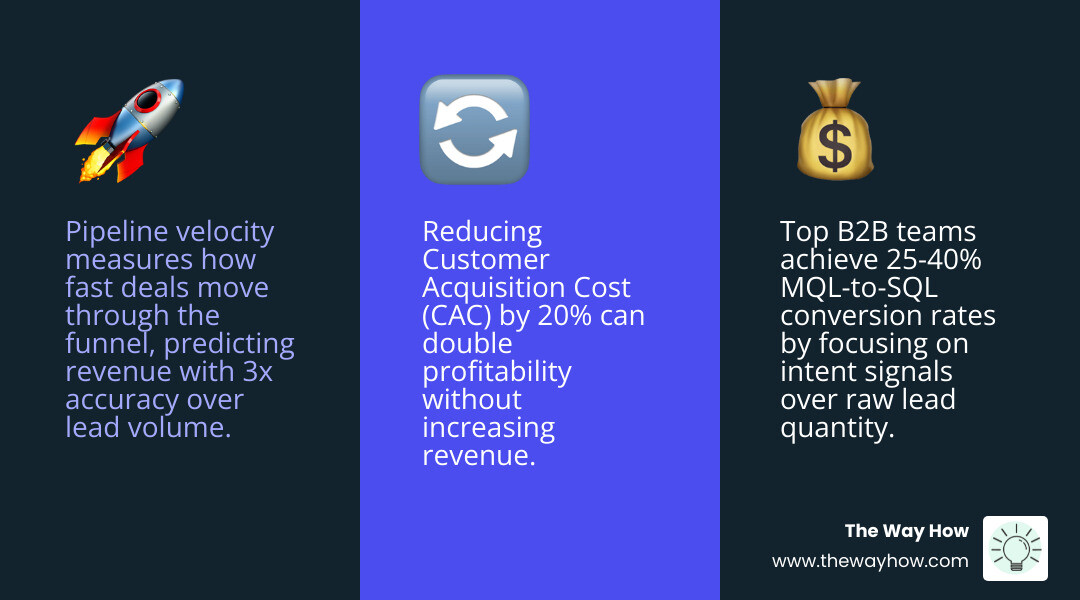
If you measure the wrong things, you will make the wrong decisions. Stop obsessing over CPL (Cost Per Lead) and start looking at:
- Pipeline Velocity: How fast are deals moving through the funnel?
- MQL-to-SQL Conversion Rate: Are the leads marketing produces actually turning into sales opportunities?
- Customer Acquisition Cost (CAC): How much does it cost to win a customer across the entire journey?
- Self-Reported Attribution: Simply asking “How did you hear about us?” on your “Contact Us” form to catch the dark funnel impact.
Common Mistakes to Avoid
We see these patterns repeat across stalled B2B companies:
- The “MQL Trap”: Celebrating high lead volume while sales is starving for quality.
- Gating Everything: Hiding your best ideas behind forms, ensuring no one actually reads them.
- Short-Term Thinking: Quitting a demand gen program after three months because it hasn’t “paid for itself” yet. Demand gen is a compounding asset; it takes 6-12 months to see the full effect.
- Ignoring the Infrastructure: Having great ads but a broken lead routing system or a messy CRM.
Aligning Sales and Marketing
This is the “secret sauce.” Effective B2B demand gen requires these two teams to be in a constant feedback loop. Marketing needs to know why deals are being lost (to create content that addresses those objections), and Sales needs to use marketing assets to nurture their own leads.
When sales and marketing are aligned, organizations see 28% higher win rates. It starts with a shared definition of what a “qualified” lead looks like and a shared goal: revenue, not just leads.
Demand Generation in the AI Era
By April 2026, AI has changed the “how” but not the “why” of demand generation.
- Personalization at Scale: AI can help you tailor messaging for 100 different accounts in the time it used to take for one.
- Predictive Analytics: AI tools can now predict which accounts are about to enter a buying cycle with startling accuracy.
- Content Saturation: Because AI can generate infinite “information,” the value of “human insight” has skyrocketed. Buyers are looking for original research, unique points of view, and real-world experience—things AI cannot fake.
Restoring Momentum Through Clarity
The reason most B2B demand gen programs fail isn’t a lack of budget or a lack of talent. It’s a lack of certainty.
When you don’t deeply understand your buyer’s psychology, you guess. When you guess, you fragment your efforts across too many channels. When you fragment, you lose the consistency required to build trust.
At The Way How, we believe that the most effective marketing doesn’t feel like marketing—it feels like help. By diagnosing the gaps in your customer journey and building a system rooted in human behavior, you can turn your marketing from a cost center into a predictable revenue engine.
If your growth has stalled and you’re tired of chasing the latest tactic, it might be time for a different perspective. We specialize in B2B Fractional CMO leadership and behavior-driven strategies that remove the guesswork from your GTM.
Ready to build a system that creates real demand? Let’s talk about your strategy.
Additional Resources:
- Ultimate B2B Sales Funnels Guide
- Automated Client Acquisition Funnel Guide 2026
- B2B Sales Strategy
- Lead Generation Strategy
- Ultimate Guide to B2B Demand Generation | ON24
- The Complete Guide to B2B Demand Generation | Informa TechTarget
- Demand Gen: Guide to Building Revenue-Driving Programs | Fullcast