
Why Ads Fail Before They Launch

A solid paid media advertising strategy is the difference between budget that builds revenue and budget that disappears into dashboards full of numbers that don’t move the business forward.
Here’s what that actually means in plain terms:
| Question | What a paid media strategy answers |
|---|---|
| Who? | The specific audience you’re trying to reach, defined by intent and buying stage |
| Where? | The channels where that audience makes decisions — not just where they scroll |
| What? | The message, offer, and creative that earns attention and drives action |
| How much? | A budget framework tied to funnel economics, not gut feel |
| Did it work? | The metrics connected to revenue, not just clicks |
Put simply: paid media is any marketing where you pay to place your message in front of a targeted audience. It sits alongside owned media (your website, content, email) and earned media (reviews, word-of-mouth, press) — but unlike those two, paid media gives you immediate control over who sees your message, when, and how often.
That control is powerful. It’s also expensive when there’s no strategy behind it.
Most paid media problems aren’t channel problems. They’re strategy problems wearing a channel disguise. The platform gets blamed when the real issue is a weak offer, a mismatched audience, broken tracking, or a landing page that leaks conversions. The money keeps flowing. The results don’t follow.
This guide is built to fix that — starting with diagnosis, not recommendations.
I’m Jeremy Wayne Howell, founder of The Way How and a revenue growth strategist with over 20 years of experience helping founders and revenue teams build marketing systems that actually close the gap between spend and growth — including building and auditing paid media advertising strategies across industries. My work is grounded in buyer psychology first, channels second, and everything in this guide reflects that order.
What paid media is and why it feels riskier than it looks
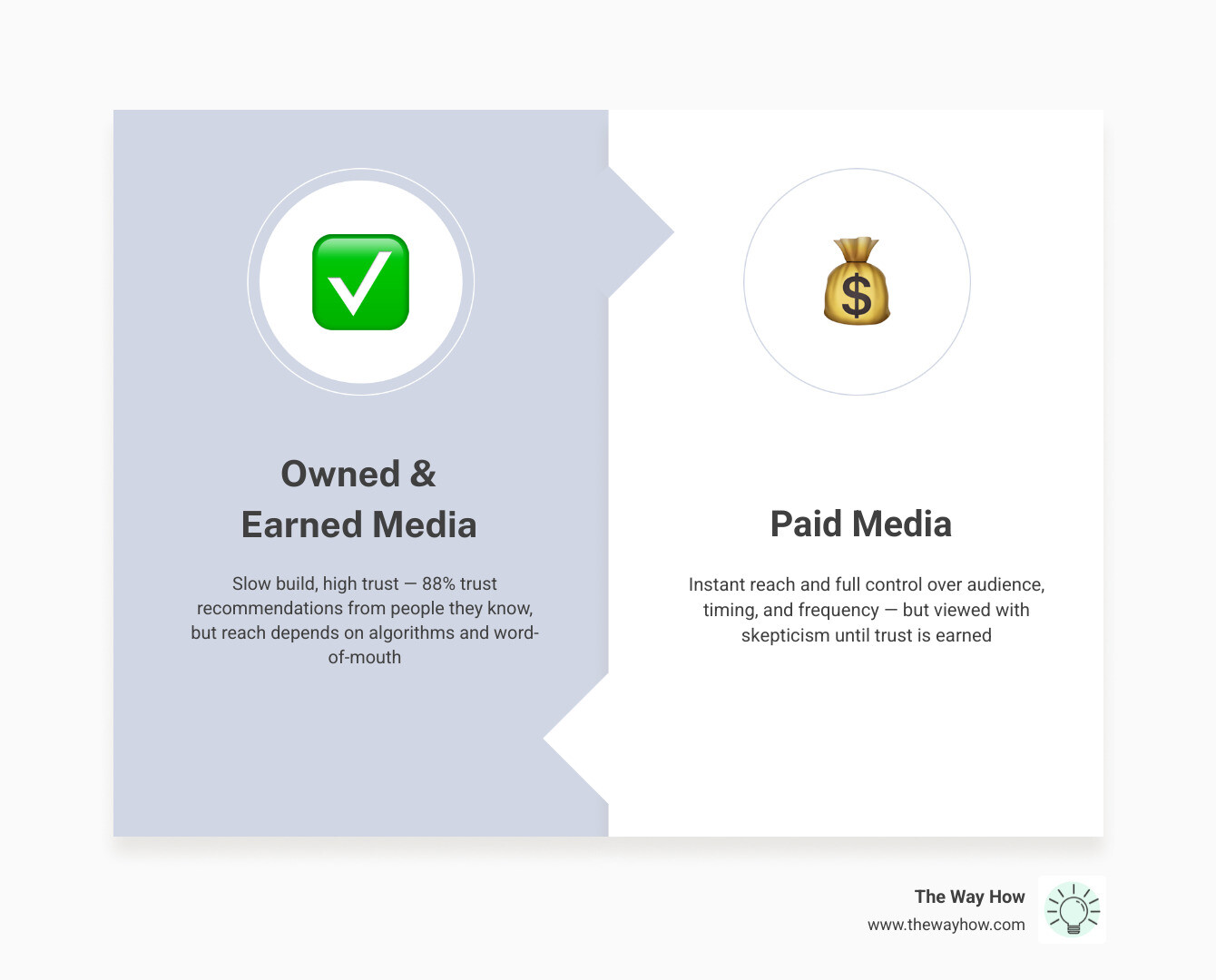
At its core, paid media is like renting billboard space, whereas owned media is owning the storefront and earned media is the word-of-mouth referral from a happy customer. Research shows that marketers typically split their digital budgets with roughly 25% going to paid, 32% to owned, and 24% to earned media.
The risk in paid media stems from the “trust gap.” While 88% of people trust recommendations from people they know (earned media), paid ads are often viewed with skepticism. However, paid media offers something the others cannot: immediate reach and granular control. You don’t have to wait for an algorithm to favor your organic post or for a journalist to pick up your story. You pay for the right to be seen right now.
What marketers think is broken vs what is actually broken
When a campaign underperforms, the first instinct is often to blame the channel. “Facebook ads don’t work for us,” or “Google is too expensive.” In our experience at The Way How, the channel is rarely the primary culprit.
Usually, the failure lies in one of these “uncertainty gaps”:
- Weak Signal: The platform’s AI isn’t receiving enough data to know who is actually converting.
- Audience-Message Mismatch: You are showing a “buy now” ad to someone who doesn’t even know they have a problem yet.
- Post-Click Friction: You spent $5.00 to get a click, only to send the user to a generic homepage that loads slowly and lacks a clear call to action.
- Tracking Errors: 76% of ad accounts have at least one critical tracking issue. If you can’t measure it, the platform can’t optimize it.
Paid Media Advertising Strategy Starts With Diagnosis, Not Channels
A paid media advertising strategy is not a list of platforms; it is a decision framework. It defines how you will use paid channels to achieve specific commercial outcomes. Without this blueprint, you are simply throwing money at ads and hoping for a random spike in growth.
Set goals that reduce uncertainty, not just increase activity
We advocate for goals that ladder up to revenue. While “brand awareness” is a valid objective, it must be defined specifically. Are you looking for reach, or are you looking for qualified pipeline?
Use the SMART framework to set targets for:
- Cost Per Acquisition (CPA): What can you afford to pay for a new customer?
- Return on Ad Spend (ROAS): For every dollar spent, how many come back in revenue? (A 3:1 ratio is a common baseline, though 2026 standards often require higher efficiency).
- Media Efficiency Ratio (MER): Total revenue divided by total ad spend. This is your “ground truth” metric that ignores platform attribution errors.
Define audiences by motivation, behavior, and buying stage
Demographics (age, gender, location) are the bare minimum. To win in 2026, you must target based on intent.
- Search Intent: What are they actively looking for?
- Behavioral Signals: Have they visited your pricing page?
- First-Party Data: Using your own customer lists to find “lookalike” audiences.
Precision matters. Narrow ICP (Ideal Customer Profile) targeting can generate 3x more high-quality leads per dollar than broad targeting. If you need to focus on specific regions, you can learn how to geo target campaigns to ensure your budget isn’t wasted on irrelevant locations.
Choose channels by decision context, not popularity
Don’t go to TikTok just because it’s trending. Go there if your audience uses it to discover new products.
- Google Ads: Best for capturing existing demand (people searching for a solution).
- LinkedIn: The premier choice for B2B, allowing you to target by job title, industry, and company size.
- Meta (Facebook/Instagram): Excellent for demand generation and visual storytelling.
You can explore the various paid advertising platforms to see which aligns with your specific buyer journey. For more technical insights, you can also review research on paid media strategy frameworks.
The Core Media Types and Where They Work Best
| Media Type | Best Funnel Stage | Primary Strength |
|---|---|---|
| SEM/PPC | Conversion | Captures high-intent searchers |
| Paid Social | Awareness/Consideration | Visual storytelling and discovery |
| Display/Native | Awareness | Broad reach and contextual relevance |
| Influencer | Consideration/Trust | Transfers credibility from a trusted source |
| Retargeting | Conversion/Nurture | Keeps your brand top-of-mind for warm leads |
Search and shopping ads for demand capture
Search Engine Marketing (SEM) is your “bottom of the funnel” workhorse. Google processes over 100 billion searches a month. While 70% of people click organic results, the 30% who click ads are often high-intent prospects ready to buy.
The secret to efficient SEM is discipline:
- Keyword Match Types: Start with “phrase match” to gather data, then move to “exact match” for your winners.
- Negative Keywords: Audits often show that 30-40% of budget is wasted on irrelevant queries. Use negative lists to block them.
- Ad Rank: This isn’t just about who pays the most; it’s about who provides the most relevant experience.
If you are just starting, here is a guide on how to create a google ads account.
Paid social, video, and display for demand creation
Paid social is about interrupting the scroll with something valuable. In 2026, creative quality is the primary driver of performance, responsible for 50-70% of an ad’s success.
- Video is King: Facebook users watch 3 billion hours of video daily. However, 85% of Facebook videos and 63% of LinkedIn videos are watched with the sound off. Your creative must work as a “silent film.”
- Meta’s Andromeda Algorithm: Modern algorithms use your creative as the targeting signal. The “hook” in your video tells the platform who should see the ad.
For a deeper look at building these frameworks, see this guide on paid social media strategy.
Native, influencer, affiliate, and retargeting for trust transfer
These formats leverage external credibility. A sponsored article on a business news site or a recommendation from a trusted influencer bypasses the traditional “ad filter” consumers have developed. Retargeting is particularly effective here; it often converts at 3x the rate of prospecting campaigns because it targets people who have already engaged with your brand.
How to Build a Paid Media Advertising Strategy That Converts
A strategy is the “why,” but the media plan is the “how.” To turn clicks into revenue, you need a system that connects creative, budget, and tracking into a single operating model.

Build the budget around funnel economics
We recommend a balanced approach to budget allocation:
- 60-70% Demand Generation: Reaching new people (top of funnel).
- 20-25% Demand Capture: Converting those looking for you (bottom of funnel).
- 5-10% Retention/Testing: Keeping current customers and experimenting with new ideas.
Avoid spreading your budget too thin. It is better to dominate two channels than to be invisible on six. For more on this, see our guide on marketing budget optimization.
Create ads that match how people decide
Psychology-first ads address the “uncertainty” in the buyer’s mind.
- The Hook: You have 2 seconds to stop the scroll.
- The Proof: Use testimonials, data, or “UGC” (User Generated Content) to build trust.
- The Transformation: Don’t sell features; sell the “after” state of the customer.
Creative fatigue is real. At meaningful spend levels, ads can lose effectiveness in 7-14 days. You need a “creative engine” that produces 5-10 new variations weekly to keep performance stable.
Fix the post-click experience before scaling spend
Scaling a campaign with a broken landing page is just a faster way to lose money.
- Message Match: The headline on your ad must match the headline on your landing page.
- Frictionless Forms: Only ask for the information you absolutely need.
- Speed: Every second of load time can drop conversions by 7% or more.
Using tools like HubSpot ads can help align your CRM data with your ad performance to ensure a seamless handoff from marketing to sales.
Install measurement before launch, not after
If you don’t have tracking set up, you aren’t marketing; you’re gambling.
- Pixels and APIs: Install the Meta Pixel and Conversions API to recover data lost to privacy changes.
- GA4: Set up Google Analytics 4 to track the full user journey.
- CRM Sync: Connect your ad platforms to your CRM (like HubSpot) to track “offline” conversions—like when a lead actually becomes a paying customer.
Helpful resources for this stage:
What to Measure, What to Ignore, and How to Optimize
The biggest mistake in paid media is optimizing for “vanity metrics” like impressions or clicks. These look good in a report but don’t pay the bills.
The metrics that actually reveal business performance
Focus on these “North Star” metrics:
- Contribution Margin per Order: How much profit is left after ad spend and COGS?
- CAC Payback Period: How long does it take for a new customer to pay back the cost of acquiring them?
- Blended MER: Is your total revenue growing in proportion to your total spend?
The diagnostic metrics that explain why performance changed
When your North Star metrics dip, use these to find out why:
- CTR (Click-Through Rate): If this is low, your creative or offer isn’t resonating.
- CPM (Cost Per Mille): If this is rising, your audience might be too small or the market too competitive.
- Conversion Rate: If people click but don’t buy, the problem is your landing page or offer.
Optimization habits that prevent wasted spend
Strategy isn’t “set it and forget it.” It requires a weekly and quarterly cadence:
- Weekly: Review search terms and add negative keywords. Identify winning creative hooks.
- Monthly: Reallocate budget from underperforming channels to winners.
- Quarterly: Conduct a deep audit of your ICP and messaging.
For advanced strategies on scaling DTC or ecommerce brands, you can study this operator’s playbook for 2026. To further improve your results, learn how to boost marketing ROI through systematic testing.
How Paid and Organic Work Better Together in 2026
In 2026, the wall between “paid” and “organic” has crumbled. They are two sides of the same coin. Paid media provides the data that makes organic better, and organic provides the trust that makes paid media convert.
Use paid media to amplify owned assets and learn faster
Don’t just run ads; run experiments.
- Use paid search to test which keywords drive the most revenue, then prioritize those for your SEO strategy.
- Use paid social to see which content topics get the most engagement, then turn those into long-form blog posts or email sequences.
- Retarget your organic website visitors with specific offers to move them down the funnel.
Trends shaping the future of paid media
As we move through 2026, several shifts are redefining the paid media advertising strategy landscape:
- AI-Powered Orchestration: AI now handles the tactical bidding, allowing humans to focus on strategy and creative.
- Signal Loss Recovery: First-party data and server-side tracking (Conversions API) are no longer optional.
- Contextual Targeting: With the deprecation of third-party cookies, showing ads based on the content a user is viewing is becoming as effective as behavior-based targeting.
- New Formats: Platforms like Pinterest and TikTok are introducing interactive and “shoppable” ad formats that reduce the steps to purchase.
For a comprehensive look at the upcoming year, see this 2026 paid media guide.
Common mistakes that quietly drain budget
- Spreading Budget Too Thin: Trying to be on every platform with a $1,000 budget.
- Sending Traffic to the Homepage: Always use a dedicated, offer-specific landing page.
- Ignoring Exclusions: Don’t pay to show acquisition ads to people who are already your customers.
- Vanity Goal Setting: Optimizing for “engagement” when you actually need sales.
Stop Renting Attention Without a Plan
Paid media is a powerful lever, but it is only as strong as the system it sits within. At The Way How, we help founders and leaders move away from the uncertainty of “hope-based” marketing and toward predictable revenue engines.
If your growth is stalled, or if you feel like you are paying for clicks that don’t convert, it’s time to stop chasing tactics and start building a psychology-first strategy. We diagnose the certainty gaps in your customer journey and design the systems that create trust and momentum.
Ready to turn your advertising into a dependable growth engine? Explore our fractional CMO and revenue strategy services to see how we can help you gain clarity and scale with confidence.