

When Marketing Feels Busy but Growth Still Feels Unclear

Marketing team management is the practice of structuring, leading, and developing a marketing team so that its daily work connects directly to business growth — not just activity.
Here is a quick summary of what it involves:
| Area | What It Covers |
|---|---|
| Structure | Roles, reporting lines, hiring sequence, team models |
| Leadership | Delegation, feedback, trust-building, motivation |
| Operations | Workflows, tools, campaign planning, process documentation |
| Performance | KPIs, individual accountability, ROI measurement |
| People | Onboarding, development, retention, burnout prevention |
Most marketing teams are not short on effort. They are short on clarity.
Campaigns launch. Calendars fill up. Metrics get reported. But leadership still asks, “What’s our actual ROI?” — and the team still feels stretched, undervalued, or unsure what to prioritize next.
That gap between activity and results is rarely a creativity problem. It is almost always a management problem.
In Marketing Week’s 2025 Career & Salary Survey of more than 3,500 marketers, 58.1% had felt overwhelmed and 56.1% undervalued over the past 12 months. These are not signs of a team working too little. They are signs of a team working without the right structure, clarity, or support underneath them.
'Overwhelmed and undervalued': Half of marketers grappling with 'emotional exhaustion'. Marketing Week, 2025-02. Read the Source →This guide was written to fix that. Whether you are managing a team of three or scaling toward twenty-five, the principles here will help you build a marketing function that performs predictably — and sustainably.
I am Jeremy Wayne Howell, founder of The Way How and a revenue growth strategist with over 20 years of experience in marketing, sales, and go-to-market strategy, helping founders and executives diagnose what is actually stalling growth and rebuild their systems — including marketing team management — around buyer psychology and operational clarity. Everything in this guide is drawn from that hands-on experience, not theory.
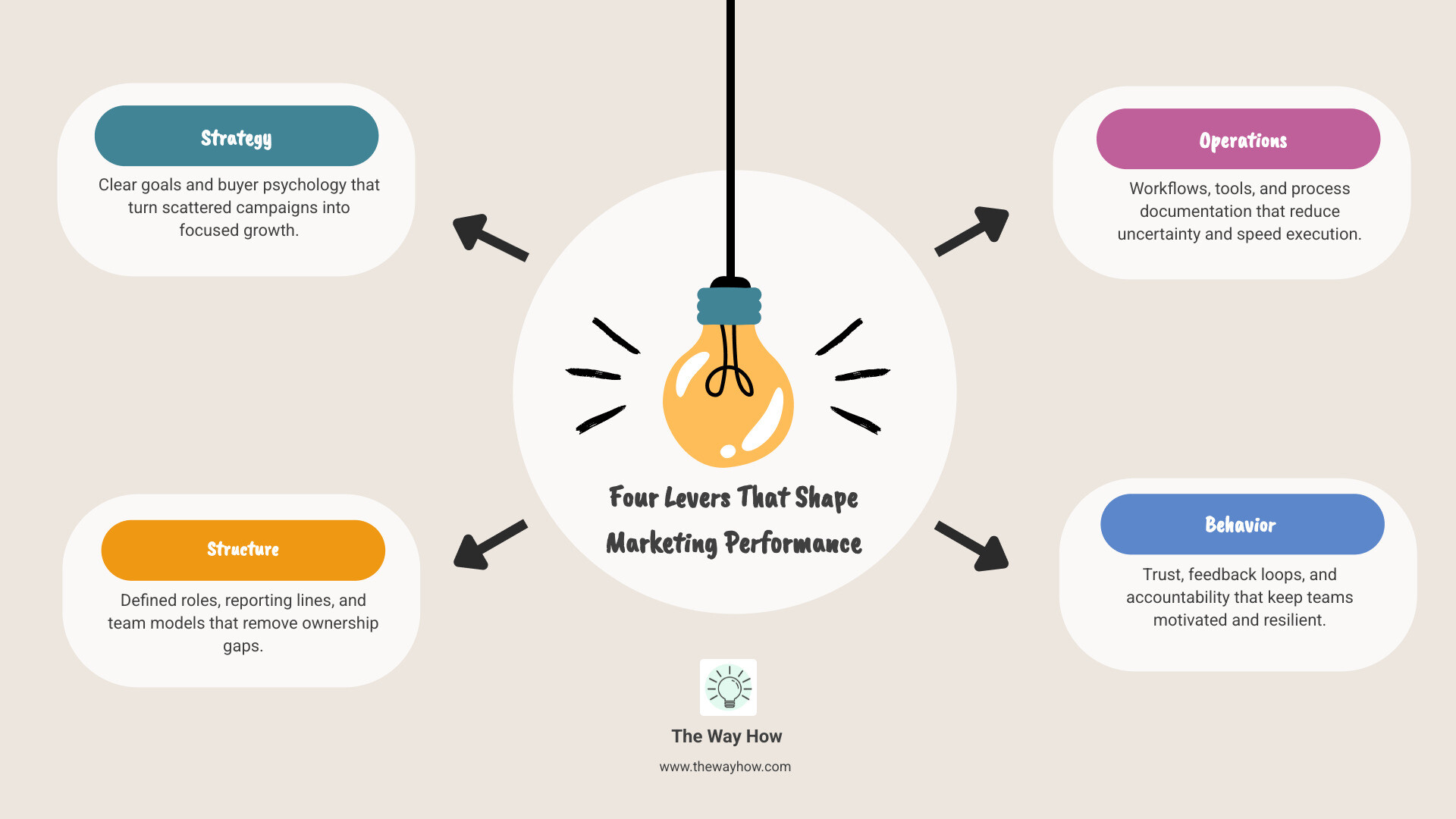
What Marketing Team Management Really Means and Why It Drives Business Results
The PointMarketing team management isn't task control. It's clarity creation: what matters most right now, who owns what, how success is measured and when to escalate decisions.
At its core, marketing team management is the system that connects people, priorities, and performance.
It includes market research, planning, budgeting, workflow design, coaching, reporting, and cross-functional alignment with sales, product, and leadership. But the real job is simpler to say and harder to do: reduce uncertainty so the team can make better decisions faster.
When teams lack clarity, they do not become lazy. They become reactive. They chase channel metrics, over-serve internal requests, and confuse motion with progress. That is why good management matters so much for business results.
Marketing team management is not task control but clarity creation
Many leaders accidentally treat management like supervision. We think of it differently.
Strong marketing team management creates clarity around:
- What matters most right now
- Who owns what
- How success is measured
- What tradeoffs are acceptable
- When to escalate decisions
- How feedback loops will work
That clarity lowers friction across the customer journey. It also helps teams avoid the common trap of doing more work without creating more trust, demand, or revenue.
In practice, that means shared goals, clear briefs, defined decision rights, documented workflows, and regular review points. Not because process is exciting, but because confusion is expensive.
Why strong management improves revenue, speed, and team confidence
A well-managed team usually produces:
- Better campaign velocity
- Higher lead quality
- Cleaner handoffs to sales
- More useful reporting
- More consistent ROI discussions
- Stronger morale and retention
It also creates emotional safety. That matters more than most leaders realize. If team members are unsure what “good” looks like, they either overwork or freeze. Neither is great for pipeline.
In a 2018 Wakefield Research study for Reflektive, 94% of office professionals said they would prefer their manager address mistakes and development opportunities in real time. That makes sense. Frequent conversation reduces ambiguity before it turns into underperformance, resentment, or burnout.
New Study Uncovers Major Gap in Employee and Employer Expectations for Performance Management and Growth. Reflektive, 2018-04. Read the Source →And burnout is not hypothetical. Marketing Week called its own findings key symptoms of burnout. Sustainable performance requires systems that support the humans doing the work.

Build the Right Team: Roles, Responsibilities, and Scalable Structures
The PointHire for missing capability, not trendiness. Keep strategy, audience insight, positioning and measurement in-house; use contractors for surge capacity and agencies for depth.
A high-performing team is not just a collection of specialists. It is a coordinated system with complete coverage.
You need strategy, execution, measurement, and operational support. Miss one, and the rest usually get noisy.
Essential roles inside a high-performing marketing team
The exact org chart depends on size and stage, but most teams need coverage in these areas:
- Marketing leader or manager
- Content marketing
- SEO
- Paid media or PPC
- Conversion rate optimization
- Analytics
- Marketing operations
- Brand strategy
- Social media
- Website or web development
- PR or communications
- Campaign coordination
In smaller teams, one person may cover several of these. In larger teams, each becomes its own specialty.
The most overlooked role is often marketing operations. Ops creates the systems behind planning, automation, handoffs, attribution, and reporting. Without that layer, teams rely on heroic effort and spreadsheet archaeology. For more on that discipline, see our guide to Marketing Ops Execution and Marketing Analytics Solutions.
A useful rule: hire for missing capability, not for trendiness. A flashy channel specialist will not fix a team that lacks positioning, workflow discipline, or measurement.
How to choose between function-based, discipline-based, product-based, and audience-led structures
There is no perfect structure. There is only the structure that best matches your business model, complexity, and growth stage.
| Structure | Best for | Strength | Risk |
|---|---|---|---|
| Function-based | Smaller teams | Clear workflow stages | Silos between planning and execution |
| Discipline-based | Growing specialist teams | Deep channel expertise | Channel goals can outrun business goals |
| Product-based | Multi-product companies | Strong product focus | Duplicate effort across teams |
| Audience-led | Complex segments or markets | Better customer relevance | Higher coordination demands |
| Hybrid | Most scaling teams | Balances strategy and execution | Requires stronger management discipline |
In general, we prefer centralized strategy with decentralized execution. That means messaging, audience insight, measurement, and core priorities stay aligned, while channels or segments execute with flexibility.
That approach is supported by resources like Google’s blueprint for building a marketing team and HubSpot’s guide to scaling a marketing team. It also matches what we see in practice: structure works best when it protects strategic coherence without slowing specialists down.
When to hire in-house, use contractors, or bring in agencies
Here is the simplest version:
- Keep strategy, audience insight, positioning, and measurement ownership in-house
- Use contractors for surge capacity or specialized execution
- Use agencies for depth, speed, or niche expertise when internal oversight is strong
In-house talent is best when the work requires close product knowledge, brand judgment, or daily coordination. Contractors are useful when demand is uneven or the business is testing a function. Agencies can help when you need specialist capabilities fast, but only if internal leaders own direction and evaluation.
In 2026, AI also changes the mix. It can reduce routine production work, but it does not replace judgment, empathy, or strategic context. Human review still matters. For more perspective on modern team building, see Robert Half’s guide to high-performing marketing teams.
How to Lead a Marketing Team Without Micromanaging It
The PointMicromanagement is a symptom. Leaders micromanage when they don't trust the system, the brief or the visibility. The fix is enough clarity that autonomy becomes safe.
Micromanagement is usually a symptom, not a personality trait. Leaders micromanage when they do not trust the system, the brief, or the visibility.
The fix is not “be more hands-off.” The fix is create enough clarity that autonomy becomes safe.
Leadership skills that matter most in marketing team management
The best marketing managers are rarely just great marketers. They are also strong at:
- Empathy
- Coaching
- Prioritization
- Communication
- Judgment
- Adaptability
- Accountability
- Systems thinking
Marketing is full of ambiguity. Campaigns rarely fail for one clean reason. So leaders need to interpret weak signals, protect focus, and help teams think clearly under pressure.
Regular one-on-ones matter here. Since most office professionals in that Reflektive study wanted a check-in at least once a month, leaders should use them to remove blockers, rebalance workloads, and coach decision-making in real time.
How to delegate work while increasing ownership and accountability
Delegation is not dumping tasks downhill and hoping for the best. It is transferring ownership with enough context to succeed.
A practical delegation framework looks like this:
- Explain the outcome, not just the task
- Clarify why it matters
- Define success criteria
- Set guardrails and deadlines
- Agree on a review cadence
- Let the person own the execution
- Debrief what worked and what did not
When mistakes happen, handle them privately and treat them as teachable moments. Public criticism usually creates fear, not better judgment. Public credit, on the other hand, builds confidence and trust.
If you want a related perspective on coaching leadership, our Coaching Sales Team guide is useful beyond sales teams too.

Communication habits that keep teams aligned and motivated
Most communication problems are really prioritization problems wearing a communication costume.
The habits that help most are simple:
- Weekly team standups
- Regular one-on-ones
- Async status updates
- Monthly workload reviews
- Discipline-based meetings when needed
- Cross-functional check-ins with sales and leadership
- No-meeting blocks for focus work
- Public recognition of wins
One more thing: celebrate progress without pretending everything is fine. Marketing teams are smart. Forced positivity is easy to spot and strangely exhausting.
Run the Work Well: Workflows, Tools, Metrics, and Workload Management
The PointBurnout prevention is operational design. Manage capacity, not just deadlines: review workload monthly, document workflows, and reward outcomes, not visible busyness.
Teams do not scale on talent alone. They scale on repeatable workflows.
Tools and systems that make marketing team management easier
Most teams need a small, intentional stack covering:
- Project management
- CRM
- Marketing automation
- Analytics
- Reporting dashboards
- Collaboration and documentation
- Template libraries
- AI assistants for routine tasks
The keyword is intentional. Many teams use too many tools, which creates reporting gaps, duplicate work, and version-control chaos. In many cases, better management comes from tool consolidation, not new software.
If your team uses HubSpot or is considering it, see our resources on Marketing Automation Hubspot and B2B Marketing Automation Consultant.
How to measure team performance and individual contribution fairly
Good performance measurement answers two questions:
- Is the team creating business value?
- Is each person contributing in a way that fits their role?
Team-level KPIs often include:
- Website traffic quality
- Leads and qualified pipeline
- Conversion rates
- Customer acquisition cost
- Customer lifetime value
- Marketing ROI
- Campaign delivery against timelines
- Brand or engagement indicators where relevant
Individual measurement should reflect actual role scope. A content lead should not be judged like a paid media buyer. A marketing ops manager should not be measured only on lead volume.
We recommend balancing:
- Outcome metrics
- Quality indicators
- Collaboration signals
- Self-evaluation
- Peer feedback
This creates a fairer picture than vanity metrics like hours worked or number of meetings attended.
For deeper planning and reporting support, see our guides on Data Driven Marketing Strategies and Marketing Budget Optimization.
Prevent burnout by managing capacity, not just deadlines
Burnout prevention is not a wellness poster in the break room. It is operational design.
The numbers are sobering: in the same Marketing Week survey, 50.8% of marketers reported emotional exhaustion in the past year, and 80.1% had experienced imposter syndrome at some point in their career. If a leader sees missed deadlines, revision loops, and low morale, the issue may be capacity, not commitment.
'Overwhelmed and undervalued': Half of marketers grappling with 'emotional exhaustion'. Marketing Week, 2025-02. Read the Source →'Massive warning sign': Marketers on the 'seismic' scale of imposter syndrome. Marketing Week, 2025-02. Read the Source →Ways to reduce burnout include:
- Review workload monthly, not just quarterly
- Compare weekly priorities to department goals
- Rebalance resources after launches or staffing changes
- Document workflows so work is not trapped in one person’s head
- Protect focus time
- Reduce unnecessary meetings
- Reward outcomes, not visible busyness
- Create room for honest conversations about stress
A good workload system makes overload visible early. That is far better than discovering it through resignations.
Hire, Onboard, and Develop Marketers Who Can Grow With the Business
The best teams are built for learning, not just for current tasks.
What to look for when hiring marketers in 2026
In 2026, strong hiring profiles usually combine:
- Adaptability
- Curiosity
- Customer empathy
- Learning agility
- Technical fluency
- AI literacy
- Clear communication
- Good judgment
Experience still matters, but rigid experience checklists often miss better candidates. Marketing changes too fast for static resumes to tell the whole story.
Use role scorecards. Define expected outcomes, not just responsibilities. And move quickly. Research shows salary pressure remains high and top candidates disappear when hiring drags.
How to onboard new team members without slowing the whole department
Bad onboarding creates months of hidden drag.
A simple 30-60-90 plan helps new hires learn faster and reduces manager guesswork. Include:
- Clear role expectations
- Access to systems and documentation
- Key stakeholders
- Success metrics
- Shadowing time
- Early wins
- Regular manager check-ins
If you are hiring multiple people, stagger start dates when possible. Training four people at once sounds efficient until nobody knows where anything lives and your best team member becomes a full-time tour guide.
How to develop talent through coaching, feedback, and continuous learning
Retention improves when people can see a future, not just a backlog.
Strong development systems include:
- Skills mapping
- Career path conversations
- Cross-training
- Internal workshops
- Stretch projects
- Mentorship
- Sponsorship
- Recognition for growth, not just output
Continuous learning matters even more as AI reshapes workflows. Teams benefit when some members become internal champions who test tools, document what works, and help others adopt them sensibly.
For support at the strategy and leadership level, explore our Marketing Strategy Consulting and Marketing Advisory Services.
Frequently Asked Questions About Marketing Team Management
What are the most common problems in marketing team management?
The usual suspects are:
- Unclear ownership
- Channel silos
- Reporting chaos
- Meeting overload
- Weak prioritization
- Friction with sales
- Underused talent
- Too much execution, not enough thinking
Most of these are symptoms of unclear operating rules, not bad intentions.
Should you improve processes first or hire more people?
Usually, improve processes first.
Before adding headcount, run a capacity audit. Look for:
- Work that should be automated
- Repeated approval bottlenecks
- Duplicate tools
- Undefined ownership
- Poor briefing quality
- Low-value reporting
Then hire where capability gaps remain. Otherwise, you just scale confusion.
How do you balance short-term campaign execution with long-term strategy and team well-being?
Use multiple planning horizons.
A practical model is:
- Quarterly priorities for strategic direction
- Monthly planning for campaign sequencing
- Weekly sprints for execution
- Protected time for analysis, experimentation, and recovery
This helps teams maintain momentum without becoming trapped in permanent urgency. It also keeps brand-building, customer insight, and process improvement from getting crushed by this week’s requests.
From Activity to Momentum: The Operating Model That Keeps Teams Effective
The healthiest marketing teams are not the busiest ones. They are the clearest ones.
They know who they serve, what matters now, how decisions get made, and how daily execution connects to revenue. They combine structure, empathy, accountability, and operational discipline. That is what turns marketing from a swirl of activity into a dependable growth engine.
At The Way How, we approach this through psychology first. We look at behavior, trust, decision friction, and certainty gaps before prescribing tactics. Because when growth stalls, the answer is rarely “do more marketing.” It is usually “design a better system for the people doing it and the buyers experiencing it.”
If you want help building that system, explore our services or read our guide to Sales Team Optimization Complete Guide.
For additional outside reading, these resources are also useful:
- Marketing Teams: Structure, Roles And Growth Strategies
- Managing a Marketing Team: The Ultimate Playbook
Good marketing team management is not about controlling people more tightly. It is about helping them think, decide, and execute more clearly. That is how better marketing gets made. And, conveniently, it is also how fewer people end up crying into their dashboards on a Thursday afternoon.