A Complete Guide to CRM Systems and Database Management
 Jeremy Wayne Howell : Jul 22, 2026 9:48:31 PM
9 min read


Marketing operational efficiency is the measure of how much revenue output your marketing function generates relative to the time, money, and resources it consumes.
Here is what that means in practice:
| Concept | What It Means |
|---|---|
| What it is | Getting more pipeline and revenue from the same — or fewer — marketing resources |
| What it is not | Doing more campaigns, hiring more people, or buying more tools |
| Why it matters | Companies with mature marketing operations see 15–25% better marketing effectiveness and up to 25% higher revenue growth |
| Common causes of inefficiency | Disconnected tools, dirty data, undocumented processes, and activity metrics that don’t tie to revenue |
| Where to start | Audit your current stack, processes, and data quality before changing anything else |
Most marketing teams are not inefficient because they lack effort. They are inefficient because the systems underneath the effort are broken — or were never built for scale.
Marketing budgets grew 8.7% in 2025 while pipeline contribution dropped 12%, according to Gartner’s CMO Spend Survey. More spend. Worse results. That gap is not a creativity problem. It is a structural one.
The hard truth: most marketing operations are built to execute, not to prove that any of it moved revenue. When the system is built around activity — emails sent, leads captured, campaigns launched — the business pays for motion without momentum.
If your team is busy but revenue is not moving, the leak is probably not where you think it is.
I’m Jeremy Wayne Howell, founder of The Way How, and I’ve spent over 20 years diagnosing exactly this kind of marketing operational efficiency gap — helping founders and revenue leaders identify where their systems are quietly bleeding money before we ever talk about tactics. This guide is built from that diagnostic work, and it will show you what’s actually broken and how to fix it from the foundation up.
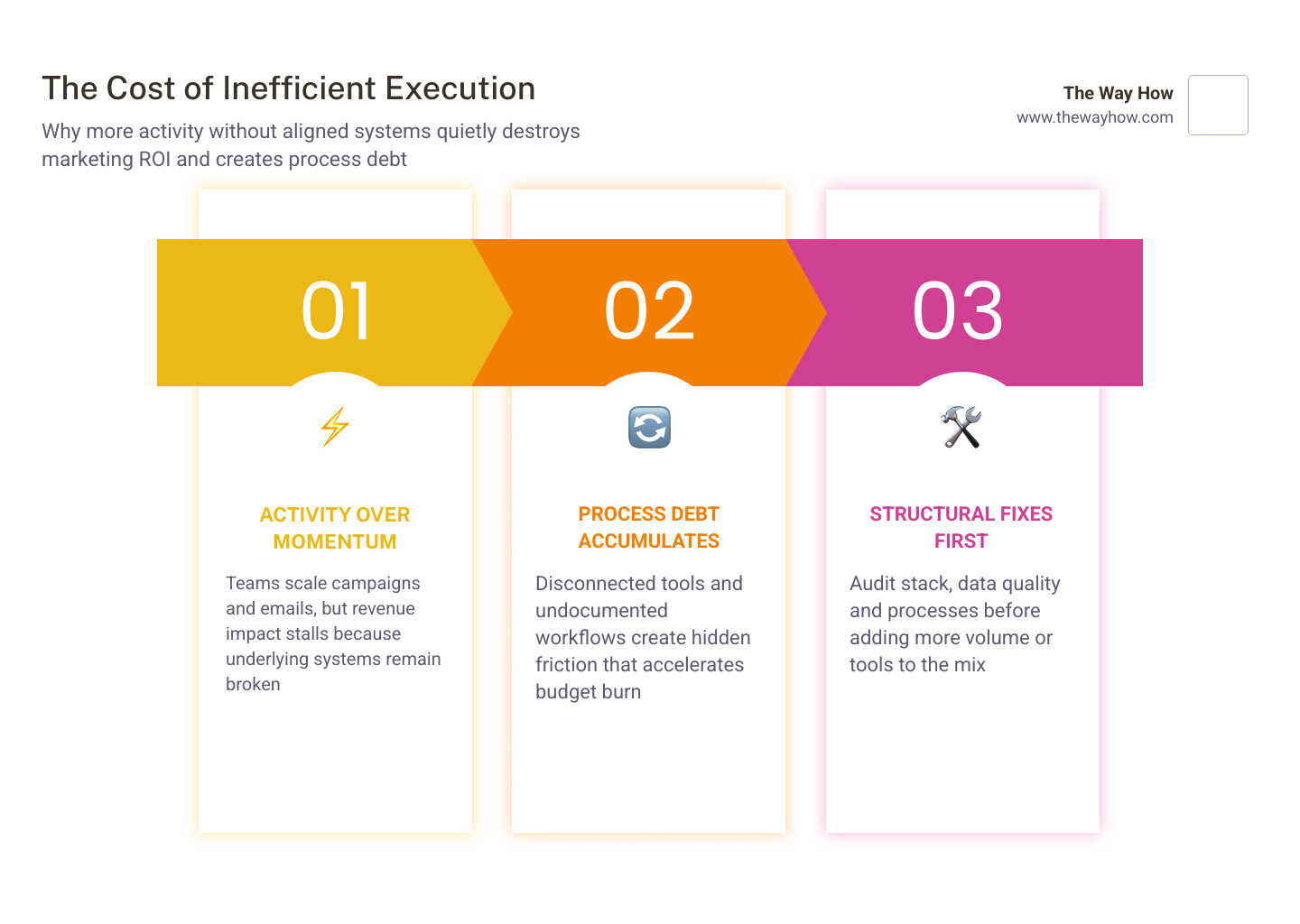
When marketing performance stalls, the default reaction is almost always to speed up. We tell our teams to build more landing pages, write more email sequences, and increase the volume of social posts. We assume that if we throw enough activity at the market, some of it will stick.
This is a profound cognitive error. When you scale an inefficient system, you do not get more revenue. You simply build process debt and accelerate your burn rate.
This frantic pace creates massive cognitive fatigue. Your team spends their days jumping between disconnected software platforms, triaging broken automations, and manually patching data gaps. They are working harder than ever, but they are trapped in “busywork” rather than high-leverage strategic thinking.
This is the difference between activity and momentum. Activity is the volume of work produced; momentum is the measurable progress of that work toward a commercial outcome. When process debt accumulates, execution speed slows down, and your customer acquisition costs (CAC) rise. In fact, optimizing operational efficiency in marketing can lead to a 20-30% reduction in customer acquisition costs, proving that the solution to high CAC is often internal organization rather than external ad spend.
To build a marketing engine that drives predictable revenue, we must transition from a reactive execution model to a strategic, systems-first operating model. True efficiency is not about cutting corners; it is about eliminating friction so that your team’s energy is fully focused on activities that drive growth.

When we design systems with high operational efficiency, we create a distinct competitive advantage. In highly competitive markets, companies that prioritize operational structures are far more resilient. Academic research shows that firms adopting proactive, structured business strategies perform significantly better than those with defensive, reactive strategies under intense competition.
By building a mature marketing operations (MOps) function, you turn your marketing department from a cost center into a predictable revenue driver. To understand the structural components of this transition, leaders can look to Marketing Operations: The Executive Guide to Building a Revenue-Driving MOps Function - RevenueTools Blog | RevenueTools to map out their internal capabilities.
In traditional business operations, efficiency is often calculated by measuring raw output against input cost. This manufacturing-style metric works well on an assembly line, but it breaks down completely when applied to marketing.
If your marketing team measures productivity solely by the number of campaigns launched or assets created, they are missing the point. Productivity is a measurement of output volume over time. Operational efficiency, however, is about the cost per unit of production relative to the revenue generated.
To diagnose your real efficiency, we must borrow financial metrics like asset utility (total revenue divided by total assets) and the profit margin index. If your marketing assets—such as your website, database, and content library—are not actively generating pipeline, their utility is near zero, no matter how quickly they were built.
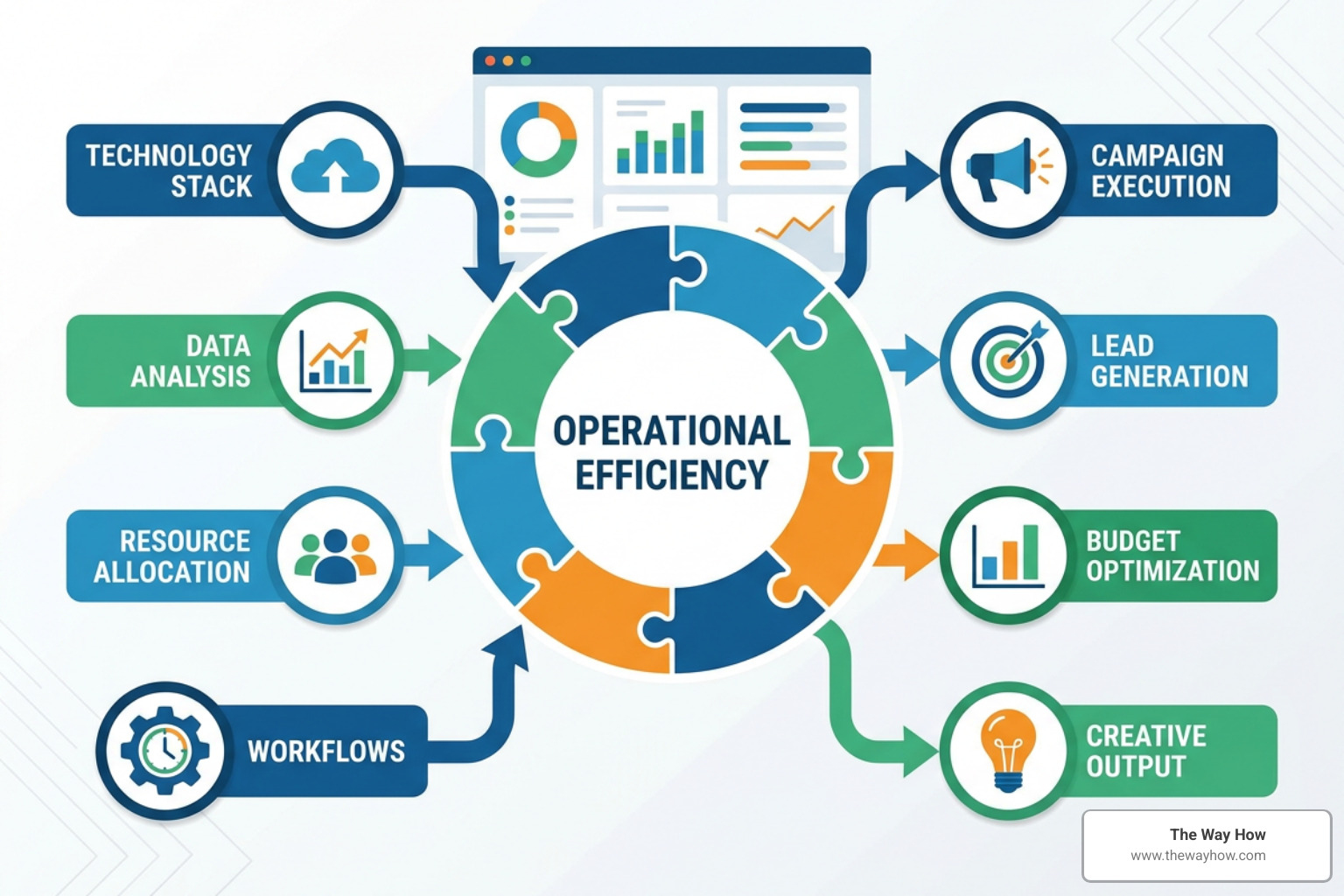
To build a frictionless marketing engine, we must optimize five core components. These are the functional pipes through which your customer journey flows:
There is a common belief that buying more software will automatically solve operational problems. We call this the Martech Mirage.
In 2026, the median martech stack size for mid-market organizations is 28 tools. Yet, research reveals that marketers utilize only 42% of their technology stack’s actual capabilities. We are paying for enterprise-grade features while using our tools as glorified databases and basic email senders.
This underutilization is not a training problem; it is a stack architecture problem. When you buy point solutions to solve isolated problems, you create a fragmented landscape of disconnected data silos. To evaluate your current tools and identify where you are losing leverage, we recommend checking out our Marketing Automation Tools Guide 2026.
Every new tool added to your stack introduces integration debt, security risks, and administrative overhead. When tools do not talk to each other seamlessly, your team must resort to manual data uploads, spreadsheets, and custom workarounds.
This “swivel-chair” operational model is where budgets go to die. To combat this, we must establish strict integration standards and run quarterly stack audits. If you are using HubSpot, you can optimize your system configuration by applying these practical HubSpot Operations Hub Tips to automate data curation and clean up redundant workflows.
Marketing automation is incredibly powerful, but only when applied to a system that already works. The golden rule of operations is simple: standardize first, automate second.
If you automate a broken, chaotic process, you will only scale the chaos. Before building any automated workflow, map out the campaign lifecycle manually. Ensure that triggers, data ownership, and handoff points are clearly defined.
When implemented correctly, marketing automation is a massive efficiency lever. Statistics show that companies implementing marketing automation experience an average 14.5% increase in sales productivity and a 12.2% reduction in marketing overhead, alongside a 451% increase in qualified leads.
If your marketing operations team is organized around channels (the “email person,” the “ads person,” the “social person”), you are structurally set up for misalignment. Siloed teams naturally optimize for siloed metrics—like open rates, impressions, and clicks—rather than pipeline and closed revenue.
To scale efficiently, your operating model must align with revenue outcomes. This is why more than 58% of marketing operations teams now report directly into a unified Revenue Operations (RevOps) structure. This structural shift ensures that marketing, sales, and customer success share a single source of truth and are measured on the same pipeline efficiency multipliers.
To see how your team compares to modern operational benchmarks, review the latest data in Marketing Operations Statistics 2026: Teams & Tools.
The disconnect between marketing activity and revenue is a structural problem, not a talent problem. Without a reliable attribution architecture, your marketing team cannot defend its budget to the CFO, and your leadership team cannot make data-driven scaling decisions.
Building a revenue-aligned model requires connecting every marketing touchpoint directly to CRM opportunity data. This allows you to track multi-touch attribution and understand which campaigns actually influence closed-won deals. To design this connection strategically, explore our guide on building a resilient Revenue Operations Strategy.
You do not need a massive team or an enterprise-grade budget to achieve operational excellence. In fact, bloated teams often move slower because of excessive approval layers and meeting overhead. A lean operations framework focuses on:
By focusing on lean systems, you can significantly accelerate your execution speed. For a deeper look at how to run a lean, high-output team, read our playbook on Marketing Ops Execution.
The most sophisticated automation workflows and attribution models in the world are completely useless if they are built on top of bad data. Data quality is the single point of failure for most marketing automation initiatives.
When your database is cluttered with invalid email syntaxes, duplicate contacts, and aged, unengaged records, your deliverability plummets and your system costs skyrocket. Furthermore, if your CRM fails to properly associate contacts with their parent accounts, your sales team loses the context they need to close deals (in most unmanaged enterprise CRMs, 15% to 25% of contacts are unassociated).
Before you launch your next campaign, you must clean your data pipes. Implementing automated validation rules at the point of lead capture prevents bad data from entering your system in the first place. You can learn how to set up these automated checks in our guide on CRM Workflow Automation.
For businesses using HubSpot, maintaining a clean data architecture is highly achievable. By leveraging native features like progressive forms, custom validation rules, and automated database hygiene workflows, you can keep your data synchronized and reliable. To build a robust data foundation, consult our HubSpot Operations Hub Complete Guide to configure your platform for maximum operational clarity.
As we focus on optimization, automation, and efficiency, we must remember a critical truth: your customers do not care about your operational efficiency. They care about their own experience with your brand.
If your efficiency initiatives result in cold, overly automated, and robotic touchpoints, you will alienate your buyers. The goal of marketing operations is not to remove the human element; it is to automate the administrative busywork so that your team has more time to build genuine, empathetic relationships with your audience.
From a psychological perspective, buyers seek certainty and safety. When they encounter a broken link, a generic automated email that ignores their actual needs, or an aggressive sales sequence triggered too early, they experience cognitive friction.
This friction creates “certainty gaps” in the customer journey, causing buyers to stall or abandon their purchase. To prevent this, we must build customer-facing systems that respect user preferences. Providing clear preference centers that allow subscribers to control the frequency and topics of your communications is a simple way to build trust while maintaining database health.
To design empathetic, high-converting systems, focus on creating low-friction touchpoints. Use progressive profiling to gather data naturally over time, and ensure that transactional notifications (like order confirmations or shipping updates) are clear, timely, and on-brand. By optimizing your automated workflows to match the natural decision-making speed of your buyers, you create a seamless experience. Discover how to build these balanced flows in our guide to HubSpot Workflow Optimization.
We measure efficiency by tracking metrics that connect resource inputs directly to financial outputs. The most critical KPIs include:
Marketing productivity measures volume—how many campaigns, emails, or landing pages your team produces in a given period. Marketing efficiency measures cost and impact—the resources, time, and budget required to produce those assets relative to the revenue they generate. High productivity with low efficiency simply means you are producing waste at a faster rate.
With a structured approach, you can see initial operational improvements quickly:
At The Way How, we believe that sustainable business growth is not about chasing the latest marketing tactics or adding more software to an already bloated tech stack. It is about building clear, reliable systems rooted in human psychology and operational discipline.
If your marketing engine is running hot but your revenue is stalling, you do not have a talent problem—you have a systems problem.
We help founders and leadership teams remove uncertainty from their sales and marketing pipelines through Fractional CMO leadership, strategic behavioral insights, and clean technical execution. We don’t just tell you what is broken; we roll up our sleeves to design and build the architecture that restores momentum.
If you are ready to stop leaking money and start building a predictable, highly efficient revenue engine, explore our approach to HubSpot CRM Architecture and let’s design a system that works for your business.
 Jeremy Wayne Howell : Jul 22, 2026 9:48:31 PM
 Jeremy Wayne Howell : Jul 21, 2026 9:47:10 PM
 Jeremy Wayne Howell : Jul 20, 2026 9:46:47 PM