A Complete Guide to CRM Systems and Database Management
 Jeremy Wayne Howell : Jul 22, 2026 9:48:31 PM

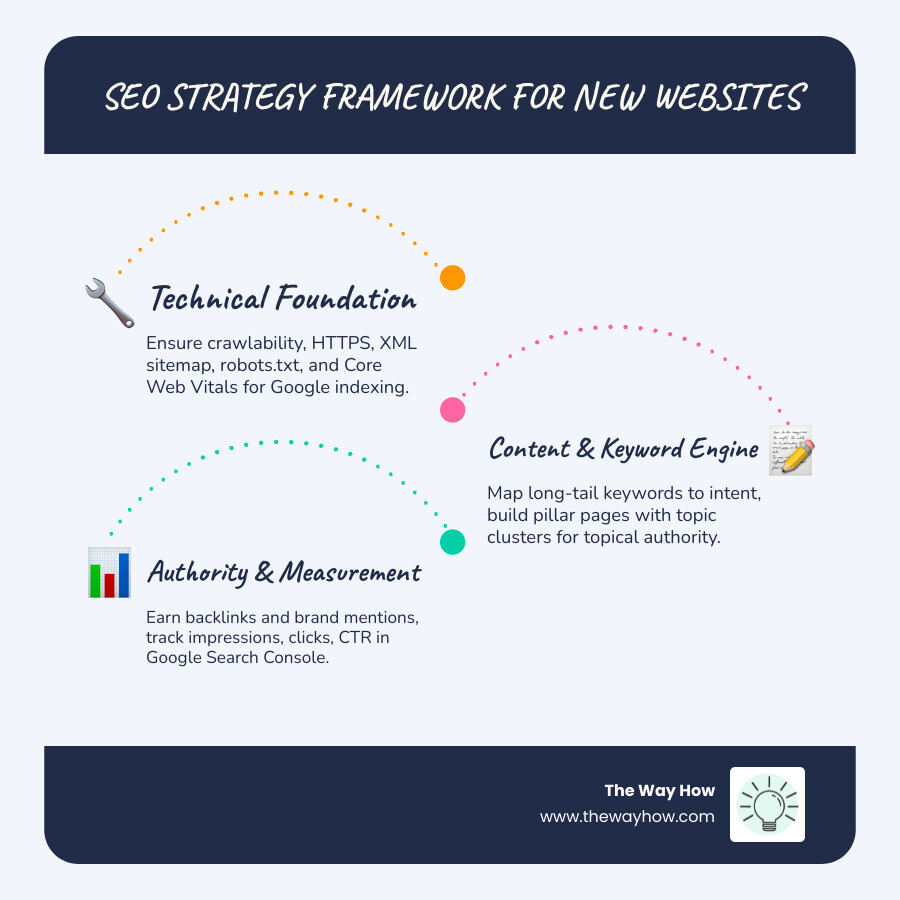
A strong seo strategy for new website launches follows this core framework:
Here is the hard truth most new website owners don’t want to hear: 96.55% of web pages get zero traffic from Google (Ahrefs). Not a little traffic. Zero.
That number isn’t a warning about bad luck. It’s a signal about a systematic gap between what founders believe will get them found and what actually drives discovery.
Most new sites aren’t buried because the product is wrong or the content is bad. They’re buried because the strategy was assembled backwards — tactics first, understanding second. A homepage goes live. A few blog posts get written. Then the waiting begins. And the silence that follows isn’t Google ignoring you. It’s Google telling you something specific.
The good news? The gap between invisible and discoverable is far more predictable than most people realize. It’s a structural problem. And structural problems have structural solutions.
I’m Jeremy Wayne Howell, founder of The Way How and a revenue growth strategist with over 20 years of experience helping founders and executive teams diagnose why growth stalls — including building the kind of seo strategy for new website launches that compounds into real pipeline. In this playbook, I’ll walk you through exactly how to build that foundation from the ground up, without wasting runway on tactics that skip the human in the search bar.
Simple seo strategy for new website glossary:
When we launch a new domain, we are essentially asking search engines to trust a stranger. In psychological terms, Google is looking for certainty. It needs to know that your site is safe, your content is relevant, and your expertise is real. Without these signals, you fall into the “Invisible Founder Syndrome”—working tirelessly on a platform that no one can find.
The search engine discovery lifecycle is a journey from crawling to authority. First, “bots” scurry around the internet to find your pages. Then, they gather and organize that content in a massive database (indexing). Finally, Google uses over 200 ranking factors to decide where you belong on the “search ladder.” For a new site, the biggest challenge is the lack of historical data. You have no “friends” (backlinks) and no reputation. Our goal is to build that reputation systematically.
Before we ever type a word of content, we must ensure the “house” is built on solid ground. Technical SEO is the blueprint of your digital presence. If Google’s crawlers can’t navigate your site, they can’t index your value. We start by ensuring your site architecture is logical and shallow—meaning most pages are only a few clicks away from the homepage.
We recommend using a descriptive URL structure. Instead of random strings of numbers, use clear paths like domain.com/category/topic. This helps both users and search engines understand the context of the page before they even land on it.
To get started, you must verify your site with the right tools. How to set up Google Search Console is your first priority. This tool acts as your direct line to Google, telling you how many pages are indexed and alerting you to any crawl errors. Once verified, you need to provide a roadmap for the bots. Following SOP-055: How to setup and optimize an XML sitemap ensures that every important page on your new site is discoverable.
It is also vital that search engines see your site exactly as a user does. This means Google must have access to your CSS and JavaScript files. If you hide these components, the “librarians” of the internet might misinterpret your site’s quality or structure.

When the average user won’t wait longer than three seconds for a page to load, speed is a matter of empathy. Slow sites create friction, and friction kills conversions. Google measures this through Core Web Vitals—a set of metrics focusing on loading performance (LCP), interactivity (INP), and visual stability (CLS).
We suggest you regularly check site speed on Google PageSpeed to identify bottlenecks. This is especially critical for mobile performance, as more than half of all web traffic now comes from mobile devices. From day one, your seo strategy for new website must prioritize a responsive design that adapts seamlessly to any screen size.
Think of structured data as a translator. While Google is advanced at understanding language, implementing Schema.org markup provides explicit clues about the meaning of your content. By using JSON-LD schema, we can tell Google exactly who our organization is, what products we sell, and how our breadcrumbs are structured. This increases our chances of winning “rich results,” such as star ratings or FAQ snippets, which significantly improve click-through rates.
Most founders start with a list of keywords they want to rank for—usually high-volume, generic terms. This is a mistake. For a new site, trying to rank for “marketing” is like trying to yell over a crowd at a stadium. Instead, we must map keywords to the buyer’s journey:
We begin by learning how to create a list of primary or seed keywords for your site. These are the broad topics that define your business. From there, we filter for opportunity by learning how to choose keywords with low difficulty and high search volume. For a new domain, “low difficulty” is the only metric that matters in the first 90 days.
The secret to early traction is long-tail keywords. These are longer, more specific phrases that have lower search volume but much higher conversion intent. If you sell “organic cat food,” don’t try to rank for “cat food.” Try to rank for “organic cat food for senior cats with sensitive stomachs.”
We use tools like Ahrefs or Semrush to find these gems. Understanding how to create a list of long-tail keywords using Ahrefs or Semrush allows us to target “problem statements”—the exact questions our customers are typing into the search bar when they are frustrated and seeking certainty.
We don’t operate in a vacuum. To win, we must understand what the current “winners” are doing. This isn’t about copying; it’s about identifying gaps. By performing how to do an SEO competitor analysis, we can see which keywords our competitors have overlooked.
Using tools to find competitor keywords helps us build a keyword map that captures the traffic they are leaving on the table. This market research ensures our seo strategy for new website is built on actual demand rather than founder intuition.
Content is the fuel of your SEO engine, but not all content is created equal. To rank a new site, we must build “topical authority.” This means Google shouldn’t just see you as a site with a few blogs; it should see you as an expert on a specific subject.
The most effective way to do this is the Pillar-Cluster model. You create one massive, comprehensive “pillar page” on a core topic and then surround it with 6-12 “cluster” articles that dive deeper into specific sub-topics. We’ve mastered how to build topical authority for your niche by focusing on this hierarchical structure.
Understanding what is a pillar page and why it matters for your SEO strategy is crucial. It serves as the hub of your expertise. We then work to identify main topic clusters for your business to ensure every piece of content we publish reinforces our central message.
In the age of AI-generated noise, human expertise is your greatest competitive advantage. Google prioritizes E-E-A-T: Experience, Expertise, Authoritativeness, and Trustworthiness. As a founder, your unique POV, original research, and case studies are signals that AI cannot replicate.
We encourage you to analyze competitors content not to mimic them, but to find where their “E-E-A-T” is thin. By publishing data-driven studies or interviewing subject matter experts, you provide search engines with a reason to rank your new site over established competitors who are simply recycling generic information.
While we write for humans, we must format for bots. This is where the technical meets the creative. If you are on WordPress, learning how to perform on-page optimization on a WordPress post with Yoast is a great starting point.
Key elements include:
The SEO landscape is shifting. With the rise of AI Overviews and “zero-click” searches, many users get their answers directly on the search results page without ever clicking through to a website. This makes brand mentions and digital PR more important than ever.
| Feature | Traditional Search | AI Overviews (SGE) |
|---|---|---|
| Primary Goal | Drive traffic to websites | Provide immediate answers |
| Ranking Factor | Backlinks and keywords | Originality and expert citations |
| User Behavior | Clicks multiple links | Reads summary, might click one |
| Strategy | Long-form SEO content | Clear, concise expert summaries |
To survive in this environment, we must build a brand that people trust. According to research on global trust in advertising and brand messages, word-of-mouth and editorial content remain the most trusted forms of communication. For a new website, this means getting your name mentioned on credible third-party sites, even if they don’t provide a direct link.
Backlinks are the “votes of confidence” of the internet. For a new site, they are the fastest way to build authority. However, we must avoid “gray-hat” tactics that can lead to penalties. Instead, we focus on earning links through high-quality content and genuine relationships.
First, perform a backlink audit on your website to see where you currently stand. Then, we can reverse engineer your competitors backlink strategy to see which industry blogs, podcasts, or directories are linking to them. Guest blogging on niche sites and participating in community forums like Reddit or LinkedIn are excellent ways to build a natural, sustainable backlink profile.
SEO is a marathon, but we need milestones to ensure we aren’t running in the wrong direction. A realistic seo strategy for new website success looks like this:
Days 1-30: The Foundation Phase
Days 31-60: The Content Engine Phase
Days 61-90: The Scaling Phase
We don’t just look at traffic; we look at the health of the system. In the first 90 days, your most important metric is Impressions. This tells us that Google is starting to show your site for relevant queries. Next, we look at Clicks and Click-Through Rate (CTR).
If your impressions are high but clicks are low, your title tags or meta descriptions aren’t resonating with the human behind the search. We also need to fix crawl errors in Google Search Console as they arise to ensure momentum isn’t stalled by technical friction. We measure success by assisted conversions and pipeline impact—did this traffic actually lead to a business outcome?
Early traction typically appears in 4 to 8 weeks through impressions on long-tail terms, while compounding growth and significant traffic usually require 3 to 6 months of consistent execution. New sites can often see 10–20 target keywords ranking in the top 30 within the first 60 days if the strategy is focused on low-difficulty terms.
New websites should prioritize long-tail, low-difficulty keywords to build initial topical authority and capture specific user intent before attempting to rank for high-volume, competitive head terms. High-volume terms are often dominated by legacy sites with massive backlink profiles that a new domain cannot compete with initially.
The most frequent errors include blocking search engines via robots.txt (often left on after a site launch), neglecting mobile optimization, creating thin content that lacks original value, and failing to implement a logical internal linking structure. Another common mistake is “keyword stuffing,” which Google views as spam and can lead to a lack of indexing.
At The Way How, we believe that marketing shouldn’t feel like a gamble. We are a psychology-first marketing and revenue strategy firm that helps founders remove the fog of uncertainty. By focusing on human behavior and structural clarity, we turn your website from a quiet digital brochure into a dependable growth engine.
Whether you need Fractional CMO leadership to guide your long-term vision or a deep dive into your HubSpot architecture to ensure your leads aren’t falling through the cracks, we specialize in designing systems that create trust and momentum. We don’t just chase the latest SEO tactics; we diagnose why your growth has stalled and build the roadmap to restore it.
If you’re ready to move beyond the “Invisible Founder” phase and start building a predictable pipeline, we’re here to help you see the problem clearly before we ever talk about solutions.
 Jeremy Wayne Howell : Jul 22, 2026 9:48:31 PM
 Jeremy Wayne Howell : Jul 21, 2026 9:47:10 PM
 Jeremy Wayne Howell : Jul 20, 2026 9:46:47 PM