

Why Most GTM Strategies Miss the Mark (and How to Fix Yours)

The 7 elements of go to market strategy are: defining your market and customer psyche, crafting your core narrative and value proposition, designing your pricing and packaging strategy, choosing your go-to-market motions, mapping your distribution and channel plan, aligning your internal stakeholders and teams, and implementing your measurement and optimization loop.
Quick Reference: The 7 Elements
- Define Your Market and Customer Psyche – Understand who buys, why they buy, and what creates certainty
- Craft Your Core Narrative and Value Proposition – Articulate why you exist and why it matters
- Design Your Pricing and Packaging Strategy – Signal value and position in the market
- Choose Your Go-to-Market Motions – Decide how you’ll acquire and convert customers
- Map Your Distribution and Channel Plan – Define where and how customers will find you
- Align Your Internal Stakeholders and Teams – Ensure everyone understands the plan and their role
- Implement Your Measurement and Optimization Loop – Track what matters and adapt based on reality
McKinsey’s research shows that for every successful market entry attempt, about four fail. That’s an 80% failure rate, even among sophisticated companies with experience and resources.
The problem isn’t lack of effort. It’s lack of clarity.
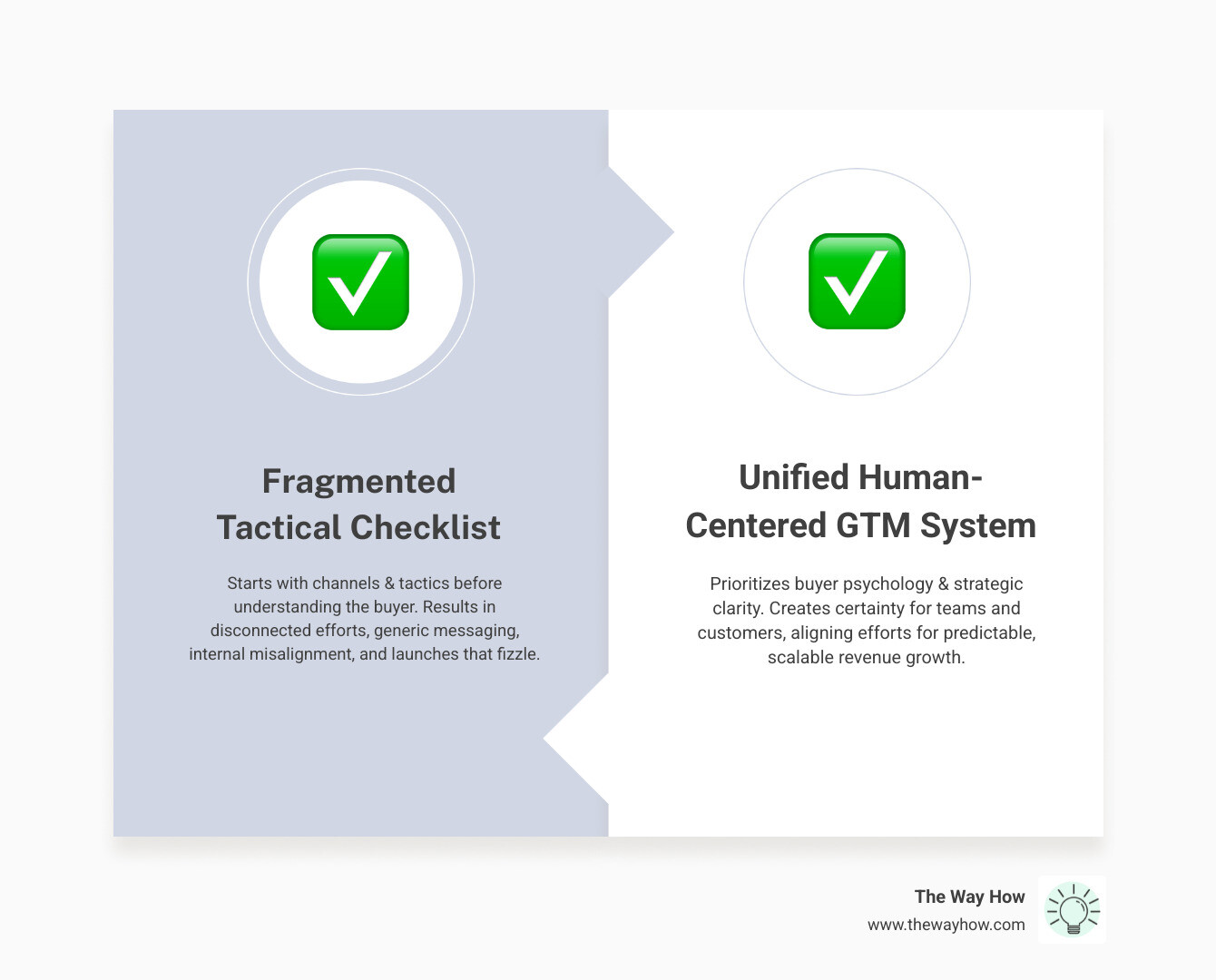
Most GTM strategies are built backward. They start with channels, tactics, and tools before anyone asks the fundamental question: What does the human on the other side of this decision actually need to feel certain enough to buy?
When you skip that question, you get:
- A “strategy” that’s really just a list of marketing activities
- Messaging that sounds like everyone else in your category
- Sales and marketing teams working from different playbooks
- Tactics that work on paper but don’t move revenue
- Launches that fizzle because no one knew why they were supposed to care
A real go-to-market strategy isn’t a checklist. It’s a system for creating certainty — for your team, your buyers, and your business.
It answers who you’re serving, why they should believe you, how they’ll buy, and what success looks like. And it does all of this before you build the funnel, write the emails, or hire the sales team.
That’s what this article is about.
Not another tactical template. Not a list of “best practices” copied from someone else’s playbook. A framework grounded in how humans actually make decisions, how revenue systems actually work, and how companies actually grow when the fundamentals are right.
I’m Jeremy Wayne Howell, and I’ve spent over 20 years helping companies diagnose why their growth stalled and rebuild from a foundation of buyer psychology and strategic clarity. I’ve seen the same GTM mistakes repeated across industries, and I’ve helped businesses restructure around the 7 elements of go to market strategy to create predictable, scalable revenue.
The 7 Elements of Go-to-Market Strategy: A Human-Centered Framework
At The Way How, we believe that an effective Go-to-Market (GTM) strategy is less about a rigid formula and more about a deep, empathetic understanding of human behavior. It’s about designing a system that removes uncertainty for your potential customers and empowers your team to build trust, momentum, and predictable revenue. This is our psychology-first approach to business growth and strategic clarity.
While many GTM frameworks exist, like Bain’s go-to-market system, we’ve distilled the core components into 7 elements of go to market strategy that focus on the human side of the equation. These elements aren’t just steps; they’re interconnected pillars designed to create a customer-centric system that truly resonates.
1. Define Your Market and Customer Psyche
The first and most critical element of any GTM strategy is to truly understand who you’re trying to reach and why they behave the way they do. As we often say, “The key to your go-to-market strategy is knowing who to sell to.” This isn’t just about demographics; it’s about delving into their deepest motivations, pain points, and decision-making processes.
To achieve this, we must go beyond surface-level analysis:
- Identify Your Ideal Customer Profile (ICP): This defines the type of company or customer most likely to benefit from and buy your product. For B2B, this might involve firmographics (industry, size, revenue), while for B2C, it could be broader demographics.
- Develop Detailed Buyer Personas: These are semi-fictional representations of your ideal customers, based on market research and real data about your existing customers. Personas help us understand not just who the decision-makers are, but also their designations, roles, and the influencers in their purchasing journey. This contrasts with an ICP, which identifies the consumer who uses your product, whether they are the regular user, budget owner, approver, or gatekeeper.
- Uncover “Jobs-to-be-Done”: What fundamental problem are customers trying to solve, or what progress are they trying to make? This shifts the focus from your product’s features to the customer’s desired outcome.
- Analyze Customer Psychology and Pain Points: What emotional triggers drive their decisions? What frustrations do they experience with current solutions (or lack thereof)? Laura Robison, Founder and Marketing Consultant at GainKite, contends that “research is the first step to understanding both your customer and your competitors.” We cannot stress enough the importance of conducting thorough market research, including surveys, focus groups, and one-on-one interviews, to gather these insights.
- Conduct Competitive Analysis and Demand Analysis: Understand who your competitors are, what customer segments and regions they target, and how your product differs. Crucially, map competitors broadly, including not just direct rivals but also indirect solutions like manual processes, DIY approaches, or even the option of doing nothing. This helps identify market gaps you can fill and whether there’s sufficient demand.
- Startup Nuances: For startups, this step involves defining an Early Customer Profile (ECP) — customers with a “burning pain,” “willingness to pay,” “reference potential,” and “proximity” to you. This is distinct from a broader ICP and is crucial for initial traction.
A comprehensive GTM strategy helps businesses avoid costly missteps, such as targeting the wrong customer segments or entering a market flooded with similar products. We help you build a solid foundation for your client acquisition funnel by deeply understanding the human at its core.
For more on understanding your market, explore how to do an SEO competitor analysis.
2. Craft Your Core Narrative and Value Proposition
Once you understand your customer’s psyche, the next step is to articulate why your solution matters to them. Your core narrative and value proposition are the heart of your communication strategy, designed to resonate deeply with their needs and desires.
- Define Your Value Proposition: This isn’t just a list of features; it’s a clear statement of the value a customer gains from a purchase and why they should use your product or service. As McKinsey insights suggest, a value proposition isn’t a broad positioning statement aimed at mass appeal; it should be the perfect solution for your target audience, highlighting unique benefits that address their specific pain points.
- Establish Your Unique Selling Proposition (USP): What makes you distinct from every other option, including the status quo? This is your differentiator, the reason customers choose you over competitors.
- Develop Authentic Brand Messaging: Your business messaging needs to be developed to communicate your value proposition in a way that resonates with your ICP’s pain points. This requires an emotional touch and authentic, relatable messaging. We’ve seen the power of customized communication in action; tailoring your message significantly increases conversion likelihood and fosters long-term loyalty.
- Accept Storytelling and Emotional Resonance: Humans connect with stories, not just facts. Frame your offering in a way that taps into their emotions and aspirations. This is where understanding the marketing framing effect guide becomes invaluable, ensuring your message is perceived in the most favorable light.
- Strategic Positioning: Where do you stand in the competitive landscape? Your narrative should clearly position you as the ideal solution for your defined target segment.

3. Design Your Pricing and Packaging Strategy
Pricing isn’t just a number; it’s a powerful psychological signal that communicates your product’s value and positions you in the market. This element of your GTM strategy requires careful thought, blending economic realities with behavioral insights.
Understand Perceived Value: Pricing strategy is deeply tied to how customers perceive your offering. Lower-priced products, for example, can sometimes be seen as inferior. Your price should reflect the quality and benefits you deliver.
Choose Your Pricing Model: Consider various approaches such as:
- Value-based pricing: Based on the perceived value to the customer, not just your costs.
- Competitor-based pricing: Setting prices relative to what competitors charge.
- Cost-plus pricing: Adding a markup to your production costs.
- Penetration pricing: Initially low prices to gain market share quickly.
Strategic Packaging: How you bundle your offerings can significantly impact perceived value and sales. Options include:
- Tiered pricing: Offering different levels of features or service at varying price points.
- Freemium/Free Trial: Providing a basic version for free to attract users, then upselling to premium features.
Align with GTM Motions: Your pricing strategy must align with your overall GTM motion. For example, a high-touch, sales-led approach might justify premium pricing, while a product-led growth model often benefits from freemium or low-cost entry points.
The Psychology of Pricing: We often advise clients that it’s generally wiser to start higher with selective discounts than to start too low. This leverages the psychological anchor effect and allows room for future promotions without devaluing your brand.
Effective revenue cycle management analytics can help you analyze the impact of different pricing models on your bottom line.
4. Choose Your Go-to-Market Motions
This element dictates how you’ll actually get your product into the hands of your customers. It’s about selecting the primary acquisition and conversion engines for your business. There isn’t a one-size-fits-all answer; the optimal GTM motion depends heavily on your product, target market, competitive landscape, and organizational strengths.
- Product-Led Growth (PLG): A hot buzzword in the B2B SaaS space, PLG leverages the product itself to drive customer acquisition, conversion, and expansion. Think freemium models, free trials, and self-service onboarding. As Rex Huxford, Director of Demand Generation at MD Clarity, points out, “product-led strategies work by leveraging the product itself to pull customers.”
- Sales-Led Growth (SLG): This traditional model relies on direct sales teams to engage prospects, build relationships, and close deals. Rex Huxford notes that “sales-led strategies focus on relationship-building to push customers to convert.” This is often ideal for complex products, high average contract values, or B2B markets requiring personalized attention.
- Marketing-Led Growth: Driven primarily by marketing efforts to generate leads that are then handed off to sales (or convert directly). This includes inbound marketing (content, SEO, social media) and outbound marketing (ads, email campaigns).
- Hybrid Approaches: Many successful companies blend these motions. As Mandy Idol, Co-Founder and Chief Marketing Officer at Indigo Collective Group, suggests, “the optimal GTM strategy depends on factors such as target market, competitive landscape, product complexity, and organizational strengths.” You might use a freemium model (PLG) to generate leads, then have an inside sales team (SLG) engage those who show high product qualified lead (PQL) intent.
- Strategic Selection: There are typically seven common GTM motions (Outbound, Inbound, PLG, Partnerships, Channel/Alliances, Events, Community). Most companies find that two or three will work best for them. We help you diagnose which motions align with your customer’s buying psychology and your internal capabilities to create an automated client acquisition funnel guide 2026 that actually works.

5. Map Your Distribution and Channel Plan
This element defines where and how your customers will find, access, and ultimately purchase your product or service. It’s about creating a seamless path to your solution that aligns with your customers’ natural behaviors.
Omnichannel Marketing: Customers expect a seamless experience across all channels in today’s connected world. Your strategy should encompass a personalized omnichannel marketing plan, using a mix of traditional and digital tactics. This means integrating your messaging and experience across all touchpoints.
Direct vs. Indirect Channels:
- Direct: Selling directly to the customer (e.g., your website, direct sales team).
- Indirect: Utilizing partners, resellers, distributors, or marketplaces (e.g., app stores, retail stores, affiliate networks).
Strategic Channel Selection: The choice of channels should be informed by your target audience and the nature of your product. For instance, Oatly’s US market entry shows the power of strategic channel selection. Rather than immediately fighting for supermarket shelf space, they partnered with specialty coffee shops where baristas became authentic product ambassadors. This positioned their product as premium and craft-oriented, generating buzz and demand before mass market expansion.
Align with Product Development: For network effect businesses, Reid Hoffman, founder of LinkedIn, believes that distribution strategy must be developed alongside the product itself. In some cases, your distribution mechanisms can change or take on a multi-faceted approach as you grow.
Customer Journey Mapping: Visualize the entire path a customer takes from awareness to purchase and beyond. This helps identify key touchpoints where your channels need to be present and optimized. We assist clients in designing comprehensive marketing strategies with HubSpot that ensure consistent engagement across their chosen channels.
6. Align Your Internal Stakeholders and Teams
Even the most brilliant GTM strategy will falter without unified internal support. This element is about ensuring that every part of your organization, from product development to sales and customer support, is on the same page and working towards a common goal.
- Cross-Functional Collaboration: A successful GTM strategy requires collaboration from all stakeholders, including your internal teams, partners, investors, and even customers. Involving key players from the beginning of the GTM strategy process and maintaining open communication is the best way to achieve alignment.
- Shared Understanding and Purpose: A well-crafted GTM strategy that involves cross-functional collaboration can significantly boost employee engagement by giving everyone clear direction and purpose in their work. Interestingly, a Gallup study found only 33% of US workers feel genuinely engaged with their work. This disconnect can be a silent killer of GTM efforts.
- RACI Matrix and Clear Roles: Define clear roles and responsibilities (Responsible, Accountable, Consulted, Informed) for each task within the GTM plan. This removes ambiguity and fosters accountability.
- Consistent Messaging: Ensure that sales, marketing, and customer support teams are all communicating a consistent message about the product’s value proposition. This reduces buyer uncertainty and builds trust.
- Empowerment and Resources: The sales team, in particular, needs the necessary tools, training, and resources to execute the GTM plan effectively. This includes up-to-date product knowledge, sales enablement materials, and a clear understanding of the target audience’s needs.
- Leadership Buy-in: Stakeholder alignment starts at the top. Leadership must champion the GTM strategy and model cross-functional collaboration. For many growing companies, bringing in a fractional CMO guide can be instrumental in driving this alignment and ensuring strategic execution.
7. Implement Your Measurement and Optimization Loop
The final, but continuous, element of the 7 elements of go to market strategy is about proving success and adapting to reality. No GTM strategy is perfect from the outset. It is important to continually fine-tune, iterate, and improve your chance for success.
- Define Key Performance Indicators (KPIs): Clearly identify what success looks like. KPIs should be simple, achievable, and measurable. Examples include Customer Acquisition Cost (CAC), Customer Lifetime Value (LTV), LTV:CAC ratio, conversion rates, sales cycle length, and market share.
- Track and Analyze Performance: Regularly monitor your chosen KPIs. This isn’t just about collecting data; it’s about analyzing it to understand why certain results are occurring. This allows for data-driven decisions. We help clients leverage tools like HubSpot analytics to gain these crucial insights.
- Establish Feedback Loops: Create systematic ways to gather feedback from customers, sales teams, and market performance. This includes user interviews, NPS surveys, usage analytics, churn interviews, and reviewing sales call recordings.
- Accept Iteration and A/B Testing: Be prepared to make adjustments. Most companies take five to seven spins to align all the elements of product-market fit and go-to-market motions. Run small, controlled experiments (A/B tests) to validate assumptions and optimize specific elements of your strategy, from messaging to pricing.
- Closed-Loop Reporting: Ensure there’s a continuous flow of information and insights between marketing, sales, and product teams. This fosters a culture of continuous improvement and allows for rapid adaptation to market changes.
- The Human Element of Measurement: While data is crucial, remember the human-centered mindset. Feedback from real people, even anecdotal, can provide invaluable context to the numbers.
This continuous loop of measurement and adjustment is vital for making data-driven decisions that refine your strategy and build sustained momentum.
Frequently Asked Questions about Go-to-Market Strategy
What is the difference between a GTM strategy and a marketing plan?
This is a common point of confusion. Think of it this way: a Go-to-Market (GTM) strategy is a highly focused, tactical roadmap for introducing a specific product or service to a specific market or audience, with a clear timeline. It’s about the initial launch and early customer acquisition. Its goal is to get the product to market successfully and profitably.
A marketing plan, on the other hand, is a broader, long-term strategy that encompasses all marketing activities for a company’s entire portfolio of products or services. It’s an ongoing effort to build brand awareness, nurture customer relationships, and achieve overall marketing goals over an extended period.
The GTM strategy is short-term and involves thorough research and planning for a particular launch. A marketing plan is continuous and supports the company’s overall brand and sales efforts. One is a sprint, the other a marathon. We help clients define go to market strategies that are distinct yet integrated with their broader marketing efforts.
How do you know if your GTM strategy is successful?
You know your GTM strategy is successful when customer acquisition becomes predictable, your Customer Acquisition Cost (CAC) is comfortably below your Customer Lifetime Value (LTV), and your channels are scalable. We call this achieving “go-to-market fit.”
Key indicators of success include:
- Achieving GTM Fit: This means you have a repeatable sales process, successful customer adoption, and all your internal teams are aligned.
- Quantifiable KPIs: Define and track metrics that are simple, achievable, and measurable. These could include conversion rates, sales velocity, market share growth, and customer retention rates.
- Healthy LTV:CAC Ratio: A ratio of 3:1 or higher is often considered ideal for a sustainable business model, meaning the value a customer brings over their lifetime is significantly greater than the cost to acquire them.
- Meeting SMART Goals: Setting Specific, Measurable, Attainable, Relevant, and Time-specific goals for your GTM efforts is crucial.
- Predictable Revenue: Your ability to forecast future revenue becomes more accurate, indicating a stable and repeatable growth engine.
Regular business data analysis and continuous monitoring of these metrics are essential to gauge success and identify areas for improvement.
How does a GTM strategy differ for B2B vs. B2C?
While the core 7 elements of go to market strategy remain consistent, their application differs significantly between B2B (Business-to-Business) and B2C (Business-to-Consumer) markets, primarily due to differences in buyer psychology and sales cycles.
B2B GTM Strategies:
- Target Audience: Often involves a “buying committee” with multiple stakeholders (economic buyers, technical buyers, end-users, champions, influencers).
- Sales Cycle: Typically longer and more complex, involving extensive relationship-building, demonstrations, and negotiations.
- Messaging: Focuses on ROI, efficiency, scalability, and addressing specific business challenges. It’s often more logical and problem-solution oriented.
- Channels: Direct sales, account-based marketing (ABM), industry events, webinars, and specialized content are common.
- Relationship: Emphasizes long-term partnerships and strategic value.
B2C GTM Strategies:
- Target Audience: Often a single individual or household.
- Sales Cycle: Generally shorter, with quicker decision-making.
- Messaging: Appeals more to emotional drivers, personal benefits, lifestyle, and immediate gratification.
- Channels: Mass marketing, social media, e-commerce, retail distribution, and broad advertising campaigns are prevalent.
- Relationship: Focuses on brand loyalty, community, and ease of purchase.
Commonalities:
Regardless of B2B or B2C, the fundamental human desire for certainty, value, and connection remains. Authentic, relatable messaging and fostering genuine relationships are key to long-term success in both sectors. Both require a deep understanding of the customer’s pain points and a clear value proposition. For B2B companies looking to refine their approach, our insights on HubSpot B2B marketing strategies can be particularly helpful.
From Checklist to Cohesive System
We’ve explored the 7 elements of go to market strategy, moving beyond a simple checklist to a cohesive, human-centered system. This isn’t just about launching products; it’s about building enduring connections and predictable revenue streams.
At The Way How, we understand that true business growth comes from diagnosing why growth is stalled, identifying certainty gaps in the customer journey, and designing systems that create trust, momentum, and predictable revenue. Our psychology-first approach, rooted in human behavior, empathy, and decision-making psychology, ensures that your GTM strategy is not just effective, but sustainable.
Ready to transform your go-to-market approach from a series of disconnected tactics into a powerful, integrated system? We blend strategic clarity, behavioral insight, and operational execution to turn marketing into a dependable growth engine.
Explore our marketing, advertising & brand design services to see how we can help you build certainty, momentum, and predictable revenue.