A Complete Guide to CRM Systems and Database Management
 Jeremy Wayne Howell : Jul 22, 2026 9:48:31 PM

Analytics driven marketing is the practice of using real customer behavior data — not gut instinct — to shape every marketing decision, from messaging and targeting to budget allocation and timing.
Here’s what it means in practice:
| What It Is | What It Does |
|---|---|
| Behavior-based decision making | Replaces guesswork with evidence |
| Multi-channel data collection | Reveals where customers actually are |
| Predictive and prescriptive analysis | Tells you what will happen and what to do |
| Continuous optimization loops | Improves performance over time, not just once |
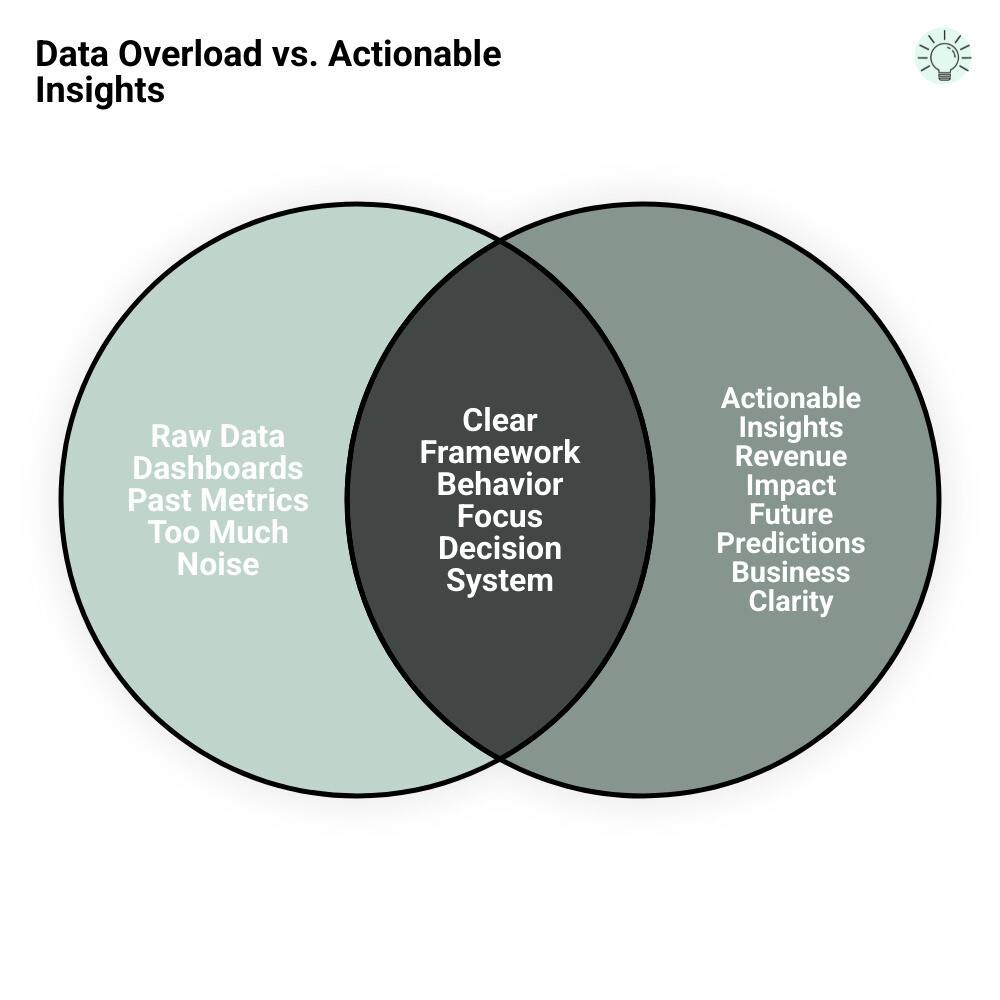
Most marketing teams aren’t failing because they lack data. They’re failing because they have too much of the wrong data and no clear system for turning any of it into decisions.
83% of marketers say translating data into actionable insight at the right moment is very important. Yet most teams are still drowning in dashboards that describe the past without pointing toward what to do next.
That’s the gap this guide is designed to close.
You don’t need a data science team. You don’t need perfect data. You need a clear framework that connects what your customers are doing to what your business should do next — built around how people actually make decisions, not just how they click.
I’m Jeremy Wayne Howell, founder of The Way How, a psychology-first revenue strategy firm where I’ve spent over 20 years helping founders and revenue leaders build marketing systems around buyer behavior — including implementing analytics driven marketing strategies that tie directly to pipeline and revenue, not just impressions. That context shapes everything in this guide.
Basic Analytics driven marketing glossary:
For decades, marketing was a “gut feel” game. You hired a creative agency, launched a campaign because it felt right, and hoped for the best. This traditional approach relied on broad methods like TV and print with limited ability to measure what actually worked.
Today, that model is broken. We have shifted toward an evidence-based approach where every dollar spent is backed by a reason. According to McKinsey’s research on marketing analytics, companies that excel at this are 2.4x more likely to significantly outperform their competitors on key business metrics.
The difference isn’t just about having numbers; it’s about the precision of those numbers. Traditional marketing treats your audience like a monolith. Analytics driven marketing treats them like individuals with unique behaviors, preferences, and psychological triggers.
| Traditional Gut-Feel | Analytics-Driven Model |
|---|---|
| Focuses on “Who” (Demographics) | Focuses on “Why” (Behavior & Intent) |
| Reactive (Adjusts after the campaign) | Proactive (Optimizes in real-time) |
| Siloed data (Spreadsheets & guesses) | Centralized truth (Integrated systems) |
| Static messaging | Dynamic, personalized content |
By moving toward data-driven-decisions, we remove the “I think” from the boardroom and replace it with “The data shows.” This transition doesn’t replace creativity; it gives creativity a target.
Uncertainty is the silent killer of growth. When leadership teams aren’t sure which channel is driving revenue, they hesitate. They under-invest in winners and over-spend on losers.
Analytics driven marketing serves as the antidote because it provides a clear map of the customer journey. When you understand the path a buyer takes, you can identify “certainty gaps”—those moments where a prospect feels confused or hesitant—and fix them.
The benefits are measurable:
By focusing on data-driven-marketing-strategies, we move from chasing tactics to building a dependable growth engine.
One of the most powerful aspects of modern analytics is the ability to look forward, not just backward. We aren’t just recording what happened; we are predicting what will happen next based on behavioral signals.
Take RFM segmentation (Recency, Frequency, Monetary value). By analyzing how recently a customer bought, how often they buy, and how much they spend, we can identify our most valuable segments. One men’s apparel brand, 2xist, used this to completely transform their strategy, moving beyond basic metrics to deep customer analysis.
We also use these insights for:
According to HubSpot’s State of Marketing Report, organizations using real-time analytics achieve 34% faster decision-making velocity. When consumer behavior changes overnight, speed is a competitive advantage.

To truly master analytics driven marketing, we need to look through four distinct lenses. Most companies stop at the first one. To drive revenue, you need all four.
Establishing a Gartner’s data governance framework ensures that these lenses are focused on accurate, clean data. Without governance, you’re just looking through a dirty window.
Data tells you that someone clicked. Psychology tells you why. At The Way How, we believe that marketing-data-analysis is incomplete without behavioral insight.
If your analytics show a high bounce rate on a pricing page, the “what” is the bounce. The “why” might be a lack of social proof, a confusing pricing structure, or a perceived lack of empathy for the buyer’s problem.
By combining quantitative data (clicks, time on page, conversion rates) with qualitative signals (sentiment analysis, customer feedback, session recordings), we can decode human intent. This allows us to optimize the journey for trust and momentum, not just for clicks.
The biggest mistake we see is “tool sprawl.” Companies buy ten different platforms, but none of them talk to each other. This creates data silos—fragmented islands of information that make it impossible to see the full customer journey.
To build a system that works for humans, we must prioritize:
Implementing marketing-analytics-solutions shouldn’t feel like building a house of cards in a windstorm. It should feel like building a foundation.
You don’t need every tool on the market. You need the right ones for your specific stage of growth. Here are the core components of a modern analytics stack:
The goal is to move from “data-rich but insight-poor” to “decision-ready.”
The “last mile” of analytics driven marketing is where most teams stumble. They have the report, they see the insight, but they don’t take action. This is often caused by analysis paralysis—the fear of making the wrong move because the data isn’t “perfect.”
As Dr. Katia Walsh said, “You will never have perfect data, and that’s okay.”
To overcome this, we implement experimentation loops:
For a deeper dive into managing this entire process, see our revenue-cycle-analytics-complete-guide.
Traditional marketing relies on broad, intuition-based campaigns with limited measurement. It’s the “spray and pray” approach. Data-driven marketing uses specific customer behavior data to tailor messaging and optimize performance in real-time. It shifts the focus from “what we want to say” to “what the customer needs to hear.”
The primary hurdles include data silos where information is fragmented across tools, poor data quality (the “garbage in, garbage out” problem), and a skills gap in translating technical metrics into strategic business actions. Many teams have plenty of analysts but few “translators” who can turn a spreadsheet into a strategy.
AI and machine learning automate the identification of patterns in massive datasets that would be impossible for a human to spot. This allows for predictive lead scoring, real-time anomaly detection (like spotting a broken checkout page in minutes), and hyper-personalization at scale. AI can reallocate up to 30% of a marketing team’s time toward strategic initiatives by automating routine reporting.
At The Way How, we don’t believe in chasing the latest shiny object or AI trend just for the sake of it. We believe in systems that work because they are rooted in how humans actually behave.
If your marketing feels like a black box—if you’re spending money but aren’t sure why it’s working (or why it isn’t)—you don’t have a tactical problem. You have a certainty gap.
Our work as a psychology-first revenue strategy firm is to help you close that gap. Whether through Fractional CMO leadership or building out your HubSpot architecture, we focus on turning analytics driven marketing into a dependable growth engine that removes uncertainty for both you and your customers.
We diagnose before we prescribe. We teach before we persuade. And we always prioritize the human on the other side of the screen.
Ready to see the “why” behind your “what”? Explore our services and let’s build a system that creates trust, momentum, and predictable revenue.
 Jeremy Wayne Howell : Jul 22, 2026 9:48:31 PM
 Jeremy Wayne Howell : Jul 21, 2026 9:47:10 PM
 Jeremy Wayne Howell : Jul 20, 2026 9:46:47 PM