A Complete Guide to CRM Systems and Database Management
 Jeremy Wayne Howell : Jul 22, 2026 9:48:31 PM

Behavioral revenue tactics are strategies that use buyer psychology, real-time behavior signals, and decision science to influence purchasing decisions and drive predictable revenue growth.
Here’s a quick overview of how they work and why they matter:
| Tactic Category | What It Does | Example |
|---|---|---|
| Pricing Psychology | Shapes perceived value | Decoy pricing, anchoring, charm pricing |
| Behavioral Targeting | Matches messages to buyer intent | Cart abandonment emails, retargeting ads |
| Social Proof & Scarcity | Reduces uncertainty, triggers action | Reviews, limited stock alerts, FOMO |
| Sales Behavior Design | Improves deal outcomes using buyer signals | Engagement-based outreach, JOLT framework |
| Penetration & Premiumisation | Drives category revenue growth | Buyer acquisition + price-per-volume lift |
Most companies stall not because they lack tactics — but because their tactics are built on assumptions instead of behavior.
They know their funnel numbers. They’ve hired the agencies. They’ve run the campaigns. And still, revenue plateaus. The problem isn’t effort. It’s that the strategy is aimed at who they think the buyer is, not how that buyer actually thinks and decides.
Here’s what the research confirms: in a 13-year study of 474 consumer categories, the primary driver of revenue growth wasn’t ad spend or product innovation. It was penetration — reaching more buyers — combined with price per volume, meaning customers willing to pay more. Not frequency. Not basket size. Buyers and value perception.
That’s a behavioral insight disguised as a sales metric.
Most marketing fails because it’s built on assumptions about what people *should* do — not what they actually do.
The same pattern shows up in B2B sales, SaaS pricing, e-commerce conversion, and even post-training sales adoption. When revenue stalls, there’s almost always a human behavior problem underneath the performance problem.
I’m Jeremy Wayne Howell, founder of The Way How and a revenue growth strategist with over 20 years of experience applying behavioral revenue tactics across marketing, sales, and go-to-market strategy. I’ve helped businesses increase close rates by 20–40% and rebuild stalled growth engines by addressing the psychological gaps that data dashboards don’t surface.
In this guide, we’ll diagnose exactly where those gaps live — and how to close them.
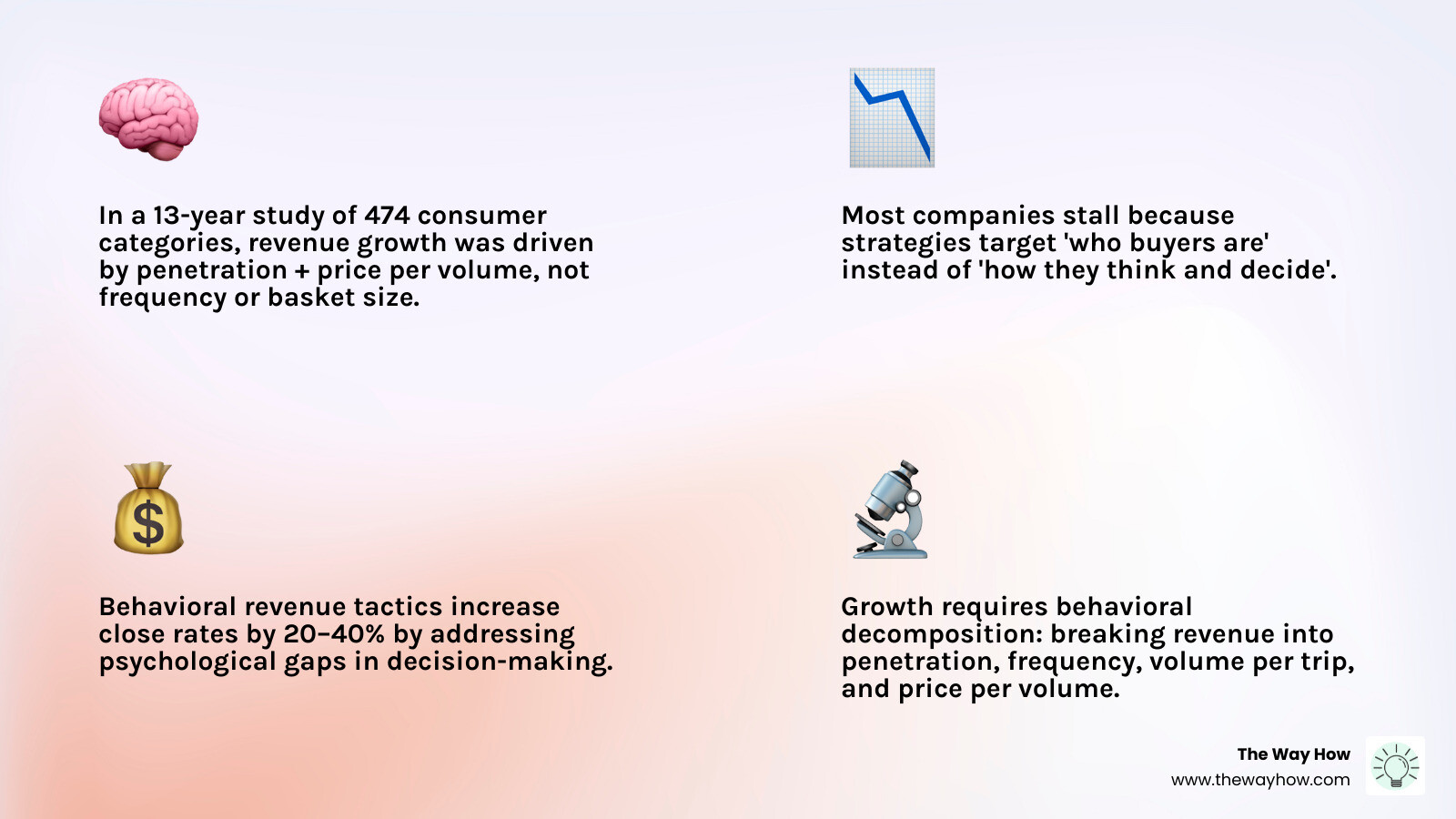
To understand why some companies thrive while others plateau, we have to look past total sales figures and perform a behavioral decomposition of revenue. This means breaking down growth into its atomic parts: penetration, purchase frequency, volume per trip, and price per volume.
When we look at sustainable revenue growth, we often find that teams focus on the wrong levers. They try to “increase loyalty” by getting existing customers to buy more often (frequency). However, empirical studies using 13 years of household panel data reveal a different reality. Growth is overwhelmingly driven by expanding the buyer base and increasing the value of each unit sold.
Traditional revenue strategies rely on static demographics—the “who.” Behavioral tactics focus on the “why” and “how.” By analyzing scientific research on category growth drivers, we see that revenue management is less about convincing one person to buy ten times and more about convincing ten people to buy once at a premium price.
The CPG industry provides a masterclass in these dynamics. Longitudinal data across 474 categories shows that when a category declines, the leading cause is almost always penetration loss. People simply stop entering the category. Conversely, growth is fueled by two main engines:
Interestingly, volume per trip and purchase frequency rarely move the needle significantly for overall category expansion. This suggests that the most effective behavioral revenue tactics are those that lower the barrier to entry for new customers and justify a higher price point through psychological framing.
Pricing is the most powerful lever in your business. A 1% increase in price can lead to an 11% lift in profit for the average S\&P 500 company. Yet, most businesses default to cost-plus pricing—adding a margin to their expenses—which leaves millions on the table.
Value-based pricing, by contrast, sets the price based on what the customer believes the product is worth. To capture this value, we use choice architecture—the way choices are presented to influence the outcome.
| Feature | Cost-Plus Pricing | Value-Based Pricing |
|---|---|---|
| Primary Driver | Internal costs and margins | Customer’s perceived economic value |
| Market Perception | Commodity-focused | Quality and outcome-focused |
| Revenue Potential | Limited by cost fluctuations | Captured 15–35% higher revenue |
| Customer Logic | “Is this fair based on their cost?” | “Is this worth the result I get?” |
One of the most effective tools here is anchoring bias marketing. By presenting a high-priced “Enterprise” tier first, you set a mental anchor. Suddenly, the “Pro” tier at half the price feels like a bargain, even if it’s priced higher than your competitors. We also leverage the endowment effect marketing principle, where customers value something more simply because they feel a sense of ownership, often triggered by free trials or highly personalized “your” dashboards.
Consider the classic wine decoy experiment. When a restaurant offered two wines—one for $10 and one for $30—the $10 wine was the top seller. But when they added a $50 “decoy” wine, the $30 bottle became the most popular choice. The $50 bottle didn’t need to sell; its job was to make the $30 bottle look reasonable.
We see this in Starbucks sizing (the “Tall” makes the “Grande” feel standard) and in software portfolio simplification. Too many choices lead to decision paralysis. By using price laddering—clearly defined steps in value and cost—we guide customers toward the premium option we want them to buy.
Ethical implementation is vital. These tactics should be used to communicate value, not to deceive. When pricing differences are explainable—such as a premium for a laptop with a 12-hour battery versus an 8-hour one—customers maintain trust.
In the B2B world, the “lone decision-maker” is a myth. Modern buying groups average 6 to 10 stakeholders, each with their own fears and motivations. This is where the psychology of marketing meets complex sales orchestration.

The biggest competitor in 2026 isn’t another vendor; it’s the status quo. Between 40% and 60% of qualified pipeline is lost to “no decision” because the buying group is paralyzed by indecision. To counter this, we use good sales tactics for B2B like the JOLT framework:
By facilitating the decision rather than just pitching the product, we help the group overcome the “consensus tax”—the fact that each additional stakeholder reduces the likelihood of a deal closing by 10–15%.
Most sales training is forgotten within 90 days. To make behavioral revenue tactics stick, we use the PRIMR methodology: Priority, Relevance, Integration, Measurement, and Reinforcement.
It’s not enough to teach a rep how to anchor a price; that behavior must be integrated into the CRM and reinforced through manager coaching. When leadership inspects these behaviors daily, they become part of the culture rather than a one-time initiative.
In the digital realm, behavior is the most honest signal of intent. Demographics tell us someone is a “40-year-old manager,” but behavior tells us they’ve visited your pricing page three times in the last 48 hours.
We use neuromarketing techniques to identify these high-intent signals. For instance, a user who watches 90% of a product demo is in a different psychological state than someone who just read a blog post.
Effective targeting includes:
By following the revenue cycle analytics complete guide, businesses can map these digital clues to specific stages of the buyer journey, ensuring the right nudge happens at the right time.
AI has moved beyond the hype of 2023 into a practical execution tool. Amazon’s recommendation engine, which drives over a third of its revenue, is the gold standard for behavioral scaling. AI platforms like Clari now allow sales teams to predict deal outcomes by analyzing engagement signals—like how quickly a prospect responds to an email or who they include in the CC line.
We’ve seen brands like Neutrogena achieve a £5.84 return on behavioral advertising spend (ROAS) by using shopping cart data to pair products. This isn’t just “better math”; it’s using machine learning to understand the psychological relationship between products.
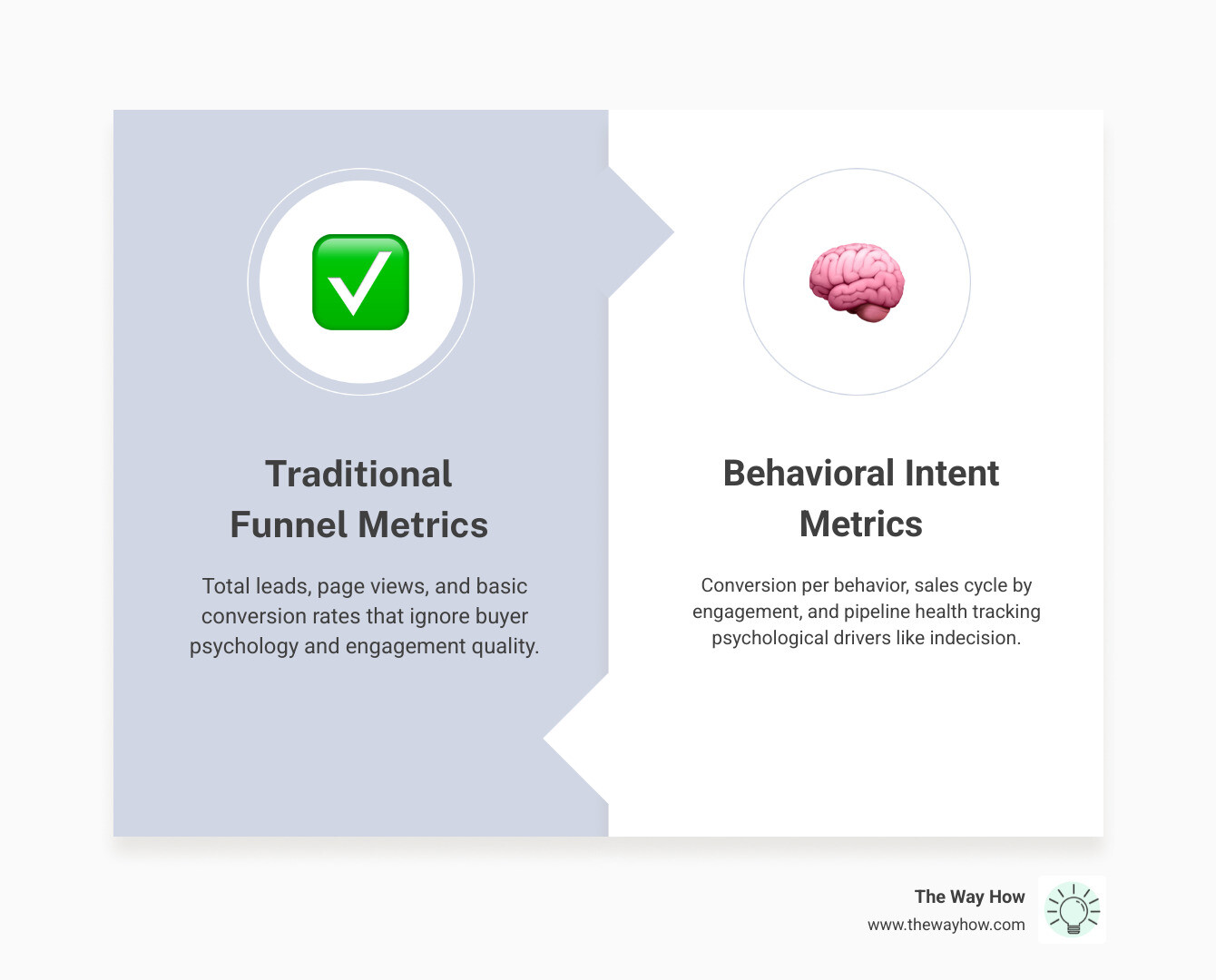
If you can’t measure the behavior, you can’t manage the revenue. While traditional KPIs like “total leads” are fine, they don’t explain why the revenue is moving. We look deeper into revenue management analytics complete guide metrics:
Focusing on these metrics allows us to justify the ROI of behavioral initiatives. For example, personalization isn’t just a “nice to have”—it typically generates a 10–15% revenue lift.
Traditional strategies often rely on static demographics (age, location, job title) and assumptions about what “should” work. Behavioral revenue tactics use real-time actions and psychological drivers (like loss aversion or social proof) to predict actual intent. It is the difference between marketing to a persona and marketing to a person’s current actions.
Social proof (reviews and testimonials), scarcity (limited time or quantity), and loss aversion (the pain of losing out) are the heavy hitters. These principles work because they reduce the uncertainty that naturally exists in the buyer’s mind, providing the mental “safety” required to make a purchase.
Transparency is the foundation. We advise clients to ensure that any price differentiation is based on clear value differences—such as different service levels or product features—rather than opaque data manipulation. When customers understand the “why” behind a price, trust remains intact.
At The Way How, we believe that revenue growth is a byproduct of psychological clarity. When your growth stalls, it’s rarely a lead generation problem; it’s a certainty gap. Your buyers are uncertain about the value, uncertain about the risk, or uncertain about the decision itself.
We help founders and leadership teams remove that uncertainty. Through our psychology-first strategy, we don’t just hand you a list of tactics. We help you diagnose the behavioral bottlenecks in your customer journey and design systems—from HubSpot architecture to fractional CMO leadership—that create trust and momentum.
If you’re ready to turn marketing into a dependable growth engine rooted in human behavior, let’s talk.
 Jeremy Wayne Howell : Jul 22, 2026 9:48:31 PM
 Jeremy Wayne Howell : Jul 21, 2026 9:47:10 PM
 Jeremy Wayne Howell : Jul 20, 2026 9:46:47 PM