
Beyond the Spreadsheet: Why Your Brain Needs an External Hard Drive

The Ultimate Guide to CRM for Founders
The best crm for founders isn’t the one with the most features — it’s the one you’ll actually use when you’re juggling a product launch, an investor pitch, and three unanswered follow-ups at the same time.
Here’s a quick answer if that’s all you need:
| Use Case | Best CRM Type | Examples |
|---|---|---|
| Investor pipeline & fundraising | Purpose-built fundraising CRM | Visible, Foundersuite, OpenVC |
| Sales + fundraising in Gmail | Inbox-native CRM | Streak |
| AI-first, flexible data model | AI-native startup CRM | Attio |
| Solo founder, lightweight | Notion template or simple tool | Founder CRM |
| All-in-one with automation | AI growth platform | Starch, Startr |
| Scaling to Series B+ | Enterprise CRM | HubSpot, Salesforce |
Most founders don’t have a leads problem. They have a systems problem.
The average early-stage founder is managing product development, sales conversations, investor outreach, hiring, and partnership discussions — often alone, often simultaneously. There’s no sales team to catch dropped balls. There’s no ops manager tracking follow-ups. It’s just you, your inbox, and a growing pile of context that’s slowly leaking out of your head.
That’s not a discipline problem. That’s a cognitive architecture problem.
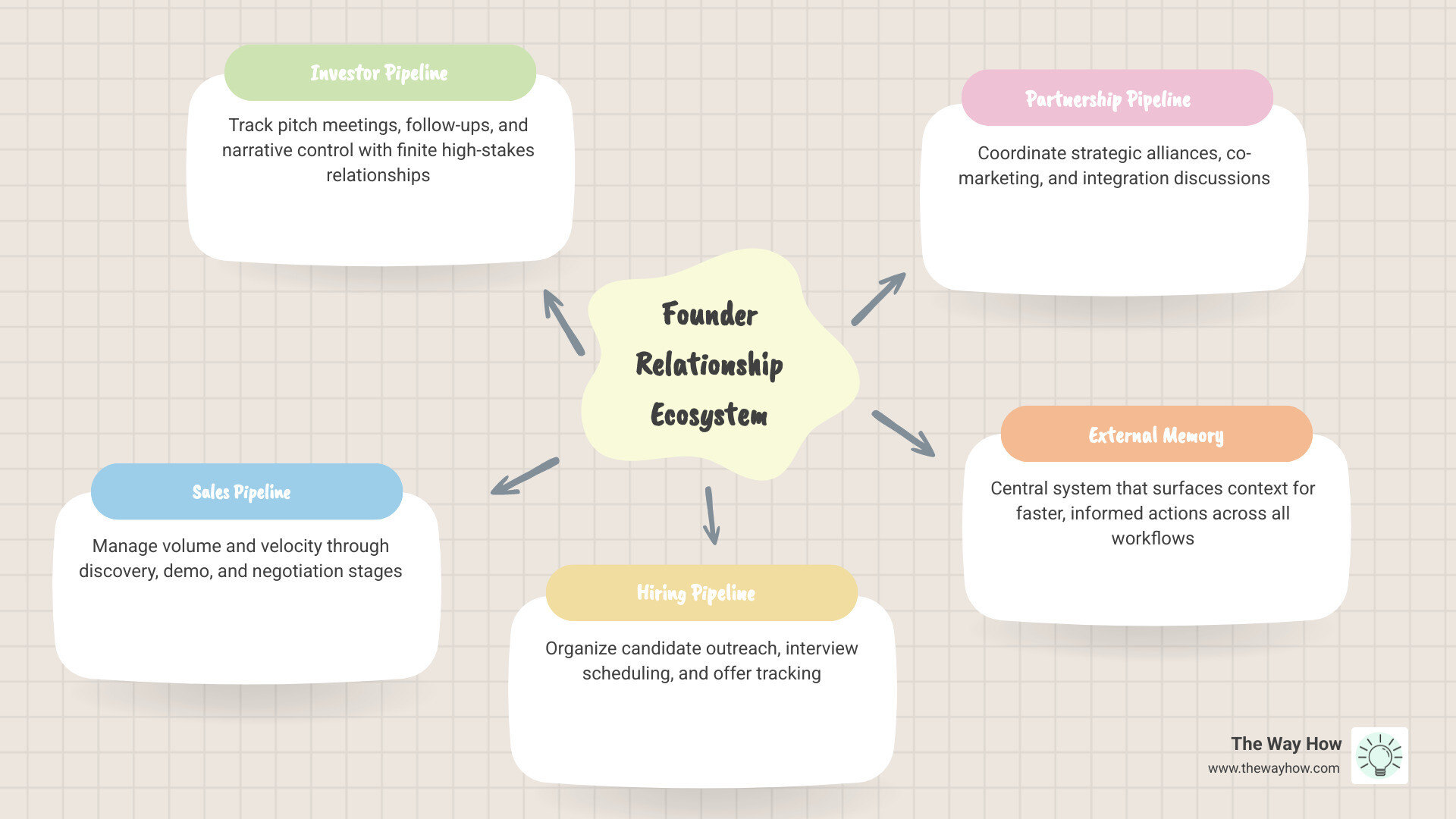
A CRM doesn’t just organize contacts. At its best, it acts as an external memory system — one that surfaces the right relationship, at the right moment, with just enough context to take action without starting from scratch. Research consistently shows that companies using CRM systems are 86% more likely to hit their sales goals, and startups that adopt them can cut sales cycles by up to two weeks while reducing customer acquisition costs by around 20%.
But most CRM guides are written for sales teams, not founders. The needs are genuinely different — and the wrong tool will cost you more time than a spreadsheet ever did.
I’m Jeremy Wayne Howell, founder of The Way How and a revenue growth strategist with over 20 years of experience implementing CRM systems — including HubSpot — for founders and revenue teams who needed clarity before they needed more tools. In this guide, I’ll walk you through how to choose and use the right crm for founders at every stage of your company’s growth, from pre-seed to Series C.
Choosing the Right CRM for Founders: Sales vs. Fundraising
When we look at the requirements of a crm for founders, we aren’t just looking for a place to store phone numbers. We are looking for a relationship architecture that supports two very different, yet equally critical, workflows: the sales pipeline and the investor pipeline.
A sales pipeline is built for volume and velocity. You are moving prospects through stages like discovery, demo, and negotiation. In contrast, a fundraising pipeline is built for narrative control and deep relationship tracking. You are managing a finite list of VCs or angels through a high-stakes process where a single missed email can mean the difference between a closed round and a dead end.
For many, the initial instinct is to use a spreadsheet. While spreadsheets are free, they lack the “active” intelligence needed to manage complex interactions. They don’t remind you that an investor opened your deck three times this morning, nor do they automatically pull in the last six months of email history when you’re preparing for a call.
Whether you are looking for a CRM for Real Estate Developers or a CRM for Web Developers Guide, the fundamental need remains the same: reducing the cognitive load required to maintain momentum.
Why Generic Sales Tools Fail Early-Stage Founders
Traditional CRM giants were built for mid-market sales teams with dedicated administrators. For a solo founder or a team of three, these tools often become a source of “feature bloat.” You find yourself spending more time configuring the tool than actually talking to customers.
Generic tools often force you into a fixed schema—a rigid way of organizing data—that doesn’t match the chaotic reality of a startup. When you are pivoting your product or testing a new market, you need a system that adapts to you, not the other way around. Furthermore, the manual data entry required by legacy systems is the primary reason founders eventually abandon them. A CRM that doesn’t integrate with your daily workflow is just another chore on an already overflowing to-do list.
Effective systems should prioritize Human-Centered CRM Empathy Features, focusing on the quality of the relationship rather than just the quantity of the data.
Purpose-Built Fundraising CRM for Founders
Fundraising is a unique beast. It requires tracking warm introductions, pitch deck views, and investor engagement signals. This has led to the rise of dedicated fundraising platforms that offer features you won’t find in a standard sales tool.
Platforms like Visible and Foundersuite provide massive databases of investors—Foundersuite alone lists over 216,000—allowing you to build a target list in minutes. These tools include built-in data rooms, pitch deck tracking, and automated investor updates. OpenVC offers a similar experience, helping over 25,000 startups annually manage their rounds for free.
If you find yourself overwhelmed by complex software, you might prefer a Founder CRM | The CRM for Founders Who Hate CRMs. This is often a lightweight system, such as a Notion template, designed to get you organized in under ten minutes without the overhead of a traditional platform.
The Psychology of the Follow-Up: Automating Trust Without Losing the Human Touch
At The Way How, we focus on the psychology of the buyer. Every interaction in your CRM is an opportunity to build certainty or create doubt. When a founder fails to follow up, they aren’t just missing a task; they are creating an “uncertainty gap.” The prospect or investor begins to wonder if you are as organized as your pitch deck suggests.
The “lost momentum” founders experience usually isn’t due to a lack of interest from the other party—it’s due to scattered follow-ups. Behavioral science tells us that trust is built through consistency. By using a CRM to automate the “administrative” part of the follow-up, you free your brain to focus on the “human” part of the connection.
Systems like Startr - AI-Powered CRM for Solo Founders and Indie Hackers are designed specifically for this. They help you capture interest across various platforms and use AI to draft personalized outreach, ensuring that no lead goes cold simply because you were too busy to send a manual email. This approach leverages Behavioral Science for CRM to maintain momentum through systematic empathy.
AI and Automation: Reducing the Solo Founder’s Manual Burden
In May 2026, the standard for a crm for founders is no longer just a database; it is an AI-powered assistant. Modern tools are moving away from manual entry and toward automatic data capture.
Streak is a prime example of an inbox-native solution. It lives inside Gmail, meaning your CRM is where your conversations already happen. It tracks email opens and automatically links threads to your pipeline. For founders who need a more comprehensive “second brain,” Founder - AI for Your Journey uses AI to classify thoughts, tasks, and knowledge, helping you spot patterns and “anti-patterns” in your own behavior—such as building without validation.
If you are looking to consolidate your entire stack, Starch — The Founder Stack offers an all-in-one platform that handles everything from CRM and marketing automation to financial planning and investor updates. These tools allow founders to “10x their output without 10x-ing their headcount.”
Building a Scalable CRM for Founders from Pre-Seed to Series C
One of the most dangerous traps for a founder is “data fragmentation.” This happens when your investor leads are in one tool, your customer leads are in another, and your hiring pipeline is in a third. As you scale, this fragmentation creates friction.
When choosing a tool, consider its ability to scale. Attio is a popular choice for over 80,000 startups because it is AI-native and highly flexible. It doesn’t force you into a pre-set structure, allowing your CRM to evolve as your business model does.
Prioritizing CRM Data Integration early on ensures that you won’t have to go through a painful migration process later. Whether you are looking into custom CRM Development or choosing an off-the-shelf solution, the goal is to create a single source of truth for all company relationships.
When to Graduate to Enterprise Systems: The HubSpot and Salesforce Pivot
There comes a point in every successful startup’s journey where “founder-led” everything must transition into “team-led” operations. This usually happens around the time you hit Series A or B and begin hiring a dedicated sales and marketing team.
At this stage, the flexibility of a lightweight tool can become a liability. You need the robust reporting, advanced permissions, and deep marketing automation found in enterprise systems. This is where HubSpot CRM Architecture becomes invaluable.

Graduating to a platform like HubSpot isn’t just about getting a bigger database; it’s about building a revenue engine. A proper HubSpot CRM Implementation allows you to align your HubSpot CRM Marketing efforts directly with your sales results, giving you a clear view of your customer acquisition costs (CAC) and lifetime value (LTV).
Measuring ROI: How a CRM Restores Your Most Valuable Asset
The return on investment for a crm for founders isn’t just measured in dollars; it’s measured in hours returned to the founder. Time is your most scarce resource. If a CRM saves you five hours a week on manual follow-ups and reporting, that is five hours you can spend on product strategy or closing key hires.
| Metric | Impact of CRM Adoption |
|---|---|
| Sales Cycle Duration | Reduced by up to 14 days |
| Revenue Growth | Potential increase of up to 30% |
| Customer Retention | Improved by 25% |
| Customer Acquisition Cost (CAC) | Reduced by 20% |
| Goal Achievement | 86% more likely to hit sales targets |
Beyond the numbers, a CRM provides the peace of mind that comes from knowing exactly where every relationship stands. It removes the “anxiety of the unknown” that plagues many solo founders. If you find yourself struggling to see the ROI or feeling overwhelmed by the technical setup, seeking CRM Consulting Services can help you design a system that actually serves your growth rather than hindering it.
Frequently Asked Questions about Founder CRMs
How do I choose between a free and paid CRM for my startup?
Start with your primary goal. If you are currently focused 100% on fundraising, a free tool like OpenVC or the basic tier of Foundersuite is often sufficient. However, if you are actively selling a product, a paid tool that offers automation and email tracking (like Streak or Attio) will pay for itself in saved time almost immediately. Avoid “free” versions of enterprise tools if they gate the specific automation features you need to stay productive as a solo founder.
What integrations are essential for a founder’s CRM in 2026?
In 2026, the “bare minimum” for a crm for founders includes:
- Two-way Email Sync: To ensure all history is captured without manual entry.
- Calendar Integration: To automatically log meetings and set follow-up tasks.
- Pitch Deck Analytics: To see which investors are actually engaging with your materials.
- Financial Data: Integration with tools like Stripe or QuickBooks to track real-time revenue and runway.
How does a CRM help with investor relations post-funding?
The work doesn’t end when the check clears. Maintaining transparency with your investors is key to securing follow-on rounds. A CRM allows you to manage “Investor Updates” as a systematic process. Tools like Visible allow you to create professional dashboards and reports in minutes, keeping your stakeholders informed and engaged with minimal effort on your part.
From Chaos to Clarity: Building Your Growth Engine
A CRM is just a tool. It is a reflection of your strategy. If your strategy is unclear, a CRM will only help you execute that lack of clarity more efficiently.
At The Way How, we help founders look past the software to the underlying human behavior that drives growth. We specialize in removing the uncertainty from your sales and marketing systems. Whether you need fractional CMO leadership to guide your narrative or technical expertise in HubSpot to build your revenue architecture, our goal is to turn your marketing into a dependable growth engine.
We believe in diagnosing the problem before prescribing the solution. If your growth has stalled, it is rarely because you chose the “wrong” CRM—it is usually because there is a gap in the psychology of your customer journey. We help you identify those gaps, build trust with your audience, and create systems that scale with your ambition.