
The Friction in the Funnel: Why More Data Isn’t Solving Your Sales Problem

Customer behavior sales optimization is the practice of aligning your pricing, messaging, and sales process with how buyers actually make decisions — not how you assume they do.
If you’re a founder or revenue leader trying to improve sales efficiency, here’s the short version:
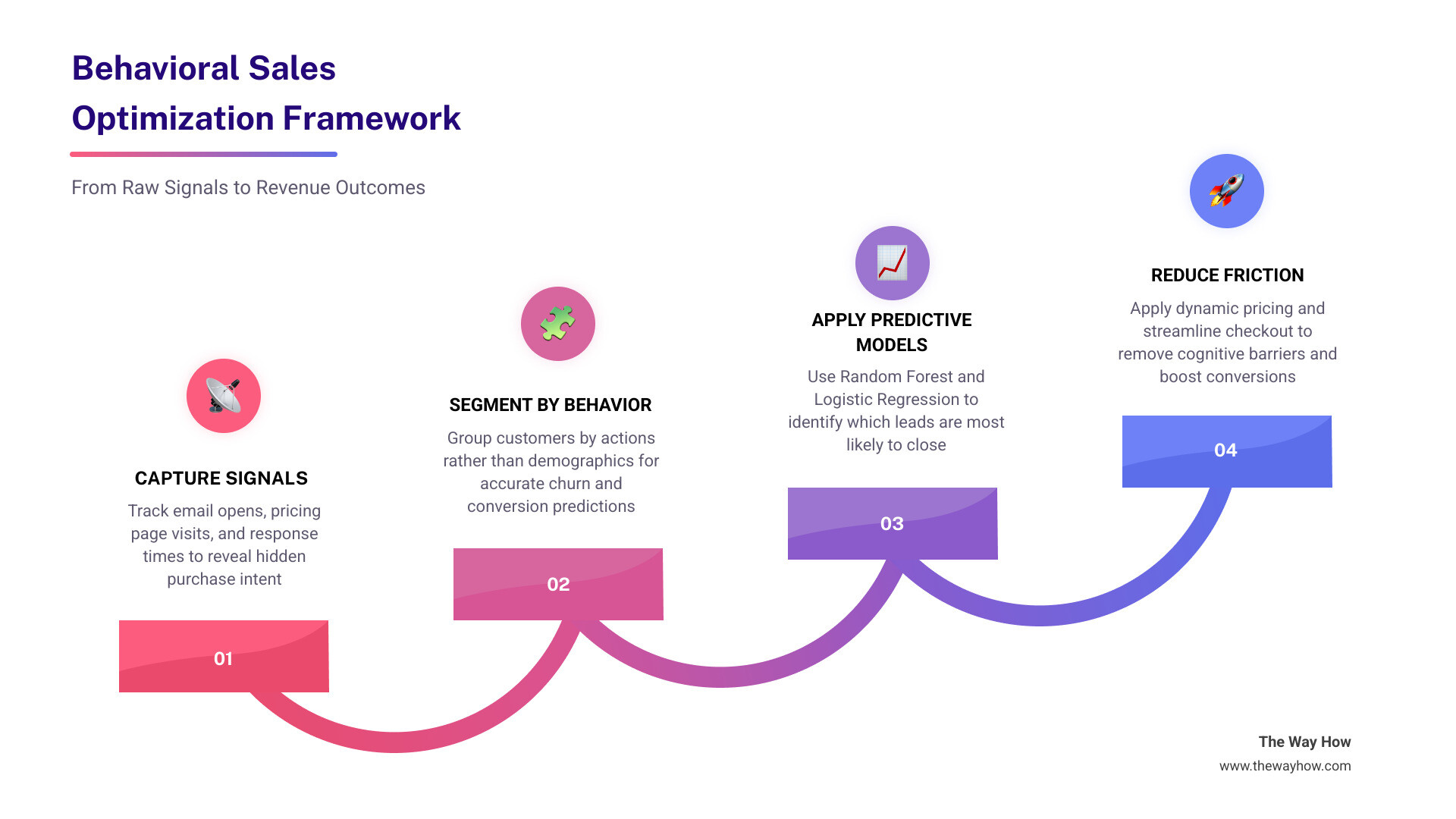
| What to Do | Why It Works |
|---|---|
| Analyze behavioral signals (email opens, pricing page visits, response times) | They reveal purchase intent before buyers say a word |
| Segment customers by behavior, not just demographics | Behavioral data predicts churn and conversion more accurately |
| Use predictive models (Random Forest, Logistic Regression) | They surface which leads are most likely to close |
| Apply dynamic pricing tied to demand and customer segment | Increases revenue without losing competitive positioning |
| Reduce checkout and funnel friction | Removes the cognitive barriers that kill conversions |
Most sales teams already have the data. The problem is they’re using it to explain the past — not to predict what happens next.
B2B sales cycles rarely behave the same way twice. Buying committees shift. Decision-makers go quiet. A deal that looked certain last Tuesday stalls on Friday for reasons no dashboard can explain. The issue isn’t effort. It isn’t even data volume. It’s that most teams are optimizing tactics before they understand the human on the other side of the decision.
That gap — between what the data shows and what the buyer is actually feeling — is where revenue gets lost.
I’m Jeremy Wayne Howell, founder of The Way How, a psychology-first revenue strategy firm where I’ve spent over 20 years helping founders and revenue teams diagnose the human problems underneath their performance problems — applying customer behavior sales optimization frameworks that have consistently moved close rates by 20–40% and rebuilt stalled pipelines. In the sections ahead, I’ll walk you through exactly how to close that gap: from pricing psychology and machine learning models to first-party data and behavioral segmentation.
What is Price Optimization and How Does It Drive Customer Behavior?
At its core, price optimization is a strategic, data-driven approach to setting the most effective price point for a product or service. It is not simply about finding the highest price the market will tolerate, nor is it a race to the bottom to undercut competitors. Instead, it is about balancing revenue maximization with long-term brand equity and competitive positioning.
When we optimize prices, we directly influence customer purchasing behavior and overall sales performance. Price acts as an immediate cognitive cue. In the minds of buyers, price is often shorthand for value, risk, and status. An optimized price point reduces the friction of decision-making by matching the customer’s perceived value of the product. If a price is set too high without sufficient justification, it triggers purchase anxiety and cart abandonment. Conversely, if it is set too low, it can inadvertently signal poor quality, triggering skepticism and damaging brand trust.
By leveraging insights from Behavioral Economics Marketing Tactics, we can design pricing frameworks that align with how the human brain processes cost and value, transforming pricing from a static operational metric into an active tool for conversion.
The Seven Pillars of E-Commerce Pricing Decisions
To build a pricing strategy that actually drives positive behavior, we must look beyond basic margins. In e-commerce, pricing decisions are shaped by seven primary factors:
- Production and Operational Costs: This is your financial baseline. You must understand your cost structures to ensure that any optimized or promotional price remains fundamentally profitable.
- Market Demand and Price Elasticity: How sensitive are your customers to price changes? Understanding demand elasticity helps us predict whether a slight price increase will suppress volume or if a price drop will sufficiently boost sales to offset lower margins.
- Competitor Benchmarking: Real-time visibility into what competitors charge is critical. However, the goal is not always to match them. Sometimes, maintaining a premium price point actually reinforces your superior value proposition.
- Customer Behavior and Purchase Signals: By monitoring how buyers interact with your digital storefront, you can identify high-intent segments. For example, a customer who spends significant time comparing features is signaling a different level of intent than a casual browser.
- Seasonality and Timing: Demand naturally fluctuates throughout the year. Pricing structures must adapt to seasonal surges and post-holiday lulls to clear inventory and capture peak demand.
- Value-Based Pricing: Setting prices based on the perceived value to the customer rather than the cost of production. This requires a deep understanding of the customer’s pain points and the specific utility your product provides.
- Promotional Triggers: Strategic discounts and limited-time offers can nudge hesitant buyers over the line, but they must be used carefully. Over-reliance on promotions trains customers to never pay full price.
To learn how to systematically track these variables and integrate them into your day-to-day sales operations, explore our comprehensive guide on Customer Behavior Analysis: How To Predict And Influence Sales.
The Psychology of Pricing: Leveraging Data and Consumer Insights
Setting the right price is as much an exercise in human psychology as it is in mathematics. When customers land on your pricing page, they are balancing desire against the pain of paying. To optimize this moment, we must combine historical sales data, usability metrics, and behavioral triggers.

Historical sales data reveals patterns of when and why people buy, while usability metrics show us where they get confused or frustrated on our websites. By combining these data points, we can apply specific psychological principles that ease the path to purchase:
- Social Proof: Displaying reviews, testimonials, and “most popular” tags near pricing tiers reassures buyers that others have made this investment and found it worthwhile.
- Urgency and Scarcity: Limited-time countdown timers or low-stock alerts can gently push procrastinating buyers to make a decision, reducing the window for second-guessing.
- A/B Testing: We must constantly experiment with different price presentations, layout structures, and call-to-action phrasing to find the exact combination that minimizes cognitive friction.
By mastering Customer Experience Psychology, we can design pricing pages that make buyers feel secure, valued, and confident in their decision to buy.
Overcoming Friction with Customer Behavior Sales Optimization
One of the greatest enemies of sales efficiency is cognitive load. When a buyer is presented with too many options, complex pricing models, or confusing checkout flows, they experience decision paralysis. The brain, seeking to conserve energy, simply opts out of the decision entirely.
Through systematic customer behavior sales optimization, we actively work to remove these mental hurdles. This means simplifying your product tiers, clarifying what is included in each package, and ensuring that the absolute value of your offering is immediately clear. When we reduce cognitive load, we build trust. The buyer feels understood, and the momentum of the sales process is preserved.
This process of smoothing out the buyer’s journey is a core component of Conversion Rate Optimization, turning traffic that would otherwise bounce into highly engaged customers.
From Cart Abandonment to Completed Checkout
Cart abandonment is rarely just a pricing problem; it is a friction problem. When a customer adds an item to their cart, they have demonstrated high intent. If they leave before completing the purchase, it is usually because they encountered unexpected costs, a complex checkout process, or a sudden spike in purchase anxiety.
To recover these lost opportunities, we must deploy real-time behavioral triggers. For example, if a user’s cursor moves toward the close button (exit intent), we can instantly present a tailored offer or a simple FAQ chat widget to address their concerns. According to research published by Online Store News, implementing real-time personalization and behavioral trigger marketing can yield massive dividends, with some brands experiencing a Behavioral Trigger Marketing Drives 534% Customer Lifetime Value as Real-Time Personalization Transforms E-Commerce – Online Store News. By reacting to the customer’s exact behavior in the moment, we can turn a potential exit into a completed checkout.
The Machine Learning Playbook for Customer Behavior Sales Optimization
While traditional sales strategies rely on historical reporting, modern optimization requires predictive capabilities. Artificial intelligence and machine learning allow us to move from reactive adjustments to real-time, predictive pricing and personalization.
Instead of setting static prices and waiting to see how the market responds, machine learning algorithms analyze vast streams of incoming data — including browsing history, competitor pricing shifts, and current inventory levels — to adjust prices dynamically. This ensures that you are always offering the optimal price to the right customer at the exact right moment. To understand how to scale these advanced operations across your entire sales organization, refer to our Sales Team Optimization Complete Guide.
Comparing Predictive Models for Customer Behavior
To predict how customers will react to pricing and product offers, data scientists and revenue teams deploy several distinct machine learning models. Each algorithm has unique strengths and ideal use cases:
- Decision Trees: Excellent for simple, rule-based classifications and easy visualization of customer decision paths.
- Random Forest: An ensemble method that combines multiple decision trees to improve accuracy and prevent overfitting. In academic evaluations of customer behavior, Random Forest models achieved a solid accuracy value of 0.806, with a strong ROC-AUC score of 0.878.
- Logistic Regression: A highly efficient model for binary outcomes (such as buy vs. don’t buy). Logistic Regression models achieved an impressive accuracy of 0.826 with a perfect recall score of 1.00 in behavior prediction studies.
- Support Vector Machines (SVM): Highly effective in high-dimensional spaces, matching Logistic Regression’s top-tier accuracy of 0.826 and perfect recall (1.00) in predicting specific customer actions.
- Gradient Boosting: A powerful technique that builds models sequentially to minimize errors. It achieved an accuracy of 0.823 and a strong ROC-AUC score of 0.852, making it highly effective at distinguishing complex customer behavior classes.
| Machine Learning Model | Accuracy | Recall | Key Strength |
|---|---|---|---|
| Decision Tree | 0.787 | Varies | Simple, highly interpretable rules |
| Random Forest | 0.806 | 1.00 | Excellent at handling complex, non-linear data |
| Logistic Regression | 0.826 | 1.00 | Highly efficient for binary outcomes |
| Support Vector Machines (SVM) | 0.826 | 1.00 | Highly effective in complex, multi-variable spaces |
| Gradient Boosting | 0.823 | Varies | Exceptional predictive power with sequential learning |
These models are becoming increasingly sophisticated. For instance, researchers are now developing advanced agents, such as those detailed in Customer-R1: Personalized Simulation of Human Behaviors via RL-based LLM Agent in Online Shopping, which use reinforcement learning to simulate highly personalized, step-by-step human shopping behaviors in digital environments.
Key Evaluation Metrics for Predictive Accuracy
To ensure our predictive models actually improve sales performance rather than introducing noise, we must evaluate them using rigorous metrics:
- Accuracy: The overall percentage of correct predictions. While useful, accuracy can be misleading if your dataset is highly imbalanced (e.g., if only 2% of visitors actually buy).
- Precision: The ratio of true positive predictions to all positive predictions. High precision means that when the model predicts a customer will buy, they almost always do.
- Recall (Sensitivity): The ratio of true positive predictions to all actual positives. Perfect recall (1.00) means the model successfully identified every single potential buyer in the dataset.
- F1-Score: The harmonic mean of precision and recall, offering a single, balanced metric to assess model performance on uneven datasets.
- ROC-AUC: A metric that measures the model’s ability to distinguish between classes (e.g., separating high-intent buyers from casual window shoppers). A score closer to 1.0 indicates superior predictive power.
Building the Stack: First-Party Data, Personalization, and Loyalty
In an era of tightening privacy regulations and the decline of third-party cookies, first-party data is your most valuable asset. First-party data — the information customers willingly share with you through direct interactions — allows you to build deep, compliant, and highly accurate customer profiles.
By integrating this data into your sales stack, you can move away from generic discount campaigns and toward highly personalized experiences. When you understand a customer’s specific purchase frequency, average order value, and product preferences, you can design loyalty programs and pricing strategies that reward their specific behavior. This transition from transactional selling to relationship-first engagement is the foundation of modern Behavioral Revenue Tactics.
Scaling Long-Term Growth Through Customer Behavior Sales Optimization
To scale your revenue without endlessly chasing new customer acquisition, you must maximize the value of your existing customer base. This requires a structured approach to segmentation:
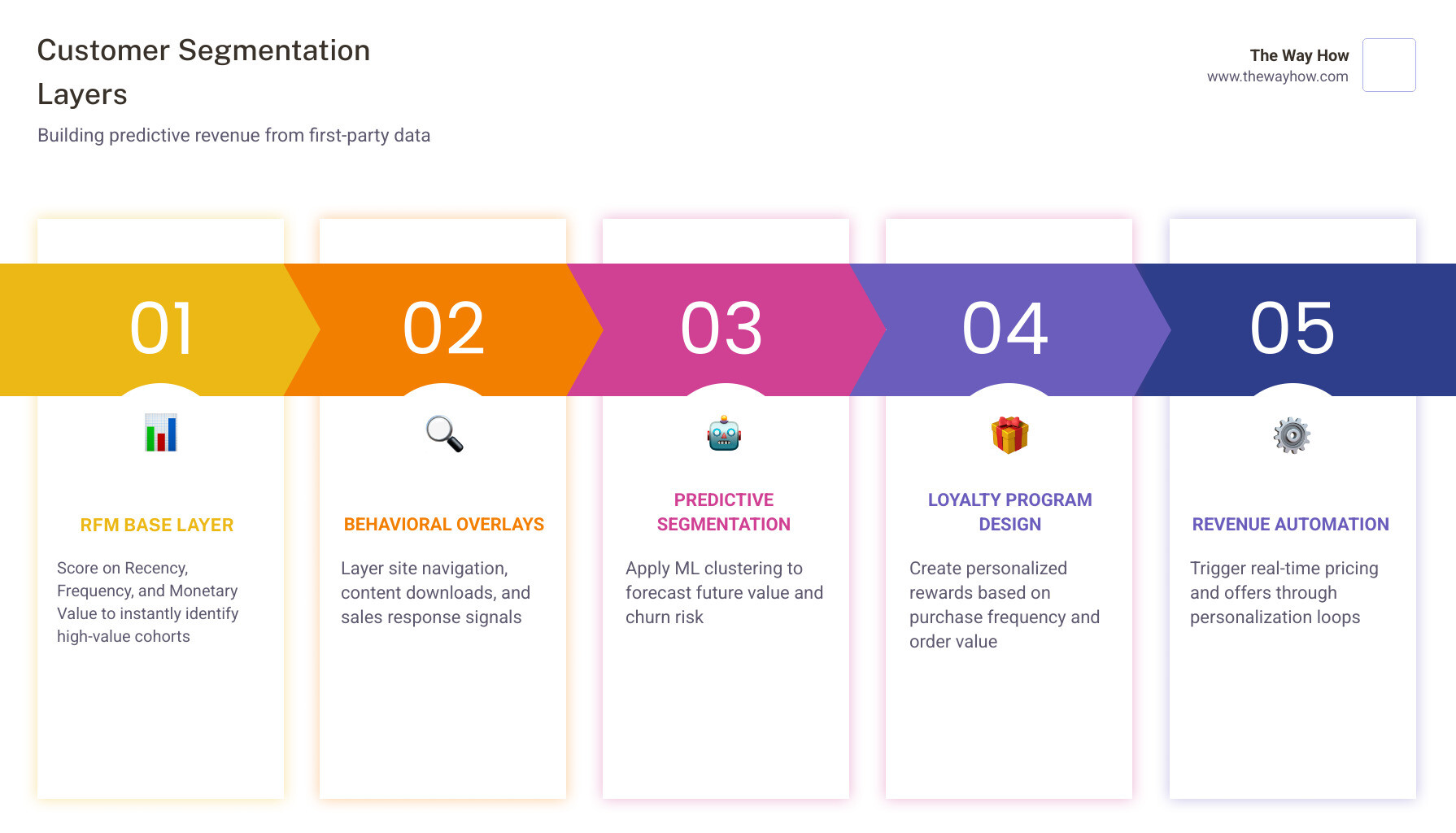
- The RFM Base Layer: We begin by scoring customers on Recency (how recently they bought), Frequency (how often they buy), and Monetary Value (how much they spend). This requires zero machine learning but immediately highlights your most valuable cohorts.
- Behavioral Overlays: Next, we layer on behavioral signals, such as how they navigate your site, which content they download, and how quickly they respond to sales outreach.
- Predictive Segmentation: Finally, we use machine learning clustering algorithms to group customers by their future potential value and churn risk.
For a detailed blueprint on building this multi-layered segmentation stack in 2026, consult our guide on Customer Segmentation 2026: RFM, Behavioral, Predictive.
Automating the Personalization Loop
To execute these strategies at scale, businesses require tools that automate data collection and real-time decision-making. Solutions like Experiences by Jebbit help brands capture zero-party data through interactive quizzes and customized digital experiences, seamlessly feeding this qualitative insight back into the marketing stack.
Simultaneously, enterprise platforms are making it easier to connect user behavior directly to revenue outcomes. For example, modern personalization engines are shifting from basic click-tracking to sophisticated, revenue-focused models. You can explore how these systems learn from product browses, cart updates, and order histories to deliver highly relevant promotions in the official guide on How Salesforce Personalization Learns Which Offers Drive Revenue - Salesforce.
Frequently Asked Questions About Sales Strategy Alignment
How does price optimization directly influence customer purchasing behavior?
Price optimization directly impacts purchasing behavior by aligning the cost of a product with the customer’s internal perception of its value. By analyzing price sensitivity and demand elasticity, businesses can set prices that reduce purchase anxiety, minimize decision paralysis, and directly boost conversion rates.
Which machine learning models are most effective for predicting customer behavior?
While simple Decision Trees are highly visual, ensemble and regression models consistently perform best. Random Forest offers exceptional predictive balance (with a high ROC-AUC of 0.878), while Logistic Regression and Support Vector Machines (SVM) frequently achieve the highest overall accuracy (0.826) and perfect recall (1.00) in binary behavior prediction tasks.
Why is first-party data critical for e-commerce sales optimization?
First-party data is critical because it is highly accurate, privacy-compliant, and unique to your business. It allows you to build direct relationships with your audience, enabling hyper-personalized pricing, tailored product recommendations, and highly effective loyalty programs that third-party data simply cannot support.
Restoring Momentum: Partnering with The Way How for Behavioral Revenue Growth
Optimizing your sales strategy around customer behavior is not a one-time project; it is a fundamental shift in how your business operates. It requires moving past surface-level metrics and looking deeply at the psychological drivers, friction points, and certainty gaps that define your buyer’s journey.
At The Way How, we help leadership teams remove the guesswork from their growth strategies. As a psychology-first marketing and revenue strategy firm, we specialize in Fractional CMO leadership, HubSpot architecture, and demand generation systems designed around human behavior, empathy, and decision-making psychology. We don’t just hand you a list of tactics. We diagnose exactly where your customer journey is stalling, design systems that build deep trust and momentum, and help you build a predictable revenue engine.
Ready to transform your sales process and unlock sustainable, behavior-driven growth? Explore our Revenue Growth Strategy Guide 2026 to see how we can help you build certainty, streamline your operations, and scale with confidence.