
The Invisible Architecture of Every Transaction

Customer experience psychology is the study of how thoughts, emotions, cognitive biases, and subconscious processes shape the way people perceive, interact with, and remain loyal to a brand.
Here is what it covers at a glance:
| Core Element | What It Means for CX |
|---|---|
| Emotions | Drive decisions before logic ever enters the picture |
| Cognitive biases | Shape perception, expectations, and memory of experiences |
| Motivations | Determine why customers choose, stay, or leave |
| Perceptions | Set the baseline for satisfaction before a product is even used |
| Belonging | Creates loyalty that no discount or feature can replicate |
Most businesses invest in better products, faster service, and slicker interfaces. And still, growth stalls.
That is because the real purchase decision rarely happens in the rational mind. Neuroscientist Antonio Damasio demonstrated this in a striking way: patients who lost emotional function due to brain damage were unable to make everyday decisions — even with their logic fully intact. Emotion is not a soft layer on top of decision-making. It is the decision-making infrastructure.
The same is true in every customer interaction your brand has.
When a customer clicks away, stays loyal, recommends you to a friend, or forgives a mistake — that behavior is driven by psychological architecture most companies never think to design for. The experience they remember is not the average of all touchpoints. It is the emotional peak and the final moment. The rest fades.
Understanding this is not a marketing nicety. It is a strategic necessity.
I’m Jeremy Wayne Howell, founder of The Way How — a psychology-first revenue strategy firm — and for over 20 years I’ve applied customer experience psychology to help founders and revenue leaders close more deals, reduce churn, and build brands that earn trust rather than just attention. In the sections ahead, we will move from the science of how emotions work, through to practical strategies you can use across every customer touchpoint.
Common Customer experience psychology vocab:
The Science of Customer Experience Psychology
To master customer experience psychology, we must first distinguish between emotions and feelings. While often used interchangeably, they represent different stages of the human response. Emotions are subconscious, physiological states — the “gut reaction” or the spike in heart rate when a website takes too long to load. Feelings are the conscious interpretations of those emotions, such as the thought, “I am frustrated with this brand.”
Research in behavioral science suggests that humans are not the “rational calculators” we once thought they were. Instead of making perfectly logical choices, we rely on Neuromarketing Techniques and mental shortcuts to navigate a world filled with too much information.
As highlighted by McKinsey, putting behavioral psychology to work to improve the customer experience involves recognizing that customers do not remember every second of their journey. They remember the peaks (the best or worst moments) and the end. If you provide a stellar service but finish with a confusing bill or a cold “goodbye,” the entire experience is tainted in the customer’s memory.
Biometrics and the Measurement of Customer Experience Psychology
By April 2026, the brands leading their industries aren’t guessing how customers feel; they are measuring it. Using biometric testing, companies can track physiological responses like galvanic skin response (which measures sweat gland activity) and facial coding to see exactly where a customer feels joy, confusion, or anxiety.
This scientific approach allows us to move beyond what customers say in surveys (which is often influenced by social desirability bias) to what they actually experience. When we understand these subconscious states, we can design journeys that align with the Human Psychology Marketing Ultimate Guide, ensuring that every touchpoint reduces friction and builds trust.
Cognitive Ease and the Path of Least Resistance
The human brain is a massive energy consumer, and it seeks to conserve that energy whenever possible. This is where “System 1” thinking comes in — our fast, instinctive, and emotional mode of thought. When a customer lands on a website that is intuitive and easy to navigate, they experience “cognitive ease.”
If the experience is difficult, it triggers “System 2” — the slow, effortful, and logical brain. While logic is good, it also leads to decision fatigue. The more effort a customer has to put into understanding your offer, the more likely they are to experience “choice paralysis” and walk away. By using a Marketing Framing Effect Guide, we can present information in a way that feels natural and reduces the mental load, making the “yes” much easier to reach.
Emotional Drivers: Why Logic Fails to Build Loyalty
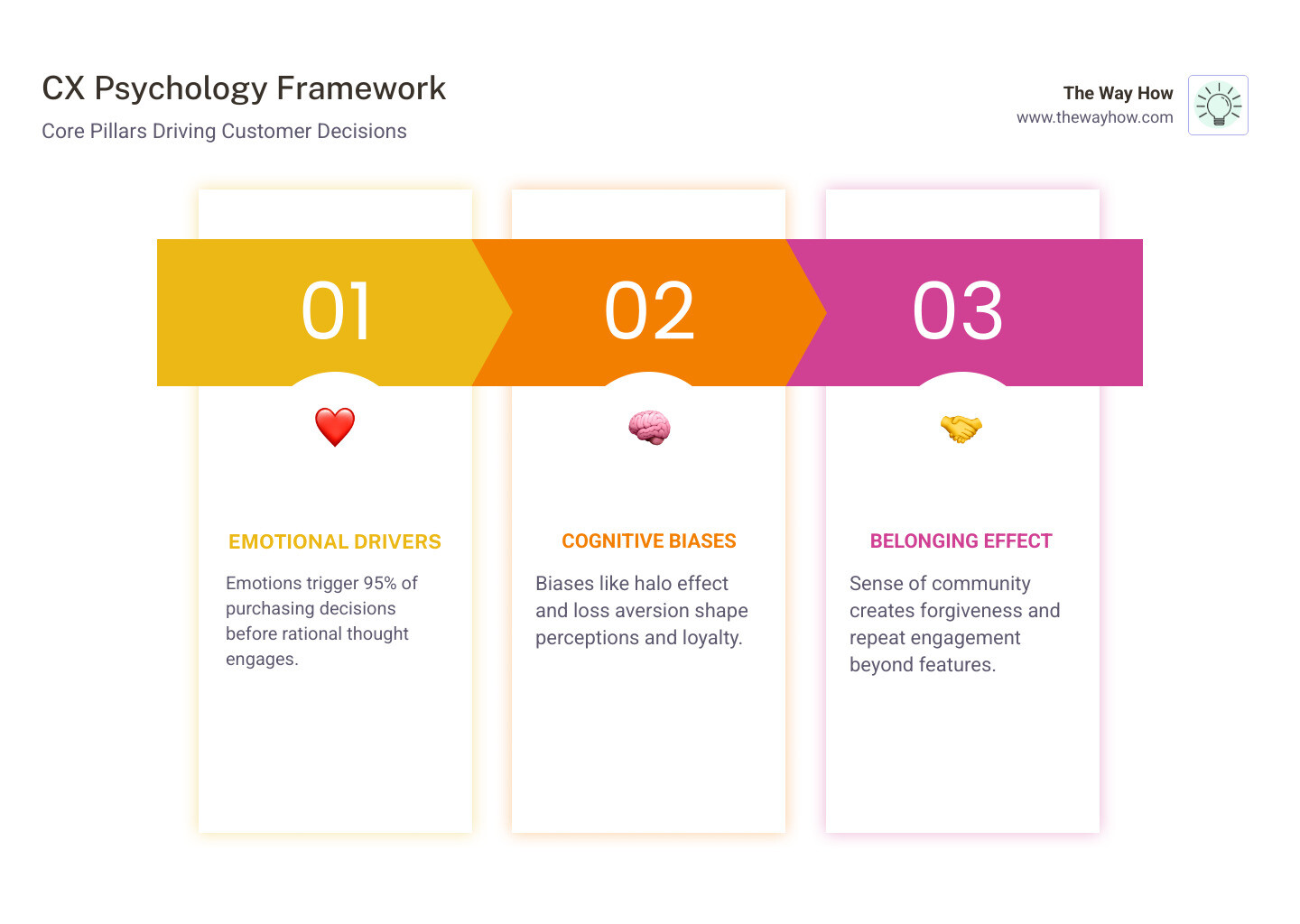
If logic were the primary driver of loyalty, the cheapest or most feature-rich product would always win. We know that isn’t the case. As Antonio Damasio’s research proved, emotions are the “on-off switch” for decision-making.
When a brand creates an emotional connection, the business outcomes are staggering:
- 81% of emotionally connected customers will promote a brand to family and friends.
- 70% of respondents spend twice as much with brands they feel connected to.
- Emotionally connected customers have a three times higher lifetime value.
To tap into this, we must use Emotional Marketing Tactics that address deep-seated needs for security, status, or belonging. We must also be wary of Loss Aversion Marketing. Humans are psychologically wired to feel the pain of a loss twice as strongly as the joy of a gain. A customer experience that feels like “losing” (losing time, losing money, or losing status) will create a lasting negative impression that logic cannot fix.
The Role of Joy in Customer Experience Psychology
While satisfaction is about meeting expectations, joy is about exceeding them in a way that impacts a customer’s overall well-being. Academic research shows that joy acts as a powerful mediator between service factors (like convenience and performance) and long-term loyalty.
When we focus on Customer Journey Design Complete Guide, we aren’t just looking for “smooth” processes. We are looking for “moments of delight.” A service that is merely “fine” is forgettable. A service that sparks joy creates a spillover effect, where the positive emotion from the transaction improves the customer’s mood for the rest of their day, linking your brand to their personal well-being.
Purpose and the Psychology of Belonging
In the modern landscape of 2026, customers are increasingly loyal to purpose-driven brands. Statistics show that 79% of Americans are more loyal to brands that stand for something beyond profit. More importantly, 67% are more willing to forgive a mistake from a purpose-driven brand.
This is rooted in the psychology of belonging and social norms. When a brand aligns with a customer’s values, the relationship moves from transactional to relational. By following a Content Marketing Psychology Ultimate Guide, we can communicate these values effectively, turning customers into advocates who feel they are part of a community.
Behavioral Activations for the Modern Customer Journey

Creating a great experience requires more than just passive service; it requires active psychological “activations.” These are intentional triggers designed to move a customer through the 4 Stages Of Customer Journey.
- Exploration: Activating the customer’s natural curiosity through personalized recommendations (“Others like you also enjoyed…”).
- Purpose: Showing the customer how their purchase contributes to a larger goal or aligns with their identity.
- Desire: Triggering aspirational emotions by showing the “future self” the customer becomes after using the product.
Generational Values and Formative Psychology
Not all customers respond to the same psychological triggers. Generational differences play a massive role in how CX is perceived. A person’s core values are often formed between birth and age 18.
For example, a generation that grew up during economic instability may value transparency and “loss aversion” triggers more than a generation that grew up in a period of digital expansion, who might prioritize “cognitive ease” and instant gratification. When looking at B2B Customer Journey Map Examples, we must account for the life stages and formative psychology of the decision-makers involved.
The Halo Effect and First Impressions
The “Halo Effect” is a cognitive bias where our overall impression of a person or brand influences how we feel about their specific traits. If a customer has a seamless, personalized first interaction with your brand, they are psychologically predisposed to believe your product is high-quality and your pricing is fair.
Conversely, a “broken” first impression—like a confusing signup form or a cold greeting—creates a “negative halo.” Every subsequent interaction is viewed through a lens of skepticism. This is why Anchoring Bias Marketing is so critical; the first piece of information or the first emotion a customer encounters sets the “anchor” for the entire relationship.
Practical Strategies for Contact Centers and Marketers

In the front lines of customer service, customer experience psychology moves from theory to real-time skill. The goal for any contact center or marketer is to bridge “certainty gaps”—those moments where a customer feels unsure, unheard, or unvalued.
Key skills include:
- Active Listening: Not just hearing words, but identifying the underlying emotional state (anxiety, frustration, or excitement).
- Emotional Intelligence: The ability to stay calm and empathetic, even when a customer is “System 1” dominant (angry or irrational).
- Empathy: Using phrases that validate the customer’s feelings before moving to a logical solution.
Understanding the psychology of marketing means knowing that a customer doesn’t just want their problem fixed; they want to feel “right” about the interaction.
Handling the Frustrated, Anxious, and Indecisive
Different psychological states require different communication strategies.
- The Frustrated Customer: They feel a loss of control. Use phrases like, “I understand why this is frustrating; let’s work together to get this back on track.” This restores their sense of agency.
- The Anxious Customer: They feel a lack of safety. Use reassurance: “I am going to stay on the line with you until this is completely resolved.”
- The Indecisive Customer: They are suffering from cognitive load. Simplify their choices. Instead of asking what they want, offer two clear options based on their needs.
Reciprocity and the Endowment Effect
Two of the most powerful tools in the CX toolkit are reciprocity and the endowment effect.
Reciprocity is the human urge to “give back” when something is given to us. Small, unexpected gestures—a handwritten note, a surprise discount, or valuable free advice—trigger a psychological debt that leads to loyalty.
The Endowment Effect Marketing strategy involves making the customer feel a sense of ownership before they’ve even bought. Free trials or “personalized” configurations make the customer feel the product is already “theirs,” making them much more reluctant to give it up.
Frequently Asked Questions about Customer Experience Psychology
How do emotions drive customer decision-making?
Emotions act as the primary filter for value perception. Before the logical brain can analyze features or pricing, the emotional brain has already decided if the brand feels “safe,” “trustworthy,” or “aligned with my identity.” As neuroscientific studies show, without this emotional input, the brain struggles to prioritize one option over another, leading to inaction.
What is the difference between emotions and feelings in CX?
Emotions are physiological, subconscious responses to stimuli (like a racing heart when a page won’t load). Feelings are the conscious reflections and interpretations of those emotional states (like thinking, “I’m annoyed because this site is slow”). Effective CX psychology aims to manage the subconscious emotion before it turns into a negative conscious feeling.
How can brands measure emotional reactions scientifically?
In 2026, leading brands use biometric technologies like galvanic skin response (GSR), eye-tracking, and facial coding. These tools capture real-time data on arousal and sentiment during a customer journey, providing a more accurate picture of the experience than traditional surveys alone.
From Transactions to Transformation
At The Way How, we believe that growth doesn’t stall because of a lack of tactics; it stalls because of a lack of clarity. When you ignore customer experience psychology, you leave your revenue to chance. You end up with a “leaky bucket” where customers leave because they never felt a true connection to the brand.
We help leadership teams identify the “certainty gaps” in their customer journey — the psychological friction points that prevent a lead from becoming a loyal advocate. By blending strategic clarity with behavioral insight, we turn your marketing into a predictable growth engine.
If you are ready to move beyond “guessing” and start designing experiences rooted in human science, we invite you to transform your customer experience strategy with us. Let’s build a system that creates trust, momentum, and revenue that you can actually count on.