
When the Data Lies — And What’s Really Going On

Market research psychology is the study of why consumers make the decisions they do — not just what they choose.
Here’s the quick version for anyone who wants it upfront:
| Question | Answer |
|---|---|
| What is market research psychology? | The application of psychological principles to understand the gap between what consumers say and what they actually buy |
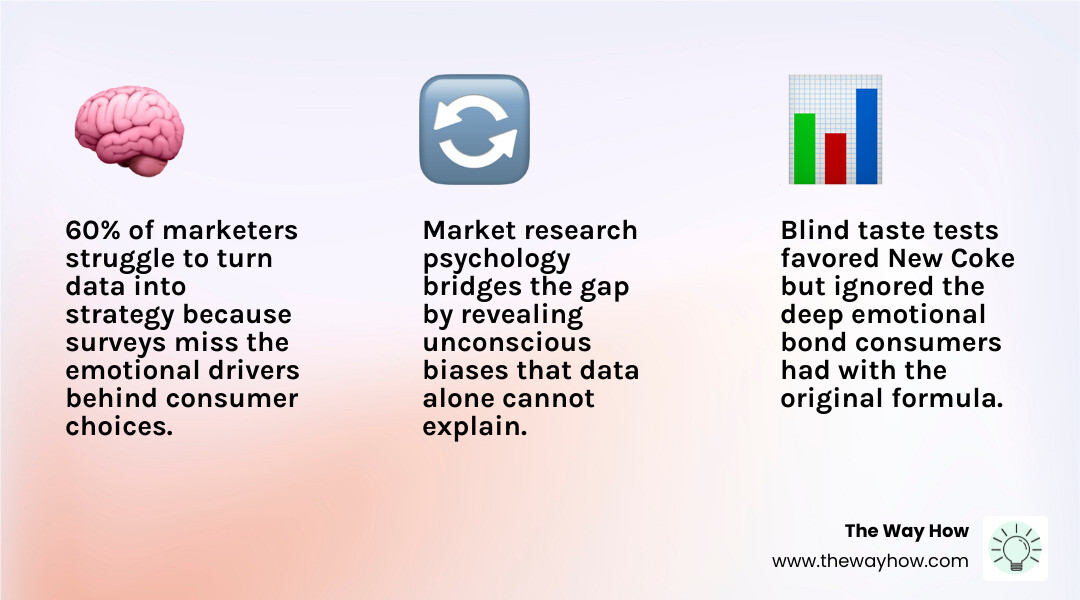
| Why does it matter? | 60% of marketers struggle to turn data into strategy — psychology explains what the numbers can’t |
| Who uses it? | Brand strategists, consumer researchers, product teams, and revenue leaders |
| Key methods used | Focus groups, in-depth interviews, implicit association tests, behavioral analytics, ethnographic studies |
| Core frameworks | Maslow’s Hierarchy, Theory of Planned Behavior, cognitive dissonance, COM-B model |
| Career path | Psychology graduates are increasingly valued as market research analysts and consumer psychologists |
Most businesses are drowning in data. Dashboards. Click rates. Conversion funnels. Survey results that say one thing while customers quietly do another.
The problem isn’t a lack of information. It’s a lack of understanding.
When Coca-Cola launched New Coke, they had the data. Blind taste tests favored the new formula. The numbers looked good. But they missed something the spreadsheets couldn’t capture: the emotional bond consumers had with the original. The launch became one of the most studied failures in marketing history — not because the research was absent, but because the psychology behind the data was ignored.
That gap — between what people say and what they actually do — is exactly what market research psychology is designed to close.
I’m Jeremy Wayne Howell, founder of The Way How, a psychology-first marketing and revenue strategy firm, and I’ve spent over 20 years diagnosing why growth stalls by studying the human behavior underneath the performance data — work that sits at the core of market research psychology. If you’re a founder, CEO, or revenue leader who’s tired of tactics that look right on paper but don’t move revenue, this guide is built for you.
Simple Market research psychology glossary:
The Myth of the Rational Consumer
We like to think of ourselves as logical beings who weigh pros and cons before making a purchase. However, the “Say-Do” gap tells a different story. In a survey by the American Marketing Association, 60% of marketers admitted they struggle to translate data into actionable strategies. This struggle exists because traditional analytics often assume a rational consumer that doesn’t actually exist in the wild.
Human beings are inherently irrational. We are driven by cognitive biases, social pressures, and subconscious emotional triggers. For example, over 70% of electric vehicle buyers in the UK in 2021 were motivated by status rather than the logical cost savings of electricity over petrol. If you only looked at the financial data, you’d miss the actual driver of the sale.
When we ignore market research psychology, we end up with “phantom data”—information that looks solid but leads to the wrong conclusions. Understanding the disconnect between stated intent (what people say in a survey) and actual purchase behavior (what they do at the checkout) is the first step toward building a predictable growth engine.
The Evolution of Market Research Psychology
Traditional market research was born out of the need to quantify trends. It asks what happened: How many units sold? What percentage of the audience likes the blue packaging? While useful, this approach treats consumers like data points on a spreadsheet.
How Behavioral Psychology is Revolutionizing Market Research and Consumer Insights - PsyForU Research International explains that we are moving toward a more nuanced era. Today, behavioral science is no longer optional. It bridges the gap between the lab and the living room, helping brands understand the messy, emotional reality of human decision-making.
Bridging the Gap with Market Research Psychology
By integrating Marketing Psychology Insights, we can begin to see the invisible forces at play. Cognitive biases, such as the anchoring bias or social proof, act as mental shortcuts (heuristics) that dictate our choices before we even realize we’ve made them.
When a brand understands these psychological levers, they stop guessing. They stop throwing spaghetti at the wall to see what sticks and start designing interventions that align with how the human brain actually processes information.
Why Numbers Reveal the What but Psychology Explains the Why
Quantitative data is great for identifying patterns, but it’s notoriously bad at explaining motivation. A high bounce rate on a landing page tells you people are leaving, but it doesn’t tell you if they left because they were confused, bored, or because the offer didn’t align with their self-identity.
This is where qualitative depth comes in. Our Psychology of Digital Marketing Guide highlights how behavioral nuance transforms a simple metric into a strategic roadmap. Knowing the “why” allows you to fix the system, not just the symptom.
From Lab to Boardroom: Transitioning Your Psychology Degree
If you have a background in psychology, you are uniquely positioned to excel as a market research analyst. The transition from academic research to consumer insights is more natural than most people realize. The same skills used to design a controlled experiment—rigorous research methods and statistical analysis—are exactly what modern corporations need to understand their market position.
According to Market Research Analyst: Psychology in Consumer Insights - iResearchNet, psychology graduates bring a level of behavioral nuance that standard business majors often lack. They don’t just see a trend; they see the human motivation behind it.
Why a Master’s in Psychology is the Ultimate Market Research Psychology Asset
An advanced degree in psychology provides more than just a line on a resume; it offers a theoretical and empirical foundation that elevates your analysis. Professionals with a Master’s can move beyond reporting on “what’s trending” to providing deep strategic insights.
Our look at the Psychology of Marketing shows that advanced behavioral theory and data analysis skills open doors to leadership opportunities. Companies aren’t just looking for someone to run a survey; they are looking for someone who can lead a team in interpreting the complex psychological landscape of a global audience.
Core Competencies for the Modern Consumer Psychologist
Success in this field requires a blend of hard and soft skills. You need the critical thinking to question the data, the empathy to understand the consumer’s pain points, and the communication skills to explain it all to a boardroom full of executives.
| Academic Psychology Skill | Market Research Analyst Requirement |
|---|---|
| Experimental Design | Designing A/B Tests & Surveys |
| Statistical Analysis (SPSS/R) | Predictive Modeling & Trend Analysis |
| Behavioral Theory | Consumer Segmentation & Persona Building |
| Qualitative Interviewing | Focus Groups & In-Depth Interviews |
| Ethics & Informed Consent | Data Privacy & GDPR Compliance |
The Psychological Frameworks Driving Modern Insights
To get past surface-level observations, we use established psychological frameworks. These aren’t just academic theories; they are practical tools for diagnosing growth. For instance, Behavioral Science for CRM allows us to see how consumers interact with technology on a psychological level.
- Maslow’s Hierarchy of Needs: Helps us understand if we are selling to a consumer’s need for security or their desire for self-actualization.
- Theory of Planned Behavior: Examines how attitudes, social norms, and perceived control combine to form intentions.
- Cognitive Dissonance: Explains the post-purchase regret that leads to returns and how to reinforce brand loyalty instead.
Applying the COM-B Model to Consumer Choice
One of the most effective frameworks is the COM-B model, which we detail in our Human Psychology Marketing Ultimate Guide. It suggests that for any Behavior (B) to occur, three factors must be present:
- Capability (C): Does the consumer have the physical and mental ability to buy?
- Opportunity (O): Is there an external environment that makes the purchase possible?
- Motivation (M): Do they have the brain’s “want” or “need” to act?
If your sales are stalled, it’s usually because one of these three levers is broken.
The Brand Psychology Architecture
Strategic interventions are 2-4x more effective when brands are managed through psychological frameworks rather than just tracking metrics. We look at the Brand Psychology Architecture across four layers:
- Cognitive Layer: Awareness and mental associations.
- Emotional Layer: The feelings evoked by the brand.
- Behavioral Layer: Habit formation and choice architecture.
- Identity Layer: What the brand signals about the consumer’s self-concept.
Using Neuromarketing Techniques, we can measure how these layers interact to create long-term brand equity.
Decoding Behavior: Qualitative and Quantitative Methods

To truly understand market research psychology, we must use a mix of methods. Quantitative data provides the skeleton, but qualitative insights provide the flesh.
Traditional methods like focus groups and in-depth interviews allow us to probe the “motivational core” of a consumer. Often, it takes 5-7 levels of probing (a technique called laddering) to reach the real reason someone buys. They might say they bought a detergent because it was on sale, but three “whys” later, you discover they bought it because it’s the brand their mother used, tapping into a deep-seated need for familiarity and safety.
Implicit Association Tests (IAT) and Unconscious Bias
Sometimes, consumers can’t tell you the truth because they don’t know it themselves. The subconscious mind processes information much faster than the conscious mind. Implicit Association Tests (IAT) measure reaction times to uncover hidden biases and brand perceptions.
For example, a fashion brand might use IATs to see if consumers truly associate their “sustainable” line with eco-friendliness or if they just see it as a marketing gimmick. This helps avoid the pitfalls of Anchoring Bias Marketing, where the first piece of information (like a high price) skews all subsequent perceptions.
Case Studies: Psychology in the Real World
- GrabFood: By using personalized marketing strategies rooted in behavioral insights, Grab achieved a 65% increase in sales. They didn’t just offer discounts; they offered the right discounts at the right time based on individual user habits.
- Coca-Cola: The New Coke failure is the ultimate lesson in ignoring the emotional layer of brand psychology. Consumers felt a sense of Loss Aversion Marketing—the pain of losing the original “Coke” was twice as powerful as the potential gain of a better-tasting drink.
- Netflix & Amazon: These giants use behavioral analytics to predict what you want before you even know it. Their recommendation engines are essentially massive, real-time psychological experiments in preference and habit formation.
The Ethics of Influence in a Data-Driven World
With great power comes great responsibility. As we use market research psychology to influence behavior, we must navigate the fine line between persuasion and manipulation. Ethical considerations like data privacy and GDPR compliance are not just legal hurdles; they are essential for maintaining consumer trust.
Using the Authority Principle Marketing, brands can build trust by being transparent and credible. If a consumer feels manipulated, the resulting cognitive dissonance will eventually drive them away, regardless of how “effective” the initial tactic was.
Navigating the Nudge: Ethical Behavioral Design
Nudging—the practice of subtly influencing choice architecture—should always be done with transparency and respect for consumer autonomy. The Endowment Effect Marketing explains why we value things more once we feel we own them (like a free trial). Ethical brands use this to provide value, not to trap users into subscriptions they don’t want.
The Future of Market Research Psychology: AI and Analytics
The future of this field lies in the marriage of AI and human empathy. Predictive modeling and behavioral analytics allow us to process vast amounts of data, while psychological expertise ensures we don’t lose the “human” in the numbers.
Our Human-Centered CRM Empathy Features are designed to help businesses maintain this balance, turning cold data into warm, personalized customer journeys.
Frequently Asked Questions about Market Research Psychology
How does a psychology degree help in market research?
It provides the foundational understanding of human behavior, research methodologies, and statistical tools necessary to interpret complex consumer data beyond surface-level trends. Psychology graduates are trained to look for biases, understand emotional drivers, and design studies that yield honest results.
What is the job outlook for market research analysts with a psychology background?
Employment for market research analysts is projected to grow 7% between 2024 and 2034. This is faster than the average for all occupations, driven by the increasing need for companies to understand consumer behavior in a hyper-competitive digital landscape.
What is the difference between consumer psychology and market research?
Market research often focuses on the “what”—the data, trends, and market share. Consumer psychology focuses on the “why”—the mental, emotional, and social processes that drive those choices. One describes the outcome; the other explains the mechanism.
Beyond the Data: Restoring Certainty in Growth

At The Way How, we believe that marketing shouldn’t be a guessing game. We are a psychology-first revenue strategy firm that helps founders and leadership teams remove uncertainty from their growth systems.
Whether it’s through Fractional CMO leadership, HubSpot architecture, or demand generation strategies, our work is always rooted in human behavior and empathy. We don’t just look at your funnel; we diagnose the “certainty gaps” in your customer journey. By blending strategic clarity with operational execution, we turn your marketing into a dependable growth engine.
Ready to see the human behavior behind your numbers? More info about our services