A Complete Guide to CRM Systems and Database Management
 Jeremy Wayne Howell : Jul 22, 2026 9:48:31 PM
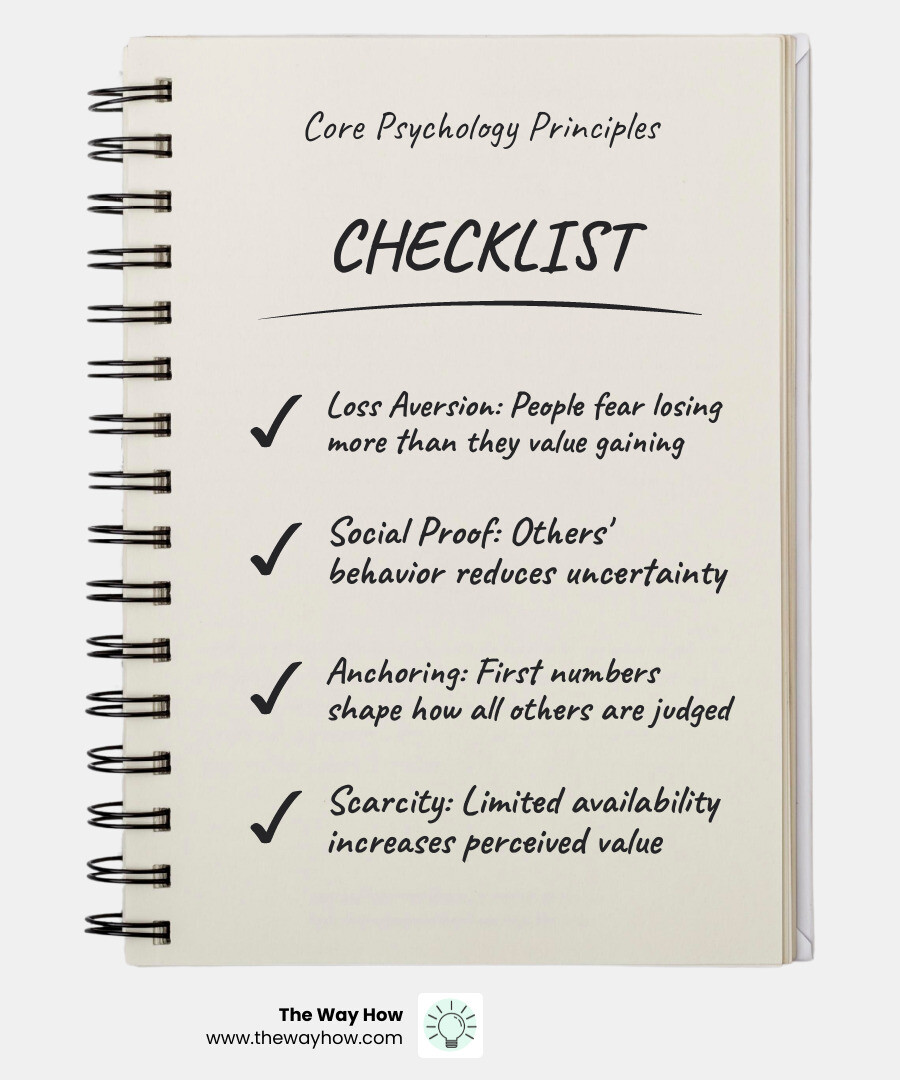
Marketing psychology insights are the principles that explain why people buy — and why they don’t, even when your offer is strong.
Here are the core insights that matter most:
| Principle | What It Does |
|---|---|
| Loss Aversion | People fear losing more than they value gaining |
| Social Proof | Others’ behavior reduces uncertainty |
| Anchoring | First numbers shape how all others are judged |
| Scarcity | Limited availability increases perceived value |
| Reciprocity | Giving first creates a felt obligation to return |
| Mere Exposure | Familiarity builds preference over time |
| Cognitive Load | Simpler paths produce more decisions |
| Authority Bias | Credibility signals reduce perceived risk |
These aren’t hacks. They’re how human decision-making actually works.
Most marketing underperforms not because the channel is wrong or the budget is too small. It underperforms because it’s built around what a brand wants to say — not around how a real buyer thinks, feels, and decides.
The average person sees more than 10,000 ads every day. Attention drops off in roughly eight seconds. In that environment, clever copy and a red button aren’t enough. Understanding the psychology underneath the decision is what separates campaigns that convert from ones that just create noise.
“They address the what but ignore the crucial why.”
That gap — between surface tactics and the human behavior driving them — is exactly where growth stalls.
I’m Jeremy Wayne Howell, founder of The Way How, a psychology-first marketing and revenue strategy firm, and I’ve spent over 20 years applying marketing psychology insights to help founders and revenue leaders close that gap — restructuring messaging and go-to-market systems around how buyers actually think, not how brands assume they do. In that time, I’ve seen one pattern repeat itself: the businesses that grow predictably are the ones that understand the human on the other side of the decision before they invest in any tactic.
To understand why growth stalls, we must look at the dual-process model of the brain. Most marketing appeals to “System 2”—the logical, slow, and calculating part of the mind. We provide lists of features and ROI calculators, assuming the buyer is a rational “homo economicus.” In reality, “System 1”—the fast, instinctive, and emotional processor—is usually in the driver’s seat.
When there is a “certainty gap”—a moment of doubt or friction in the buyer’s journey—System 1 defaults to the easiest path: doing nothing. By April 2026, the brands winning the market aren’t those with the loudest ads, but those that use Human Centered Marketing to reduce cognitive load and build genuine psychological safety.
At The Way How, we don’t view psychology as a collection of “tricks.” We see it as a curriculum in the science of human choice. When we help leadership teams diagnose stalled growth, we often find they are fighting against deeply embedded biological hardwiring.
One of the most powerful marketing psychology insights is Loss Aversion Marketing. Research indicates that the pain of losing is psychologically twice as powerful as the pleasure of gaining. If your messaging only focuses on the “upside,” you are missing the primary driver of human behavior: the desire to protect what we already have.
Another pillar is Social Proof. In an era where 93% of consumers are influenced by online reviews, the behavior of others serves as a vital proxy for quality. It reduces the perceived risk of a “wrong” decision.
To design a strategy that actually moves the needle, we must distinguish between the two systems of thinking:
| Feature | System 1 (Intuitive) | System 2 (Analytical) |
|---|---|---|
| Speed | Fast, automatic | Slow, effortful |
| Effort | Low | High |
| Role in Marketing | Creates initial preference | Provides rational justification |
| Drivers | Emotions, habits, heuristics | Logic, data, comparisons |
Understanding this Psychology Of Marketing allows us to sequence our messaging. We engage System 1 with vivid, fluent cues first, then support that choice with the hard data System 2 needs to endorse the purchase. For those looking for deep academic rigor, the Scientific research on consumer psychology metrics published in journals like Psychology & Marketing (which maintains a 9.1 Impact Factor) provides the empirical backbone for these strategies.
Pricing is rarely about the absolute number; it is about the perception of value. This is where Anchoring Bias Marketing becomes essential. The first price a customer sees sets the mental “anchor” for everything that follows. If we present a $5,000 “Enterprise” plan first, a $1,500 “Standard” plan feels like a bargain.
We also see the “Decoy Effect” in action when a third, less attractive option is added to a pricing page specifically to make the “target” option look like the best value. Combined with “charm pricing” (prices ending in .99), which can increase sales by 24%, these tactics shift the Marketing Framing Effect Guide from a cost-focus to a value-focus.
Trust is the foundational element that enables all other persuasion mechanisms. Without it, your Content Marketing Psychology Ultimate Guide will fall flat.
The data is clear: website pages featuring testimonials convert 34% more on average. However, the type of social proof matters. Specificity beats volume every time. A detailed testimonial from a recognizable peer in the same industry is far more persuasive than 50 generic five-star ratings. When 75% of consumers actively look for reviews before buying, your “consensus” signals must be authentic, current, and proximal to the buyer’s specific situation.
In a world of information overload, the human brain uses “heuristics”—mental shortcuts—to make decisions efficiently. As we discuss in our Human Psychology Marketing Ultimate Guide, these aren’t “errors” in thinking; they are evolved tools for survival.
In B2B contexts, these biases are often driven by risk aversion. The B2B buyer isn’t just buying a tool; they are buying the security of their professional reputation. If we can reduce the “Cognitive Load”—the mental effort required to understand your offer—we significantly increase the likelihood of a “yes.”
We often hear that B2B decisions are purely logical. This is a myth. Research by neuroscientist Antonio Damasio shows that people whose emotional centers are damaged can’t make decisions at all, even if their logic remains intact.
Emotional Marketing Tactics are about creating a “gut feeling” of certainty. This is supported by Cialdini’s Principles of Persuasion, specifically Authority. We are hardwired to follow the lead of credible experts. Displaying awards, certifications, or deep industry analysis isn’t bragging—it’s risk mitigation for the buyer.
We also have to manage the “post-purchase” phase. This is where Endowment Effect Marketing and cognitive dissonance come into play. Once a customer owns a product, they value it more highly. However, they also look for reassurance that they didn’t make a mistake. Providing immediate onboarding value and success stories post-purchase reduces “buyer’s remorse” and builds long-term loyalty.
As we move further into 2026, the use of Neuromarketing Techniques like eye-tracking and EEG to measure brain responses has become more accessible. While these tools offer deep marketing psychology insights, they also bring significant ethical responsibilities.
The line between persuasion and manipulation is simple: Persuasion helps the customer make a decision that is in their best interest. Manipulation uses psychological vulnerabilities to trick them into a decision they will later regret.
In a landscape where people are exposed to 10,000 ads daily, transparency is your greatest competitive advantage. Brands that respect consumer autonomy—by offering easy opt-outs and clear data practices—build the kind of durable trust that algorithms cannot replicate.
How do we know if these psychological shifts are working? We move beyond “vanity metrics” like likes or clicks and focus on behavioral outcomes.
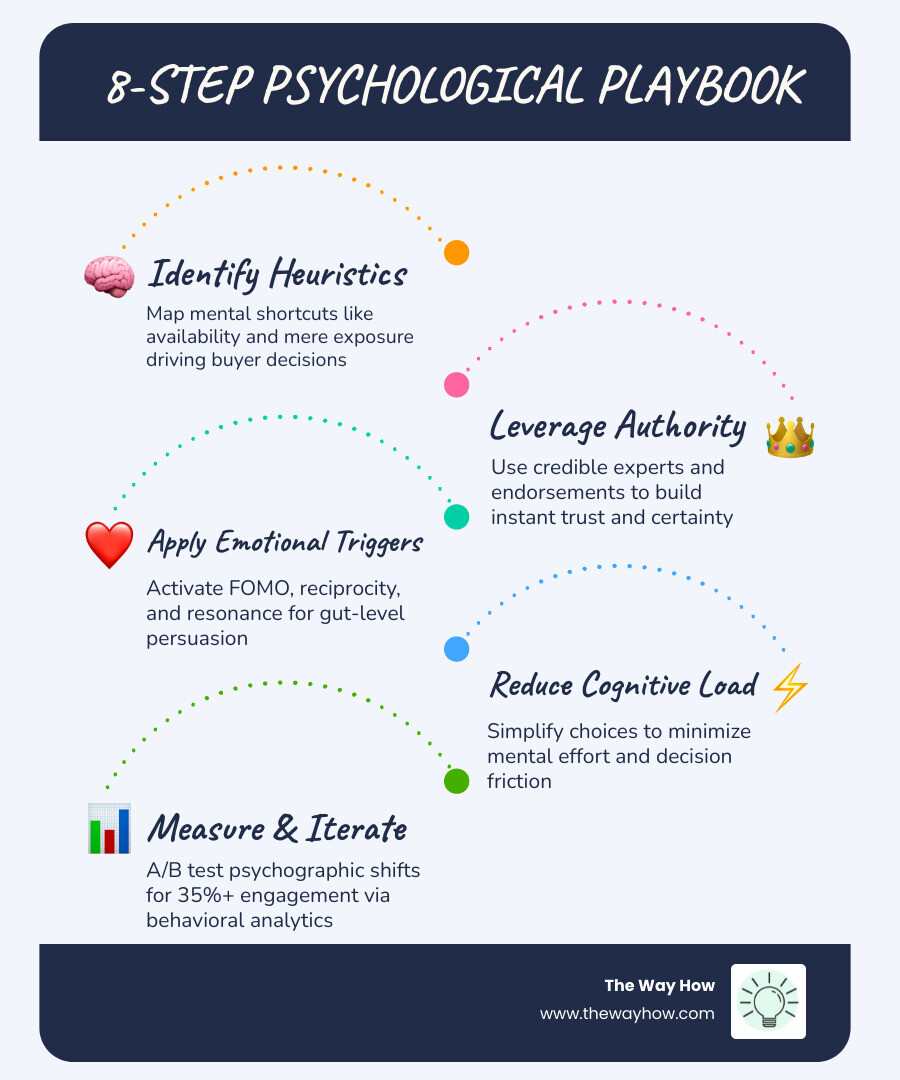
By using psychographic targeting—segmenting audiences by their values, interests, and opinions rather than just their zip code—marketers see engagement rates increase by up to 35%. We measure success through A/B testing that focuses on one psychological hypothesis at a time (e.g., “Does a loss-framed headline outperform a gain-framed one?”). This creates a predictable ROI and a dependable growth engine.
The world’s most successful brands are masters of these insights:
Heuristics are the “mental shortcuts” themselves—the process of making a quick decision. A cognitive bias is the “systematic error” that occurs when a heuristic is applied incorrectly or in the wrong context. Heuristics are often “ecologically rational,” meaning they work well in most real-world situations to save time and energy.
By using psychographic segmentation and the Elaboration Likelihood Model (ELM). Instead of casting a wide net, you tailor your message to the buyer’s level of motivation. Marketers using these insights report a 66% improvement in lead quality because they are attracting buyers whose internal motivations already align with the brand’s values.
It can be, but it shouldn’t be. Ethical marketing is about clear communication. If you use these insights to help a buyer find a solution that genuinely solves their problem, you are providing a service. Long-term brand growth is built on trust, and manipulation kills trust faster than any other factor.
At The Way How, we believe that understanding the “why” behind the buy is the only way to build a truly resilient revenue system. We don’t just “do marketing”; we diagnose the certainty gaps that are keeping your prospects from becoming customers.
Whether it’s through Fractional CMO leadership or restructuring your HubSpot architecture to reflect actual buyer behavior, our goal is to turn your marketing into a dependable growth engine. If your growth has stalled, it’s likely not a tactical failure—it’s a psychological one.
Learn more about our marketing psychology services and let’s start building a system that respects the human mind and delivers predictable results.
 Jeremy Wayne Howell : Jul 22, 2026 9:48:31 PM
 Jeremy Wayne Howell : Jul 21, 2026 9:47:10 PM
 Jeremy Wayne Howell : Jul 20, 2026 9:46:47 PM