
Beyond the Transaction: Why Humans Are Wired to Give Back

How To Use Reciprocity In Marketing with 10 Killer Examples
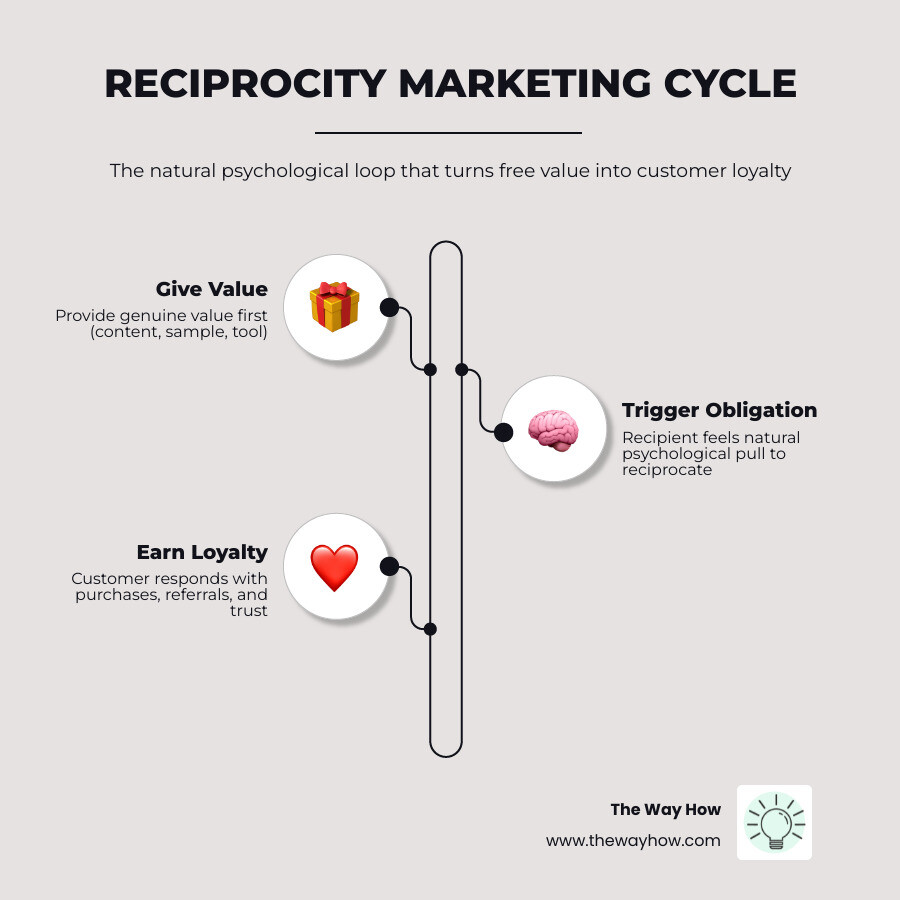
Reciprocity principle marketing is the practice of giving genuine value to customers first — before asking for anything in return — to trigger a natural human impulse to give back.
Here’s how it works at a glance:
| Element | What It Means |
|---|---|
| The trigger | You give something valuable — content, a sample, a tool, access |
| The response | The recipient feels a psychological pull to reciprocate |
| The outcome | Purchases, referrals, loyalty, and trust — earned, not forced |
| The key condition | The giving must feel genuine, not transactional |
This isn’t a manipulation tactic. It’s one of the most deeply wired social norms in human behavior — studied by psychologists, observed across cultures, and documented in decades of behavioral research.
In 1971, researcher Dennis Regan demonstrated just how powerful this pull is. Participants who received an unexpected soft drink from a stranger went on to buy twice as many raffle tickets from that same person — even though the drink was never offered as part of any deal.
Nobody told them they owed anything. They just felt like they did.
That feeling — quiet, automatic, and almost invisible — is exactly what reciprocity principle marketing is designed to understand and apply with intention.
I’m Jeremy Wayne Howell, a revenue growth strategist with over 20 years of experience helping founders and revenue teams apply buyer psychology — including reciprocity principle marketing — to build systems that drive predictable growth. If you’ve ever wondered why giving things away actually makes you more money, this guide is for you.
Quick Reciprocity principle marketing terms:
The Psychology of Reciprocity Principle Marketing
To understand why reciprocity principle marketing works so effectively in April 2026, we have to look back at our evolutionary roots. For early humans, survival depended on mutual exchange. If we shared our food today, we could reasonably expect a neighbor to share theirs tomorrow. This created a “web of indebtedness” that allowed for the development of complex societies.
In modern marketing, we aren’t trading mammoth meat, but the psychological trigger remains identical. When a brand provides value without an immediate “ask,” it creates a cognitive obligation. This is a core pillar of our Human Psychology Marketing Ultimate Guide.
Robert Cialdini, in his seminal work Influence: The Psychology of Persuasion, identifies reciprocity as the first of his key principles. He notes that we are hard-wired to respond positively to a gift, even when we didn’t ask for it. This sense of gratitude and indebtedness is what drives the effectiveness of Reciprocity Principle - Adogy.
Consider the famous experiment by sociologist Phillip Kunz in 1974. He mailed handwritten Christmas cards to 600 complete strangers. Logic suggests that most people would simply throw them away. Instead, he received over 200 replies. These strangers felt a social obligation to return the gesture, simply because Kunz had initiated it.
In a marketing context, this principle affects different audience segments in unique ways:
- First-time visitors: Reciprocity builds immediate trust and lowers the “interaction cost” of engaging with a new brand.
- Relationship-oriented buyers: These customers value the emotional exchange and are more likely to become long-term advocates when they feel a brand is generous.
- Loyal customers: For this group, reciprocity reinforces their decision to stay, especially when the “gifts” feel exclusive or personalized.
By understanding these psychological foundations, we can move away from aggressive tactics and toward building systems of mutual value.
10 Killer Examples of Reciprocity in Action
Seeing reciprocity principle marketing in the wild helps illustrate how diverse these strategies can be. Here are ten examples of brands that have mastered the art of giving first.

1. Spotify’s Seamless Free Trials
Spotify offers an ad-free premium experience for a set period. By the time the trial ends, the user has already integrated the service into their daily life. The “gift” of an uninterrupted experience makes the subsequent subscription feel like a fair exchange for the value already received.
2. Sephora’s Beauty Samples
Sephora is a master of the “surprise and delight” model. By including free samples with every purchase and offering personalized beauty tips, they create an environment where the customer feels educated and pampered, increasing the likelihood of repeat visits.
3. Amazon Prime’s Bundle of Benefits
Amazon Prime isn’t just about shipping; it’s a massive reciprocity engine. By providing streaming, music, and exclusive deals, members often feel a “sunk cost” obligation to shop more on the platform to justify and utilize the benefits they’ve been given.
4. Dropbox’s Referral Storage
Dropbox famously grew by giving away extra storage space to both the person referring and the new user. This mutual benefit creates a cycle of reciprocity where users feel rewarded for helping the company grow.
5. HubSpot Academy’s Educational Lead
HubSpot provides thousands of hours of world-class certification courses for free. This positions them as an authority and creates a strong sense of gratitude among marketers who use their free tools to advance their careers. This is a prime example of our Content Marketing Psychology Ultimate Guide.
6. TOMS One for One Model
By promising to donate a pair of shoes for every pair purchased, TOMS creates an emotional reciprocity. The customer feels they are doing a good deed, and the brand facilitates that feeling, strengthening the bond between them.
7. Starbucks Rewards
The Starbucks loyalty app uses “Stars” to reward repeat visits. However, they often layer in “Double Star” days or free birthday drinks. These unexpected perks keep the relationship feeling personal rather than purely transactional.
8. Personalized Thank-You Notes
Many D2C brands include a handwritten note in their packaging. In an age of automation, this small, human gesture carries immense weight, making the customer feel seen and more likely to leave a positive review or share the brand on social media.
9. Free Industry Audits
In the B2B world, offering a free, no-obligation audit or consultation (much like we do at The Way How) provides immediate value. It diagnoses a problem for the lead before they ever spend a dime, establishing the brand as a helpful guide.
10. The Nielsen Content-First Strategy
A 2007 study by Luciano Gamberini found that users who received content before being asked for their information provided more detailed and accurate data. This “content-first” approach respects the user’s time and intelligence, leading to higher quality leads.
Applying Reciprocity Principle Marketing to Digital Services
In digital marketing, the “interaction cost” is the mental and physical effort a user must exert to complete a task. High interaction costs (like a 20-field form) kill conversions. Reciprocity principle marketing reduces this cost by providing value before making a request.
Freemium models and gated content are the most common applications here. However, there is a nuance to doing this correctly. As noted in The Reciprocity Principle and How to Use It in Marketing, the initial offer must feel genuine. If a “free” ebook is just a 10-page sales pitch, the reciprocity trigger fails because the value wasn’t real.
At The Way How, we believe in “diagnosing before prescribing.” This means providing tools — like calculators, templates, or planners — that help a lead understand their own situation better. This is a core part of the Psychology Of Marketing.
Scaling Reciprocity Principle Marketing through Loyalty Programs
Loyalty programs are essentially scaled reciprocity systems. To move beyond simple “points for purchases,” we look at Emotional Marketing Tactics.
A truly effective loyalty program uses:
- Tiered rewards: The brand’s “giving” increases as the customer’s commitment increases.
- Exclusive access: Giving customers a “behind-the-scenes” look or early access to sales.
- Surprise and delight: Sending a gift or discount when the customer least expects it, rather than just on their birthday.
By applying Neuromarketing Techniques, we can design these programs to trigger dopamine releases associated with reward and social bonding, turning a casual buyer into a brand advocate.
Strategic Implementation: From Free Value to Long-Term Loyalty
Implementing reciprocity principle marketing requires a shift from “How can I get a sale?” to “How can I be the first to give?” This shift must be strategic, not just charitable.
The most important distinction to make is between reciprocity and bribery.
| Feature | Reciprocity | Bribery |
|---|---|---|
| Conditionality | Unconditional; given freely first. | Conditional; “Do this to get that.” |
| Feeling | Gratitude and mutual respect. | Transactional and sometimes manipulative. |
| Relationship | Long-term and trust-based. | Short-term and incentive-based. |
| Execution | “Here is something helpful for you.” | “Sign up now to get 10% off.” |
To measure if your reciprocity efforts are working, we look at relationship-focused metrics rather than just immediate clicks:
- Customer Lifetime Value (CLV): Are customers who received a “gift” first staying longer?
- Net Promoter Score (NPS): Does the generosity of the brand reflect in customer satisfaction?
- Reward Redemption Rate: Are people actually using the value you provide?
We also have to consider the Marketing Framing Effect Guide. How you present the gift matters. A “free consultation” sounds like a sales pitch; a “growth diagnostic” sounds like a gift of clarity.
Frequently Asked Questions about Reciprocity
What is the difference between reciprocity and bribery in marketing?
Reciprocity is about giving first without an explicit “if-then” contract. It relies on the internal psychological drive of the recipient to return the favor. Bribery is a direct transaction where the reward is dangled as a lure for a specific action. Reciprocity builds trust; bribery builds a habit of waiting for discounts.
Can reciprocity principle marketing backfire?
Yes. If the gesture feels inauthentic or like a “sneaky” way to get a sale, it can lead to “negative reciprocity.” This is where a customer feels misled and responds with a negative review or by actively avoiding the brand. Over-gifting can also create suspicion. The key is to keep the value relevant and the intent transparent.
How do you measure the ROI of reciprocity-based efforts?
While immediate conversion rates are important, the real ROI of reciprocity shows up in repeat purchase rates and referral growth. If your “free tool” leads to a 20% increase in Customer Lifetime Value compared to those who didn’t use the tool, your reciprocity strategy is working.
From One-Off Favors to Predictable Revenue Engines
At The Way How, we don’t believe in chasing the latest marketing “hacks.” We believe in understanding the human at the other end of the screen. Reciprocity principle marketing is not a trick to be deployed; it is a philosophy of business that prioritizes trust and value over quick wins.
When growth stalls, it is often because there is a “certainty gap” in the customer journey. The customer isn’t sure if you can help them, so they hesitate. By giving value first — through insights, education, or tools — you remove that uncertainty. You prove your worth before you ever ask for their credit card.
We help leadership teams diagnose these gaps and design systems rooted in behavioral insight. If you’re ready to move beyond transactional marketing and build a revenue engine that people actually enjoy engaging with, we should talk.
Stop wasting money on ads Grow your sales at a ridiculously lower CAC. Learn how