
Beyond the Click: Why Your Marketing Strategy is Failing the Human Brain

The psychology of digital marketing is the application of behavioral science — cognitive biases, emotional triggers, persuasion principles, and decision-making patterns — to how brands attract, engage, and convert customers online.
Here is a quick-reference breakdown of what this means in practice:
| Core Concept | What It Means | Why It Matters |
|---|---|---|
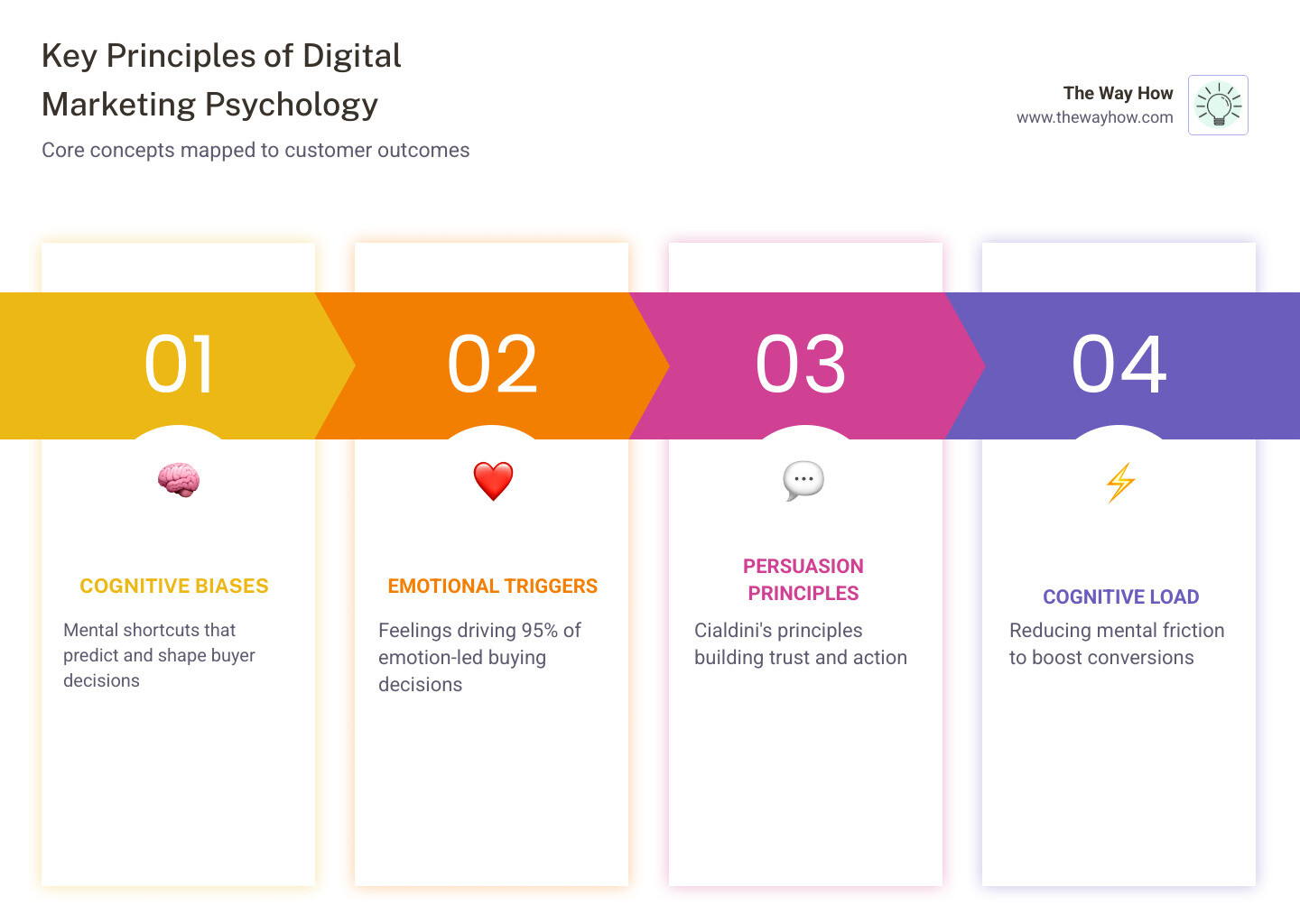
| Cognitive biases | Mental shortcuts that shape decisions | Predict and influence buyer behavior |
| Emotional triggers | Feelings that drive action | Up to 95% of buying decisions are emotion-led |
| Persuasion principles | Cialdini’s six principles and beyond | Build trust and move people to act |
| Cognitive load | Mental effort required to process information | Reduce friction to increase conversions |
| Social proof | Validation from others | Lowers perceived risk at the moment of decision |
| Scarcity and loss aversion | Fear of missing out | Creates urgency without manufactured pressure |
Most marketing fails not because of bad ads or weak copy. It fails because it ignores how the human brain actually makes decisions.
Consider this: over 192 million active websites are competing for attention right now. The average person’s attention span sits at around eight seconds. And yet most marketing strategies are still built around features, channels, and budgets — not the human on the other side of the screen.
The brands that consistently win aren’t just louder. They are clearer. They understand what their buyers feel, fear, and believe before they ever write a headline or choose an ad format.
That shift — from tactic-first to human-first — is what the psychology of digital marketing is really about.
I’m Jeremy Wayne Howell, founder of The Way How, a psychology-first marketing and revenue strategy firm, and over 20 years of working directly with founders and revenue teams has shown me that most growth problems are human problems in disguise. My entire approach to the psychology of digital marketing is built on one principle: you have to understand the person before you can build the system.
Psychology of digital marketing terms at a glance:
The Foundation of the Psychology of Digital Marketing
When we look at the psychology of marketing, we aren’t just looking for “tricks.” We are looking for the underlying architecture of human thought. In a digital context, this means moving beyond demographic data like age or location and moving into psychographic data—the “why” behind the click.
Core Pillars of the Psychology of Digital Marketing
To move from guesswork to precision, we focus on four specific pillars of digital psychology:
- Predictive Analytics: Using historical data to anticipate what a customer will do next.
- Behavioral Segmentation: Grouping your audience based on their actions (like cart abandonment or frequent browsing) rather than just who they are.
- Sentiment Analysis: Monitoring the emotional tone of customer interactions to adjust messaging in real-time.
- Psychological Profiling: Understanding the dominant motivations of your audience—whether they are driven by the need for status, security, or belonging.
Why Understanding the Psychology of Digital Marketing is Essential in 2026
As we navigate April 2026, the digital noise is deafening. With over 192 million active websites, the battle for attention is no longer won by the biggest budget. It is won by those who can interrupt the “scroll” by speaking to the brain’s subconscious needs. What is the Psychology Behind Digital Marketing? | Lumen SEOhighlights that capturing attention is increasingly difficult because our brains have evolved to filter out irrelevant information. If your message doesn’t resonate within that 8-second window, it effectively doesn’t exist.
The Architecture of Choice: Leveraging Cognitive Biases and Persuasion
The human brain uses heuristics—mental shortcuts—to make decisions without exhausting itself. In digital marketing, we can design our interfaces to align with these shortcuts.

Cialdini’s Principles in the Modern Digital Landscape
Robert Cialdini’s six (now seven) principles of persuasion are the bedrock of the psychology of digital marketing. In 2026, these have evolved from loud tactics to subtle signals of clarity:
- Reciprocity: Giving value before asking for it. This isn’t just a free PDF; it’s consistent, helpful content that builds a “debt of gratitude.”
- Social Proof: We look to others when we are uncertain. Testimonials and “Best Seller” badges act as a proxy for safety.
- Authority: Demonstrating expertise through high-quality content and backlinks.
- Scarcity: Highlighting honest limits. If an item is truly low in stock, showing that helps the user make a timely decision.
- Commitment and Consistency: Getting a small “yes” (like a newsletter signup) makes a larger “yes” (a purchase) more likely later.
- Liking: We buy from brands that share our values and speak our language.
- Unity: Creating a sense of “we.” This is the ultimate form of belonging.
Applying Behavioral Economics to the Customer Journey
Behavioral economics teaches us about the anchoring bias marketing effect, where the first price a customer sees sets the “anchor” for everything else. If you show a premium product first, the mid-tier option suddenly looks like a bargain.
Similarly, loss aversion marketing reminds us that the pain of losing something is twice as powerful as the joy of gaining it. This is why “don’t miss out” often performs better than “get this benefit.” By using the marketing framing effect guide, we can position our offers in a way that highlights the risk of inaction.
A classic example of these principles in action is the tech company AMD, which reportedly improved its social sharing by 3600% simply by optimizing how they displayed social proof. When people saw that others were sharing, the “uncertainty gap” closed, and they followed suit.
The Limbic Connection: Driving Action Through Emotional Resonance
While we like to think we are rational beings, research suggests that emotions underpin approximately 95% of buying decisions. The limbic system—the part of the brain responsible for emotions—often makes the choice before the logical prefrontal cortex even gets involved.
The Science of Visual and Sensory Stimuli
The brain processes visual content 60,000 times faster than text. This is why the psychology behind clicks: Where digital marketing meets neuroscience is so heavily focused on design.
- Color Psychology: Color can increase brand recognition by up to 80%. Blue often signals trust (common in finance), while red can trigger urgency or excitement.
- Emotional Contagion: This is the idea that we “catch” the emotions we see. Using imagery of people experiencing the positive outcome of your product can trigger a similar emotional state in the viewer.
- Microcopy: Small bits of text, like “You’re doing great!” during an onboarding process, provide dopamine hits that keep users engaged.
Narrative Transport and Grounded Cognition
Emotional marketing tactics often rely on storytelling. Grounded cognition theory suggests that when we read or hear a story, our brains simulate the experience as if it were happening to us. This is why Apple doesn’t just list processor speeds; they show a creator using an iPad to bring an idea to life. They are inviting you into a narrative where you are the hero. For more on this, see our content marketing psychology ultimate guide.
Decoding the Buyer’s Journey: Motivation, Conditioning, and Loyalty
To understand why a customer stays or leaves, we have to look at their deeper motivations.
Conditioning for Long-Term Retention
We can use principles from behavioral psychology to build loyalty:
- Classical Conditioning: Associating your brand with a specific feeling. Think of how a specific notification sound can trigger a sense of anticipation.
- Operant Conditioning: Using rewards to reinforce behavior. Loyalty programs that offer points or discounts are essentially rewarding the “habit” of buying from you.
- Dopamine Loops: Social media “likes” or progress bars in a SaaS app create small hits of dopamine, making the experience addictive.
Future-Proofing Your Strategy with the Psychology of Digital Marketing
In our human psychology marketing ultimate guide, we explore how Maslow’s Hierarchy of Needs applies to the digital world. A customer isn’t just buying software; they might be buying “security” or “esteem.”
We also have to manage the endowment effect marketing principle, which states that people value things more once they feel they “own” them. This is why free trials are so effective—once the user has set up their data in your system, losing access feels like a personal loss.
Designing for Clarity: Reducing Cognitive Load in the Digital Experience
One of the biggest conversion killers is “decision paralysis.” When a user is presented with too many choices, the brain’s cognitive load becomes too heavy, and they simply leave.
Simplification as a Conversion Strategy
To combat the “paradox of choice,” we use neuromarketing techniques to simplify the user journey:
- Information Chunking: Breaking long forms or pages into small, digestible sections.
- Progress Indicators: Showing a user how close they are to finishing a task (like a checkout process) triggers “completion bias.”
- Single CTA: Reducing the number of buttons on a page to one clear “next step.”
The results are measurable. PriceCharting, for instance, saw a 621% increase in conversions simply by improving their Calls to Action (CTAs) to be more direct and less overwhelming.
| Friction Level | User Experience | Conversion Impact |
|---|---|---|
| High Friction | Too many options, complex navigation, hidden pricing | High abandonment, low trust |
| Low Friction | Clear path, progress bars, transparent information | Higher conversion, better retention |
Alleviating Post-Purchase Dissonance
The job isn’t done at the click. “Buyer’s remorse,” or cognitive dissonance, happens when a customer questions their decision immediately after a purchase. We use the psychology of digital marketing to reassure them through:
- Immediate confirmation emails that celebrate the purchase.
- Showcasing testimonials from other happy customers.
- Consistent messaging that reinforces the value they just bought.
The Integrity Engine: Ethical Application and Data-Driven Optimization
Harness The Power of the Mind: The Role of Psychology in Digital Marketingreminds us that with great power comes great responsibility. Using psychology to help a customer find a solution is marketing. Using it to trick them into something they don’t need is manipulation. At The Way How, we believe that long-term trust is the only sustainable competitive advantage.
Testing Psychological Hypotheses
You should never guess which psychological trigger will work. You test it.
- A/B Testing: Does a red button or a blue button drive more clicks?
- Heatmaps: Where are people looking? Are they missing your most important social proof?
- Experimentation: The company Teamleader increased free trial sign-ups by nearly 13% through A/B testing commitment strategies—proving that even small psychological adjustments can have a massive impact on the bottom line.
Frequently Asked Questions about the Psychology of Digital Marketing
What is the most powerful psychological trigger in digital marketing?
Social proof remains the most influential trigger because it leverages the human instinct to follow the herd in uncertain environments, reducing the perceived risk of a decision.
How can I use psychology to reduce cart abandonment?
Address loss aversion by highlighting what the customer misses out on, and use scarcity triggers like real-time stock updates to create honest urgency.
Is using psychology in marketing manipulative?
It becomes manipulation when used to deceive. Ethical marketing uses psychology to provide clarity, reduce friction, and help customers make decisions that genuinely solve their problems.
From Tactics to Transformation: Restoring Momentum in Your Growth Engine
Mastering the psychology of digital marketing isn’t about finding a magic “buy button” in the consumer’s brain. It’s about removing the friction, uncertainty, and noise that prevents them from seeing the value you provide.
At The Way How, we help founders and leadership teams move away from chasing the latest marketing “hacks” and toward building a strategy rooted in human behavior. Whether through Fractional CMO leadership or optimizing your HubSpot architecture, we focus on diagnosing the certainty gaps in your customer journey.
If your growth has stalled, it’s likely not a technical problem—it’s a clarity problem. We are here to help you design a system that creates trust, momentum, and predictable revenue.