
Beyond the Rational Buyer Myth
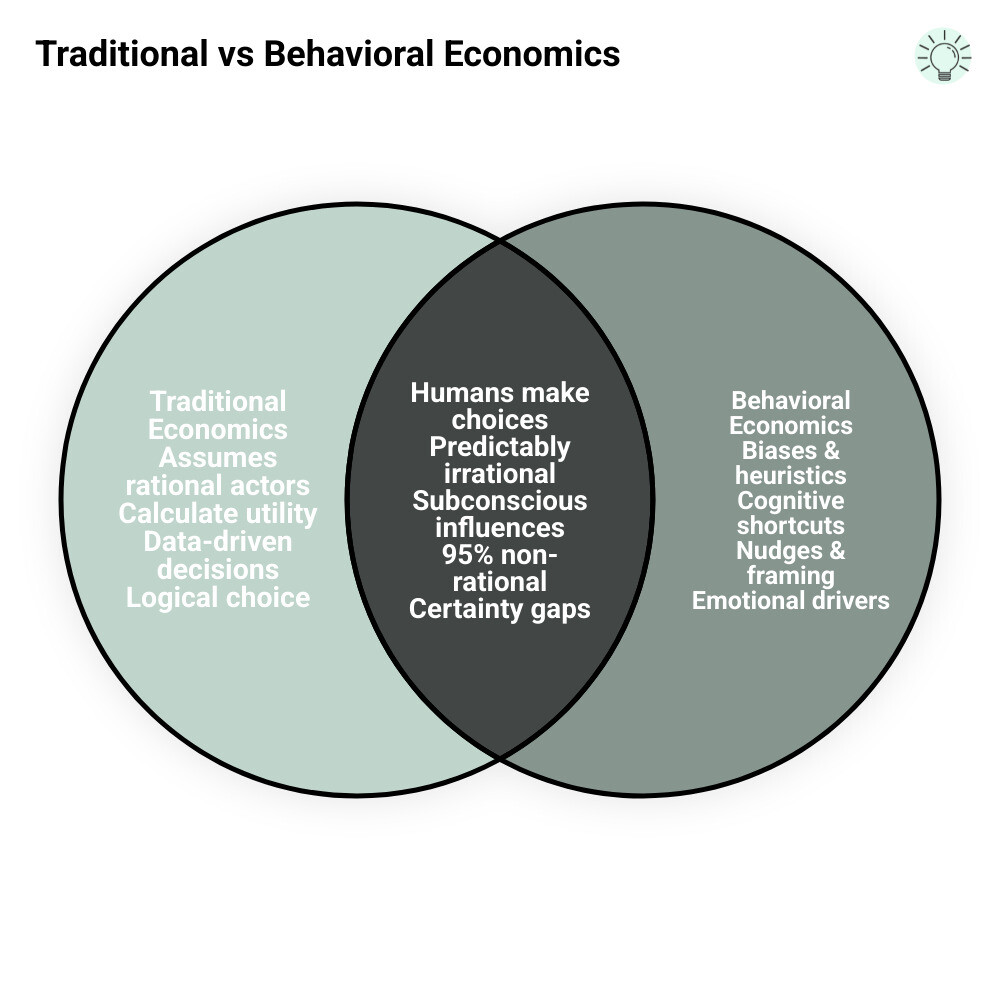
The gap between how we think we decide and how we actually decide is where most marketing budgets go to die. Traditional economics suggests that if we provide enough data, a rational consumer will calculate the utility and make the “correct” choice. But as we move through April 2026, the data tells a different story: humans are predictably irrational.
Research shows that 95% of our decisions are driven by subconscious urges. We aren’t calculating machines; we are bundles of habits, social pressures, and cognitive shortcuts. When a traveler feels overwhelmed by the volume of choices—something 58% of travelers report—they don’t just pick the “best” one; they often experience analysis paralysis and pick nothing at all.
At The Way How, we look at these “certainty gaps.” An uncertainty gap exists when the buyer’s subconscious mind feels unsafe or confused, even if the logical mind says the product is good. By bridging these gaps with behavioral economics marketing tactics, we move from guessing what might work to nudging the buyer toward a decision that feels natural and right.
The Psychology of Choice: Core Behavioral Economics Marketing Tactics

To build a marketing system that actually converts, we must move beyond surface-level “hacks” and understand the levers that move the human mind. These principles aren’t just tricks; they are the fundamental architecture of human choice.
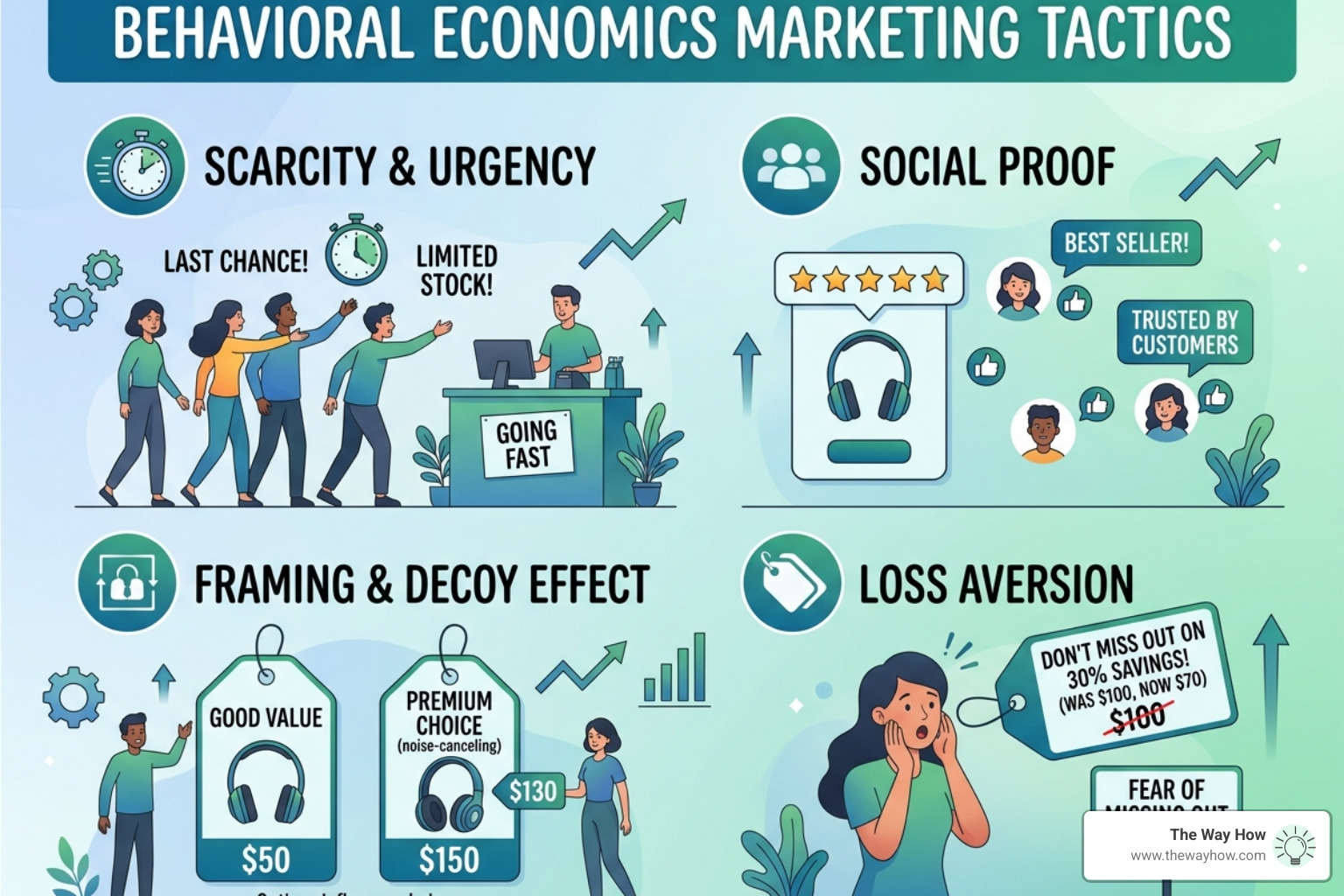
- Loss Aversion: This is the psychological principle that the pain of losing is twice as powerful as the pleasure of gaining. In marketing, this means a message like “Stop losing $100 a month on energy” often outperforms “Save $100 a month.” We are hardwired to protect what we have.
- Anchoring: Our brains rely heavily on the first piece of information offered (the “anchor”). If we see a $2,000 watch first, a $500 watch feels like a bargain. Without that anchor, $500 might feel expensive.
- Social Proof: When we are uncertain, we look to others. This is why 81% of consumers trust a company with many positive reviews, and 50% trust those reviews as much as a personal recommendation from a friend.
- Scarcity: Items become more attractive when their availability is limited. This triggers a fear of missing out (FOMO) and leverages loss aversion.
- Framing: How you say it matters as much as what you say. Describing a product as “90% fat-free” is far more effective than “10% fat,” even though the data is identical.
- The Endowment Effect: We value things more once we feel we own them. This is the “why” behind the success of free trials and “buy now, pay later” (BNPL) services, where consumers often spend 10% to 40% more because the sense of ownership is already established.
For a deeper look at how these intersect, check out this A Deep Dive into Marketing & Behavioral Economics or explore our specific guide on anchoring bias marketing.
Scaling Growth with Small-Budget Behavioral Economics Marketing Tactics
You don’t need a multi-million dollar budget to apply these principles. In fact, small businesses often have an advantage because they can iterate faster.
One of the most cost-effective tactics is Reciprocity. When we give something of value first—a high-quality guide, a free consultation, or a helpful tool—the recipient feels a subconscious urge to give back. This isn’t a transaction; it’s a social instinct.
Combine this with the endowment effect marketing strategy of offering a “freemium” model or a low-friction trial. Once a user invests time into setting up your software or customizing a profile, the psychological cost of “losing” that progress becomes a powerful retention tool. These neuromarketing techniques turn passive observers into active participants before they’ve even reached for a credit card.
Why Most Behavioral Economics Marketing Tactics Fail Without a System
The danger of behavioral economics is “tactic-spamming.” If you add a countdown timer, a “limited stock” badge, a “John from Texas just bought this” notification, and a 10% discount pop-up all at once, you haven’t created a nudge—you’ve created a headache.
This leads to choice overload and decision fatigue. In a famous jam tasting experiment, researchers found that while a display of 24 jams attracted more people, a display of only 6 jams led to sales that were five times higher. More choice does not equal more sales; it often equals more “I’ll think about it later.”
Effective psychology of marketing requires a system where each nudge supports the next, rather than competing for attention.
Beyond Hacks: Building a Systemic Choice Architecture
Choice architecture is the environment in which people make decisions. As marketers, we are the architects. Every button color, every line of copy, and every step in a checkout process is a design choice that either helps or hinders the buyer.
A classic example of successful choice architecture is the Decoy Effect. If you offer a Small coffee for $3 and a Large for $7, many will choose the Small. But if you introduce a Medium for $6.50, the Large suddenly looks like an incredible value. The Medium is the “decoy”—it exists only to make the Large look better.
By understanding the marketing framing effect guide, we can present options in a way that minimizes the “pain of payment.” For instance, breaking down a $1,200 annual subscription into “$100 per month” or even “$3.30 a day” changes the mental accounting from a major investment to a daily cup of coffee.
For more on how to structure these environments, see this guide on Utilizing Behavioral Economics: Psychological Tactics for Enhanced Marketing Strategies | SocialTargeter Blog.
The Power of Defaults and Nudges
The most powerful choice is the one the user doesn’t have to make. Defaults are pre-set options that take effect if the consumer does nothing. Because humans are prone to inertia, we rarely change the default.
In Austria, an organ donation policy based on “presumed consent” (where you are an organ donor unless you opt out) resulted in a 99% registration rate. In the United States, which uses an opt-in system, the rate was only 54%. The difference wasn’t a matter of culture or morality; it was the power of the default.
In your marketing, defaults can be used for newsletter sign-ups, subscription renewals, or “recommended” service tiers. When paired with loss aversion marketing, defaults create a sense of “pre-ownership” that users are reluctant to give up.
The Ethical Architect: Designing for Long-Term Trust
With great power comes the responsibility not to be a jerk. There is a fine line between a “nudge”—which helps a consumer make a choice that is in their best interest—and “sludge”—which uses these same principles to trick or trap them.
As David Ogilvy famously noted, “The consumer is not a moron; she is your wife.” If you use artificial scarcity (e.g., a “sale ends in 2 hours” timer that resets every time the page refreshes), the consumer will eventually find out. When they do, the trust is gone forever. This is known as the Backfire Effect.
Ethical marketing uses human psychology marketing ultimate guide principles to reduce friction and increase transparency. We use qualitative research to understand why a customer is hesitant and use behavioral insights to address that specific fear, rather than just shouting louder.
Measuring the Subconscious: The Future of Revenue Strategy
How do we know if these behavioral economics marketing tactics are actually working? We move beyond vanity metrics like “likes” and look at behavioral lift.
| Traditional KPI | Behavioral Metric | Why It Matters |
|---|---|---|
| Click-Through Rate (CTR) | Choice Consistency | Does the user stick with their choice over time? |
| Conversion Rate | Decision Velocity | How quickly does the user move from interest to action? |
| Total Revenue | Customer Lifetime Value (CLV) | Does the nudge build trust or just a one-time sale? |
| Cost Per Acquisition (CPA) | Campaign Responsiveness | Are users engaging more deeply with psychology-led ads? |
Companies utilizing behavioral segmentation report a 27% increase in campaign ROI. Furthermore, BE-based interventions can increase campaign responsiveness by up to 30% compared with standard marketing approaches.
As we look toward the rest of 2026, the integration of AI will allow for hyper-personalization. Imagine a landing page that adjusts its framing based on whether a user has historically responded better to “gain” messages or “loss avoidance” messages. This isn’t science fiction; it’s the current trajectory of revenue strategy.
For more on these future shifts, read The Marketing Forces or dive into our content marketing psychology ultimate guide.
Frequently Asked Questions about Behavioral Marketing
How does behavioral economics differ from traditional marketing?
Traditional marketing often assumes the buyer is a “Homo Economicus”—a perfectly rational being who weighs all facts. Behavioral economics recognizes that we use heuristics (mental shortcuts) to make decisions because we don’t have the time or mental energy to be perfectly rational 24/7. It focuses on the “why” behind the “what.”
Is nudging consumers ethical?
It depends on the intent. Richard Thaler coined the term “Libertarian Paternalism”—the idea that you can influence behavior to make people’s lives better (paternalism) while still respecting their freedom to choose (libertarian). If your nudge helps a customer find the right solution for their problem faster, it’s ethical. If it tricks them into a hidden fee, it’s not.
How do I measure the ROI of psychological tactics?
The best way is through A/B testing. Run your “standard” copy against copy designed with a specific behavioral principle (like social proof or framing). Look for a “conversion lift.” Personalized push notifications alone can improve conversion rates by up to 20%.
Restoring Momentum Through Behavioral Clarity
At The Way How, we don’t believe in chasing the latest trend. We believe in understanding the timeless mechanics of human decision-making. Whether we are acting as your Fractional CMO, building out your HubSpot architecture, or designing a demand generation engine, our goal is the same: to remove the uncertainty that stalls growth.
When you stop guessing what your customers want and start designing systems that align with how they behave, you create more than just sales—you create momentum.