

Beyond the Press Release: The Psychology of Public Trust

A strong public relations strategy is not about sending more press releases. It is about shaping how people feel about your organization — before they ever buy, partner, or invest.
Here is a quick answer if that is all you need:
What is a public relations strategy?
A public relations strategy is a structured, long-term plan for managing how your organization communicates with the public, media, employees, and stakeholders. It combines:
- Clear objectives tied to real business outcomes
- Target audience research to understand who you are reaching and why they care
- Core messaging that is consistent, credible, and simple
- Channel mix spanning earned, owned, shared, and paid media (the PESO model)
- Crisis protocols built before you need them
- Measurement frameworks that track reputation, not just press clippings
Most organizations assume their PR problem is execution. They need better pitches, more coverage, a bigger agency.
But the real problem is almost always upstream.
It is a trust architecture problem. People — journalists, customers, employees, investors — make decisions based on how certain they feel about your organization. If your messaging is inconsistent, your internal culture contradicts your external claims, or your strategy is built around announcements rather than relationships, no amount of media outreach will fix it.
The PRSA defines public relations as “a strategic communication process that builds mutually beneficial relationships between organizations and their publics.” Notice the word relationships. Not coverage. Not impressions. Relationships.
That distinction matters more in 2026 than it ever has. Respected media outlets have shrunk. Audiences are skeptical. And every person with a smartphone is now, in some sense, a publisher. The organizations winning on reputation are not the ones with the biggest PR budgets — they are the ones who understand the human on the other side of every message.
This guide walks you through every layer of that challenge, from strategic theory to practical execution.
I am Jeremy Wayne Howell, founder of The Way How, a psychology-first marketing and revenue strategy firm, and over 20 years of working directly with founders and revenue teams has shown me that most public relations strategy failures are not communication failures — they are clarity failures. That distinction shapes everything you will read here.
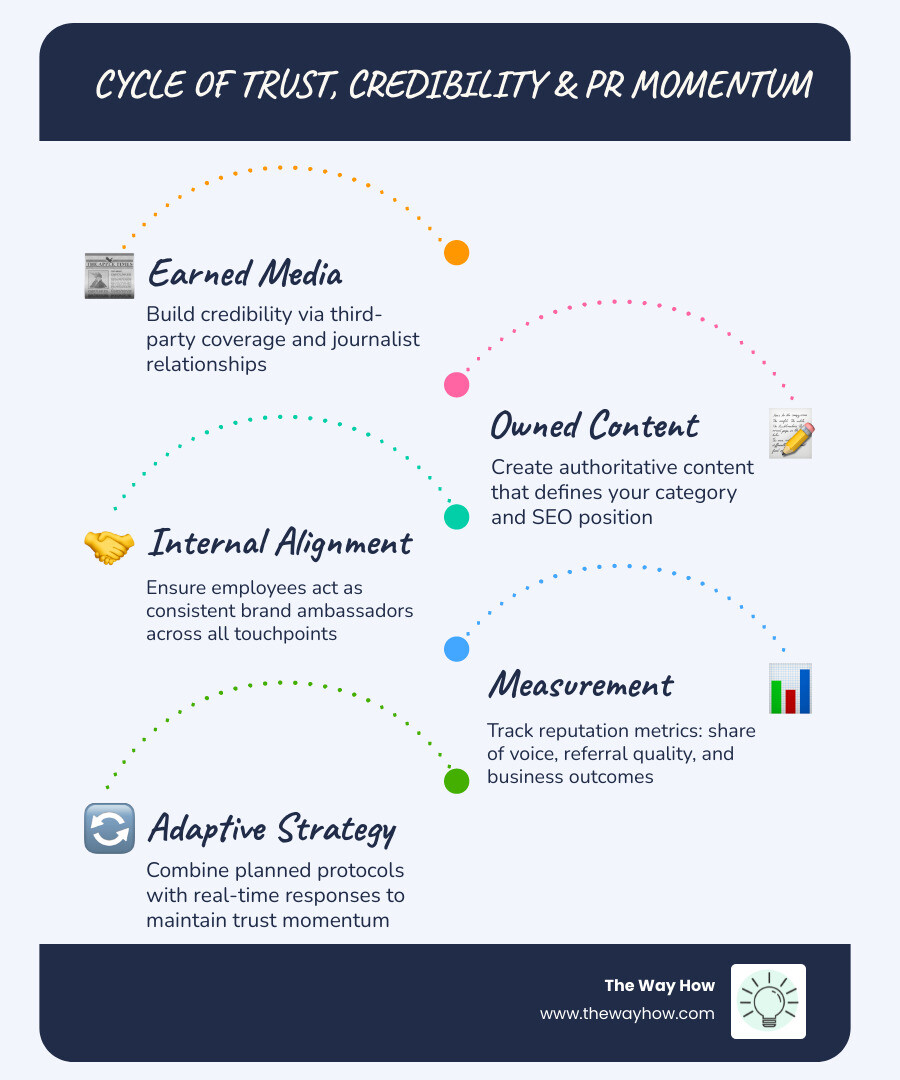
The Architecture of a Modern Public Relations Strategy
To build a strategy that actually moves the needle, we must first look inside the “black box” of how decisions are made. In the past, PR was often viewed through a purely prescriptive lens—a linear, deliberate planning process where a goal is set, a plan is written, and execution follows.
However, modern research suggests that the field needs both prescriptive and emergent approaches. While a Strategic Marketing Plan provides necessary guardrails, an emergent strategy allows an organization to adapt to real-time market shifts and the routine, non-deliberate activities of its people.
By adopting a “strategy-as-practice” lens, we stop looking at strategy as a document on a shelf and start seeing it as something an organization does. This perspective examines the social practices, practitioner socialization, and “action intelligibility”—the shared understanding of what counts as a strategic move within a specific industry. When we understand the “doing” of strategy, we can align our everyday actions with our long-term reputation goals.

Navigating the Four Modes of Public Relations Strategizing
In the daily life of a PR professional or a founder, strategizing manifests in four distinct modes. Understanding these helps us move between the “immersed” world of daily tasks and the “detached” world of high-level planning.
- Absorbed Strategizing: This is the “flow” state. It involves the routine, everyday activities where practitioners respond to situations intuitively based on their experience and socialization.
- Deliberate Strategizing: This occurs when we follow a pre-set plan or protocol. It is linear and focused on specific outputs.
- Deliberative Strategizing: This is reflective. It happens when something goes wrong or a new opportunity arises, forcing us to pause and consider our options before acting.
- Abstract Strategizing: This is the detached mode of formal planning sessions. It is where we create the frameworks that guide the other three modes.
To Run Effective Public Relations Campaigns: A 2026 Guide, you must balance these modes. If you only strategize in the abstract, your plan will fail to account for the messy reality of daily communication. If you are only in the absorbed mode, you are simply reacting to noise without a North Star.
From Earned Media to Owned Authority: The PESO Evolution
In 2026, the media landscape is a crowded room where everyone is shouting. Traditional earned media—coverage you didn’t pay for—remains vital because it provides third-party credibility. However, it is no longer the only pillar.
A modern public relations strategy leverages the PESO model: Paid, Earned, Shared, and Owned media.
We have seen a massive shift toward “Owned Authority.” Organizations are now publishers. By creating high-quality content, defining your own category, and establishing thought leadership, you gain complete control over your tone, quality, and cadence. This isn’t just about “content marketing”; it’s about creating a Demand Generation Strategy Complete Guide that positions your leadership as the go-to experts in your field.
When you own the narrative through white papers, data-backed articles, and executive insights, you also support your SEO authority. High-quality media placements that link back to your owned content act as powerful signals to search engines, boosting your visibility in both traditional search and the emerging world of AI-driven search (GEO).
The Human Element: Internal Alignment and Crisis Resilience
The most sophisticated PR strategy will crumble if your internal reality contradicts your external message. Employees are your most powerful brand ambassadors, but they are also the most savvy critics. Research shows that employees prefer to receive information from their direct supervisor rather than the CEO. Therefore, internal communication must be a cascade, not a broadcast.
When internal and external messaging align, you create a “human firewall” that protects your reputation. This is especially critical during a crisis.

Crisis management in 2026 is a blend of pre-planned protocols and real-time adaptive strategizing. We recommend identifying vulnerabilities early and creating “holding statements.” Statistics show that pre-prepared crisis messaging is often 75% applicable, saving critical time when the first hour of a response can define the narrative for weeks.
However, no protocol can cover every variable. Your team must be trained to use Effective Go-to-Market Strategies that allow for agility. You need the ability to process how an event impacts your image and shift communication in real-time without losing sight of your core principles.
Measuring What Matters: ROI and the Science of Reputation
If you cannot measure it, you cannot manage it. For too long, PR was measured by “clip counts” and “estimated media value”—metrics that rarely correlate with business growth.
In 2026, we follow the Barcelona Principles, which emphasize measuring outcomes over outputs. We look for:
- Share of Voice (SOV): How much of the conversation in your category do you own compared to competitors?
- Message Pull-Through: Are the media and the public actually repeating your core messages, or just mentioning your name?
- Referral Traffic and Lead Quality: Is your earned media driving qualified prospects to your site?
- Sentiment Analysis: Is the tone of the conversation shifting in your favor?
By aligning your public relations strategy with clear business objectives, you turn PR from a “nice-to-have” into a necessity. As The Complete Guide to Public Relations (2026) | AMW® notes, companies with strong reputations can see a significant correlation with higher market value. If you need help connecting these dots, Marketing Strategy Consulting can provide the data-driven framework needed to prove ROI.
Scaling Your Public Relations Strategy: In-House vs. Agency
A common question we encounter is whether to build an in-house team or hire an external agency. The answer depends on your scale and specific needs.
- In-House: Best for deep institutional knowledge, daily brand management, and tight integration with internal teams.
- Agency: Best for specialized expertise (like luxury or tech PR), broader media relationships, and the ability to scale resources quickly for a launch or crisis.
Many successful organizations use a hybrid model—an internal lead who manages the brand’s soul and an agency that provides the “arms and legs” for distribution and high-level strategy. Regardless of the path you choose, ensure you have the right tools in place. A B2B Marketing Automation Examples Guide can show you how to streamline the distribution of your owned content to support your PR efforts.
Frequently Asked Questions about Public Relations Strategy
What is the difference between prescriptive and emergent PR strategy?
Prescriptive strategy involves linear, deliberate planning often found in traditional corporate playbooks. It is the “plan your work and work your plan” approach. Emergent strategy, on the other hand, develops through the routine, non-deliberate activities of employees and managers responding to real-time market shifts. It is what actually happens when the plan meets reality. A healthy organization needs both: the prescriptive plan for direction and the emergent flexibility to adapt.
How can non-PR professionals contribute to a public relations strategy?
Employees and managers contribute to emergent strategy through daily social practices and interactions that shape public perception. Every time a customer service rep solves a problem, or a salesperson speaks at a conference, they are “doing” PR. When these routine actions are aligned with the organization’s values, employees effectively act as brand ambassadors whose daily behavior defines the organization’s actual reputation more than any press release ever could.
How should organizations balance pre-planned crisis protocols with real-time response?
Effective crisis management in 2026 requires pre-prepared messaging templates—which are typically 75% applicable—combined with the agility to perform real-time, adaptive strategizing as a situation evolves. The templates save critical time in the first hour, while the adaptive strategizing ensures the response is nuanced and relevant to the specific (and often unpredictable) details of the event.
Restoring Momentum Through Strategic Clarity
At The Way How, we believe that the root of most growth stalls isn’t a lack of effort, but a lack of certainty. When your public relations strategy feels disconnected from your revenue goals, or your messaging feels like “spin” rather than truth, it creates a friction that slows everything down.
We are a psychology-first marketing and revenue strategy firm. We don’t just look at the tactics; we diagnose the human behavior and decision-making psychology that drive your market. Whether it is through Fractional CMO leadership or redesigning your trust architecture, our goal is to help you remove uncertainty and turn your reputation into a dependable growth engine.
If you are ready to move beyond the “black box” of strategic decision-making and build a system that creates genuine trust and momentum, we invite you to Explore our strategic services.