
Beyond the Finger-Pointing: Why Your Revenue Engine Is Stalling
The PointAlignment means sales and marketing share the same goals, the same definition of an ideal customer and the same accountability for revenue. Misalignment is a systems problem, not a people problem.

What is sales and marketing alignment is one of the most searched — and most misunderstood — questions in B2B revenue strategy today. Here’s the short answer:
Sales and marketing alignment is the process of getting your sales and marketing teams to share the same goals, the same definition of an ideal customer, and the same accountability for revenue — so they operate as one unified growth engine instead of two competing departments.
At a glance:
- What it is: A shared system of goals, data, messaging, and accountability between sales and marketing
- What it replaces: Siloed teams chasing separate metrics (leads vs. quotas)
- Why it matters: Misaligned teams leak revenue between the first touch and the signed contract
- Core components: Shared ICP, unified KPIs, integrated data, clear lead handoffs, and regular communication
- Biggest obstacle: Poor communication, followed by inaccurate data and lack of accountability
Here’s a pattern that’s more common than most leaders want to admit.
Marketing ships a batch of leads. Sales calls them unqualified. Marketing says sales isn’t following up. Sales says the leads were never good to begin with. Nobody agrees on what “qualified” even means. And while the two teams debate, real buyers are moving on.
This isn’t a people problem. It’s a systems problem — and it’s costing B2B companies more than most realize. The bill shows up as lost productivity and wasted effort.
What’s more striking: in Forrester’s 2024 surveys, 82% of C-level executives said their product, sales and marketing teams were aligned, while 65% of sales and marketing professionals said their leaders lacked alignment. That gap — between perception and reality — is exactly where revenue quietly disappears.
The Truth About B2B Sales And Marketing Alignment. Forrester, 2024-10. Read the Source →The Truth About B2B Sales And Marketing Alignment. Forrester, 2024-10. Read the Source →The wall between these two functions is one of the oldest and most expensive problems in business. But it’s also one of the most fixable, once you understand what’s actually driving it.
I’m Jeremy Wayne Howell, founder of The Way How and a revenue growth strategist with over 20 years of experience helping founders and revenue leaders understand what is sales and marketing alignment at a systems level — and why most fixes fail because they address the symptoms instead of the cause. In the sections ahead, I’ll walk you through not just what alignment looks like, but why misalignment persists, and how to build a foundation that actually holds.
What is sales and marketing alignment in 2026?
The PointAt the heart of every aligned organization is a shared Ideal Customer Profile, so both teams target the same accounts with the same understanding of buyer behavior.
In the current landscape of April 2026, the definition of alignment has evolved. It is no longer just about “getting along” or having a weekly meeting. True alignment is a state of revenue unification. It is a strategic synchronization where both teams operate from a single shared reality, governed by integrated data and a deep understanding of human behavior.
Most of the research on sales and marketing alignment points the same way: teams that cooperate grow more predictably. This isn’t just about efficiency; it’s about survival. Modern B2B buyers now perform the vast majority of their research before ever speaking to a sales representative. If your marketing narrative doesn’t match the sales conversation, you create a “certainty gap” that kills deals before they start.
Achieving this requires a robust B2B Sales Strategy that treats the customer journey as a continuous loop rather than a linear hand-off. It is the art of ensuring that every touchpoint — from the first LinkedIn ad to the final contract signature — feels like it came from the same brain.
The shift from lead volume to revenue certainty
For decades, marketing was judged on lead volume. If they hit 1,000 Marketing Qualified Leads (MQLs), they “won,” regardless of whether those leads ever turned into a dollar of revenue. This created a fundamental disconnect.
In 2026, the industry has shifted toward quality over quantity. We focus on pipeline velocity and revenue certainty. Instead of celebrating a high volume of downloads, aligned teams celebrate the movement of high-intent prospects through the funnel. Understanding sales funnel optimization means recognizing that a smaller pool of highly qualified, psychologically ready buyers is worth more than a database full of “window shoppers” who will never close.
The role of shared ICP in what is sales and marketing alignment
At the heart of every aligned organization is a shared Ideal Customer Profile (ICP). This is not a static document hidden in a drive; it is a living, breathing definition of who the company serves best.
Misalignment often happens because marketing is targeting one persona (the “user”) while sales is trying to close another (the “economic buyer”). By collaboratively defining the ICP, both teams agree on the decision-making psychology of their target. We look at:
- What triggers their need for a solution?
- What are their specific fears or uncertainties?
- What does “success” look like for them emotionally and professionally?
When both teams target the same accounts with the same understanding of buyer behavior, the friction disappears.
The Psychology of Friction: Why Alignment Fails
The PointDifferent KPIs, managers and spaces make each team see the other as an obstacle. Regular feedback loops turn Us vs. Them into We vs. the Problem.
If alignment is so profitable, why do so few companies achieve it? The answer lies in the “Wall of Silence.”
Psychologically, humans are wired for “in-group” and “out-group” bias. When marketing and sales have different KPIs, different managers, and different physical (or digital) spaces, they naturally begin to view the other team as an obstacle rather than an ally. This leads to confirmation bias: a sales rep sees one bad lead and concludes “all marketing leads are trash,” while a marketer sees one ignored follow-up and concludes “sales is lazy.”
This friction is exacerbated by the “hand-off fallacy.” We often treat the transition from marketing to sales like a relay race where the baton is dropped into a dark void. Without a shared context, the buyer experiences a jarring shift in tone and information, leading to cognitive dissonance. To fix this, we must look at Sales Team Optimization Complete Guide to bridge the gap between lead generation and deal closure. You can also explore Align Marketing and Sales: A Complete Guide for more on breaking down these structural walls.

Overcoming the “Us vs. Them” mentality
Breaking the cycle of blame requires more than a “kumbaya” session. It requires internal empathy and structural accountability.
We recommend implementing regular communication loops where marketing listens to sales calls and sales provides real-time feedback on lead quality. This isn’t about policing; it’s about understanding the “frontstage” reality of the buyer. When marketing hears the specific objections a prospect raises, they can create content that addresses those objections before the sales call even happens. This type of Sales Enablement Training turns the “Us vs. Them” dynamic into a “We vs. the Problem” strategy.
A 7-Step Framework to Restore Momentum and Certainty
The PointDefine what an MQL, SQL and Opportunity mean, set follow-up SLAs, share North Star metrics, and give both teams a single source of truth.
Restoring momentum isn’t about working harder; it’s about working in sync. Based on our research and the Sales And Marketing Alignment: 7 Steps To Get It Right framework, here is how we recommend building a unified engine:
- Strategic Planning: Co-create the yearly and quarterly revenue goals.
- Unified ICP: Agree on exactly who you are (and are not) targeting.
- Shared Language: Define exactly what an MQL, SQL, and “Opportunity” means.
- Service Level Agreements (SLAs): Define how fast sales will follow up and how marketing will nurture “not yet ready” leads.
- Integrated Tech Stack: Ensure data flows bi-directionally between your marketing tools and CRM.
- Feedback Cadence: Hold bi-weekly “Smarketing” meetings to review pipeline health.
- Joint Content Creation: Sales provides the “objections,” marketing provides the “solutions.”
This framework ensures your Lead Generation Strategy is directly tied to what sales actually needs to close deals. For those using specific platforms, a Hubspot Sales Hub Implementation can often serve as the technical foundation for these steps.
Defining shared goals and KPIs for what is sales and marketing alignment
The fastest way to align two teams is to give them the same paycheck. While we don’t necessarily mean changing commission structures, we do mean sharing North Star metrics.
If marketing is only measured on “leads,” they will find the cheapest leads possible. If they are measured on Customer Lifetime Value (CLV) or “Marketing Influenced Revenue,” their behavior changes. Aligned teams should track:
- Win rates of marketing-sourced vs. sales-sourced deals.
- Average deal size.
- Pipeline velocity (how fast a lead turns into cash).
- Outbound Marketing Leads conversion effectiveness.
Integrating technology to support what is sales and marketing alignment
Technology should be the bridge, not the barrier. A “single source of truth” is essential. In our work at The Way How, we often find that the biggest source of friction is simply that sales is looking at one set of data in the CRM while marketing is looking at another in their automation tool.
By focusing on a unified Hubspot Marketing architecture, you ensure that when a prospect interacts with a piece of content, the sales rep sees it instantly. This allows for “warm” outreach that feels helpful rather than intrusive. AI-driven insights can further support this by predicting which leads are most likely to close based on behavioral triggers, allowing both teams to prioritize their efforts effectively.
Measuring Maturity: From Strategic Silos to Revenue Unification
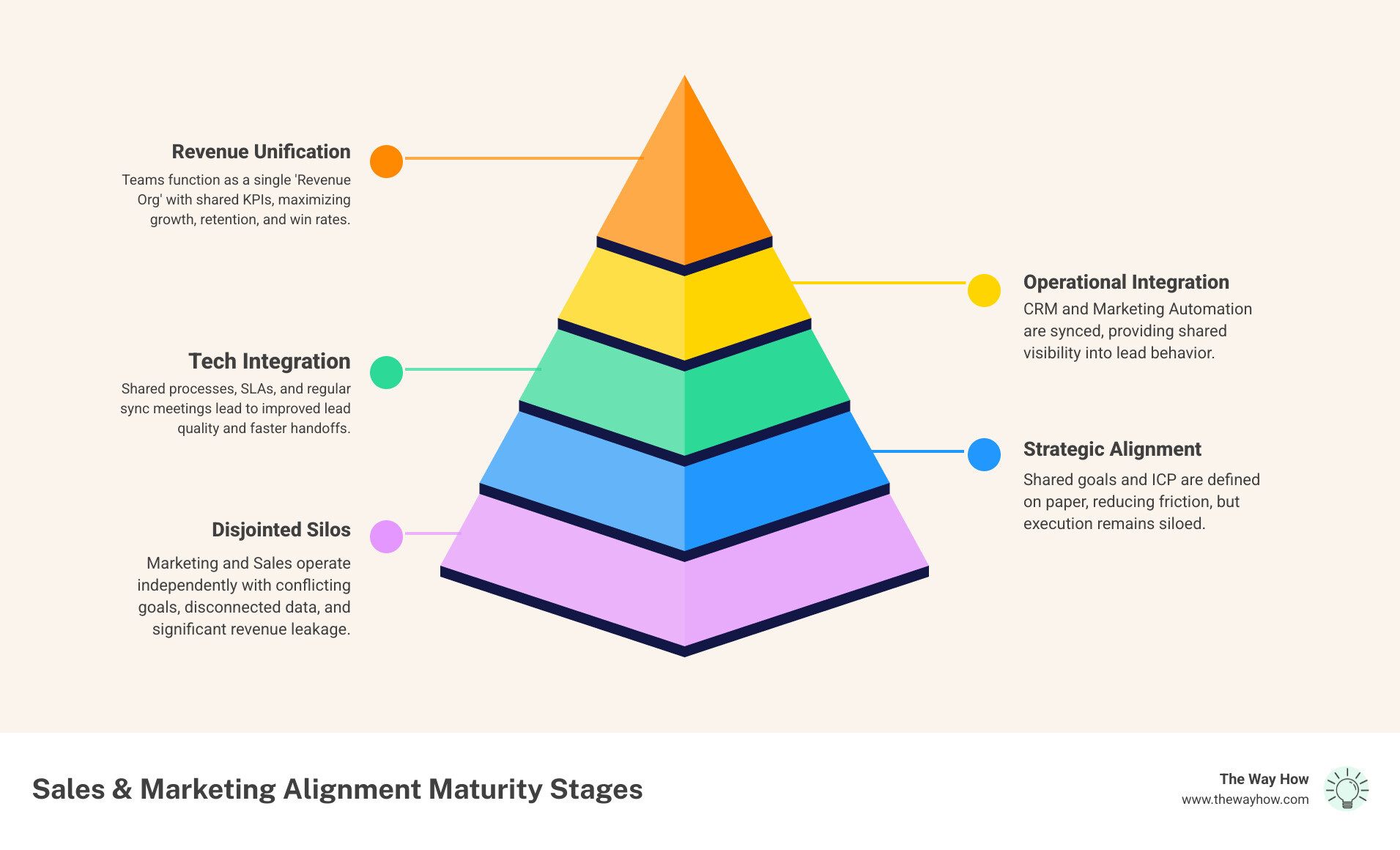
Alignment is a journey, not a destination. According to The Four Stages of Marketing and Sales Alignment | cx, organizations typically move through these levels:
| Stage | Characteristics | Outcome |
|---|---|---|
| 1. Strategic Alignment | Shared goals and ICP defined on paper. | Reduced friction, but execution is still siloed. |
| 2. Tech Integration | CRM and Marketing Automation are synced. | Shared visibility into lead behavior. |
| 3. Operational Integration | Shared processes, SLAs, and regular sync meetings. | Improved lead quality and faster handoffs. |
| 4. Revenue Unification | Teams function as a single “Revenue Org” with shared KPIs. | Maximized growth, stronger retention and better win rates. |
The impact of alignment on the bottom line
The financial argument for alignment is strong. SiriusDecisions (now part of Forrester) reported in 2013 that 60% to 70% of the content B2B marketing teams produce goes unused. When sales actually uses what marketing creates, and stops spending time on leads that will never convert, your cost of acquisition plummets.
It's Not Content: It's a Lack of Buyer Insights That's the Problem. SiriusDecisions (Forrester), 2014-01. Read the Source →If you are unsure where your organization sits on this spectrum, Marketing Strategy Consulting can help diagnose the specific certainty gaps that are stalling your growth.
Frequently Asked Questions about Alignment Basics
How long does it take to see results from alignment?
Initial improvements in lead quality and team communication often appear within 3 to 6 months. However, a full cultural and psychological transformation — where the teams truly operate as one — typically requires 12 to 18 months of consistent operational execution.
Who should own the sales and marketing alignment process?
While executive sponsorship from a CEO or CRO is vital for resource allocation, the most successful organizations treat alignment as a shared responsibility. Often, a Revenue Operations (RevOps) function acts as the neutral party that manages the data and processes between the two departments.
What is the primary cause of misalignment?
Misalignment is rarely a “people problem”; it is a systems problem. It usually stems from three things: disconnected data, conflicting incentives (volume vs. value), and the lack of a shared, psychologically-grounded definition of the ideal customer.
Turning Uncertainty into Predictable Growth
At The Way How, we believe that B2B growth isn’t just about tactics; it’s about psychology. When your sales and marketing teams are misaligned, you aren’t just losing money — you are creating uncertainty for your buyers. And in 2026, uncertainty is the ultimate deal-killer.
We help founders and leadership teams remove that uncertainty by designing systems rooted in human behavior and empathy. By shifting the focus from “how do we sell more” to “how do we help our buyer decide with certainty,” we turn marketing and sales into a dependable, unified growth engine.
If your revenue engine is stalling and you’re tired of the finger-pointing, it’s time to bridge the gap.