
Beyond the Hype: Why Your Tech Stack Feels Like a Burden
The PointFor YouThe best tools are the ones your team will actually use, that connect to the tools you already have, and that grow with you. The tool is rarely the problem.

The best marketing automation tools for small business are not the ones with the longest feature list — they’re the ones your team will actually use, that connect to the tools you already have, and that grow with you without punishing you financially.
Here’s a quick answer if that’s all you need:
| Tool | Best For | Starting Price |
|---|---|---|
| ActiveCampaign | Automation + CRM suite | See current pricing |
| HubSpot Marketing Hub | Scalability + ecosystem | From $20/seat/mo (Starter, as of October 2026) |
| Brevo | Budget-conscious startups | Free (as of October 2026); see paid plans |
| Omnisend | E-commerce brands | Free; from $16/mo (as of October 2026) |
| EngageBay | Startups needing full suite free | Free up to 15 users (as of October 2026) |
| Klaviyo | E-commerce segmentation | Free up to 250 active profiles (as of October 2026) |
| Zoho CRM | Integrations + affordability | Free for 3 users (as of October 2026); see paid plans |
But here’s what most comparison articles won’t tell you: the tool is rarely the problem.
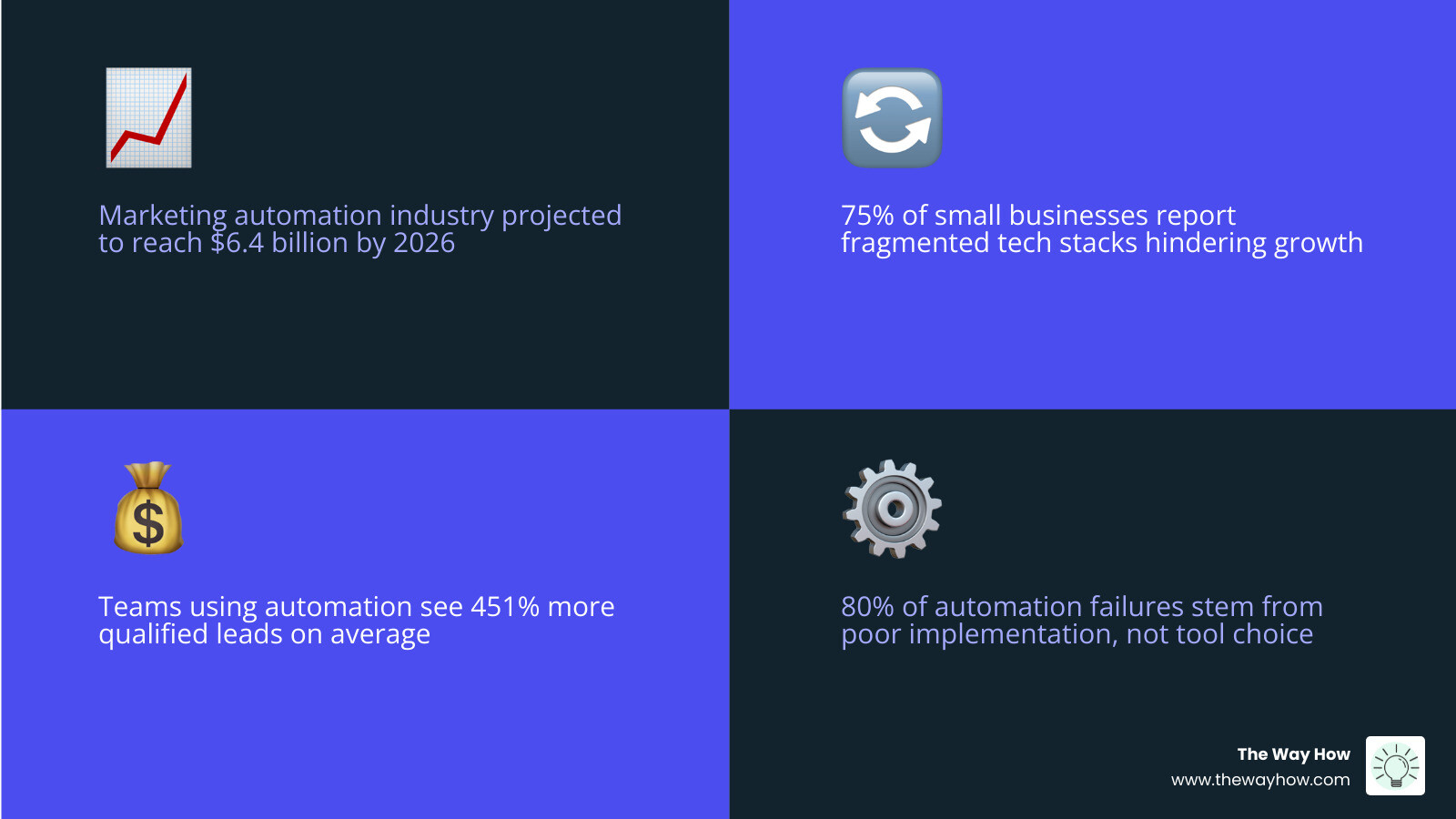
Small business founders buy software hoping it will create momentum. Instead, they end up with a fragmented tech stack, low adoption, and the quiet suspicion that they’re paying for something that isn’t working. A 2021 industry forecast put the global marketing automation market at $6.3B by 2026, and plenty of that spend will never show a measurable return.
Global Marketing Automation Market to Reach $6.3 Billion by 2026. ReportLinker (GlobeNewswire release), 2021-10. Read the Source →That’s not a technology problem. It’s a clarity problem.
Before you evaluate any platform, the more honest question is: do you know exactly what behavior you’re trying to automate, and why it matters to your buyer?
This article cuts through the noise. It draws on peer-reviewed data from Gartner Peer Insights, real Reddit discussions from practitioners in the field, and hands-on tool analysis — so you can make a decision grounded in reality, not vendor marketing.
I’m Jeremy Wayne Howell, a revenue growth strategist with over 20 years of experience helping founders build marketing and sales systems that actually convert — including hands-on implementation of the best marketing automation tools for small business across dozens of go-to-market engagements. If you’ve ever felt like your tools are working on paper but revenue isn’t moving, you’re exactly who this is written for.
The Psychology of Choice: Why Small Businesses Struggle with Automation
When we talk to founders at The Way How, we often find that the struggle with automation isn’t about technical skill—it is about a lack of certainty. Choosing a tool feels like a high-stakes commitment. You worry that if you pick the wrong one, you will be trapped in a “success tax” where your costs skyrocket just as your business finally starts to grow.
This uncertainty leads to two common behaviors: over-buying or under-utilizing.
Many small businesses buy enterprise-grade tools because they want to “feel” like a big company, only to realize they lack the internal resources to manage the complexity. Others stick with basic email blast tools because they are afraid of the learning curve, missing out on the revenue-driving power of behavioral triggers.
At the heart of empathy-driven marketing is the understanding that your customer is on a journey. Automation should not be used to “blast” them; it should be used to remove friction from that journey. When you align your tech stack with Small Business Growth Strategies, you stop chasing tactics and start building systems that create trust.
Effective Small Business CRM & Automation | Keap allows you to show up for your customers at exactly the right moment, without you having to manually send every message. It restores momentum by ensuring no lead falls through the cracks, which is the ultimate goal of any strategic revenue engine.
Selecting the best marketing automation tools for small business
The PointFor YouFocus on the boring stuff that drives ROI: data hygiene, lead scoring and multi-channel orchestration. If your data is messy, automation only helps you make mistakes faster.
Identifying the best marketing automation tools for small business requires looking past the flashy UI and focusing on the “boring” stuff that actually drives ROI: data hygiene, lead scoring, and multi-channel orchestration.
If your data is messy, automation will only help you make mistakes faster. You need a tool that makes it easy to capture, segment, and clean your contact list. From there, look for these essential features:
- Visual Workflow Builders: You should be able to see the customer journey. If you cannot map out the “if-this-then-that” logic visually, the system becomes a “black box” that is impossible to troubleshoot.
- Lead Scoring: Not every lead is ready to buy. A good tool helps you identify “hot” leads based on their behavior—like opening specific emails or visiting pricing pages—so your sales efforts are focused where they matter most.
- Integrations: Your automation tool must talk to your CRM, your website, and your e-commerce platform. Without these connections, you end up with siloed data and a disjointed customer experience.
Reviewing Marketing Automation Software Examples can help you visualize how these features come together. For those on a tight budget, Marketing Automation Software for Small Businesses | EngageBay provides a comprehensive suite that includes CRM, marketing, and service tools in one place, which is often easier for small teams to manage than a “cobbled together” stack.
Why ActiveCampaign is the best marketing automation tools for small business
ActiveCampaign is frequently cited on Reddit and in professional circles as the “goldilocks” of automation—powerful enough for complex needs but accessible enough for a team of one. It serves over 180,000 customers in 170+ countries, according to ActiveCampaign, and it has a strong reputation for deliverability.
About ActiveCampaign. ActiveCampaign, 2026-10. Read the Source →What sets it apart is its focus on “Active Intelligence.” It doesn’t just send emails; it uses machine learning to predict the best time to send a message or to identify which content is most likely to convert a specific contact. This helps small teams “punch above their weight” by automating the kind of personalization that usually requires a large marketing department.
For a scaling business, Marketing Automation Software for Small Businesses | ActiveCampaign offers a predictable path. Their current pricing scales with your contact count, and it is among the more affordable ways to get predictive sending and split testing.
Is HubSpot the best marketing automation tools for small business
HubSpot is the undisputed heavyweight in the room. Its reviews on Gartner Peer Insights are worth reading before you buy. Its greatest strength is its all-in-one architecture—your marketing, sales, and service data all live in the same place.
However, for small businesses, HubSpot can be a double-edged sword. While the Starter tier is affordable, Professional starts at $800 to $890/mo depending on billing, plus a required $3,000 onboarding fee (as of October 2026).
Marketing Hub pricing. HubSpot, 2026-10. Read the Source →If you plan to scale rapidly and want a tool that you will never “outgrow,” this is likely your best bet. We recommend checking out our Marketing Automation Hubspot Guide or exploring Hubspot For Small Businesses to see if the investment aligns with your current revenue stage.

Alternative Platforms for Specific Business Models
Not every business needs a massive CRM-integrated platform. Depending on your model, a specialized tool might serve you better:
- Brevo (formerly Sendinblue): Excellent for startups. They offer a generous free plan (automation for up to 2,000 contacts, as of October 2026), and pricing is based on email volume rather than list size, which is a huge advantage if you have a large list but send infrequently.Brevo: see all features and compare plans. Brevo, 2026-10. Read the Source →
- Omnisend & Klaviyo: If you run an e-commerce shop, these are the industry standards. They feature deep, native integrations with Shopify and WooCommerce, allowing you to automate “abandoned cart” sequences and “back in stock” alerts with almost zero technical setup.
- Zoho CRM: A favorite for those who love a “best-of-breed” approach. It is highly rated for its integration capabilities and offers an inexpensive entry point for businesses that need a solid CRM foundation before they dive into heavy marketing automation.
When comparing these, always look at ActiveCampaign’s pricing as a benchmark for what you should expect to pay as your list grows from 2,500 to 10,000 contacts.
Scaling Without the Success Tax: A Pricing Reality Check
The PointFor YouLook past the Starting At price to what the tool will cost you in 12 to 24 months, before a contact limit or a Pro feature makes the price jump.
One of the biggest mistakes small businesses make is looking only at the “Starting At” price. You need to look at what the tool will cost you in 12 to 24 months.
| Tool | Price at 2,500 Contacts | Price at 10,000 Contacts | Key “Hidden” Cost |
|---|---|---|---|
| ActiveCampaign | See pricing | See pricing | CRM features are add-ons |
| HubSpot | About $120/mo (Starter, 1 seat, as of October 2026) | About $1,300 to $1,390/mo (Pro, as of October 2026) | Required onboarding ($3,000, as of October 2026) |
| Brevo | See pricing | See pricing | Feature limits on lower tiers |
| Omnisend | See pricing | See pricing | SMS credits cost extra |
The “Success Tax” happens when a platform lures you in with a free or entry plan, and the moment you hit a contact threshold or need a “Pro” feature like A/B testing or lead scoring, the bill multiplies.
Before committing, ask about:
- Onboarding Fees: Some platforms require you to pay for a “success coach” or setup fee.
- Contact Limits: Do they charge you for “unsubscribed” contacts still in your database? (ActiveCampaign and HubSpot generally don’t, but others might).
- Integration Fees: Does it cost extra to connect to the tools you already use?
Avoiding the Complexity Trap: Common Implementation Failures
The PointFor YouAutomation fails when the implementation is too ambitious. Clean your data first, start with 1 workflow, invest in training, and align sales and marketing.
We have seen many businesses fail with automation not because the tool was bad, but because the implementation was too ambitious. This creates “technical debt”—a system so complex that no one knows how it works, and everyone is afraid to touch it.
To avoid this, follow an incremental approach:
- Clean Your Data First: Do not import 5,000 dead leads. Use a data cleansing tool to ensure you are starting with a healthy list. This protects your deliverability and your budget.
- Start with One Workflow: Do not try to automate the entire customer journey on day one. Start with a simple “Welcome Sequence” for new leads. Once that is working and generating revenue, move to the next step.
- Invest in Training: Even “no-code” tools have a learning curve. Budget time (and perhaps a little money) for your team to actually learn the logic of the platform.
- Align Your Stakeholders: Ensure sales and marketing agree on what a “qualified lead” looks like before you set up lead scoring. If the two teams aren’t aligned, automation will only create friction between them.
Frequently Asked Questions About Small Business Automation
What is the difference between a CRM and marketing automation?
Think of a CRM (Customer Relationship Management) as a digital filing cabinet for your sales team—it tracks individual interactions, deals, and notes. Marketing automation is the engine that handles the early stages of the relationship at scale. It sends the emails, tracks the website clicks, and “nurtures” the lead until they are ready to talk to a human. Today, many of the best marketing automation tools for small business (like HubSpot and ActiveCampaign) combine both into one platform.
Can small businesses use these tools without a technical team?
Yes. Most modern platforms use “drag-and-drop” interfaces and “automation recipes.” These recipes are pre-built templates for common tasks like “Recover Abandoned Cart” or “New Subscriber Welcome.” You don’t need to know how to code; you just need to be able to follow a logical flow.
Which tool offers the best free plan for startups?
Brevo and EngageBay offer some of the most robust free plans. Brevo is excellent if you have a large list but only send a few emails a month. EngageBay is better if you need a full CRM and support suite for a small team (free for up to 15 users as of October 2026).
EngageBay pricing plans. EngageBay, 2026-10. Read the Source →Restoring Momentum: From Tool Collection to Growth Engine
At The Way How, we believe that marketing should be a dependable growth engine, not a source of stress. If you find yourself constantly “fighting” with your software or wondering why your expensive tools aren’t producing leads, the problem might not be the software—it might be the strategy behind it.
We help founders and leadership teams remove uncertainty by diagnosing why growth has stalled. Whether through Fractional CMO leadership or expert HubSpot architecture, we focus on the psychology of the buyer to design systems that create trust and momentum.
If you are ready to stop chasing tactics and start building a revenue system that works, explore our growth services. We see the problem clearly before we ever talk about solutions.