
The Paradox of the Invisible Expert

The Consultant’s Guide to Marketing Strategies for Consultancy Services
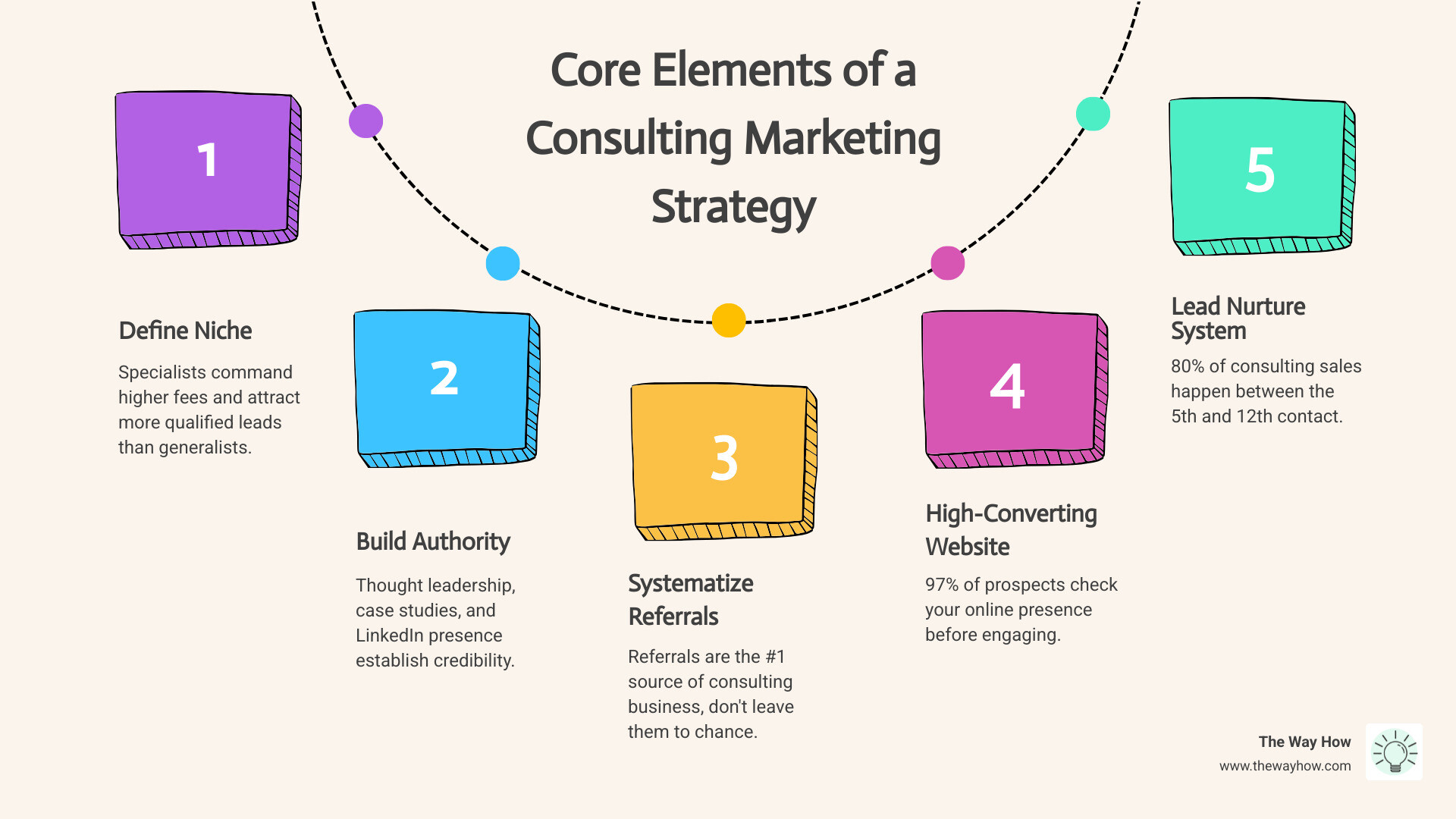
A strong marketing strategy for consulting services typically includes these core elements:
- Define your niche — Specialists consistently command higher fees and attract more qualified leads than generalists
- Build authority signals — Thought leadership content, case studies, and LinkedIn presence establish credibility before the first conversation
- Systematize referrals — Referrals are the #1 source of consulting business, but most consultants leave them to chance
- Create a high-converting website — 97% of prospects check your online presence before engaging
- Develop a lead nurture system — 80% of consulting sales happen between the 5th and 12th contact
- Measure revenue metrics — Track qualified calls and proposal conversion rates, not vanity metrics
- Invest consistently — Consultants who market daily are 52% more likely to work with six or more clients per year
Here is the core tension most consultants face: you are deeply skilled at solving complex problems for others, but marketing your own expertise feels fundamentally different from the work itself.
You know you are good at what you do. Your past clients know it too. But somewhere between the work and the market, the signal gets lost.
The consulting industry is on track to reach $471 billion by 2031. Demand is not the problem. Yet 70% of consultants generate zero leads per month from their website, and 40% invest $5,000 or less annually in marketing. The gap between expertise and visibility is wide — and costly.
Most consultants don’t have a lead problem. They have a leverage problem.
They rely on referrals that arrive unpredictably, pursue tactics without a coherent strategy, and market reactively — only when business slows down. The result is a feast-or-famine cycle that no amount of hustle can permanently fix.
What actually fixes it is structure. A clear system that makes your expertise visible, builds trust before the first conversation, and generates demand whether you are actively selling or not.
I’m Jeremy Wayne Howell, founder of The Way How and a revenue growth strategist with over 20 years of experience building psychology-first go-to-market systems — and developing a marketing strategy for consulting services that converts authority into predictable revenue is exactly where this work lives. This guide will show you how to diagnose what is actually stalling your growth and build a marketing system designed around how buyers think, not just what channels are trending.
Marketing strategy for consulting services vocabulary:
Engineering a Marketing Strategy for Consulting Services That Scales
In the high-stakes landscape of April 2026, we find that most consulting firms struggle because they treat marketing as an expense rather than infrastructure. To build a marketing strategy for consulting services that actually scales, we must move away from “hoping for the best” and toward a revenue blueprint grounded in math and psychology.
We often start by calculating what we call “Magic Numbers.” This is a simple reverse-engineering of your goals. If your monthly revenue target is $50,000 and your average project value is $10,000, you need five new clients a month. If your closing rate from discovery calls is 25%, you need 20 qualified conversations. The question then becomes: what specific systems are in place to generate those 20 conversations every single month?
A truly integrated system connects your positioning, your offer structure, and your client acquisition into a single engine. When these are misaligned, you work harder for smaller checks. When they are aligned, your authority does the heavy lifting for you.
For more depth on this, you can explore our Strategic Marketing Plan or refer to this Practical Guide to Growing Your Practice (2026).
Diagnosing the Leverage Problem
The “Referral Trap” is perhaps the most common ailment we see in consultancy. Referrals are wonderful because they come with built-in trust, but they are also passive. You cannot turn a dial to get more of them when you need them. This leads to the feast-or-famine cycle where you are too busy to market when you have work, and too desperate to be strategic when you don’t.
We help firms transition to Sustainable Revenue Growth by systematizing lead generation. This means building assets—like a content library or an automated email nurture sequence—that work 24/7. Predictable revenue is not about luck; it is about engineering a system that removes the uncertainty from where your next client is coming from.
Defining the Ideal Client Profile
Generic marketing is the fastest way to become invisible. If you help “small businesses grow,” you are competing with everyone. If you help “PE-backed industrial manufacturers increase EBITDA by 15% through leadership accountability,” you have no competition.
We define an Ideal Client Profile (ICP) by looking at decision-making behavior and urgent pain points. Who feels the pain you solve most acutely? Who has the budget and authority to act right now? Understanding the psychology of your buyer allows you to craft a Go-to-Market Strategy that speaks directly to their internal narrative.
Bridging the Certainty Gap with Niche Authority and Positioning

In a world increasingly influenced by AI, surface-level expertise is being commoditized. To stay relevant, consultants must embrace hyper-specialization. This is how you “AI-proof” your business. AI can summarize general knowledge, but it cannot replicate the deep, nuanced perspective of a specialist who has solved a specific problem a hundred times.
Your positioning should be a “Magnetic Message.” A simple formula we use is: “I help [WHO] to [solve WHAT] so they can [achieve WHAT result].” This clarity bridges the certainty gap for prospects. They aren’t just looking for a consultant; they are looking for the shortest, safest path to a specific outcome.
You can find more on this in our guide to Brand Strategy Consulting Services or this resource on Building Authority & Attracting Clients.
The Role of LinkedIn in Your Marketing Strategy for Consulting Services
LinkedIn is the non-negotiable town square for B2B consultants. Research shows it generates 80% of all B2B leads from social media. However, the goal is not to go viral; it is to build a “Content Compound Effect.”
Consistent, thoughtful posts—3 to 5 times per week—establish you as a familiar expert. We prioritize engagement over raw numbers. Twenty comments from your ideal buyers are worth more than ten thousand likes from people who will never hire you. By sharing your methodology and client wins, you humanize your expertise and build trust at scale.
Demonstrating Perspective Through Content
Clients don’t buy packages; they buy perspective. Your content should reflect an educational tone rather than a promotional one. We recommend creating “Pillar Content”—in-depth reports, white papers, or frameworks—that solve a real problem for your audience.
This type of Demand Generation Strategy works because it provides value before asking for a check. When you give away your best ideas for free, you don’t lose business; you prove that your “how” is worth paying for.
Turning Trust into Revenue with Behavioral Lead Generation

Marketing for consultants is about building a bridge of trust. Because consulting services are high-stakes and high-cost, buyers rarely act on impulse. They deliberate, compare, and seek social proof.
Our approach to Client Acquisition Funnels is rooted in empathy. We understand that a prospect is often moving from a state of anxiety (the problem) to a state of hope (your solution). Every touchpoint in your marketing—from the first LinkedIn post to the final proposal—should reinforce that they are in safe, capable hands.
Systematizing the Referral Engine
While referrals shouldn’t be your only strategy, they should be your most efficient one. Most consultants wait for referrals to happen; we suggest you make them happen. This involves formalizing the process: asking for referrals at the “peak of excitement” (usually right after a successful milestone) and nurturing a network of strategic partners.
Complementary partners—such as an IT consultant partnering with a cybersecurity expert—can provide a steady stream of B2B Lead Generation. By providing reciprocal value, you create a self-sustaining ecosystem of warm introductions.
High-Converting Sales Assets
In the final stages of the journey, your marketing assets must do the heavy lifting. Generic brochures are out. Outcome-driven case studies are in. A great case study follows a simple arc: the specific problem, the unique process you used, and the quantifiable result.
We also advocate for “Executive Briefings” or ROI calculators. These tools help a prospect justify the investment to their internal stakeholders. When you provide the logic and the data, you make it easy for them to say yes. You can see more on this in our Sales Strategy for Consulting Firms.
Measuring What Matters to Optimize Performance
If you cannot measure it, you cannot improve it. However, many consultants get distracted by vanity metrics like website traffic or social media followers. While these are nice, they don’t pay the bills.
| Vanity Metrics | Revenue Metrics |
|---|---|
| Website Hits | Qualified Discovery Calls |
| Social Media Likes | Proposal Conversion Rate |
| Email Open Rates | Average Engagement Value |
| Follower Growth | Customer Acquisition Cost (CAC) |
We use HubSpot architecture to track the entire journey. This allows us to see exactly which marketing activities are driving actual revenue. For a deeper dive into this, check our Revenue Operations Strategy.
Optimizing the Digital Footprint of Your Marketing Strategy for Consulting Services
Your website is your 24/7 sales representative. If it is slow, confusing, or looks like it was built in 2015, it is costing you money. Technical SEO and mobile optimization are basic requirements in 2026.
More importantly, your site needs to be optimized for conversion. Every page should have a clear call to action (CTA). Whether it’s “Book a Consultation” or “Download the Industry Report,” you must guide the visitor to the next step. Our Web Marketing Strategist services focus on turning passive visitors into active leads.
The Role of Fractional Leadership in Scaling
Many consultants reach a ceiling where they are too busy doing the work to manage the marketing. This is where fractional leadership becomes a game-changer. A Fractional CMO provides the strategic oversight of a full-time executive at a fraction of the cost.
We diagnose why growth is stalled and implement the systems needed to restore momentum. This allows the founder to focus on their zone of genius—delivering world-class consulting—while the marketing engine runs on autopilot. Learn more in our Fractional CMO Guide.
Frequently Asked Questions about Consultant Marketing
How much should a consulting business invest in marketing?
While 40% of consultants spend less than $5,000 a year, those earning six or seven figures typically reinvest 8% to 12% of their annual revenue back into marketing. We view this as infrastructure, not an expense. Just as you wouldn’t run a factory without maintaining the machines, you shouldn’t run a consultancy without maintaining your lead generation engine. For more on this, see Small Business Growth Strategies.
Should I choose a generalist or specialist approach?
Specialization is almost always the more profitable path. Specialists can charge premium prices because they provide “niche mastery.” When a client has a $100,000 problem, they don’t want a generalist; they want the person who has solved that exact $100,000 problem before. Specialization is the ultimate form of Marketing Strategy Consulting.
What role does insurance play in marketing efforts?
It might seem odd to include insurance in a marketing guide, but in consulting, insurance is a trust signal. It demonstrates professionalism and risk mitigation. When you can show a prospect that you are fully covered, you remove one more “certainty gap” in their mind. It says you are a serious, established professional who takes their responsibilities seriously.
Restoring Momentum to Your Growth Engine
At The Way How, we believe that a marketing strategy for consulting services should be as rigorous and thoughtful as the consulting work itself. We don’t believe in chasing the latest social media trend or using “hacky” sales tactics. Instead, we focus on the fundamental psychology of how humans make decisions and build trust.
If your growth has stalled, it is likely because there is a gap in your system—a place where prospects are losing certainty or where your expertise has become invisible. Our work is to find those gaps and bridge them with behavioral insight and operational excellence.
We help you turn marketing from a source of stress into a dependable growth engine. Whether you need a Fractional CMO to lead the way or a complete overhaul of your demand generation strategy, we are here to help you restore momentum.
Ready to see your business more clearly? Explore Our Consulting Services and let’s build something predictable together.