A Complete Guide to CRM Systems and Database Management
 Jeremy Wayne Howell : Jul 22, 2026 9:48:31 PM
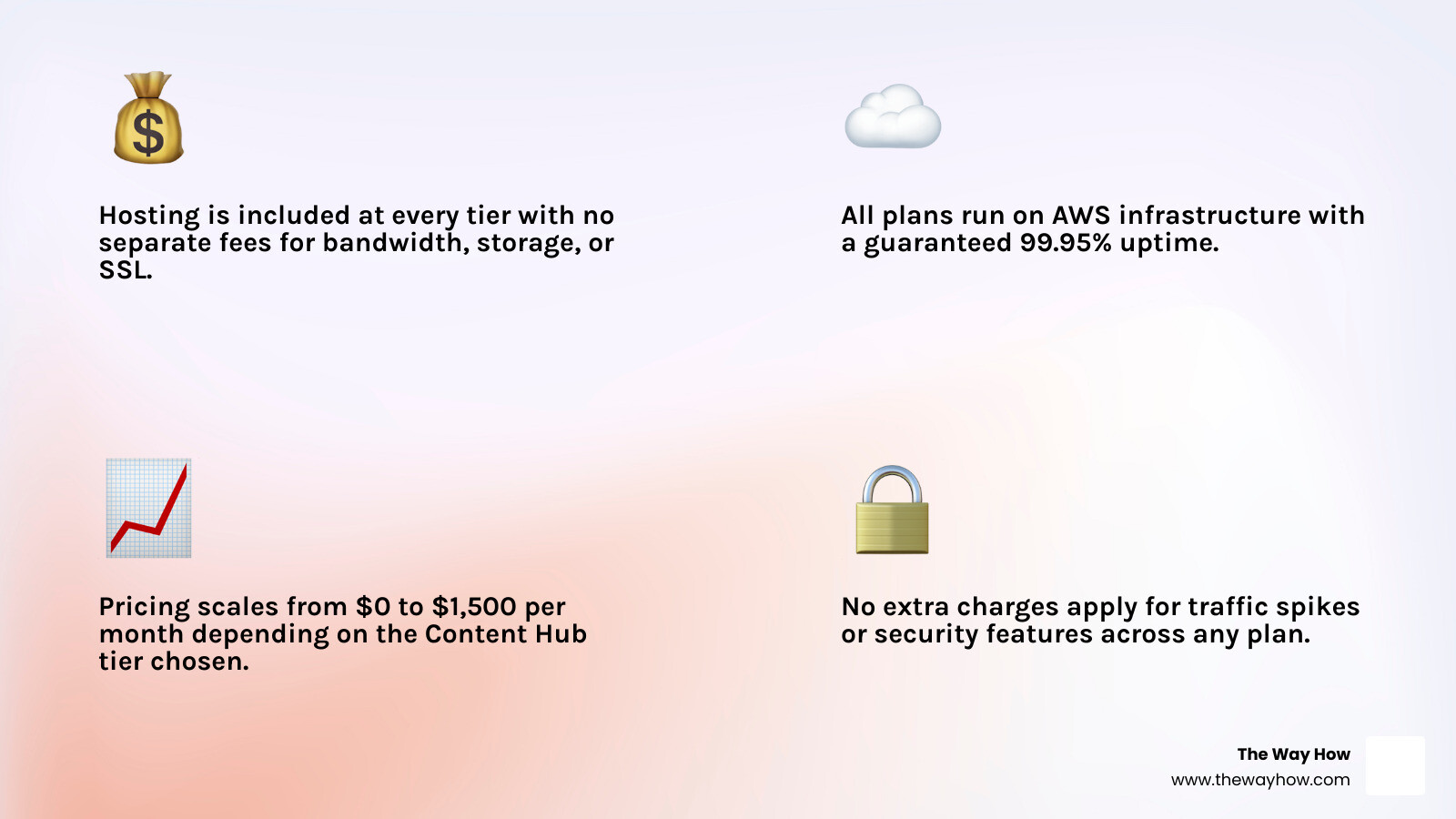
HubSpot website hosting price starts at $0 and scales with the Content Hub plan you choose. Here’s a quick snapshot:
| Content Hub Plan | Monthly Price (Annual Billing) | Hosting Included |
|---|---|---|
| Free | $0 | Yes |
| Starter | $15/month (1 seat) | Yes |
| Professional | $450/month (3 seats) | Yes |
| Enterprise | $1,500/month (5 seats) | Yes |
Key facts before you read further:
Most business leaders searching for HubSpot’s hosting price expect to find a separate line item — a monthly fee charged on top of the CMS subscription, the way traditional providers like Bluehost or WP Engine work. That’s not how HubSpot is structured. The hosting is baked in. But that doesn’t mean the total cost is always simple. When you factor in Content Hub tiers, seat-based pricing, and the potential “ecosystem tax” of stacking multiple HubSpot Hubs, the real number can look very different from the headline price.
This guide breaks down exactly what you’re paying for, what’s included, and how HubSpot’s hosting costs compare to alternatives like WordPress — so you can make a clear, confident decision.
I’m Jeremy Wayne Howell, a revenue growth strategist with over 20 years of experience helping companies implement HubSpot systems that reflect how buyers actually think — including evaluating whether the hubspot website hosting price makes sense for their stage of growth. That hands-on experience with real teams and real budgets shapes everything you’ll read here.
When we talk about web hosting, we usually talk about megabytes, gigabytes, and server response times. But beneath these technical specifications lies a much deeper human problem: cognitive load and decision fatigue.
For a marketing director or a business founder, a website is not just a collection of code. It is the primary vehicle for building trust with prospective customers. Every time a server goes down, a plugin breaks, or a page load drags, it creates a “certainty gap” in the mind of the buyer. On the back end, it creates operational friction for your team.

Traditional hosting setups force your team to act as systems integrators. You have to purchase the hosting, configure the DNS, select and renew an SSL certificate, set up a Content Delivery Network (CDN), and establish security protocols. If something breaks, your marketer is stuck in a loop of finger-pointing between the hosting provider, the domain registrar, and the web developer.
This operational friction has a real financial and psychological cost. When your team spends hours troubleshooting server configurations, they are not designing better customer journeys or generating demand. HubSpot’s managed hosting model aims to eliminate this mental tax by bundling infrastructure, security, and content management into a single, unified system.
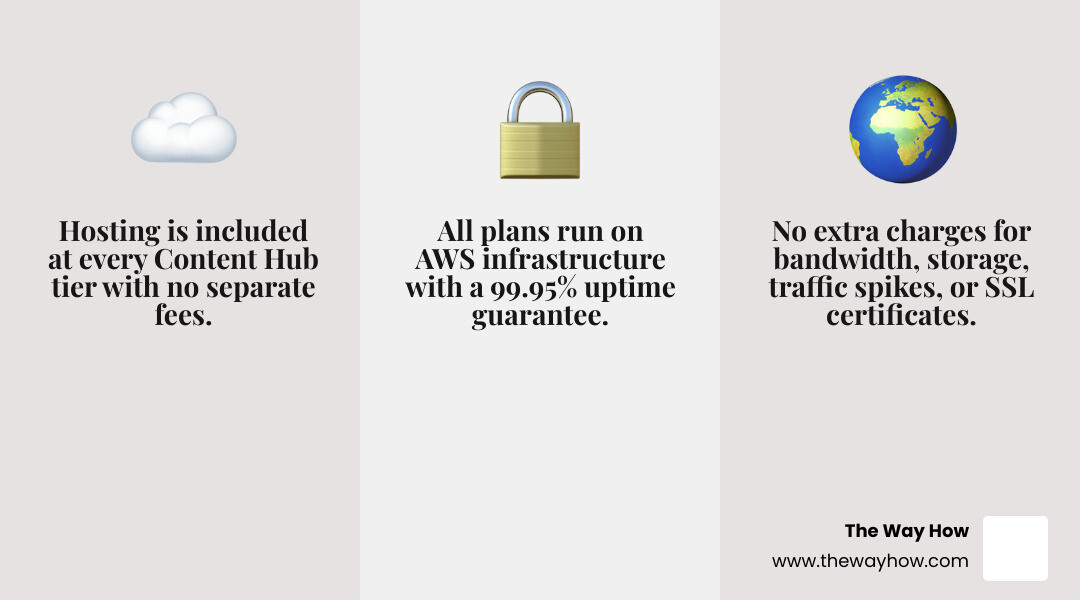
To understand the true cost of HubSpot hosting, we must look at how it is packaged within Content Hub. HubSpot’s hosting infrastructure is built on Amazon Web Services (AWS), leveraging its global cloud network to deliver enterprise-grade speed and reliability.
Because hosting is bundled directly into Content Hub, the hubspot website hosting price is determined entirely by which software tier you select. As your business grows, you do not upgrade your “hosting package” for more bandwidth; instead, you upgrade your software tier to unlock more advanced marketing, content creation, and governance features.
For a detailed look at how these software features scale, you can consult the HubSpot Content Hub pricing guide — smarter content, built to scale. Below is a comprehensive breakdown of how hosting capabilities map across the four primary tiers in 2026.
| Hosting Feature | Free | Starter | Professional | Enterprise |
|---|---|---|---|---|
| Base Price (Annual) | $0/month | $9/user/month (or $15/mo flat) | $450/month | $1,500/month |
| AWS Cloud Infrastructure | Included | Included | Included | Included |
| Global CDN (Cloudflare/Akamai) | Included | Included | Included | Included |
| SSL Certificate | Standard (HubSpot branded domain) | Custom Domain SSL | Custom Domain SSL | Custom Domain SSL |
| Bandwidth & Traffic Limits | Unlimited | Unlimited | Unlimited | Unlimited |
| Custom Domains Allowed | No (HubSpot branding) | 1 Custom Domain | Unlimited | Unlimited (up to 10 root domains) |
| Uptime Guarantee | 99.95% (Platform average) | 99.95% | 99.95% (SLA backed) | 99.95% (SLA backed) |
| Content Remix Limits | N/A | N/A | Up to 20 pieces/day | Up to 50 pieces/day |
For startups, solopreneurs, and small teams, the entry-level options offer a remarkably robust foundation. HubSpot’s free CMS tools are free forever and have no time limit. This plan includes premium cloud hosting, standard security monitoring, and a drag-and-drop website builder. However, the free tier limits you to 30 website pages, 30 landing pages, and requires you to use a HubSpot-branded domain (e.g., yourcompany.hs-sites.com).
Upgrading to the Starter tier, which costs $9/user/month when billed annually, removes the HubSpot branding and allows you to connect your own custom domain name. For small businesses looking to establish a professional web presence without a massive upfront software investment, this is an incredibly cost-effective path. You get the same AWS-backed speed and security as enterprise clients, without the enterprise price tag.
If you are just getting started with the ecosystem, reading through our guide on HubSpot for Beginners can help you navigate these initial setup steps. You can also explore the official Free Web Hosting | Launch Your Website Todaypage to see how easily you can launch a site on the free tier.
For mid-sized companies and rapidly growing brands, Content Hub Professional is the standard choice. Starting at $450/month with annual billing (which includes 3 seats), this tier is designed for teams that need to scale their content engine and optimize the customer journey.
At the Professional level, you are not just buying hosting; you are buying advanced marketing automation, dynamic personalization, smart content, A/B testing, and SEO recommendations. You also gain access to AI-powered content remix tools, allowing you to generate up to 20 pieces of content remix per day from a single asset.
When you evaluate the Professional tier, the question is rarely about server performance — which is flawless — but whether your team is ready to utilize these sophisticated marketing tools. For more context on this tier’s structural value, see our breakdown of HubSpot Professional Pricing.
For large organizations, multi-brand companies, and heavily regulated industries, Content Hub Enterprise starts at $1,500/month with annual billing (including 5 seats).
Enterprise hosting solves complex organizational problems. It allows you to host up to 10 distinct root domains from a single portal, making it ideal for managing regional sites, spin-off brands, or microsites. It also introduces advanced governance features like content partitioning, single sign-on (SSO), activity logging, and custom CDN configurations.
Additionally, the Enterprise tier ups your creative velocity, supporting up to 50 content remixes per day. If your organization requires strict security partitioning, multi-language content variants at scale, and deep database controls, the Enterprise tier is designed to handle that complexity seamlessly.
A common objection we hear from founders is: “Why should I pay $450 a month for HubSpot Content Hub Professional when I can host a WordPress site for $30 a month?”
This is a classic comparison trap. It compares the price of a software platform to the price of a utility. To understand the real financial impact, we have to look at the Total Cost of Ownership (TCO) over a multi-year horizon.
WordPress is open-source. The software itself is free, but you must buy everything else à la carte. You need to purchase a hosting plan, an SSL certificate, security plugins, backup services, a CDN, premium themes, and third-party extensions for basic forms or analytics.
More importantly, WordPress requires constant manual maintenance. Plugins must be updated regularly. When a plugin updates, it can conflict with your theme or other plugins, causing the site to crash or display visual bugs.

To understand this landscape better, you can review How Much Does a Website Cost? Everything You Need to Know. When you add up these fragmented costs, the financial gap between the platforms begins to close rapidly.
When we calculate the three-year TCO of a website, we must look at all the hidden line items that traditional self-hosted websites accumulate. Let’s compare the ongoing maintenance costs of a standard mid-sized business website on WordPress versus HubSpot Content Hub over a three-year period:
Over three years, these hidden WordPress costs can easily add up to $15,000 to $45,000 in direct out-of-pocket expenses. This doesn’t even account for the internal team hours spent managing these issues.
For a deeper dive into these real-world cost comparisons, check out How Much Does a Website Cost? Here’s What I Found Out….
There is another, more insidious cost associated with traditional hosting: the cost of delay.
When a marketing team relies on an external developer or an internal IT queue to make simple website updates — like launching a landing page, changing a headline, or updating a form — it stalls marketing momentum. If it takes two weeks to get a new campaign page live because of developer bottlenecks, that is two weeks of lost leads and stalled pipeline.
HubSpot’s drag-and-drop editor and modular theme system are built to give autonomy back to the marketing team. Marketers can build, test, and publish high-performing pages in minutes, without touching a line of code or worrying about server deployment. The average time to fully operationalize a HubSpot product, including Content Hub, is just 6 weeks. By reducing developer dependency, you eliminate the friction that keeps your team from executing their ideas in real time.
If you want to understand how this impacts the creative process, our guide on HubSpot Web Design explains how to design high-converting, low-maintenance page systems.
Traditional hosting providers often lure you in with a low introductory rate, only to hit you with overage charges when your site experiences a sudden surge in traffic. If your marketing campaign goes viral or you get featured in a major industry publication, a traditional host might throttle your bandwidth or take your site offline entirely to protect their servers.
HubSpot’s hosting infrastructure handles this differently. Built on AWS and supported by global CDN partners like Cloudflare and Akamai, HubSpot hosting is designed to auto-scale dynamically.
Whether you have 1,000 visitors a month or 1,000,000, HubSpot handles the traffic spikes automatically without any extra charges, bandwidth limits, or performance degradation. There are no hidden storage fees or usage-based penalties for hosting your media files, PDFs, or images.
However, while the hosting itself has no hidden fees, navigating HubSpot’s broader product architecture requires a strategic eye. To make sure you aren’t caught off guard by other platform costs, we recommend reading How Much Does HubSpot Cost in 2026? CRM Pricing, Hubs, and Hidden Fees | CompareTiers.
While hosting is free of hidden fees, you must be aware of what we call the “ecosystem tax.” HubSpot’s product architecture is modular. If you buy Content Hub, you have premium hosting and a world-class CMS. But if you want to connect that website to advanced marketing automation, you will need to purchase Marketing Hub. If you want to connect it to a robust sales pipeline, you will need Sales Hub.
Because HubSpot uses a hybrid pricing model — where Content Hub is priced primarily by seat and tier, while Marketing Hub is priced by the volume of marketing contacts in your database — stacking these hubs can cause your monthly bill to scale quickly. For example, growing your database from 2,000 to 100,000 marketing contacts can significantly increase your Marketing Hub costs.
To plan your budget effectively and avoid unexpected pricing jumps, read our detailed guide on HubSpot Marketing Hub Pricing.
No. HubSpot does not offer general-purpose web hosting. You cannot use HubSpot to host a website built on WordPress, Joomla, Drupal, or custom-coded HTML files that are independent of the HubSpot ecosystem. To use HubSpot’s hosting, your website must be built, managed, and published directly within HubSpot Content Hub.
If you have an existing website on another platform, you will need to migrate it by rebuilding your templates and content inside HubSpot. For growing businesses, this is often an ideal opportunity to clean up technical debt and redesign the site for better conversion rates. If you are a smaller organization looking to evaluate this move, our guide on HubSpot for Small Businesses outlines the practical steps for a smooth transition.
Security is one of the strongest arguments for HubSpot hosting. Unlike self-hosted platforms where you must configure and pay for security tools, HubSpot includes enterprise-grade security out of the box at no extra charge. This includes:
These built-in features save your team from the anxiety of security management. To see how these security features fit into the broader system, check out our resource on HubSpot Features.
Yes. While the Free tier requires you to use a HubSpot-branded subdomain, all paid tiers (starting with Content Hub Starter at $9/user/month) allow you to connect your own custom domain name (e.g., www.yourcompany.com).
Connecting your domain is a straightforward process. You simply update your DNS settings with your domain registrar (such as GoDaddy, Namecheap, or Google Domains) to point to HubSpot’s secure servers. Once connected, HubSpot automatically provisions your SSL certificate and routes your traffic through its global CDN.
Choosing a website hosting provider isn’t just a technical check-the-box exercise. It is a strategic decision that directly impacts your team’s operational velocity, your website’s performance, and your buyer’s psychological experience of your brand.
At The Way How, we help leadership teams look past surface-level tactics to diagnose the friction points stalling their growth. Whether you are trying to understand the compounding costs of stacking HubSpot Hubs, evaluating a complex website migration, or looking to integrate tools like HubSpot Operations Hub Pricing and HubSpot Transactional Email Pricing into a seamless architecture, we provide the strategic clarity you need.
We design revenue systems rooted in human behavior, empathy, and decision-making psychology. We help you remove the uncertainty from your marketing and sales infrastructure, turning your website and CRM into a predictable growth engine.
If you are ready to eliminate the technical friction, close the certainty gaps in your customer journey, and design a high-performance system that scales, let’s talk.
 Jeremy Wayne Howell : Jul 22, 2026 9:48:31 PM
 Jeremy Wayne Howell : Jul 21, 2026 9:47:10 PM
 Jeremy Wayne Howell : Jul 20, 2026 9:46:47 PM