
Beyond the Algorithm: Why Your Growth Is Stalled

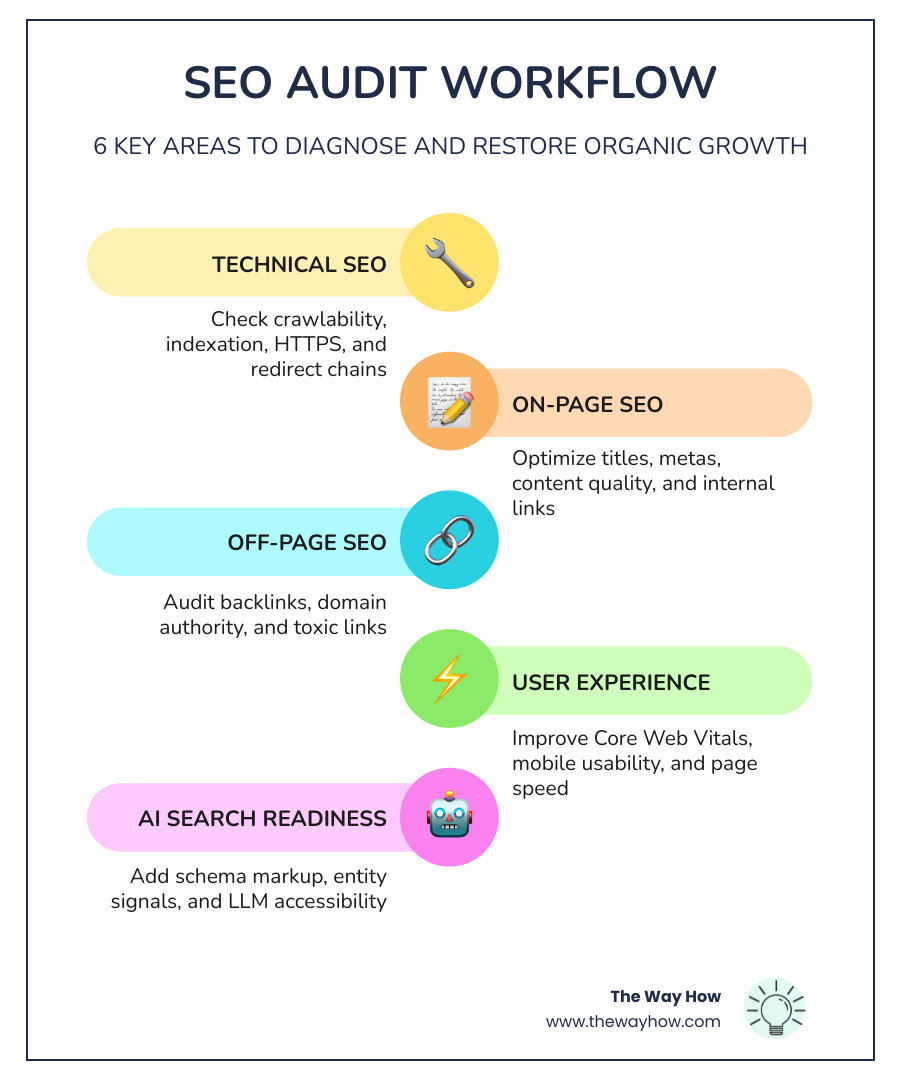
An seo audit checklist is a structured process for diagnosing why your website isn’t ranking, converting, or growing the way it should. Here’s what a complete audit covers:
| Audit Area | What It Checks |
|---|---|
| Technical SEO | Crawlability, indexation, site speed, HTTPS, redirects |
| On-Page SEO | Title tags, meta descriptions, content quality, internal links |
| Off-Page SEO | Backlink profile, domain authority, toxic links |
| User Experience | Core Web Vitals, mobile usability, page speed |
| AI Search Readiness | Schema markup, entity signals, LLM accessibility |
| Local SEO | NAP consistency, Google Business Profile, local citations |
Most websites aren’t failing because of one catastrophic problem. They’re failing because of dozens of smaller problems compounding quietly over time — broken links, duplicate content, slow load speeds, missing schema — each one small enough to ignore, but together significant enough to stall growth.
The stakes are real. Technical SEO issues alone account for roughly 40% of ranking drops. And yet most founders and revenue leaders only run an audit after something has already gone wrong.
Here’s what that costs: ignoring internal linking for six months can suppress tens of thousands in revenue. Ranking well for the wrong keywords can drive 50,000 visitors and zero sales. Organic traffic problems are almost always diagnostic problems first.
That’s the real reason an SEO audit matters — not to chase algorithm changes, but to see your website the way search engines and buyers actually see it, so you can fix what’s broken and build from a position of clarity.
I’m Jeremy Wayne Howell, founder of The Way How and a revenue growth strategist with over 20 years of experience helping founders diagnose what’s actually blocking growth — including building the kind of seo audit checklist frameworks that connect technical fixes to real revenue outcomes. In the sections below, I’ll walk you through ten strategies that go beyond surface-level checks to give you a complete picture of where your site stands and what to do about it.
The Foundation of Certainty: Technical SEO Audit Checklist
Before we ever look at the “creative” side of your website, we must look at the plumbing. Technical SEO is the foundation upon which every other strategy rests. If your technical house is not in order, your content—no matter how brilliant—will effectively be invisible. We find that technical debt accumulates silently; it can cut organic traffic by 30% or more before a leadership team even notices a dip in the dashboard.
A thorough Site Audit Check begins with understanding how search engine crawlers interact with your infrastructure. Googlebot operates with a finite “crawl budget”—the amount of time and resources it allocates to your site each day. If your site is cluttered with duplicate URLs or deep redirect chains, Google may stop crawling before it ever reaches your high-value revenue pages.
To ensure your foundation is solid, follow this Technical SEO Audit: Complete Checklist Guide 2026 approach:
- Robots.txt Validation: This file is your first line of communication with search engines. A single misplaced “disallow” command can accidentally de-index your entire blog or product catalog overnight. Ensure you Setup the Perfect Robots.txt File to guide bots exactly where you want them.
- XML Sitemap Optimization: Your sitemap should only contain canonical, indexable URLs. If your sitemap is bloated with 404s or non-canonical pages, you are wasting crawl budget. We recommend you Setup and Optimize an XML Sitemap and submit it directly to Google Search Console to monitor the “submitted vs. indexed” ratio.
Eliminating Infrastructure Friction
Friction is the enemy of momentum. In our diagnostic work, we often see websites that have “ghost” errors—issues that don’t always break the site for a human user but cause search engines to retreat.
- Crawl and 404 Errors: Use Google Search Console to identify pages that return errors. A high volume of 404s signals to Google that your site is poorly maintained. You can learn How to Find and Fix 404 Errors to restore the flow of link equity.
- Redirect Chains: Every time a user (or bot) has to jump through multiple redirects to reach a destination, you lose page speed and crawl efficiency. Consolidate these into a single hop.
- HTTPS Security: Since 2014, security has been a confirmed ranking signal. Ensure your SSL certificate is valid and that you have resolved all mixed content warnings. For more on the basics, see How to Fix Crawl Errors in Google Search Console.
Architecture and URL Strategy
The way your site is organized tells a story about what matters most. We believe in a psychology-first architecture where the most important pages are reachable within three clicks of the homepage. This isn’t just for bots; it reduces the cognitive load on your buyers.
When you Perform a URL Audit on Your Site, look for a clean, logical taxonomy. Use lowercase letters and hyphens to separate words. Avoid “URL bloat” caused by excessive parameters that create thousands of duplicate pages. If you are just starting, our guide on Technical SEO Basics: Essential Tips for Beginners can help you set the right trajectory.

Aligning Intent: On-Page Optimization and Information Gain
Once the foundation is secure, we turn our attention to the content itself. However, we don’t just look at keywords. We look at intent. In May 2026, simply rehashing what is already at the top of the search results is no longer enough. Google looks for “information gain”—the unique value or perspective your content adds to the conversation.
Using a Practical 2026 Framework for your seo audit checklist requires a ruthless look at your current pages. This often involves “content pruning”—the process of removing or consolidating low-quality pages. In fact, some sites have seen traffic increases as high as 44% simply by deleting “zombie pages” that were dragging down the site’s overall authority.
When you Perform an On-Page SEO Audit on a Page, you must also look for internal competition. If you have five different blog posts all trying to rank for the same keyword, you are likely suffering from “keyword cannibalization,” where Google doesn’t know which page to prioritize. You can learn How to Fix Keyword Cannibalism to ensure your strongest pages get the spotlight.
Content Quality and Semantic Relevance
Search engines are increasingly sophisticated at understanding topical authority. They don’t just look for a single keyword; they look for a cluster of related topics that prove you are an expert. This is where a Content Gap Analysis becomes essential. By identifying what your competitors are covering that you aren’t, you can build a more comprehensive resource that satisfies both the algorithm and the buyer’s need for certainty.
Meta Tags and Click-Through Psychology
Your title tags and meta descriptions are your “organic ad copy.” They are the first interaction a buyer has with your brand.
- Title Tags: Keep them between 50-60 characters. Place your primary keyword near the beginning, but write for the human first.
- Meta Descriptions: While not a direct ranking factor, these heavily influence click-through rate (CTR). Aim for 140-155 characters that summarize the value proposition and include a clear call to action.
By performing a Competitor Analysis, you can see which titles are winning the “click” in your industry and adapt your strategy to stand out.
Building Trust: Off-Page Signals and Authority Audits
If technical SEO is your foundation and on-page SEO is your message, off-page SEO is your reputation. Google uses backlinks as a primary signal of trust. According to industry studies, the top-ranking result on Google typically has 3.8 times more backlinks than positions 2 through 10.
A Complete Audit Guide must include a deep dive into your link profile. You need to know who is talking about you and why. When you Perform a Backlink Audit on Your Website, you are looking for:
- Domain Authority: The overall “strength” of the sites linking to you.
- Relevance: A link from a respected industry journal is worth far more than a hundred links from unrelated directories.
- Toxic Links: Links from “link farms” or spammy sites can actually trigger penalties. If your audit reveals a high volume of these, you may need to use Google’s disavow tool.
Local SEO and Entity Recognition
For businesses with a physical presence, local SEO is a critical component of the seo audit checklist. Google needs to be certain that your business is a real “entity.” This is achieved through NAP (Name, Address, Phone) consistency across the web.
Ensure your Google Business Profile is fully optimized with current hours, photos, and reviews. Modern Audit Checklists for Modern Websites also emphasize entity signals—making sure your brand is clearly defined in a way that AI systems can recognize and cite.
The New Frontier: Auditing for AI and Generative Search
As we move through 2026, traditional search is being augmented by AI Overviews and Large Language Models (LLMs). This has given rise to Answer Engine Optimization (AEO) and Generative Engine Optimization (GEO).
Your seo audit checklist must now include checks for AI readiness. AI search engines are even more sensitive to quality signals than traditional search. Sites that regularly audit for these factors are 5x more likely to appear in AI-generated results. Key elements include:
- LLM Accessibility: Is your content structured in a way that AI can easily parse? Using a
llms.txtfile can help define your content policy for AI crawlers. - Structured Data and Schema: Only about 20% of pages currently use schema markup correctly. This represents a massive competitive advantage. Use 50+ Checks for SEO + AEO + GEO to ensure your FAQ, Article, and Person schemas are properly implemented.
- Citation-Ready Content: AI models love to cite facts and statistics. Including original data and clear, factual claims makes your content more “citable” for systems like ChatGPT or Perplexity.

Speed as a Service: User Experience and Site Performance
In our work at The Way How, we view site speed not just as a technical metric, but as a form of customer service. A slow site creates anxiety and friction, causing buyers to abandon their journey. Google’s Core Web Vitals (CWV) are the standard for measuring this experience.
| Metric | Description | “Good” Threshold |
|---|---|---|
| LCP (Largest Contentful Paint) | How long it takes for the main content to load. | Under 2.5 seconds |
| INP (Interaction to Next Paint) | Measures the responsiveness of the page to user input. | Under 200 milliseconds |
| CLS (Cumulative Layout Shift) | Measures how much the page elements “jump” during loading. | Under 0.1 |
A 50-Step Audit Guide will often reveal that simple fixes—like preloading your LCP image or serving images in modern formats like WebP or AVIF—can dramatically improve these scores. We recommend you Check Site Speed on Google PageSpeed regularly, as even a one-second delay can increase bounce rates by 20%. Understanding How Page Speed Impacts SEO Strategies is essential for any leader looking to build a dependable growth engine.
Common Questions on the SEO Audit Checklist
How often should I use an SEO audit checklist?
For most established websites, a comprehensive audit should be conducted every 6 to 12 months. However, we recommend monthly monitoring of core technical health. If you are undergoing a site migration, redesign, or major content restructuring, an immediate audit is mandatory to prevent ranking loss.
What tools are best for an SEO audit checklist?
You don’t need a massive budget to start. Google Search Console and Google PageSpeed Insights are essential free tools. For deeper crawls, Screaming Frog is the industry standard. Premium tools like Semrush or Ahrefs are excellent for competitor analysis and backlink auditing.
What are the most common issues found in an SEO audit?
The most frequent culprits include crawl budget waste (due to duplicate content), missing meta descriptions (found on 34% of pages), and failing Core Web Vitals. We also frequently see “orphan pages”—valuable content that has no internal links pointing to it, making it nearly impossible for Google to find.
From Diagnosis to Momentum: Restoring Your Growth Engine
At The Way How, we believe that you cannot fix what you have not diagnosed. An seo audit checklist is more than a list of chores; it is a diagnostic framework designed to remove uncertainty.
When growth stalls, it is rarely because the market has disappeared. It is usually because the systems meant to capture that market have developed friction. Our psychology-first approach focuses on why buyers stop moving forward and how to restore that momentum through strategic clarity and behavioral insight.
Whether you are looking for Fractional CMO leadership to guide your long-term strategy or need to refine your HubSpot architecture to better track revenue, we help you see the problem clearly before we ever talk about solutions. By turning your website into a transparent, high-performing asset, we turn marketing into a predictable engine for growth.
If you are ready to move beyond tactics and start building a system rooted in human behavior, we are here to help. More info about our marketing and revenue services can be found here.