
The Certainty Gap in the AI Gold Rush
The PointBelief in AI is nearly universal. The execution is not. The gap between believing in AI and choosing the right platform with confidence is where most organizations stall.

Choosing the right enterprise AI software solutions may be the most consequential technology decision your organization makes this decade — and most leaders are making it under pressure, with incomplete information, and a quiet fear of getting it wrong.
That fear is rational. The market is crowded. The promises are enormous. And the cost of a bad implementation — in money, trust, and lost time — is real.
Here is a quick-reference breakdown to orient your decision before we go deeper:
| What You’re Trying to Do | What to Look For |
|---|---|
| Unify company knowledge and search | Glean, IBM watsonx.ai |
| Build and deploy custom AI agents | Gemini Enterprise Agent Platform, Haystack |
| Use turnkey industry applications | C3 AI |
| Run AI in secure or airgapped environments | Enterprise h2oGPTe (H2O.ai) |
| Scale predictive and generative AI on enterprise data | IBM watsonx.ai, Gemini Agent Platform |
In a late 2023 Frost & Sullivan survey, about 89% of IT and business decision makers said AI and machine learning are important to goals like operational efficiency, innovation and customer experience. The belief is nearly universal. The execution is not.
Global State of AI, 2024. Frost & Sullivan, 2024-02. Read the Source →The gap between believing in AI and choosing the right platform with confidence is where most organizations stall.
This guide is built to close that gap — not by telling you which platform is “the best,” but by helping you understand what each solution actually does, who it’s built for, and how to evaluate it against your specific situation.
I’m Jeremy Wayne Howell, founder of The Way How — a psychology-first revenue strategy firm where I’ve spent over 20 years helping founders and revenue leaders cut through market noise and make decisions that actually move the needle, including how to evaluate and adopt enterprise AI software solutions without falling into the trap of buying tools before understanding the problem. The sections ahead reflect that same discipline: diagnose first, prescribe second.
Important enterprise ai software solutions terms:
What Defines True Enterprise AI vs. General Applications?
The PointGeneral AI tools operate in isolation. Enterprise AI must scale, protect your proprietary data, carry clear governance and connect to your existing systems.
To understand how to choose the right tools, we must first define what we are actually buying. There is a profound difference between general-purpose AI applications and true enterprise-scale systems.
General AI applications—like a consumer-facing chatbot or a basic copy-generation tool—operate in isolation. They are designed for individual productivity. They do not understand your company’s proprietary data, they do not respect your security parameters, and they cannot coordinate complex workflows across different departments.
True enterprise AI goes beyond simple automation. It is designed to solve complex business challenges using machine learning, natural language processing, deep learning, and computer vision at scale. To qualify as enterprise-ready, an AI system must meet strict criteria:
- Scalability: The system must be able to process billions of data points and execute thousands of queries simultaneously without performance degradation.
- Security & Data Privacy: Enterprise platforms must protect proprietary data, enforce real-time user permissions, and comply with global standards like SOC 2 Type II, ISO 27001, GDPR, and HIPAA.
- Governance & Accountability: Enterprise AI requires clear policies for monitoring algorithmic bias, tracking model lineage, and ensuring compliance.
- Integration: It must connect seamlessly with your existing enterprise systems, such as your ERP, CRM, and internal databases, rather than forcing you to rebuild your infrastructure.
Implementing this successfully requires a structured ai software development process that starts with a thorough discovery phase, moves through rigorous prototyping, and establishes continuous feedback loops. By following a structured ai software development life cycle guide, organizations can ensure that their AI models are grounded in high-quality data and aligned with specific business outcomes.
Overcoming Adoption Friction with Enterprise AI Software Solutions
When we examine why enterprise technology initiatives fail, the root cause is rarely the code. It is human behavior.
Introducing new enterprise AI software solutions triggers a natural psychological response in employees: anxiety. They worry about job displacement, struggle with the learning curve of complex interfaces, and feel overwhelmed by tool sprawl. This friction stalls user adoption and kills ROI.
To overcome this adoption friction, leaders must treat change management as a core component of the implementation process. Here is how we recommend addressing the behavioral side of AI adoption:
- Solve Real Pain Points First: Do not deploy AI for its own sake. Identify high-impact, low-friction use cases where AI can immediately make an employee’s day easier—such as reducing repetitive admin work or speeding up internal information retrieval.
- Ensure Transparency: Demystify how the AI makes decisions. When employees understand how a model arrives at an output, they develop trust in the system.
- Provide Continuous Enablement: Shift from one-off training sessions to ongoing support. If you are a smaller organization, refer to our ai for small business complete guide to understand how to right-size your training and implementation resources without overwhelming your staff.
By designing your AI strategy around human psychology and workflows, you turn a potential source of friction into a tool that empowers your team.
The Top 6 Enterprise AI Software Solutions of 2026
The PointMatch the platform to your need: unified knowledge search, custom agents, turnkey industry applications, or secure airgapped deployments.
The vendor landscape has matured significantly. Rather than trying to build everything from scratch, organizations can leverage robust platforms that match their technical maturity, security needs, and operational goals.
Below is a detailed comparison of the top six enterprise AI software solutions in 2026, helping you evaluate which platform fits your technical architecture and organizational needs.
| Provider / Platform | Primary Focus | Key Strengths | Best For |
|---|---|---|---|
| Gemini Enterprise Agent Platform | Agentic Workflows & Multi-Model Scale | 200+ models, Agent Studio, MLOps tools | Organizations built on Google Cloud seeking advanced agent orchestration |
| IBM watsonx.ai | Model Customization & RAG | Enterprise-grade governance, RAG pipelines, foundation models | Regulated industries requiring deep compliance and model tuning |
| C3 AI | Turnkey Industry Applications | 40+ pre-built applications, predictive analytics | Enterprises looking for rapid deployment of specific vertical solutions |
| Glean | Enterprise Search & Knowledge Management | 100+ app connectors, permissions-enforced search | Teams drowning in internal documentation and tool sprawl |
| Enterprise h2oGPTe | Secure, Hybrid & Airgapped AI | Multimodal analysis, SLMs, strict data control | Organizations requiring on-premise or highly secure deployments |
| Haystack Enterprise Platform | Composable AI Orchestration | Open-source framework, custom pipeline builder | Engineering teams wanting modular, customizable AI architectures |
To successfully run these platforms, you need to understand how they fit into your overall ai tech stack, including the data orchestration layers, machine learning frameworks, and infrastructure runtimes.
Gemini Enterprise Agent Platform (formerly Vertex AI)
Google Cloud’s Gemini Enterprise Agent Platform (formerly Vertex AI) | Google Cloudis a comprehensive, open foundation designed for organizations that want to build, scale, and govern enterprise-grade AI agents.
The platform provides access to over 200 Google and third-party models—including Gemini 3.5, Claude, and Gemma. Through its Agent Studio, developers can evaluate, tune, and deploy agents using natural language or deep code. A key differentiator is the Google Antigravity application, which allows organizations to orchestrate multiple agents simultaneously to automate complex, end-to-end workflows (such as executing entire digital assets and email campaigns during product launches).
Gemini Enterprise Agent Platform (formerly Vertex AI). Google Cloud, 2026-10. Read the Source →For organizations heavy on data science, Gemini Enterprise offers integrated MLOps tools like Model Registry, Feature Store, and automated pipelines, with usage-based pipeline pricing.
IBM watsonx.ai
For enterprises focused on trust, governance, and deep customization, IBM watsonx.aiserves as a unified, end-to-end AI development studio. It allows teams to move from initial model experimentation to production deployment within a secure, governed environment.
A core strength of watsonx.ai is its Retrieval-Augmented Generation (RAG) capabilities. It allows organizations to ground large language models in their proprietary knowledge bases, ensuring that generative AI outputs are highly accurate, verifiable, and relevant to the business.
The platform supports a broad choice of foundation models, including OpenAI gpt-oss models, and provides advanced tuning methods to optimize models for specific domain vocabularies. IBM reports that its client AddAI cut unanswered customer queries by 50% with watsonx.ai, drastically improving support efficiency.
IBM watsonx.ai. IBM, 2026-10. Read the Source →C3 AI
Unlike platforms that require you to build models from the ground up, C3 AI focuses on delivering immediate business value through over 40 turnkey Enterprise AI applications. C3 AI has spent more than 15 years refining predictive analytics for complex industries like oil and gas, manufacturing, defense, utilities, and financial services.
C3 AI Announces C3 Code. C3 AI, 2026-04. Read the Source →C3 AI. C3 AI, 2026-10. Read the Source →C3 AI’s platform provides an integrated environment that supports deep-code, low-code, and no-code development tools. This makes it accessible to both hard-core data scientists and business analysts.
Whether you are looking to optimize supply chains, predict equipment failures, or manage financial risk, C3 AI says its pre-built applications can go live in production in weeks to months, significantly faster than typical custom-build timelines.
C3 AI Initial Production Deployment. C3 AI, 2026-10. Read the Source →Glean
If your organization’s primary challenge is that employees cannot find the information they need to do their jobs, Glean is the industry-leading solution. Positioned as a “Work AI” platform, Glean connects with over 100 enterprise apps (including Google Drive, ServiceNow, SharePoint, and GitLab) to index and understand your company’s data wherever it lives.
Connectors. Glean, 2026-10. Read the Source →Glean’s primary strength is its permissions-enforced search. It strictly respects your existing security protocols, ensuring employees only see information they are authorized to access.
The platform’s impact on operational efficiency is backed by remarkable statistics:
- Saves up to 110 hours per user/year.Glean. Glean, 2026-10. Read the Source →
- Saves 36 hours per new hire during onboarding, in a Forrester study Glean commissioned (2024).The Total Economic Impact of Glean. Forrester Consulting, 2024-09. Read the Source →
- Cuts IT support requests by 20%, in that same Forrester study.The Total Economic Impact of Glean. Forrester Consulting, 2024-09. Read the Source →
- Reaches 93% enterprise adoption in under 2 years, Glean reports, and paid back in under 6 months for the organization Forrester modeled.Glean. Glean, 2026-10. Read the Source →The Total Economic Impact of Glean. Forrester Consulting, 2024-09. Read the Source →
Enterprise h2oGPTe
For organizations operating in highly regulated sectors—such as healthcare, defense, or banking—data privacy is non-negotiable. Enterprise h2oGPTe | H2O.aiis purpose-built for these environments, offering robust generative and predictive AI capabilities with the option for completely airgapped, on-premise deployment.
H2O.ai’s platform relies on purpose-built Small Language Models (SLMs) that deliver high performance on commodity hardware (including a single 24GB GPU), drastically lowering the total cost of ownership.
Enterprise h2oGPTe. H2O.ai, 2026-10. Read the Source →Key features include multimodal analysis (processing audio, vision, and handwritten documents), citation-based verification to eliminate hallucinations in RAG pipelines, and intelligent model routing that automatically selects the most cost-effective model for any given task.
Haystack Enterprise Platform
For engineering teams that demand full control over their AI architecture, deepset’s Build & Scale AI Agents and Apps Faster | Haystack Enterprise Platformprovides a highly composable, production-ready framework to orchestrate LLM components without vendor lock-in.
Haystack features an intuitive visual Pipeline Builder and pre-built templates that allow developers to construct custom workflows for search, RAG, Text-to-SQL, and intelligent document processing. The platform is designed for enterprise-grade operations, featuring one-click deployment, auto-scaling, and deep observability tools (such as the Groundedness metric, which tracks how well generative models adhere to facts in your databases).
Haystack supports cloud, hybrid, and Virtual Private Cloud (VPC) deployments, making it an excellent choice for businesses that want to maintain complete sovereignty over their data and infrastructure.
The Psychology of Selection: A Framework for Evaluating Enterprise AI Software Solutions
The PointBefore you compare features, answer 3 questions: what core problem you are solving, how technically mature your team is, and what compliance constraints you carry.
When leadership teams evaluate enterprise AI software solutions, they often fall into the trap of feature-comparison. They look at model sizes, token costs, and processing speeds. While these technical metrics matter, they do not address the strategic alignment of the technology.
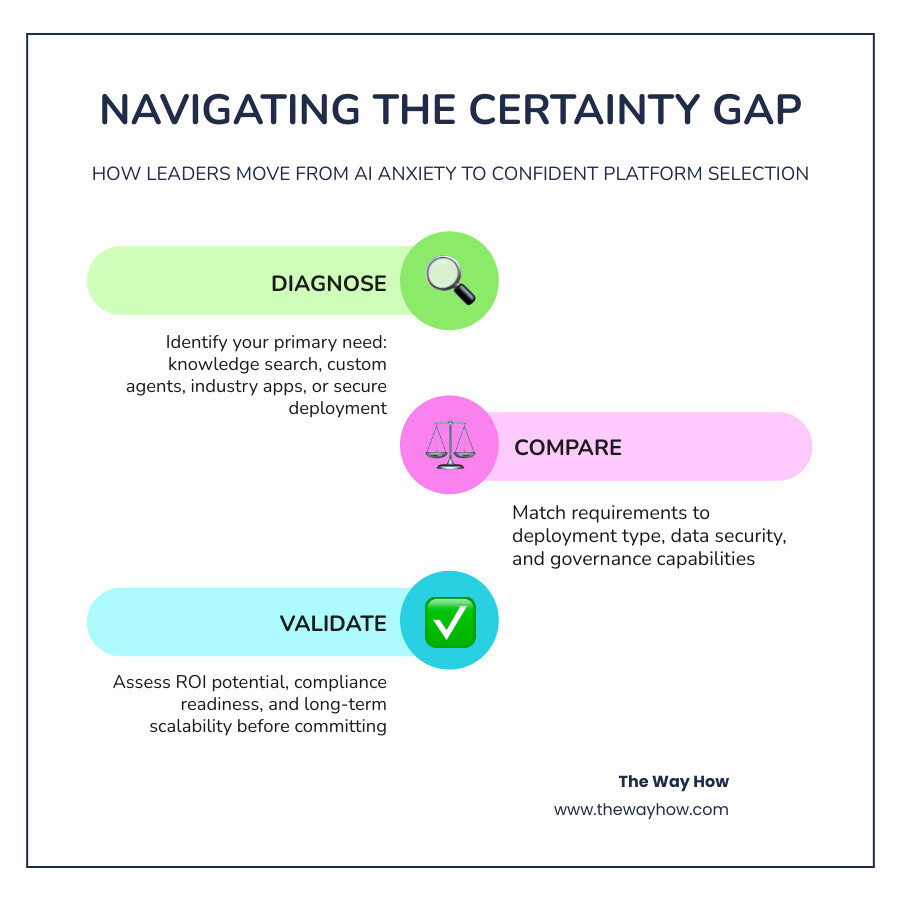
To make a decision with absolute certainty, we must shift from a tactical checklist to a diagnostic framework.

Before choosing a partner, ask your leadership team these three diagnostic questions:
- What is the core problem we are trying to solve? Are we trying to drive operational efficiency (e.g., automating customer support, indexing internal knowledge) or are we trying to build proprietary product value? If it is the former, off-the-shelf platforms like Glean or C3 AI will get you to market faster. If it is the latter, you need custom development.
- What is our internal technical maturity? Do we have a robust team of data scientists and machine learning engineers who can orchestrate pipelines on platforms like Haystack or Gemini Enterprise? Or do we need a partner to provide ai application development services and build custom ml software solutions tailored to our exact workflow?
- What are our compliance and data residency constraints? Can we operate in a public cloud environment, or do our industry regulations require an airgapped, on-premise setup like Enterprise h2oGPTe?
By diagnosing these structural needs first, you eliminate the anxiety of vendor lock-in and select a platform that supports sustainable, long-term growth.
Frequently Asked Questions
What is the Real ROI of Enterprise AI Software Solutions?
Measuring the ROI of AI requires looking at both direct cost savings and efficiency gains. For example, applying AI to QA automation can reduce repetitive testing work, which shortens software development cycles. Similarly, Glean reports saving users up to 110 hours a year on search and retrieval, and a Forrester study Glean commissioned found payback in under 6 months for the organization it modeled. When evaluating platforms, focus on metrics like time-to-resolution, employee onboarding speed, and resource reallocation to measure true impact. For a deeper look at how AI impacts development workflows, read our ai software engineering guide.
The Total Economic Impact of Glean. Forrester Consulting, 2024-09. Read the Source →How do enterprise AI platforms handle data security and compliance?
Leading enterprise AI platforms build security directly into their architecture. They enforce real-time, permissions-based access, meaning the AI will never show an employee data they do not already have permission to see in source systems. Furthermore, enterprise platforms comply with global regulations (SOC 2, GDPR, HIPAA) and offer deployment options—such as Virtual Private Clouds (VPC) or completely airgapped, on-premise environments—to ensure that your proprietary data is never used to train public models.
What is the difference between custom and off-the-shelf AI?
Off-the-shelf AI solutions are pre-built applications designed to solve common business problems (like search, basic summarization, or standard CRM forecasting) with minimal setup. Custom AI, on the other hand, involves building tailored machine learning models designed around your unique business logic, proprietary data pipelines, and specific competitive advantages. While off-the-shelf tools offer a faster time-to-market, custom solutions provide superior long-term differentiation and integration. To explore how custom development fits into modern engineering, see our ai in software engineering guide 2026.
Restoring Momentum: Moving from AI Anxiety to Strategic Certainty
The pressure to adopt AI can easily lead to “tactical chasing”—buying software licenses and launching pilot programs without a clear strategic anchor. This approach creates fragmented systems, wastes budget, and ultimately stalls your growth.
At The Way How, we believe that technology should serve your revenue strategy, not dictate it. We help leadership teams step back from the noise, diagnose the certainty gaps in their customer journeys and internal operations, and design aligned systems that build trust and predictable momentum.
If you are ready to stop guessing and start building a clear, behavior-driven AI and marketing roadmap, we are here to guide you. Partner with us for strategic growth and let’s turn technological complexity into a dependable engine for your enterprise.