
The High Cost of Waiting: Why Your Pipeline Is Stalling

A demand generation speed strategy is how B2B marketing teams compress the time between first awareness and qualified pipeline — without sacrificing lead quality or burning out their team.
If you’re here looking for a quick framework, here it is:
What a demand generation speed strategy involves:
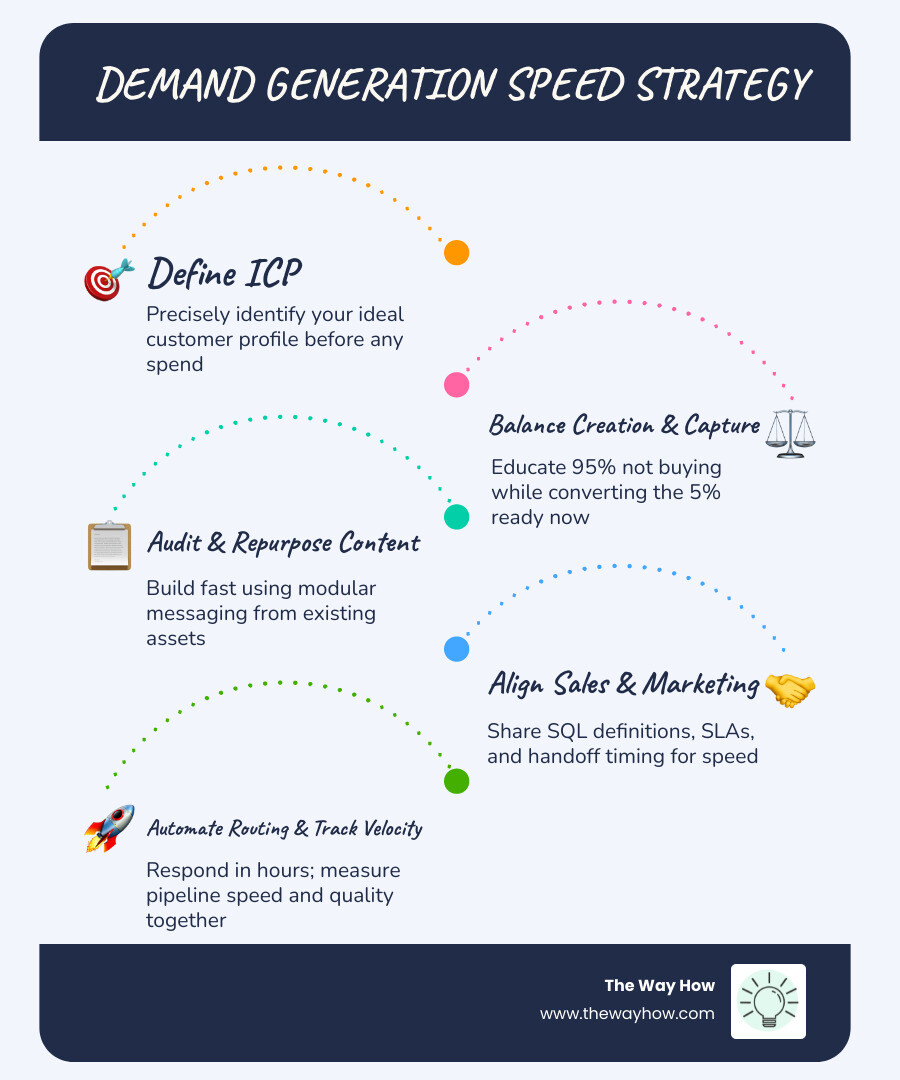
- Define your ICP precisely — know exactly who you’re targeting before spending a dollar
- Balance demand creation and capture — educate the 95% not yet buying while converting the 5% who are
- Audit and repurpose existing content — build fast from what you already have
- Align sales and marketing on shared definitions — SQLs, SLAs, and handoff timing
- Automate qualification routing — contact high-intent leads within hours, not days
- Track pipeline velocity, not just MQL volume — measure speed and quality together
- Test rapidly in sprints — prove what’s working before scaling spend
Read on for the full breakdown of each step.
There’s a math problem sitting on most revenue leaders’ desks right now. The board wants growth. The budget barely moved. And the pipeline feels like it’s running through wet concrete.
According to recent research, 45% of marketers say economic uncertainty is their top challenge — and that pressure is compounded by internal expectations that keep rising regardless of what the market is doing.
The instinct is to do more — more campaigns, more channels, more content. But more isn’t the problem. Slow is the problem.
Most demand gen programs aren’t failing because of effort. They’re failing because the system between first touch and qualified opportunity is full of friction, misalignment, and delay. Buyers only spend 17% of their time talking to sales, which means the window to create momentum — and hold it — is far smaller than most teams realize.
Speed, in this context, isn’t about urgency for urgency’s sake. It’s about building a system that moves buyers from awareness to intent without losing them to a competitor, distraction, or decision fatigue.
I’m Jeremy Wayne Howell, founder of The Way How, and I’ve spent over 20 years helping founders and revenue teams diagnose exactly why their pipeline stalls — and how a properly structured demand generation speed strategy rebuilds it from the ground up. This guide walks you through the frameworks, psychology, and operational wiring that turn slow demand engines into predictable revenue systems.
Defining the Demand Generation Speed Strategy
In the context of modern B2B marketing, a demand generation speed strategy is a shift from the “slow build” mentality to a high-velocity, precision-targeted engine. Traditional demand generation often involves annual planning cycles and long-term campaigns that take quarters to validate. In May 2026, that timeline is no longer viable.
The core difference lies in how we treat the buyer’s time. While traditional approaches focus on volume (filling the top of the funnel with as many leads as possible), a speed-focused strategy prioritizes speed-to-value. This means delivering the right education or solution to a buyer the moment they signal a need, effectively shortening the distance between “I have a problem” and “I trust this solution.”
For B2B SaaS companies, this is the difference between a 6-month sales cycle and a 90-day pipeline. By following a Demand Generation Strategy Complete Guide, we can see that velocity is a byproduct of clarity. When you understand your Optimizing GTM Speed: A Strategic Guide to Rapid Campaign Deployment in B2B SaaS, you stop guessing and start executing.
| Feature | Traditional Demand Gen | Speed-Focused Demand Gen |
|---|---|---|
| Planning Cycle | Annual / Quarterly | Bi-weekly Sprints |
| Primary Metric | MQL Volume | Pipeline Velocity & SQO Rates |
| Content Focus | Gated Whitepapers | Product-Led Experiences |
| Lead Routing | Manual / Batch | Real-time / Automated |
| Testing | Sequential (A then B) | Parallel (Multi-variant Sprints) |
The Shift from Traditional Lead Gen to High-Velocity Demand
We need to address the elephant in the room: the MQL is often a vanity metric that slows us down. “MQL bloat” occurs when marketing teams pass names to sales based on arbitrary actions, like downloading a generic PDF. This creates a bottleneck where sales teams waste time chasing people who have no declared intent.
A high-velocity demand generation speed strategy focuses on brand recall and emotional resonance. Research shows that campaigns appealing to emotion outperform rational ones by 31%. When a buyer remembers your brand because you solved a small problem for them through content, their purchase intent increases by 69%. We aren’t just capturing leads; we are building B2B Demand Gen systems that make the eventual sale feel like the next logical step.
Core Components of a Demand Generation Speed Strategy
To move fast, you must first remove the friction. This starts with a comprehensive audit of your existing assets. Most companies are sitting on a goldmine of content that simply needs to be modularized. Instead of writing a new ebook, we take a high-performing webinar and break it into ten LinkedIn posts, three blog articles, and a series of short-form videos.
Speed also requires Demand Generation Best Practices like automated routing and modular messaging. If your messaging is “pre-approved” and your audience segments are already built in your CRM, you can launch a campaign in minutes rather than weeks.
The Psychology of Velocity: Balancing Creation and Capture
From a psychology-first perspective, speed is about reducing the “certainty gap.” Every buyer is fighting a battle between the desire for a solution and the fear of making a wrong decision. When your marketing is slow or disconnected, that gap widens.
To accelerate, we must balance demand creation (educating the 95% of the market not currently looking to buy) with demand capture (converting the 5% who are). If you only focus on capture, you end up in a “bloodbath” of price competition with every other vendor. If you only focus on creation, you’ll have a great brand but no revenue.
By using Sales Funnel Optimization techniques, we ensure that the transition from awareness to consideration is seamless. We want to be the “default choice” in the buyer’s mind long before they even open a browser to search for a vendor. This is the essence of a high-performance Conversion Funnel In Digital Marketing.
Accelerating Demand Generation Speed Strategy through Content Audits
Content is the fuel for your speed engine. However, creating content from scratch is slow. We recommend a “pillar-and-spoke” model. One anchor asset — like a deep-dive research report — can generate enough derivative content to fuel five channels for a month.
Using AI-assisted targeting can further accelerate this. In fact, 65% of companies using AI tools for audience targeting report positive results. These tools help us identify which “spokes” of our content are resonating with specific segments in real-time. This allows us to refine our Lead Generation Strategy on the fly, focusing only on what moves the needle.

Shortening the Buyer Journey with Product-Led Experiences
One of the fastest ways to build trust is to let the buyer “touch” the product without a salesperson present. Gartner research indicates that buyers increasingly prefer “rep-free” models. By integrating interactive demos or “freemium” paths early in the journey, you provide immediate speed-to-value.
When you Build Sales Funnels that prioritize the user’s experience over the salesperson’s schedule, you naturally compress the sales cycle. The buyer moves from “Is this for me?” to “I see how this works” in minutes, not weeks of discovery calls.
High-Velocity Channels: Where to Deploy for Immediate Impact
Not all channels are created equal when it comes to speed. While SEO is a long-term powerhouse, channels like paid search, social, and events provide the immediate feedback loops necessary for a demand generation speed strategy.
Interestingly, 70% of marketing-sourced pipelines come from three main sources: events, search engines, and social platforms. To maximize impact, we use a Demand Generation Framework | GTM Playbook that treats these channels as an integrated system rather than silos. This holistic approach is the foundation of a modern B2B Lead Generation Complete Guide.
Optimizing Paid Social for a Demand Generation Speed Strategy
Paid social, specifically LinkedIn, is the king of B2B demand creation. But the way we use it has changed. It’s no longer about “click to download.” It’s about “consume in the feed.” By providing value directly on the platform, you build trust in “dark social” — the places where attribution software can’t see, like Slack groups and private DMs.
To measure this, we use self-reported attribution (“How did you hear about us?”). The results speak for themselves: LinkedIn can deliver a 121% Return on Ad Spend (ROAS) for B2B brands when used for education rather than just lead capture. This is a critical component of any Outbound Lead Generation Complete Guide.
Leveraging Search and Intent Data for Rapid Capture
While social creates demand, search captures it. We focus on “pain-point SEO” — targeting long-tail keywords that signal a buyer is looking for a solution to a specific problem now.
Pairing this with intent data from platforms like 6sense or Bombora allows us to see which accounts are visiting our site or researching our category before they ever fill out a form. This “early warning system” lets us deploy Lead Generation Methods And Strategies with surgical precision, reaching out to the right people at the exact moment they are ready to listen.
Operational Wiring: Aligning Sales and Marketing for Speed
You can have the fastest marketing in the world, but if the handoff to sales is broken, the engine stalls. This is where Revenue Operations Strategy becomes the “oil” in the machine.
Speed-to-lead is a non-negotiable metric. Research shows that leads contacted within one hour convert at a 53% rate, compared to just 17% if contacted after 24 hours. A true demand generation speed strategy targets a five-minute response time for high-intent inquiries. This requires Automated Lead Qualification and real-time CRM routing to ensure no opportunity is left to cool. These are the B2B Revenue Strategies that separate market leaders from the rest.

Shared KPIs and the Growth Council Framework
To maintain speed, marketing and sales must stop arguing about lead quality and start focusing on pipeline health. We recommend forming a “Growth Council” — a cross-functional team that meets weekly to review shared KPIs like pipeline coverage ratios and win rates.
When both teams are incentivized by Increase Business Revenue rather than just lead volume, the friction disappears. Marketing starts caring about the “closed-won” data, and sales starts providing the feedback marketing needs to refine the target audience.
Automating the Nurture to SQL Path
The traditional 30-day nurture sequence is dead. If a buyer is interested today, they might be over it by next Tuesday. We implement a 72-hour qualification framework.
Using Automated Lead Nurturing, we trigger personalized, behavioral-based touches the moment a prospect engages. If they visit the pricing page three times in 24 hours, they shouldn’t get “Blog Post #4.” They should get a direct invite to a tailored demo. This compressed timeline ensures we capture intent while it is at its peak.
Frequently Asked Questions about Demand Velocity
How do I balance demand creation with demand capture?
We generally recommend a 60/40 split: 60% of your budget and effort should go toward brand building and demand creation (the 95% of future buyers), while 40% goes toward demand capture (the 5% currently in-market). This ensures you are winning today while planting the seeds for tomorrow. Refer to our Lead Generation Best Practices Guide for more on this balance.
What metrics best track demand generation speed?
The most important metric is pipeline velocity. This is calculated by multiplying (Number of Opportunities x Deal Value x Win Rate) and dividing by (Length of Sales Cycle). Other key indicators include SQO (Sales Qualified Opportunity) conversion rates and CAC (Customer Acquisition Cost) payback periods. For a deeper dive, see our Funnel Optimization Complete Guide.
How does AI impact the speed of pipeline growth?
AI acts as a force multiplier. It allows a lean team to scale content production 5-10x without adding headcount. More importantly, it helps in identifying intent signals across massive datasets, saving marketing teams an average of 12 hours per week on manual research. This directly translates into more Outbound Marketing Leads with less effort.
Restoring Momentum: Your Roadmap to Predictable Revenue
At The Way How, we believe that marketing shouldn’t be a source of uncertainty. It should be a dependable system rooted in human behavior and strategic clarity. Whether we are providing Fractional CMO leadership or redesigning your HubSpot architecture, our goal is always the same: to remove the friction that’s stalling your growth.
By diagnosing the certainty gaps in your Client Acquisition Funnel and applying a psychology-first demand generation speed strategy, we help you turn “maybe” into “momentum.”
If you’re ready to stop chasing tactics and start building a high-velocity revenue engine, we can help you design a Get Clients Now Funnel Client Acquisition Lead Gen that actually works. And remember, technical speed matters too — don’t forget to How to Check Site Speed on Google PageSpeed to ensure your digital doorstep is as fast as your strategy.
Let’s get your pipeline moving again.